How to resolve AdBlock issue?
Refresh this page
How to resolve AdBlock issue?
Refresh this page
Lake County News,California
  • Home
    • Registration Form
  • News
    • Education
    • Veterans
    • Community
      • Obituaries
      • Letters
      • Commentary
    • Police Logs
    • Business
    • Recreation
    • Health
    • Religion
    • Legals
    • Arts & Life
    • Regional
  • Calendar
  • Contact us
    • FAQs
    • Phones, E-Mail
    • Subscribe
  • Advertise Here
  • Login

News

As flu cases break records this year, vaccine rates are declining, particularly for children and 65+ adults


It’s not too late to get a flu shot. Fat Camera/E+ via Getty Images

In February 2025, flu rates spiked to the highest levels seen in at least 15 years, with flu outpacing COVID-19 infections and hospitalizations for the first time since the beginning of the COVID-19 pandemic. The Centers for Disease Control and Prevention has classified this flu season as having “high” severity across the U.S.

The Conversation asked epidemiologist Annette Regan to explain why this flu season is different from last year’s and what people can do to help reduce the spread.

How do flu cases and hospitalizations this year compare with previous years?

Beginning in late January and extending through February 2025, flu hospitalizations have been higher than any other week since before 2009.

Most flu cases appear to be from influenza A strains, with a split between influenza A/H3N2 and influenza A/H1N1. These are two different subtypes of the influenza A virus.

Researchers believe that historically seasons that are predominated by influenza A/H3N2 infections tend to be more severe, but infections from influenza A/H1N1 can still be very severe.

This year’s season is also peaking “late” compared with the past three flu seasons, which peaked in early or late December.

Unfortunately, there have been a number of deaths from flu too this season. Since Jan. 1, 2025, alone, over 4,000 people, including 68 children, have died from flu. While the number of deaths do not mark a record number, it shows that flu can be a serious illness, even in children.

Unless directed otherwise, everyone ages 6 months and older should get a flu shot.

Why are flu cases so high this year?

There are a number of factors behind any severe season, including poor community protection from low immunization rates and low natural immunity, virus characteristics, vaccine effectiveness and increased human contact via travel, office work or schools.

Unfortunately, flu vaccination rates have declined since the COVID-19 pandemic. At the end of the 2023-24 flu season, 9.2 million fewer doses were administered in pharmacies and doctors’ offices compared with an average year before the pandemic.

In addition, since 2022, fewer and fewer doses of flu vaccine have been distributed by private manufacturers. Flu vaccination rates for adults have historically been in the 30% to 60% range, much lower than the recommended 70%. Before the COVID-19 pandemic, flu vaccination rates were increasing by around 1% to 2% every year.

Flu vaccination rates began dropping after the COVID-19 pandemic, especially in higher-risk groups. Flu vaccination in children has dropped from 59% in 2019-20 to 46% in 2024-25. In adults 65 years and older, the group with the greatest risk of hospitalization and death, flu vaccination rates dropped from 52% in 2019-20 to 43% in 2024-25.

Lower vaccination rates mean a greater portion of the population is not protected by vaccines. Data shows that vaccination reduces the risk of flu hospitalization. Even if a vaccinated person gets infected, they may be less likely to experience severe illness. As a result, low vaccination rates could contribute to higher flu severity this season.

However, low vaccination rates are probably not the only reason for the high rates of flu this season. In previous severe seasons, genetic changes to the viruses have made them better at infecting people and more likely to cause severe illness.

The effectiveness of annual flu vaccines varies depending on how well the vaccine matches the circulating virus. The effectiveness of vaccines ranges from 19% to 60% in any given season. In the 2023-24 flu season, the vaccine was 42% effective.

Similarly, early 2024-25 data from the U.S. shows that the vaccine was 41% to 55% effective against flu hospitalizations in adults and 63% to 78% effective against flu hospitalizations in children.

Something as simple as regular handwashing could keep you from getting the flu.

How do seasonal flu symptoms differ from COVID-19 and other illnesses?

It’s important to remember that people often incorrectly refer to “the flu” when they have a common cold. Flu is caused only by the influenza virus, which tends to be more severe than common colds and more commonly causes a fever.

Many of the signs and symptoms for flu, COVID-19 and other respiratory viruses are the same and can range from mild coldlike symptoms to pneumonia and respiratory distress. Common flu symptoms are fever, cough and fatigue, and may also include shortness of breath, a sore throat, nasal congestion, muscle aches and headache.

Some symptoms, such as changes in or loss of taste and smell, are more common for COVID-19. For both COVID-19 and flu, the symptoms do not start until about one to four days after infection, and symptoms seem to last longer for COVID-19.

The only way to know what virus is causing an infection is to test. This can be done using a rapid test, some of which now test for flu and COVID-19 together, or by seeing a doctor and getting tested using a nasal swab. There are prescription antiviral medications available to treat flu and COVID-19, but they need to be taken near the time that symptoms start.

Some people are at high risk of severe flu and COVID-19, such as those who are immunosuppressed, have diabetes or have chronic heart or lung conditions. In these cases, it is important to seek early care and treatment from a health care professional. Some doctors will also prescribe via telehealth calls, which can help reduce the strain on doctors’ offices, urgent care centers and emergency rooms when infection rates are high.

What can people do now to help steer clear of the flu?

There are a number of ways people can reduce their risk of getting or spreading flu. Since the flu season is still underway, it’s not too late to get a flu vaccine. Even in seasons when the vaccine’s effectiveness is low, it is likely to offer better protection compared with remaining unvaccinated.

Handwashing and disinfecting high-traffic surfaces can help reduce contact with the flu virus. Taking efforts to avoid contact with sick people can also help, including wearing a mask when in health care facilities.

Finally, remember to take care of yourself. Exercising, eating healthy and getting sufficient sleep all help support a healthy immune system, which can help reduce chances of infection.

Those who have been diagnosed with flu or are experiencing flu-like symptoms should avoid contact with other people, especially in crowded spaces. Covering coughs and sneezes can help reduce the amount of virus that is spread.The Conversation

Annette Regan, Adjunct Associate Professor of Epidemiology, University of California, Los Angeles

This article is republished from The Conversation under a Creative Commons license. Read the original article.
Space News: What’s up for March 2025


What’s up for March? A good time to catch Mercury, an eclipse approaches, and the dark side of the Moon.

March begins with Venus still hanging out low in the west after sunset, but it quickly drops out of the sky – by mid-month it's getting lost in the glare of sunset. Once it gets dark, you'll find Jupiter and Mars high overhead, keeping you company through the evening. Mars sets a couple of hours after midnight this month, leaving the morning sky "planet free" for the first time in a year.

March also has the best opportunity this year for trying to spot fast-moving Mercury if you're in the Northern Hemisphere. It's only visible for a few weeks at a time every 3 to 4 months. This is because the speedy planet orbits the Sun in just 88 days, so it quickly shifts its position in the sky from day to day.

It's always visible either just after sunset or just before sunrise. On March 7th through 9th, look for Mercury beginning about 30 minutes after sunset in the west, about 10 degrees above the horizon.

You'll want to ensure your view isn't blocked by trees, buildings, or other obstructions. Observing from a large, open field, or the shore of a lake or the seaside can be helpful. Spying Mercury isn't always easy, but catching the fleet-footed planet is a worthy goal for any skywatcher.

There's a total lunar eclipse on the way this month, visible across the Americas. Lunar eclipses can be viewed from anywhere the Moon is above the horizon at the time. The show unfolds overnight on March 13th and into the 14th, depending on your time zone. Check the schedule for your area for precise timing.

Now, during a total lunar eclipse, we watch as the Moon passes through Earth's shadow. It first appears to have a bite taken out of one side, but as maximum eclipse nears, the Moon transforms into a deep crimson orb. That red color comes from the ring of all the sunsets and sunrises you'd see encircling our planet if you were an astronaut on the lunar surface right then.

Afterward, the eclipse plays out in reverse, with the red color fading, and the dark bite shrinking, until the Moon looks like its usual self again.

And here's an interesting pattern: eclipses always arrive in pairs. A couple weeks before or after a total lunar eclipse, there's always a solar eclipse. This time, it's a partial solar eclipse that will be visible across Eastern Canada, Greenland, and Northern Europe.

The dark side of the Moon

The Moon has a dark side, but it may not be what you think. As it orbits around Earth each month, the Moon is also rotating (or spinning). So, while we always see the same face of the Moon, sunlight sweeps across the lunar surface every month as it rotates.

This means there's no permanently "dark" side. The Moon's dark side faces Earth when the Moon passes between our planet and the Sun each month. This is the moment when the Moon is said to be "new," as in a fresh start for its changing phases.

The new moon is also located quite close the Sun in the sky, making it more or less invisible, unless there's a solar eclipse.

Nights around the new moon phase provide excellent opportunities for observing the sky – especially if you're using a telescope or doing astrophotography. Without moonlight washing out the sky, you can better see faint stars, nebulas, the Milky Way, and distant galaxies. So next time someone mentions the "dark side of the Moon," you'll know there's more to the story – and you might even discover some deep-sky treasures while the Moon takes its monthly break.

Above are the phases of the Moon for March. Stay up to date on all of NASA's missions exploring the solar system and beyond at NASA Science.

Preston Dyches works for NASA's Jet Propulsion Laboratory.

Proposed federal budget cuts could ‘devastate’ local health care

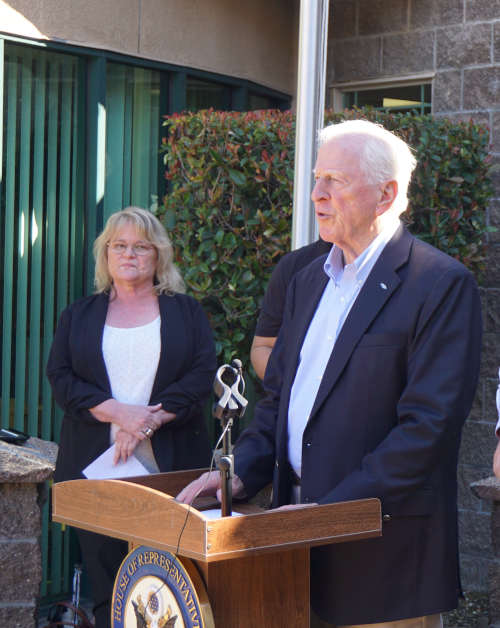
Congressman Mike Thompson discusses potential cuts as the result of a newly passed Republican budget bill as Lake Family Resource Center Executive Director Lisa Morrow looks on at Lake County Tribal Health Consortium on Friday, Feb. 28, 2025. Photo by Elizabeth Larson/Lake County News.

LAKE COUNTY, Calif. — Congressman Mike Thompson, the chair of the Board of Supervisors and local health care leaders warned Friday that the newly passed Republican budget resolution may jeopardize access to care and create more food insecurity in Lake County, and they issued a joint call for action.

The House Republican-backed resolution directs several committees to reduce spending, including $880 billion in potential Medicaid cuts and $230 billion from the Supplemental Nutrition Assistance Program California, also known as SNAP.

In California, this would slash funding for Medi-Cal and CalFresh, two critical safety net programs, disproportionately affecting communities that heavily rely on them, including Lake County.

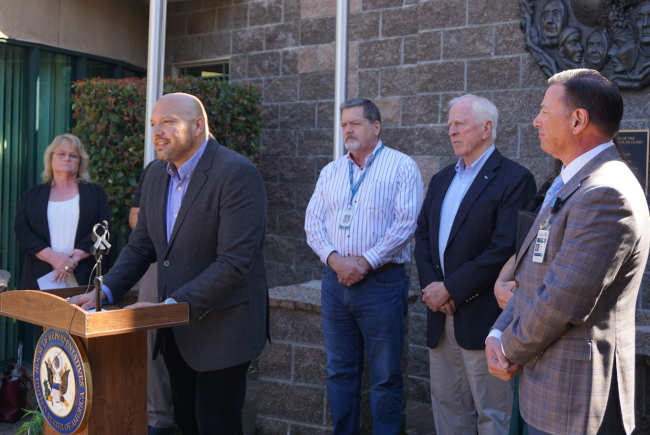
At a press conference Friday at the Lake County Tribal Health Consortium’s Lakeport campus, Thompson, Board of Supervisors Chair Eddie Crandell and six local health care leaders warned that these cuts could lead to hospital closures, reduced health care services, increased mental health crises and worsening food insecurity — outcomes they repeatedly called “devastating.”

In Lake County, over 35,000 out of its total 68,000 residents—more than half of the population — rely on MediCal for health care, and one in four residents depends on CalFresh for food, according to Lake County Behavioral Health Director Elise Jones.

“If these cuts go through, services will be reduced. Certain hospitals and facilities will cease to exist. Others will pare back their services to make way for those cuts,” Thompson said. “That means that everybody in the community will be punished.”

“So this is not a Tribal Health or Sutter or Adventist issue,” said Tribal Health CEO Ernesto Padilla. “This is a Lake County issue.”

Tribal Health receives 60 to 70% of its funding from Medi-Cal, Padilla told Lake County News after the press conference.

“This could be crippling,” Padilla said of the potential cuts.

A matter of life and death

While the cuts would impact the entire community, people relying directly on these federally funded health and food programs would suffer the most.

“For many who rely on MediCal, CalFresh and IHSS, this is truly a matter of life and death. Protecting these programs protects people,” said Jones.

“I see first hand how Medicaid funds critical mental health and substance use treatment that keep our residents housed, employed and alive,” Jones said, explaining the importance of each of the programs that will potentially get cut. “If these cuts move forward, we can expect devastating outcomes.”

For Rod Grainger, CEO of Mendocino Community Health Clinics, these cuts just “fly in the face of any compassionate, community-based, mission-driven organization.”

“We're going to be seeing — if this goes through — large increases in our health care deserts that already exist and are struggling,” he added.

“We then see the downstream from that, which then impacts other jobs and other industries within our county system. So please think long and hard about this, because it will impact all of us, not just people who have Medicaid or Medicare,” said Chuck Kassis, administrator for Adventist Health Clear Lake.

“These are not just statistics. They are real people in our community—our neighbors and friends,” said Lisa Morrow, executive director of the Lake Family Resource Center.

She highlighted the real-life impact of the cuts, pointing to single mothers struggling to provide for their children and elderly residents relying on Medicaid for essential medications and health checkups. There also is the potential for cuts to services such as suicide prevention, and support for victims of sexual assault and human trafficking.

For many families that are already struggling, “Medicaid provides them with a lifeline,” she said. “The consequences are dire and far reaching.”

Crandell told Lake County News that Jones and Social Services Director Rachel Dillman Parsons have been monitoring developments and updating the Board of Supervisors as the situation unfolds.

“County leadership is strategizing in order to be ready to adjust from the potential impacts,” he said.

Lake County Tribal Health Consortium Chief Executive Officer Ernesto Padilla speaks about the potential for service cuts on Friday, Feb. 28, 2025. Photo by Elizabeth Larson/Lake County News.

Calling for action

The speakers at Friday’s press conference urged the public and policymakers to recognize the impact and take action to stop the cuts.

“The proposed cuts to Medicaid funding threaten to unravel the safety net that so many in our community rely on, we must remember that behind every policy decision, real lives are at stake,” Morrow said, urging policy makers to reconsider these cuts.

“I urge all of our federal representatives to fight these cuts as if their own life depended on it,” said Jones.

Crandell acknowledged the community’s resilience but stressed that some crises can and should be avoided.

“It’s unfortunate that we’ve been experienced with crisis, but we’ve always pulled together in a time of crisis,” Crandell said. “However, that doesn’t need to happen.”

“You, who are watching, please reach out to your elected officials or anyone that’s related to you that has elected officials,” Crandell said.

Thompson agreed, thanking Crandell for highlighting the community’s history of overcoming natural disasters.

“This is not a natural disaster; this is a man-made disaster,” Thompson said.

Thompson argued that these cuts at health care and food programs put the elderly, the disabled and children at risk, to finance “tax cuts to the richest people in our country — people making over $743,000 a year.”

“Please get the word out, let your friends know, your neighbors know,” Thompson said at the end of the press conference. “Let's not be silent about this.”

Email staff reporter Lingzi Chen at This email address is being protected from spambots. You need JavaScript enabled to view it.. 

February storms help snowpack, but regional disparities remain

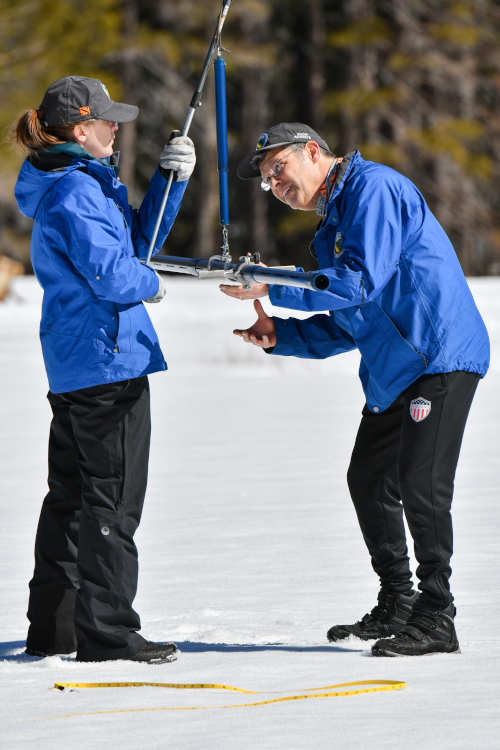
From left to right, California Department of Water Resources staff Angelique Fabbiani-Leon, State Hydrometeorologist, Jordan Thoennes, Water Resources Engineer, and Andy Reising, Snow Surveys and Water Supply Forecasting Unit Manager, conduct the third media snow survey of the 2025 season at Phillips Station in the Sierra Nevada. The snow survey is held approximately 90 miles east of Sacramento off Highway 50 in El Dorado County.  Photo taken Feb. 28, 2025, by Xavier Mascareñas/California Department of Water Resources.


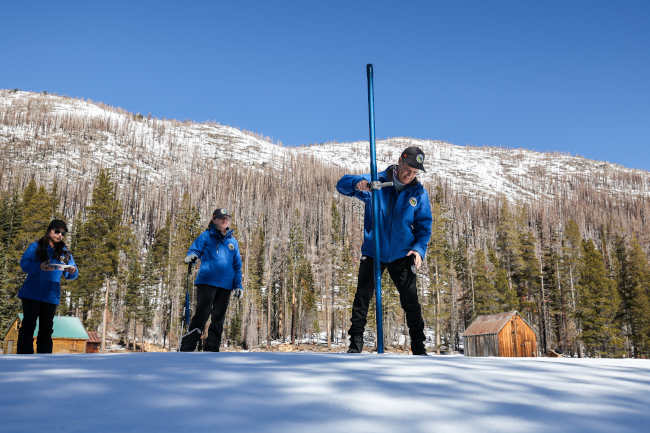
The Department of Water Resources, or DWR, on Friday conducted the third snow survey of the season at Phillips Station.

The manual survey recorded 34 inches of snow depth and a snow water equivalent of 13.5 inches, which is 58 percent of average for this location.

The snow water equivalent measures the amount of water contained in the snowpack and is a key component of DWR’s water supply forecast. Statewide, the snowpack is 85 percent of average for this date.

This winter has been marked by a series of extremes, as unseasonably dry and warm conditions have been interrupted by powerful storms that temporarily boosted the snowpack to near normal.

That was certainly the case in February where multiple rounds of atmospheric rivers earlier in the month brought the statewide snowpack to near average only to have dry conditions return.

Following the storms in the middle of February, the statewide snowpack was 97 percent of average and has since fallen to 85 percent. For every day that it’s not snowing, the averages will continue to drop.

DWR’s electronic readings from 130 stations placed throughout the Sierra Nevada indicate that the statewide snowpack’s snow water equivalent is 19.2 inches, or 74 percent of the critical April 1 average, which is when the snowpack usually peaks.

While forecasts show storm activity may pick up in March, there is no guarantee it will be enough for the snowpack to catch back up to average by April 1.

California has seen several years in recent history with large early season snow totals, only for predominantly dry conditions to dominate the rest of the season.

The southern Sierra Nevada has especially fallen behind this season, with the region’s snowpack just 70 percent of average.

“In addition to the large swings in snowpack conditions we’ve seen this year, a big regional disparity remains between the Northern, Central and Southern Sierra Nevada,” said Andy Reising, manager of DWR’s Snow Surveys and Water Supply Forecasting Unit. “With so many of this season’s storms missing the southern half of the state, our statewide snowpack average can mask just how below average some regions are. Water managers will need to consider not just the extreme swings through the winter and spring months, but also the big differences from watershed to watershed.”

Measuring California’s snowpack is a key component that guides how California’s water supplies are managed.

The data and measurements collected help inform water supply and snowmelt runoff forecasts, known as Bulletin 120, that help water managers plan for how much water will eventually reach state reservoirs in the spring and summer.

This information is also a key piece in calculating State Water Project allocation updates each month.

On average, California’s snowpack supplies about 30 percent of California’s water needs. Its natural ability to store water is why California’s snowpack is often referred to as California's “frozen reservoir.”

Data from these snow surveys and forecasts produced by DWR’s Snow Surveys and Water Supply Forecasting Unit are important factors in determining how DWR and other agencies manage the state’s water resources.

Thanks to efforts to capture as much water as possible from the storms we do receive, reservoirs across the state are currently 118 percent of average.

DWR conducts four or five media-oriented snow surveys at Phillips Station each winter near the first of each month, January through April and, if necessary, May. The next survey is tentatively scheduled for April 2.

For California’s current hydrological conditions, visit https://cww.water.ca.gov. 

California Department of Water Resources staff members Jordan Thoennes (left), Water Resources engineer, and Andy Reising, Snow Surveys and Water Supply Forecasting Unit manager, conduct the third media snow survey of the 2025 season at Phillips Station in the Sierra Nevada. The snow survey is held approximately 90 miles east of Sacramento off Highway 50 in El Dorado County. Photo taken Feb. 28, 2025, by Nick Shockey/California Department of Water Resources.

March 13 town hall to discuss Clearlake Fire Safe Council, Firewise Community project

CLEARLAKE, Calif. — An upcoming meeting will be held to discuss the formation of a Fire Safe Council as well as a Firewise Community project for Clearlake.

The meeting will be held at 6 p.m. Thursday, March 13, at Clearlake City Hall, 14050 Olympic Drive.

The meeting will be available for both in person and online via Zoom.

To join the meeting remotely, follow this link.

The passcode is 842057.

Fire season too often brings back past trauma, anxiety and heightened concerns about our community’s resilience to wildfires.

A Fire Safe Council and Fire Wise Communities can help organize projects within a specific designated area of a community to reduce hazardous vegetation and create more resilient communities to wildfires.

Those in attendance at the town hall meeting will learn how they can become a part of the Fire Safe Council and create their own Fire Wise Communities.

By working together, communities can strengthen their defensive space and become more resilient.

Attendees will also learn about a new program that the Lake County Fire Protection District has created to survey and review your property’s fire safety.

This service can lead you to what more you can do to make your home more resilient to fires and provide you with documentation that may be useful in your conversations with insurance companies.

Finally, Clear Lake Environmental Research Center, or CLERC, will provide a presentation on the services they have provided to other Fire Safe Councils and Fire Wise Communities with the funding that they’ve received through grants.

Working with organizations like CLERC and Fire Wise Communities can be the best way to get community projects accomplished so that entire neighborhoods can be protected by the fire mitigation work that is completed.

“We know that fires will occur in the future, but how we prepare is the most important work we can do to lessen the burden, costs and potential catastrophe that fires bring to our communities,” said Lake County Supervisor Bruno Sabatier. “Defensible space, organized communities, and access to funding are part of the solution to bringing fire resilience to the Clearlake and Lower Lake landscape.”

Join them March 13 to learn more about how you and your communities can organize towards a more fire resilient community.

For more information contact Bruno Sabatier at This email address is being protected from spambots. You need JavaScript enabled to view it. or Russ Cremer at This email address is being protected from spambots. You need JavaScript enabled to view it..

Space News: Colliding plasma ejections from the Sun generate huge geomagnetic storms − studying them will help scientists monitor future space weather


The Sun periodically ejects huge bubbles of plasma from its surface that contain an intense magnetic field. These events are called coronal mass ejections, or CMEs. When two of these ejections collide, they can generate powerful geomagnetic storms that can lead to beautiful auroras but may disrupt satellites and GPS back on Earth.

On May 10, 2024, people across the Northern Hemisphere got to witness the impact of these solar activities on Earth’s space weather.

Bright colors visible across the night sky, with a tree silhouetted in the foreground.
The northern lights, as seen here from Michigan in May 2024, are caused by geomagnetic storms in the atmosphere. Shirsh Lata Soni

Two merging CMEs triggered the largest geomagnetic storm in two decades, which manifested in brightly colored auroras visible across the sky.

I’m a solar physicist. My colleagues and I aim to track and better understand colliding CMEs with the goal of improving space weather forecasts. In the modern era, where technological systems are increasingly vulnerable to space weather disruptions, understanding how CMEs interact with each other has never been more crucial.

Coronal mass ejections

CMEs are long and twisted – kind of like ropes – and how often they happen varies with an 11-year cycle. At the solar minimum, researchers observe about one a week, but near the solar maximum, they can observe, on average, two or three per day.

During the solar maximum, solar flares and coronal mass ejections are more common.

When two or more CMEs interact, they generate massive clouds of charged particles and magnetic fields that may compress, merge or reconnect with each other during the collision. These interactions can amplify the impact of the CMEs on Earth’s magnetic field, sometimes creating geomagnetic storms.

Why study interacting CMEs?

Nearly one-third of CMEs interact with other CMEs or the solar wind, which is a stream of charged particles released from the outer layer of the Sun.

In my research team’s study, published in May 2024, we found that CMEs that do interact or collide with each other are much more likely to cause a geomagnetic storm – two times more likely than an individual CME. The mix of strong magnetic fields and high pressure in these CME collisions is likely what causes them to generate storms.

During solar maxima, when there can be more than 10 CMEs per day, the likelihood of CMEs interacting with each other increases. But researchers aren’t sure whether they become more likely to generate a geomagnetic storm during these periods.

Scientists can study interacting CMEs as they move through space and watch them contribute to geomagnetic storms using observations from space- and ground-based observatories.

In this study, we looked at three CMEs that interacted with each other as they traveled through space using the space-based observatory STEREO. We validated these observations with three-dimensional simulations.

The CME interactions we studied generated a complex magnetic field and a compressed plasma sheath, which is a layer of charged particles in the upper atmosphere that interacts with Earth’s magnetic field.

When this complex structure encountered Earth’s magnetosphere, it compressed the magnetosphere and triggered an intense geomagnetic storm.

Four images showing a CME–CME interaction based on white-light observations from the STEREO telescope.
Four images show three interacting CMEs, based on observations from the STEREO telescope. In images C and D, you can see the northeast flank of CME-1 and CME-2 that interact with the southwest part of CME-3. Shirsh Lata Soni

This same process generated the geomagnetic storm from May 2024.

Between May 8-9, multiple Earth-directed CMEs erupted from the Sun. When these CMEs merged, they formed a massive, combined structure that arrived at Earth late on May 10, 2024. This structure triggered the extraordinary geomagnetic storm many people observed. People even in parts of the southern U.S. were able to see the northern lights in the sky that night.

More technology and higher stakes

Scientists have an expansive network of space- and ground-based observatories, such as the Parker Solar Probe, Solar Orbiter, the Solar Dynamics Observatory and others, available to monitor the heliosphere – the region surrounding the Sun – from a variety of vantage points.

These resources, coupled with advanced modeling capabilities, provide timely and effective ways to investigate how CMEs cause geomagnetic storms. The Sun will reach its solar maximum in the years 2024 and 2025. So, with more complex CMEs coming from the Sun in the next few years and an increasing reliance on space-based infrastructure for communication, navigation and scientific exploration, monitoring these events is more important than ever.

Integrating the observational data from space-based missions such as Wind and ACE and data from ground-based facilities such as the e-Callisto network and radio observatories with state-of-the-art simulation tools allows researchers to analyze the data in real time. That way, they can quickly make predictions about what the CMEs are doing.

These advancements are important for keeping infrastructure safe and preparing for the next solar maximum. Addressing these challenges today ensures resilience against future space weather.The Conversation

Shirsh Lata Soni, Postdoctoral Research Fellow, University of Michigan

This article is republished from The Conversation under a Creative Commons license. Read the original article.
  • 243
  • 244
  • 245
  • 246
  • 247
  • 248
  • 249
  • 250
  • 251
  • 252

Community

  • Lake County Wine Alliance offers sponsor update; beneficiary applications open 

  • Mendocino National Forest announces seasonal hiring for upcoming field season

Public Safety

  • Lakeport Police logs: Thursday, Jan. 15

  • Lakeport Police logs: Wednesday, Jan. 14

Education

  • Woodland Community College receives maximum eight-year reaffirmation of accreditation from ACCJC

  • SNHU announces Fall 2025 President's List

Health

  • California ranks 24th in America’s Health Rankings Annual Report from United Health Foundation

  • Healthy blood donors especially vital during active flu season

Business

  • Two Lake County Mediacom employees earn company’s top service awards

  • Redwood Credit Union launches holiday gift and porch-to-pantry food drives

Obituaries

  • Rufino ‘Ray’ Pato

  • Patty Lee Smith

Opinion & Letters

  • The benefits of music for students

  • How to ease the burden of high electric bills

Veterans

  • CalVet and CSU Long Beach team up to improve data collection related to veteran suicides

  • A ‘Big Step Forward’ for Gulf War Veterans

Recreation

  • Wet weather trail closure in effect on Upper Lake Ranger District

  • Mendocino National Forest seeking public input on OHV grant applications

  • State Parks announces 2026 Anderson Marsh nature walk schedule 

  • BLM lifts seasonal fire restrictions in central California

Religion

  • Kelseyville Presbyterian to host Ash Wednesday service and Lenten dinner Feb. 18

  • Kelseyville Presbyterian Church to hold ‘Longest Night’ service Dec. 21

Arts & Life

  • Auditions announced for original musical ‘Even In Shadow’ set for March 21 and 28

  • ‘The Rip’ action heist; ‘Steal’ grounded in a crime thriller

Government & Politics

  • Lake County Democrats issue endorsements in local races for the June California Primary

  • County negotiates money-saving power purchase agreement

Legals

  • March 3 hearing on ordinance amending code for commercial cannabis uses

  • Feb. 12 public hearing on resolution to establish standards for agricultural roads

How to resolve AdBlock issue?
Refresh this page