How to resolve AdBlock issue?
Refresh this page
How to resolve AdBlock issue?
Refresh this page
Lake County News,California
  • Home
    • Registration Form
  • News
    • Education
    • Veterans
    • Community
      • Obituaries
      • Letters
      • Commentary
    • Police Logs
    • Business
    • Recreation
    • Health
    • Religion
    • Legals
    • Arts & Life
    • Regional
  • Calendar
  • Contact us
    • FAQs
    • Phones, E-Mail
    • Subscribe
  • Advertise Here
  • Login

News

Thompson, Pelosi, Bay Area members, physicians and patients warn of devastating health care cuts


On Tuesday, Rep. Mike Thompson (CA-04), Speaker Emerita Nancy Pelosi, Senator Adam Schiff (D-CA), Rep. Kevin Mullin (CA-15), Rep. Lateefah Simon (CA-12), Dr. Amy Herold, and patient and physician advocates participated in a press conference at University of San Francisco’s Wayne and Gladys Valley Center for Vision.

The speakers warned that Congressional Republicans’ plan to cut $880 billion from the budget that funds Medicaid in order to fund tax cuts for the ultra-rich will devastate local access to care for everyone.

“Congressional Republicans have mandated an $880 billion budget cut, something that can’t be done without destroying Medicaid. And the destruction of Medicaid will hurt everyone,” said Thompson. “One-third of health care in California comes from Medicaid. Without this funding, hospitals and health centers in our community will be forced to slash services or shut down altogether. That means everyone loses access to care. All of this is for one purpose: to facilitate a tax cut for the richest people in our country.”

“Republicans want to cut $880 billion or more in Medicaid so they can give a tax cut to the wealthiest people in America. Republicans are choosing to protect the wealthy while ripping away health care from millions of Americans, closing hospitals and nursing homes, and diminishing the quality of care. Here in San Francisco, 100,000 people, including 21,000 children on Medicaid, are at risk of losing their health care — but Democrats stand united against the cruel Republican scheme,” said Pelosi.

Members were joined by physicians and patients, including Dr. Amy Herold, OB-GYN and Chief Administrative Office and Chief Medical Officer for Providence Queen of the Valley Medical Center in Napa.

Dr. Herold spoke on the impacts Medicaid cuts will have on rural hospitals like hers.

“When we look at these proposed cuts, they would be devastating for my hospital. If we lose government funding, we will have to close services,” Herold said. “We are the only hospital in Napa County that has a trauma center. We are the only hospital in the county that has a labor and delivery unit. If these services close, there will be a health care desert. So not only do the people who are on Medi-Cal not have access to care, but anyone, regardless of insurance status, will not have access to care if we have to close our programs. This is what keeps me up at night.”

In February, Congressional Republicans passed a partisan budget bill that instructs the House Energy and Commerce Committee, which has jurisdiction over Medicare and Medicaid, to cut its spending by $880 billion.

The nonpartisan Congressional Budget Office has since analyzed the budget and confirmed that the committee cannot meet Congressional Republicans’ mandated level of spending cuts without deep cuts to Medicaid.

Millions of people would lose coverage entirely, and those who remain covered would see reduced benefits and fewer available providers.

Congressional Republicans’ proposed cuts to health care and nutrition programs in their budget bill add up to nearly the exact amount of savings the party needs in order to implement their tax bill delivering massive tax cuts for corporations and those making over $743,000 per year.

Fires, wars and bureaucracy: The tumultuous journey to establish the US National Archives


The 1952 procession to deliver the Declaration of Independence and Constitution from the Library of Congress to the National Archives included military guards and a tank. National Archives
Elizabeth Call, Rochester Institute of Technology

Some of the United States’ most important historical documents, including the Declaration of Independence, the Constitution, the Bill of Rights and the Emancipation Proclamation, are housed in the U.S. National Archives. Beyond these high-profile items, it also preserves lesser-known but no less vital records, such as national park master plans, polar exploration documents and the records of all U.S. veterans. Together, these materials stand as a testament to the country’s commitment to preserving its history.

While these crucial documents in U.S. history now have a home in the National Archives, the road to establishing this institution was paved with catastrophic losses and bureaucratic inertia.

Creating the National Archives required decades of advocacy by historians, politicians and government officials. The National Archives was not simply an administrative convenience – it was a necessity born from repeated disasters that underscored the fragility of government records. And with President Donald Trump’s firing of the head archivist in February 2025, as well as the loss of several high-level archives staff members, the organization faces a new era of uncertainty.

Documentary heritage – the recorded memory of a nation that preserves its cultural, historical and legal legacy – is essential for a country as it safeguards its identity, informs its governance and ensures that future generations can understand and learn from the past.

I am a university archivist with two decades of experience in the library and archives field. I oversee the preservation and accessibility of historical records at Rochester Institute of Technology, advocate for inclusivity, and engage in national conversations on the evolving role of archives in the digital age.

Understanding the precarious nature of historical records, it’s clear to me that maintaining, staffing and funding the National Archives is a necessary safeguard against the destruction of the nation’s documentary heritage.
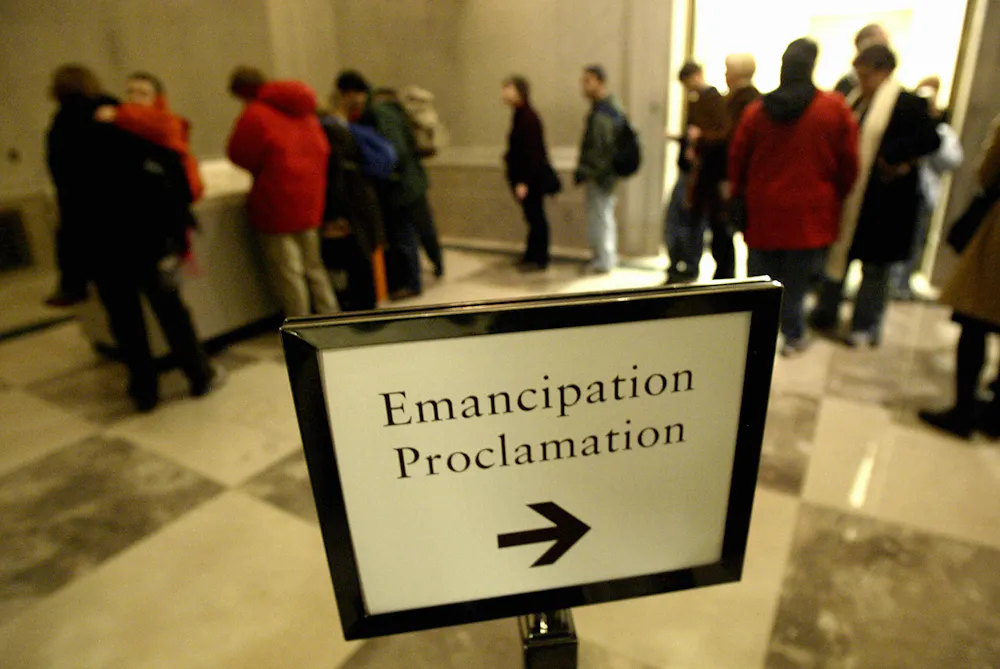
A line stands behind a direction sign that says 'Emancipation Proclamation' on it.
People line up to view the original Emancipation Proclamation on Martin Luther King Jr. Day, Jan. 19, 2004, at the National Archives building in Washington, D.C. Tim Sloan/AFP-Getty Images

Destroyed by fire

The idea of preserving the government’s records dates back to the country’s founding. Charles Thomson, secretary of the Continental Congress during the American Revolution and then secretary of Congress under the Articles of Confederation, recognized the need for proper storage of the Congress’ records.

But the young nation lacked the money and infrastructure to act. Many of the Continental Congress’ records were kept by Thomson himself for years, and while some were later transferred to the Department of State, others were lost.

Throughout the 19th and early 20th centuries, fires repeatedly ravaged federal records. Fires were very common in the 19th century due to a combination of highly flammable building materials, open frames used for lighting and heating, and the lack of modern fire safety measures such as sprinklers and fire-resistant construction.

In 1800, a blaze destroyed the War Department’s archives, a loss that severely hampered government operations. In 1810, Congress authorized better housing for government records, but the law was never fully executed. Instead, different parts of the government, from the Department of State to the Department of Treasury, continued maintaining their own records.

The Treasury Department suffered fires in 1801 and again in 1833, further erasing crucial financial records. The Patent Office, home to invaluable documentation of American innovation, burned in 1877, having already been damaged by an 1836 fire.

A messy room with furniture and documents stacked haphazardly.
Storage at the federal Office of Indian Affairs in 1935. National Archives Foundation

One of the most devastating losses occurred in 1921 when a fire at the Department of Commerce destroyed nearly all records from the 1890 federal census. This loss had far-reaching consequences, particularly for genealogical and demographic research.

Fires weren’t the only threat to the government’s records.

“It is a matter of common report that during the civil war, great quantities of documents stored in the Capitol were thrown away to make quarters for soldiers,” Historian and founding member of the American Historical Association J. Franklin Jameson noted in a 1911 Washington Post article.

“At a later date,” he added, “the archives of the House of Representatives were systematically looted for papers having a market value because of their autographs.”

Jameson spent decades lobbying Congress for a centralized repository. His persistence, coupled with the advocacy of key officials, laid the groundwork for future action.

A dark colored book with 'George Washington' stamped on the cover above 'Original Manuscript Account of Expenses while Commander in Chief of the Continental Army'
A bound copy of George Washington’s account of expenses while commander in chief of the Continental Army. National Archives and Records Administration

These repeated disasters illuminated a glaring issue: The federal government lacked a centralized, protected repository to safeguard its records.

Finding a home

Momentum for a dedicated archives building gained traction in the late 19th century. In 1903, a bipartisan bill passed Congress giving the OK to purchase land in Washington, D.C., for a Hall of Records.

But the legislation didn’t lead to any action. Government records remained scattered, vulnerable and neglected. That same year, Congress authorized that any records not needed for daily business be transferred to the Library of Congress.

In 1912, President William H. Taft issued executive order 1499, aptly named Disposal of Useless Papers, requiring agencies to consult the librarian of Congress before disposing of documents.

This established a formal review process for government document disposal, but agencies still discarded records, often haphazardly, until stricter records management laws were enacted.

In 1926, Congress passed the Public Buildings Act, authorizing construction of an archives facility in Washington, D.C. Departing president Herbert Hoover laid the cornerstone of the new building on Feb. 20, 1933. He then deposited facsimiles of the Declaration of Independence and the Constitution, an American flag and daily newspapers from that day underneath the cornerstone.

Growth and standardization

President Franklin D. Roosevelt, who took office two weeks later, was himself a meticulous record-keeper. He understood the importance of historical preservation. Roosevelt kept all of his personal and presidential records and books in a fire-safe space he built on his Hyde Park, New York, property, which he donated to the government after he died. This building and the materials inside became part of the National Archives as the first U.S. presidential library.

The National Archives, an independent agency, was officially established under Roosevelt in the 1934 National Archives Act. The head archivist was to be appointed by the president. The first archivist, Robert D.W. Connor, took office that year with a mandate to organize, preserve and make accessible the nation’s records.

Initially, the National Archives was simply a building – an impressive neoclassical structure in Washington, D.C., that opened in 1935. The very first records deposited there came from three World War I-era regulatory agencies – the U.S. Food Administration, the Sugar Equalization Board and the U.S. Grain Corporation.

Initially, the Archives lacked a formalized records management program. There were no clear guidelines on what to keep and what to discard, so agencies made their own decisions. This led to inconsistent preservation.

The creation of the first federal records administration program in 1941, together with the 1943 Records Disposal Act, codified things. These policies granted the National Archives authority to establish a structured approach to determining which records held historical value and should be preserved, while allowing for the responsible disposal of other documents.

A 1950 law gave the National Archives more power to decide what should be kept and what could be discarded, creating a more organized and accountable system for preserving the nation’s history.

As the volume of records increased and their formats changed, the archives adapted. By 2014, amendments to the Federal Records Act explicitly included electronic records, recognizing the shift toward digital documentation.

A woman in a dark dress standing in front of a huge cabinet of stacked drawers.
Stacks at the National Archives in Washington in 1950, where rare photographs and national records are ordered and stored. Three Lions/Getty Images

Ensuring accountability

Beyond mere storage, the National Archives plays a vital role in upholding democracy.

It ensures transparency by preserving government accountability, preventing manipulation or loss of records that could distort historical truth. The National Archives also provides public access to documents that shape civic awareness and historical knowledge, from the Declaration of Independence to declassified government files.

In an era of digital misinformation and contested narratives, the National Archives stands as a guardian of primary sources. Its existence reminds the nation that history is not a matter of convenience, but a cornerstone of informed governance.The Conversation

Elizabeth Call, University Archivist, RIT Libraries and Archives, Rochester Institute of Technology

This article is republished from The Conversation under a Creative Commons license. Read the original article.

Helping Paws: Cattle dogs and shepherds

LAKE COUNTY, Calif. — Lake County Animal Care and Control’s shelter is filled with dogs eager to get out and join new families.

The dogs available for adoption this week include mixes of Akita, American blue heeler, Australian shepherd, Belgian malinois, border collie, cattle dog, German shepherd, husky, Labrador Retriever, pit bull terrier, Rottweiler and Siberian husky.

Dogs that are adopted from Lake County Animal Care and Control are either neutered or spayed, microchipped and, if old enough, given a rabies shot and county license before being released to their new owner. License fees do not apply to residents of the cities of Lakeport or Clearlake.

Those dogs and the others shown on this page at the Lake County Animal Care and Control shelter have been cleared for adoption.

Call Lake County Animal Care and Control at 707-263-0278 or visit the shelter online for information on visiting or adopting.

The shelter is located at 4949 Helbush in Lakeport.

Email Elizabeth Larson at This email address is being protected from spambots. You need JavaScript enabled to view it.. Follow her on Twitter, @ERLarson, and on Bluesky, @erlarson.bsky.social. Find Lake County News on the following platforms: Facebook, @LakeCoNews; X, @LakeCoNews; Threads, @lakeconews, and on Bluesky, @lakeconews.bsky.social.

 
Jet's preview photo
Jet

Bear-Bear's preview photo
Bear-Bear

Hamilton's preview photo
Hamilton

Scout's preview photo
Scout

Sable's preview photo
Sable

Shepp's preview photo
Shepp

Chia's preview photo
Chia

Oscar(Brutus)'s preview photo
Oscar(Brutus)

Dolly's preview photo
Dolly

Buck's preview photo
Buck

Benny 's preview photo
Benny

Fred's preview photo
Fred

Annie 's preview photo
Annie

Sephire's preview photo
Sephire

Oliver's preview photo
Oliver

Rocco's preview photo
Rocco

Honey's preview photo
Honey

Aria's preview photo
Aria

 
Alma 's preview photo
Alma

Makita's preview photo
Makita

Hariett's preview photo
Hariett

Mila's preview photo
Mila

Beau's preview photo
Beau

Queenie's preview photo
Queenie

Odie's preview photo
Odie

Kennel#5b's preview photo
Kennel#5b

Kennel#5a's preview photo
Kennel#5a

Kennel#2b's preview photo
Kennel#2b

Kennel#2a's preview photo
Kennel#2a

Kennel#8's preview photo
Kennel#8


Space News: 3D printing will help space pioneers make homes, tools and other stuff they need to colonize the Moon and Mars


3D printing could make many of the components for future structures on Mars. 3000ad/iStock via Getty Images Plus
Sven Bilén, Penn State

Throughout history, when pioneers set out across uncharted territory to settle in distant lands, they carried with them only the essentials: tools, seeds and clothing. Anything else would have to come from their new environment.

So they built shelter from local timber, rocks and sod; foraged for food and cultivated the soil beneath their feet; and fabricated tools from whatever they could scrounge up. It was difficult, but ultimately the successful ones made everything they needed to survive.

Something similar will take place when humanity leaves Earth for destinations such as the Moon and Mars – although astronauts will face even greater challenges than, for example, the Vikings did when they reached Greenland and Newfoundland. Not only will the astronauts have limited supplies and the need to live off the land; they won’t even be able to breathe the air.

Instead of axes and plows, however, today’s space pioneers will bring 3D printers. As an engineer and professor who is developing technologies to extend the human presence beyond Earth, I focus my work and research on these remarkable machines.

3D printers will make the tools, structures and habitats space pioneers need to survive in a hostile alien environment. They will enable long-term human presence on the Moon and Mars.

An astronaut holding a wrench poses for the camera.
NASA astronaut Barry Wilmore holds a 3D-printed wrench made aboard the International Space Station. NASA

From hammers to habitats

On Earth, 3D printing can fabricate, layer by layer, thousands of things, from replacement hips to hammers to homes. These devices take raw materials, such as plastic, concrete or metal, and deposit it on a computerized programmed path to build a part. It’s often called “additive manufacturing,” because you keep adding material to make the part, rather than removing material, as is done in conventional machining.

Already, 3D printing in space is underway. On the International Space Station, astronauts use 3D printers to make tools and spare parts, such as ratchet wrenches, clamps and brackets. Depending on the part, printing time can take from around 30 minutes to several hours.

For now, the print materials are mostly hauled up from Earth. But NASA has also begun recycling some of those materials, such as waste plastic, to make new parts with the Refabricator, an advanced 3D printer installed in 2019.

Manufacturing in space

You may be wondering why space explorers can’t simply bring everything they need with them. After all, that’s how the International Space Station was built decades ago – by hauling tons of prefabricated components from Earth.

But that’s impractical for building habitats on other worlds. Launching materials into space is incredibly expensive. Right now, every pound launched aboard a rocket just to get to low Earth orbit costs thousands of dollars. To get materials to the Moon, NASA estimates the initial cost at around US$500,000 per pound.

Still, manufacturing things in space is a challenge. In the microgravity of space, or the reduced gravity of the Moon or Mars, materials behave differently than they do on Earth. Decrease or remove gravity, and materials cool and recrystallize differently. The Moon has one-sixth the gravity of Earth; Mars, about two-fifths. Engineers and scientists are working now to adapt 3D printers to function in these conditions.

An illustration of an astronaut looking at a base camp on Mars.
An artist’s impressions of what a Mars base camp might look like. peepo/E+ via Getty Images

Using otherworldly soil

On alien worlds, rather than plastic or metal, 3D printers will use the natural resources found in these environments. But finding the right raw materials is not easy. Habitats on the Moon and Mars must protect astronauts from the lack of air, extreme temperatures, micrometeorite impacts and radiation.

Regolith, the fine, dusty, sandlike particles that cover both the lunar and Martian surfaces, could be a primary ingredient to make these dwellings. Think of the regolith on both worlds as alien dirt – unlike Earth soil, it contains few nutrients, and as far as we know, no living organisms. But it might be a good raw material for 3D printing.

My colleagues began researching this possibility by first examining how regular cement behaves in space. I am now joining them to develop techniques for turning regolith into a printable material and to eventually test these on the Moon.

But obtaining otherworldly regolith is a problem. The regolith samples returned from the Moon during the Apollo missions in the 1960s and 70s are precious, difficult if not impossible to access for research purposes. So scientists are using regolith simulants to test ideas. Actual regolith may react quite differently than our simulants. We just don’t know.

What’s more, the regolith on the Moon is very different from what’s found on Mars. Martian regolith contains iron oxide –that’s what gives it a reddish color – but Moon regolith is mostly silicates; it’s much finer and more angular. Researchers will need to learn how to use both types in a 3D printer.

See models of otherworldly habitats.

Applications on Earth

NASA’s Moon-to-Mars Planetary Autonomous Construction Technology program, also known as MMPACT, is advancing the technology needed to print these habitats on alien worlds.

Among the approaches scientists are now exploring: a regolith-based concrete made in part from surface ice; melting the regolith at high temperatures, and then using molds to form it while it’s a liquid; and sintering, which means heating the regolith with concentrated sunlight, lasers or microwaves to fuse particles together without the need for binders.

Along those lines, my colleagues and I developed a Martian concrete we call MarsCrete, a material we used to 3D-print a small test structure for NASA in 2017.

Then, in May 2019, using another type of special concrete, we 3D-printed a one-third scale prototype Mars habitat that could support everything astronauts would need for long-term survival, including living, sleeping, research and food-production modules.

That prototype showcased the potential, and the challenges, of building housing on the red planet. But many of these technologies will benefit people on Earth too.

In the same way astronauts will make sustainable products from natural resources, homebuilders could make concretes from binders and aggregates found locally, and maybe even from recycled construction debris. Engineers are already adapting the techniques that could print Martian habitats to address housing shortages here at home. Indeed, 3D-printed homes are already on the market.

Meanwhile, the move continues toward establishing a human presence outside the Earth. Artemis III, now scheduled for liftoff in 2027, will be the first human Moon landing since 1972. A NASA trip to Mars could happen as early as 2035.

But wherever people go, and whenever they get there, I’m certain that 3D printers will be one of the primary tools to let human beings live off alien land.The Conversation

Sven Bilén, Professor of Engineering Design, Electrical Engineering and Aerospace Engineering, Penn State

This article is republished from The Conversation under a Creative Commons license. Read the original article.

Thompson hosts over 150 constituents at ‘Coffee with Our Congressman’ event in Middletown

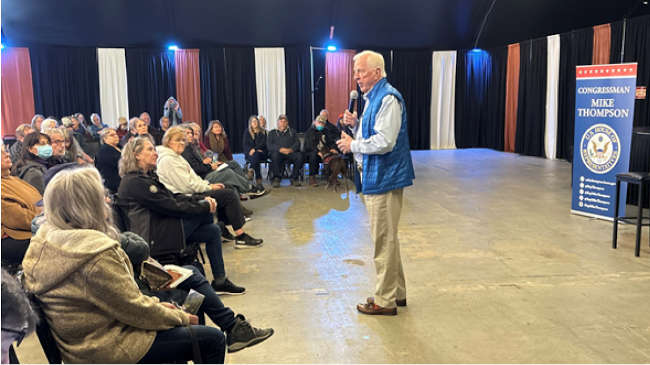
The Middletown “Coffee with Our Congressman” with Congressman Mike Thompson on Friday, March 21, 2025. Courtesy photo.

MIDDLETOWN, Calif. — On Friday, Rep. Mike Thompson (CA-04) held a “Coffee with Our Congressman” community event for residents in the Middletown area to meet him and ask questions about the latest news out of Washington.

The event was hosted at The Twin Pine Event Center, with over 150 residents in attendance.

“My event today was open to the entire Middletown community. Residents from both parties showed up and it was clear from the beginning that many residents are concerned about the chaos coming out of the administration. As your Congressman, I’m working to fight back against the president’s unlawful actions in Congress, in the courts, and in the court of public opinion,” Thompson said Friday.

“Thank you to the over 150 community members who attended today's event, and the countless more who have written me, called my office, and raised their voices against this administration’s unlawful and unethical actions,” Thompson said. “There’s a reason that Republican leaders are urging their party not to hold town halls. Americans are rightfully angry over threats to their personal data, health care, veterans’ services, Social Security, and more. The president and his party are losing in the court of public opinion.”

Friday’s event was one in a series of community events Thompson has hosted across our district.

Since the president took office in January, Thompson has worked to combat the Administration’s unlawful actions and protect Americans’ sensitive data from DOGE.

Some of Thompson’s actions include:

Congressional action

Rep. Thompson voted no on the Republican Budget, which slashed Medicaid, nutrition funding and other services, and voted no on Congressional Republicans’ partisan Fiscal Year 2025 funding bill, which enabled deeper Trump-Musk cuts to programs Americans rely on every day.

Congressional Republicans’ proposed cuts to health care and nutrition programs add up to the exact cost for their planned tax cuts for the ultra-rich. Congressional Republicans are sacrificing the programs Americans rely on in order to fund tax cuts for the ultra-rich. That’s why Rep. Thompson has coauthored dozens of bills and letters to demand answers from the President and hold him accountable.

Rep. Thompson continues to use his position on the powerful Ways and Means Committee to hold the president’s feet to the fire. Rep. Thompson, alongside Ways and Means Democrats, has introduced a resolution of inquiry to obligate the Department of Treasury and DOGE to answer questions on their unlawful access to sensitive taxpayer information and the federal payment systems. He also joined his Democratic colleagues to introduce a resolution of inquiry to demand answers from the Social Security Administration on their proposed mass layoffs and closures of field and regional offices.

Rep. Thompson has also cosponsored the Taxpayer Data Protection Act, which will protect the nation’s payment system from reckless and unlawful interference and ensure that anyone who accesses the federal government’s central payment system with a personal financial conflict faces criminal penalties.

Court action

Rep. Thompson has joined House Democrats to support over 108 lawsuits against the president’s unlawful executive orders, including his firing of inspectors general and termination of civil servants.

Public opinion

Rep. Thompson stands with the millions of Americans who are outraged at the president’s unlawful actions. Since January, Rep. Thompson has held community events and posted updates online reaching over half a million people. Through town halls, coffees, press conferences, and online video updates, Rep. Thompson is working daily to update Americans about the chaos coming out of Washington and how Democrats are working to combat it.

Thompson said public pressure is yielding results. Already, Congressional pressure, litigation, and public outrage have:

• Stopped the funding freeze for federal programs.
• Forced the reinstatement of tens of thousands of federal workers.
• Prevented DOGE access to certain sensitive data.
• Stopped the president’s attempt to end constitutional birthright citizenship.
• Reinstated bird flu researchers.
• Reinstated nuclear safety engineers.
• Stopped efforts to remove air traffic control workers and other FAA employees making flying safer.
• Rehired some agriculture researchers including those doing smoke exposure research.

Thompson’s office said this is only the beginning, that he remains committed to working on behalf of Fourth District residents to protect the programs they rely on and strengthen our democracy.

Thompson represents California’s Fourth Congressional District, which includes all or part of Lake, Napa, Solano, Sonoma and Yolo counties.

Tongson named Yuba College women’s volleyball coach

Kellie Tongson. Courtesy photo.

NORTHERN CALIFORNIA — It’s because of Yuba College’s summer volleyball camp that Kellie Tongson fell in love with the sport.

During the Thea Post era (volleyball coach from 1986-2005), it was Tongson’s impressionable experience as a young camper that kicked off a playing career that ultimately led to coaching.

“That was a big piece of our summers,” Tongson said. “Me, my friends, my sisters, we loved it and looked forward to it. It makes me emotional just thinking about it … being able to bring that back to our community.”

In a full circle moment, with the approval of the Yuba College Board of Trustees on March 13, Tongson was appointed the women’s volleyball coach for the 49ers.

“This will be a new experience being at the college level, but I think she’s really going to enjoy working with the older athletes and taking them to another level with their skillset,” said Yuba College Athletic Director Erick Burns.

Coaching at the college level wasn’t on Tongson’s radar. As the River Valley High School and a club coach for a top 18s team, Tongson enjoys youth development, fundamentals and seeing their growth.

But she started to notice a trend: her graduating players weren’t staying local. In fact, a couple of years ago, her entire roster of 12 all went on to play in college, but no one went to Yuba College, the most local option.

Tongson wants to change that.

“I know that not everyone can afford to go away for college,” Tongson said. “I want them to be able to play and not feel like they have to commute so they can play. I guess it’s filling that need and rebuilding. Thea left a legacy and that’s super important to me.”

Tongson is building a local legacy of her own. She became involved, as both a player and a coach, with Yuba Elite Volleyball Club, a local competitive volleyball league.

With no home base, gym space was rented from Yuba College or local schools, which occasionally led to canceled practices due to school events taking precedence.

Following the COVID-19 pandemic, Tongson zeroed in on facility ownership. In 2022, she opened the Yuba Elite Sports Facility in Yuba City, creating a home court for her volleyball club along with creating opportunities for the community to enjoy, including youth and adult recreation leagues and fitness training.

As part of the club’s academy program, Tongson’s system is teaching 130 kids ranging from seven-years-old to teens, volleyball fundamentals in preparation for the junior high level and beyond.

“It’s led to some really good improvements in our club and our high school volleyball as well,” Tongson said.

Tongson prides herself in building a good culture and community within her programs, emphasizing to the young players to be good people first, then good athletes. If they play for Yuba Elite, they're expected to meet a certain standard; a standard Tongson will carry to the college level.

“We talk about having integrity, doing the right thing when no one is watching, being kind and being good daughters,” she said.

Burns looks forward to having Tongson’s positive energy in the Yuba College program.

“She’s very organized and energetic and has a vision for the direction of the program,” he said.
  • 228
  • 229
  • 230
  • 231
  • 232
  • 233
  • 234
  • 235
  • 236
  • 237

Community

  • Lake County Wine Alliance offers sponsor update; beneficiary applications open 

  • Mendocino National Forest announces seasonal hiring for upcoming field season

Public Safety

  • Lakeport Police logs: Thursday, Jan. 15

  • Lakeport Police logs: Wednesday, Jan. 14

Education

  • Woodland Community College receives maximum eight-year reaffirmation of accreditation from ACCJC

  • SNHU announces Fall 2025 President's List

Health

  • California ranks 24th in America’s Health Rankings Annual Report from United Health Foundation

  • Healthy blood donors especially vital during active flu season

Business

  • Two Lake County Mediacom employees earn company’s top service awards

  • Redwood Credit Union launches holiday gift and porch-to-pantry food drives

Obituaries

  • Rufino ‘Ray’ Pato

  • Patty Lee Smith

Opinion & Letters

  • The benefits of music for students

  • How to ease the burden of high electric bills

Veterans

  • CalVet and CSU Long Beach team up to improve data collection related to veteran suicides

  • A ‘Big Step Forward’ for Gulf War Veterans

Recreation

  • Wet weather trail closure in effect on Upper Lake Ranger District

  • Mendocino National Forest seeking public input on OHV grant applications

  • State Parks announces 2026 Anderson Marsh nature walk schedule 

  • BLM lifts seasonal fire restrictions in central California

Religion

  • Kelseyville Presbyterian to host Ash Wednesday service and Lenten dinner Feb. 18

  • Kelseyville Presbyterian Church to hold ‘Longest Night’ service Dec. 21

Arts & Life

  • Auditions announced for original musical ‘Even In Shadow’ set for March 21 and 28

  • ‘The Rip’ action heist; ‘Steal’ grounded in a crime thriller

Government & Politics

  • Lake County Democrats issue endorsements in local races for the June California Primary

  • County negotiates money-saving power purchase agreement

Legals

  • March 3 hearing on ordinance amending code for commercial cannabis uses

  • Feb. 12 public hearing on resolution to establish standards for agricultural roads

How to resolve AdBlock issue?
Refresh this page