How to resolve AdBlock issue?
Refresh this page
How to resolve AdBlock issue?
Refresh this page
Lake County News,California
  • Home
    • Registration Form
  • News
    • Education
    • Veterans
    • Community
      • Obituaries
      • Letters
      • Commentary
    • Police Logs
    • Business
    • Recreation
    • Health
    • Religion
    • Legals
    • Arts & Life
    • Regional
  • Calendar
  • Contact us
    • FAQs
    • Phones, E-Mail
    • Subscribe
  • Advertise Here
  • Login

News

US workers with remote-friendly jobs are still working from home nearly half the time, 5 years after the pandemic began


Where did everybody go? AP Photo/Ted Shaffrey
Radostina Purvanova, Drake University and Alanah Mitchell, Drake University
CC BY-ND

Five years after the COVID-19 pandemic disrupted office life, American workplaces are settling into a new rhythm. Employees in remote-friendly jobs now spend an average of 2.3 days each week working from home, a research team that tracks remote employment has found. And when you look at all workers – and not just those in remote-friendly positions – they’re working remotely 1.4 days a week, or 28% of the time.

That’s a huge change from 2019, when remote work accounted for only 7% of the nation’s paid workdays, even if it’s down from the height of the pandemic in 2020, when 61.5% of all work was remote. And it’s a giant leap from 1965, the dawn of telework. At that time, fewer than 0.5% of all paid workdays were out of the office, according to the Bureau of Labor Statistics.

As management professors who study remote work and collaboration, we’ve learned a lot about remote work’s challenges and its often underappreciated advantages. In analyzing the latest data, we’ve observed that employers and employees are still trying to strike the balance between working from home and at the office. That’s why employers’ requirements for in-person work don’t always align with their employees’ preferences.

Hybrid work is on the rise

Employers swiftly made the jump to remote work in 2020. Zoom, along with other previously unfamiliar collaboration software companies, became commonplace overnight.

Five years later, many employers, including JPMorgan, TikTok, Amazon and the federal government, are rejecting remote work, demanding that employees return to the office full time.

But these examples are not the norm.

According to Flex Index, which tracks the workplace strategies of over 10,000 U.S. companies quarterly, fully in-office work is on the decline. At the start of 2023, 49% of employers insisted that their staff report to the office daily. That percentage fell to 32% at the end of 2024.

Companies are also retreating from remote-only work. While 31% of employers were fully remote in 2023, only 25% had remained fully remote at the end of 2024.

Instead, companies are increasingly turning to hybrid arrangements, in which employees spend a part of their week at the office. About 20% of professional workplaces were hybrid at the start of 2023. Just two years later, hybrid’s share had risen to 43%.

Some industries are more remote than others

The story of remote work is more complicated than general trends indicate. Its prevalence varies widely by industry, location and employer size.

The technology, insurance, telecommunications, professional services, and media and entertainment industries are among the biggest adopters of long-term remote and hybrid arrangements.

The states where remote and hybrid work are the most popular are Massachusetts, Washington, Oregon, Colorado and California. The states where it’s the least popular are Kentucky, Louisiana, Nevada, Nebraska and Alaska. In part, some of these regional differences are due to where remote-friendly industries like technology and insurance are concentrated.

Businesses with 500 or fewer employees are the most likely to embrace remote work. Staying connected and coordinating with your colleagues is easiest with smaller teams, we’ve observed. Midsize employers, with 500 to 25,000 employees, are equally split across fully in-office, remote and hybrid strategies. Very large employers, which have 25,000 employees or more, are the most likely to adopt hybrid work.

These patterns show that remote work tends to be more popular among small employers, and in remote-friendly industries and states, whereas hybrid work has found a home in large companies.

What employees prefer

The remote work story is complicated also because employees have developed different preferences for in-office work, hybrid work and remote work over the course of the pandemic and since it subsided.

In 2024, roughly 25% of professional employees preferred office work, 35% preferred remote work, and 40% preferred hybrid work, according to research by Zoom. Even recent college graduates express a range of preferences: 15% prefer to work at an office, 20% prefer remote work, and 65% would rather have a hybrid schedule.

However, the ideal balance of office and remote work remains a point of contention. While employees favor three days at home and two in the office, employers prefer the opposite: three days in the office and two working remotely, the Zoom survey found.

Generally, the future of work looks hybrid. But the remote work of the lockdown days – what’s now known as “fully remote” – is also here to stay.

This is good news for those who prefer fully remote work. These employees are often parents or are caring for adults in need of assistance. They may live in rural communities or reside too far from their offices to regularly commute. Many LGBTQ+ employees and people of color have expressed a preference for remote work as a way to limit the microaggressions they experience on the job.

On the fifth anniversary of the COVID-19 lockdown, there’s no one-size-fits-all workplace. And we believe that’s a good thing.The Conversation

Radostina Purvanova, Professor of Management and Organizational Leadership, Drake University and Alanah Mitchell, Professor of Information Management and Business Analytics, Drake University

This article is republished from The Conversation under a Creative Commons license. Read the original article.

Supervisors to discuss housing commission, cannabis farm appeal

LAKE COUNTY, Calif. — The Board of Supervisors this week will get an update on the county’s housing commission and hold a hearing for a cannabis farm appealing its denial before the Lake County Planning Commission.

The‌ ‌board will meet beginning ‌at‌ ‌9‌ ‌a.m. Tuesday, March 25, in the board chambers on the first floor of the Lake County Courthouse, 255 N. Forbes St., Lakeport.

The‌ ‌meeting‌ ‌can‌ ‌be‌ ‌watched‌ ‌live‌ ‌on‌ ‌Channel‌ ‌8, ‌online‌ ‌at‌ ‌https://countyoflake.legistar.com/Calendar.aspx‌‌ and‌ ‌on‌ ‌the‌ ‌county’s‌ ‌Facebook‌ ‌page. ‌ ‌Accompanying‌ ‌board‌ ‌documents, ‌the‌ ‌agenda‌ ‌and‌ ‌archived‌ ‌board‌ ‌meeting‌ ‌videos‌ ‌also‌ ‌are‌ ‌available‌ ‌at‌ ‌that‌ ‌link. ‌ ‌

To‌ ‌participate‌ ‌in‌ ‌real-time, ‌join‌ ‌the‌ ‌Zoom‌ ‌meeting‌ ‌by‌ ‌clicking‌ ‌this‌ ‌link‌. ‌ ‌

The‌ ‌meeting‌ ‌ID‌ ‌is‌ 865 3354 4962, ‌pass code 726865.‌ ‌The meeting also can be accessed via one tap mobile at +16694449171,,86533544962#,,,,*726865#. The meeting can also be accessed via phone at 669 900 6833.

At 9:30 a.m., the board, sitting as the Lake County Board of Housing Commission, will consider a presentation on the commission’s status, including a proposal to transfer the operations to a larger regional housing authority.

At 10 a.m., the board will hold a public hearing to consider the appeal of the Planning Commission’s denial of major use permit for Nina Star Farms, LLC/ Nevelina Bogdanova at 23180 Shady Grove Road, Middletown.

The full agenda follows.

CONSENT AGENDA

5.1: Adopt resolution amending Resolution No. 2024-99 to amend the adopted budget for FY 2024-2025 by appropriating unanticipated revenues and adding appropriations in Budget Unit 2711 - Animal Medical Clinic.

5.2: Approve Board of Supervisors meeting minutes for March 4, 2025, and March 18, 2025.

5.3: a) Approve budget transfer to Budget Unit 2603 - Code Enforcement for $500 from inventory account 726.38-00 to capital asset account 726.62-72; and b) amend the list of capital assets of the 2024-2025 budget to increase the Code Enforcement vehicle to $39,906.70 and authorize the chair of the board to sign.

TIMED ITEMS

6.2, 9:03 a.m.: Pet of the Week.

6.3, 9:06 a.m.: Consideration of presentation of the semi-annual employee service awards for the county of Lake.

6.4, 9:30 a.m.: Sitting as the Lake County Board of Housing Commission, consideration of presentation on the status of the Lake County Housing Commission.

6.5, 9:45 a.m.: Sitting as the Lake County Board of Housing Commission, consideration of the Lake County Housing Commission Housing Choice Voucher Program Administrative Plan for 2025 and signing of HUD Forms HUD-50077-CR and HUD-50077-SL.

6.6, 10 a.m.: Public hearing, consideration of appeal (AB 24-05) of the Planning Commission’s denial of major use permit (UP 20-14), Nina Star Farms, LLC/ Nevelina Bogdanova, applicant and appellant; location: 23180 Shady Grove Road, Middletown (APN 004-006-16).

6.7, 11 a.m.: Consideration of update on Drought Water Shortage Task Force and Drought Resilience Plan Advisory Committee membership and activities.

6.8, 1 p.m.: Sitting as the Board of Directors Lake County Watershed Protection District, consideration to: a) Waive County Code Chapter 2 Sec. 2-38.2(2) due to the unique nature of services; and b) award Clear Lake LG Sonic Buoy Harmful Algal Bloom Mitigation Project in the amount of $921,407.12 and authorize the chair to sign and the Water Resources director to execute the contract between the Watershed Protection District and LG Sonic.

6.9, 1:30 p.m.: Consideration of a) update on Golden Mussel prevention programming; b) approval of funding request to support fiscal year 2024-25 Golden Mussel prevention activities for Lake County in the amount of $25,000.

UNTIMED ITEMS

7.2: Consideration of the appointment to Big Valley Advisory Council.

7.3: Consideration of presentation of 2024 Housing Element and General Plan annual progress reports.

CLOSED SESSION

8.1, 3 p.m.: Public employee evaluation: Public Health officer.

8.2: Public employee evaluation: County Counsel.

8.3: Public employee evaluation: Air Pollution Control director.

8.4: Conference with labor negotiator: a) Chief negotiator: C. Torrez; County negotiators: S. Parker, S. Carter, C. Moreno, P. Samac, and D. Rico; and b) Employee organizations: LCDDAA, LCDSA, LCCOA, LCEA, LCSEA and LCSMA.

Email Elizabeth Larson at This email address is being protected from spambots. You need JavaScript enabled to view it.. Follow her on Twitter, @ERLarson, and on Bluesky, @erlarson.bsky.social. Find Lake County News on the following platforms: Facebook, @LakeCoNews; X, @LakeCoNews; Threads, @lakeconews, and on Bluesky, @lakeconews.bsky.social.

Lakeport Fire Protection District to hold special meeting on possible appointment

LAKEPORT, Calif. — The Lakeport Fire Protection District Board will hold a special meeting this week to discuss an appointment to fill a vacancy.

The meeting will take place beginning at 5:30 p.m. Tuesday, March 25, at the district’s Station 50, 445 N. Main St.

The meeting’s main item of business is the interviewing of applicants for a vacant position on the district’s board of directors.

The six individuals who submitted applications to the Board of Supervisors for the position are Terry Cherney, Gary Deas, Joseph Iaccino, Gregory Scott, Joseph Szupello and Jennifer Williams-Richardson.

After the interviews, the fire board will review and discuss the applicants, and possibly hold a vote on whether to submit a recommendation for the vacant board position to the Lake County Board of Supervisors.

Email Elizabeth Larson at This email address is being protected from spambots. You need JavaScript enabled to view it.. Follow her on Twitter, @ERLarson, and on Bluesky, @erlarson.bsky.social. Find Lake County News on the following platforms: Facebook, @LakeCoNews; X, @LakeCoNews; Threads, @lakeconews, and on Bluesky, @lakeconews.bsky.social.

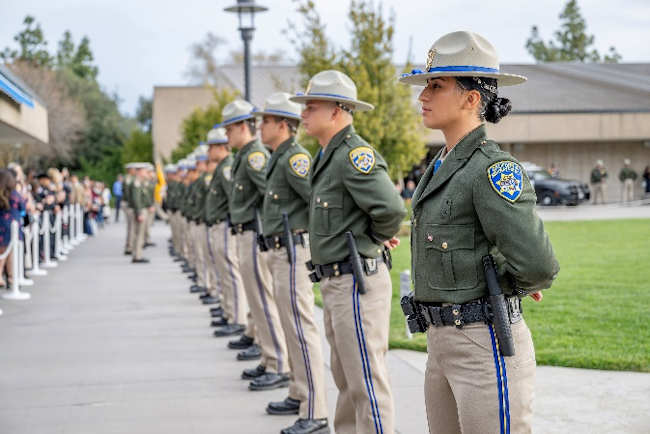
125 new officers join the ranks of the California Highway Patrol

Graduating cadets at the California Highway Patrol’s Academy on Friday, March 21, 2025. Photo courtesy of the CHP.

The California Highway Patrol has announced the promotion of 125 cadets to the rank of officer.

The Friday graduation ceremony marks the successful completion of a 26-week intensive training schedule at the CHP Academy in West Sacramento.

The new officers will now report to one of the CHP’s 102 area offices throughout the state to begin their careers in public service.

The cadets being assigned to Northern Division, the region which includes Lake County, are Dylan Logelin of Auburn, assigned to duty at the CHP’s Quincy Area office; Robert Ruiz of Norwalk, assigned to the CHP’s Garberville, Laytonville Resident Post Area office; Moises Suarez Arredondo of Oakland, Calif., who is assigned to the CHP’s Trinity River Area office; Nikolas Welch of Sonora, assigned to the CHP’s Trinity River Area office; and Nolan Williams of Redding, assigned to duty at the CHP’s Mount Shasta Area office.

“Today, we celebrate the dedication and perseverance of our newly promoted officers,” said CHP Commissioner Sean Duryee on Friday. “Their commitment to integrity, service, and the safety of our communities embodies the core values of the CHP. As these officers begin their new role, they will carry the trust of those they serve — and with that, the ability to make a lasting impact.”

This is the largest graduating class since June 2022, when 128 officers were sworn in.

Nearly 300 cadets remain in training at the CHP Academy, with another 160 cadets scheduled to arrive on April 7 in preparation to serve the people of California.

During their CHP Academy training, cadets receive comprehensive instruction in critical areas, including traffic enforcement, collision investigation, defensive tactics, firearms proficiency, emergency vehicle operations, and community policing.

Training also includes a focus on legal responsibilities, communication skills, ethical conduct, and cultural diversity awareness, ensuring that cadets are equipped with the knowledge and skills necessary to protect and serve California’s communities effectively.

As part of California’s efforts to improve public safety, in June 2022, the state funded a multi-year CHP recruitment campaign aimed at filling 1,000 officer positions by hiring qualified individuals. In November 2024, the CHP met and surpassed the administration’s ambitious hiring goal.

The CHP is actively recruiting dedicated individuals to make a difference in communities throughout California.

As a CHP officer, you can make a meaningful impact by enhancing road safety, enforcing traffic laws, and responding to emergencies. With comprehensive training, competitive benefits, and opportunities for career advancement, the CHP offers a rewarding and fulfilling career path for individuals committed to upholding the highest standards of service and professionalism.

To learn more about joining the CHP, please visit its website.

Graduating cadets at the California Highway Patrol’s Academy on Friday, March 21, 2025. Photo courtesy of the CHP.

5 years on, true counts of COVID-19 deaths remain elusive − and research is hobbled by lack of data


National COVID-19 memorial wall for the five-year anniversary on March 11, 2025, in London, England. Andrew Aitchison/In Pictures via Getty Images
Dylan Thomas Doyle, University of Colorado Boulder

In the early days of the COVID-19 pandemic, researchers struggled to grasp the rate of the virus’s spread and the number of related deaths. While hospitals tracked cases and deaths within their walls, the broader picture of mortality across communities remained frustratingly incomplete.

Policymakers and researchers quickly discovered a troubling pattern: Many deaths linked to the virus were never officially counted. A study analyzing data from over 3,000 U.S. counties between March 2020 and August 2022 found nearly 163,000 excess deaths from natural causes that were missing from official mortality records.

Excess deaths, meaning those that exceed the number expected based on historical trends, serve as a key indicator of underreported deaths during health crises. Many of these uncounted deaths were later tied to COVID-19 through reviews of medical records, death certificates and statistical modeling.

In addition, lack of real-time tracking for medical interventions during those early days slowed vaccine development by delaying insights into which treatments worked and how people were responding to newly circulating variants.

Five years since the beginning of COVID-19, new epidemics such as bird flu are emerging worldwide, and researchers are still finding it difficult to access the data about people’s deaths that they need to develop lifesaving interventions.

How can the U.S. mortality data system improve? I’m a technology infrastructure researcher, and my team and I design policy and technical systems to reduce inefficiency in health care and government organizations. By analyzing the flow of mortality data in the U.S., we found several areas of the system that could use updating.

Critical need for real-time data

A death record includes key details beyond just the fact of death, such as the cause, contributing conditions, demographics, place of death and sometimes medical history. This information is crucial for researchers to be able to analyze trends, identify disparities and drive medical advances.

Approximately 2.8 million death records are added to the U.S. mortality data system each year. But in 2022 – the most recent official count available – when the world was still in the throes of the pandemic, 3,279,857 deaths were recorded in the federal system. Still, this figure is widely considered to be a major undercount of true excess deaths from COVID-19.

In addition, real-time tracking of COVID-19 mortality data was severely lacking. This process involves the continuous collection, analysis and reporting of deaths from hospitals, health agencies and government databases by integrating electronic health records, lab reports and public health surveillance systems. Ideally, it provides up-to-date insights for decision-making, but during the COVID-19 pandemic, these tracking systems lagged and failed to generate comprehensive data.

Two health care workers in full PPE attending to a patient lying on hospital bed
Getting real-time COVID-19 data from hospitals and other agencies into the hands of researchers proved difficult. Gerald Herbert/AP Photo

Without comprehensive data on prior COVID-19 infections, antibody responses and adverse events, researchers faced challenges designing clinical trials to predict how long immunity would last and optimize booster schedules.

Such data is essential in vaccine development because it helps identify who is most at risk, which variants and treatments affect survival rates, and how vaccines should be designed and distributed. And as part of the broader U.S. vital records system, mortality data is essential for medical research, including evaluating public health programs, identifying health disparities and monitoring disease.

At the heart of the problem is the inefficiency of government policy, particularly outdated public health reporting systems and slow data modernization efforts that hinder timely decision-making. These long-standing policies, such as reliance on paper-based death certificates and disjointed state-level reporting, have failed to keep pace with real-time data needs during crises such as COVID-19.

These policy shortcomings lead to delays in reporting and lack of coordination between hospital organizations, state government vital records offices and federal government agencies in collecting, standardizing and sharing death records.

History of US mortality data

The U.S. mortality data system has been cobbled together through a disparate patchwork of state and local governments, federal agencies and public health organizations over the course of more than a century and a half. It has been shaped by advances in public health, medical record-keeping and technology. From its inception to the present day, the mortality data system has been plagued by inconsistencies, inefficiencies and tensions between medical professionals, state governments and the federal government.

The first national efforts to track information about deaths began in the 1850s when the U.S. Census Bureau started collecting mortality data as part of the decennial census. However, these early efforts were inconsistent, as death registration was largely voluntary and varied widely across states.

In the early 20th century, the establishment of the National Vital Statistics System brought greater standardization to mortality data. For example, the system required all U.S. states and territories to standardize their death certificate format. It also consolidated mortality data at the federal level, whereas mortality data was previously stored at the state level.

However, state and federal reporting remained fragmented. For example, states had no unifom timeline for submitting mortality data, resulting in some states taking months or even years to finalize and release death records. Local or state-level paperwork processing practices also remained varied and at times contradictory.

Close-up of blank form titled CERTIFICATE OF DEATH
Death record processing varies by state. eric1513/iStock via Getty Images Plus

To begin to close gaps in reporting timelines to aid medical researchers, in 1981 the National Center for Health Statistics – a division of the Centers for Disease Control and Prevention – introduced the National Death Index. This is a centralized database of death records collected from state vital statistics offices, making it easier to access death data for health and medical research. The system was originally paper-based, with the aim of allowing researchers to track the deaths of study participants without navigating complex bureaucracies.

As time has passed, the National Death Index and state databases have become increasingly digital. The rise of electronic death registration systems in recent decades has improved processing speed when it comes to researchers accessing mortality data from the National Death Index. However, while the index has solved some issues related to gaps between state and federal data, other issues, such as high fees and inconsistency in state reporting times, still plague it.

Accessing the data that matters most

With the Trump administration’s increasing removal of CDC public health datasets, it is unclear whether policy reform for mortality data will be addressed anytime soon.

Experts fear that the removal of CDC datasets has now set precedent for the Trump administration to cross further lines in its attempts to influence the research and data published by the CDC. The longer-term impact of the current administration’s public health policy on mortality data and disease response are not yet clear.

What is clear is that five years since COVID-19, the U.S. mortality tracking system remains unequipped to meet emerging public health crises. Without addressing these challenges, the U.S. may not be able to respond quickly enough to public health crises threatening American lives.The Conversation

Dylan Thomas Doyle, Ph.D. Candidate in Information Science, University of Colorado Boulder

This article is republished from The Conversation under a Creative Commons license. Read the original article.

Public Health officer resigns, Board of Supervisors approves interim hire

LAKE COUNTY, Calif. — With Lake County’s latest Public Health officer resigning, the Board of Supervisors has approved a contract with a physician to cover the job on a temporary basis.

Lake County Public Health Officer Dr. Noemi Doohan has resigned, effective March 31. The Board of Supervisors unanimously approved a temporary replacement on Tuesday.

Doohan has served as Lake County’s Public Health officer since September 2023.

She was the first non-temporary Public Health officer appointee since the resignation of her predecessor, Dr. Erik McLaughlin, in June 2022.

California state law requires counties to have Public Health officers to enforce local health orders and ordinances, as well as state regulations and statutes.

Following Doohan’s resignation, Health Services Director Anthony Arton cited the need for an interim officer to prevent service disruptions, while looking for a full-time, permanent health officer.

“Appointing a contracted temporary Public Health Officer will ensure continuity and effectiveness of LCHS operations and will avoid a lapse of coverage and services to our community,” Arton wrote in a memo to the Board of Supervisors.

“Without the appointment of a Public Health Officer, vital records and immunization services will be immediately impacted, among other services,” Arton wrote in his memo.

After a search, Arton proposed hiring Anju Goel, MD, MPH, for a temporary six-month term, from April 1 to Sep. 30.

“Dr. Goel is very qualified for this role. She brings extensive experience as an Interim Health Officer in California and has served as an independent medical doctor for the CDC,” Arton wrote in the memo, citing Goel’s “deep expertise” in public health.

Arton explained that three candidates declined the interim position due to conflicting obligations or pay concerns, while two others gave “mixed responses” before Goel was recommended to him.

“Dr. Goel was recommended by Dr. Doohan as a temporary fill-in while we conduct a search for a longer-term solution,” Health Services wrote in an email to Lake County News about the contact with Geol.

“At this time, we do not have prior experience working with Dr. Goel. However, her qualifications and expertise make her a strong candidate during this interim period,” the agency noted in the email.

Prior to this new job, Goel has worked as the interim health officer for the city of Berkeley in September 2023 for a term of 18 months through 2025, according to Berkeleyside. While she did not live in Berkeley, the hybrid role allowed in-person and remote work.

Medical Board of California records show that Goel graduated from the Stanford University School of Medicine in 1999, four years earlier than Doohan who went to the same medical school.

As Goel prepares to step in temporarily for Lake County, Doohan departs for Berkeley.

“Dr. Doohan has accepted a position as the Health Officer for the City of Berkeley, which led to her resignation from Lake County Health Services,” Health Services wrote in the email response to Lake County News’ inquiries. “We wish her the best of success in her new role.”

However, Health Services declined Lake County News’ request to see Doohan’s resignation letter: “Because this is a confidential personnel matter, no further information will be released.”

They acknowledged that “transitions in leadership can have an impact,” but noted that Arton “continues to oversee the day-to-day operations of the department and hold all administrative authority.”

While all the current and former public health officers, permanent or interim, have been reporting to the Board of Supervisors, Goel however “reports administratively to the Health Services Director,” the contract stated.

The current job post for the full-time Public Health officer does not specify if the role will be reporting to the department director or the Board of Supervisors.

It is uncertain if the reporting structure has changed temporarily or permanently.

The cost of having a Public Health officer

The county’s Health Services has reached an agreement with Dr. Goel on compensation.

Goel will be paid $165 for every hour of her service, and $10.50 an hour for on-call, Arton reported at Tuesday’s Board of Supervisors’ meeting.

A Berkeleyside 2023 report said that Goel’s hourly pay as city of Berkeley’s interim health officer was $131.86 to $149.79 at that time.

“We took about four to five weeks to reach reasonable terms with her,” Arton said during the board meeting. “That will allow us to have full coverage in the absence of a full time employee health officer.”

The contract states that in the event of a Board of Supervisors declaring an emergency that requires Goel to be present in-person, the county will reimburse mileage at $0.71 per mile and lodging at $110 per day.

The total combined compensation within a year — or in this case six months — shall not exceed $49,860, according to the contract.

Health Services confirmed with Lake County News that over the six-month period, Dr. Goel’s total hours would be approximately 302 hours, averaging around 50 hours per month.

They also said that they found 50 hours per month is sufficient for the temporary appointment, “given the nature of the work and Dr. Goel’s experience.”

“And perhaps less given the on-call pay we actually project about a 12–15-week projection and will use this time to find longer term solutions,” their email said.

“We will use that time to recruit a full-time health officer as an employee or reach terms with a longer term health officer,” said Arton during the supervisors’ meeting. “I do have a candidate in waiting that I'm very excited about.”

The job posting for a full-time health officer remains active, with a listed salary range of $199,824 to $242,880.

When Doohan was hired in 2023, county documents indicated she was offered an annually renewable contract not to exceed $290,000, along with a $20,000 hiring incentive.

At that time, the listed salary was $265,000 — $22,000 more than the top end of the current listed range.

Health officer turnover continues in Lake County

Since Dr. Karen Tait resigned in 2017 after nine years in the role, no Public Health officer has held the position for more than 20 months.

The longest term since Tait has been that of Dr. Gary Pace, whose service began in August 2019 and continued through the beginning of the COVID-19 pandemic to April 2021.

The next full-time officer after Pace was Dr. McLaughlin. He was appointed in March 2022 and quickly resigned in June.

In fact, McLaughlin's three-and-a-half month tenure has been the shortest of any permanently appointed Public Health officer in Lake County in over 20 years.

With an urgent need to cover the Public Health officer’s duty during the pandemic, the Board of Supervisors approved rehiring Pace, Mclaughlin’s predecessor, as an interim officer.

For the temporary appointment, Pace received a rate of $150 per hour for his work not to exceed $4,000 per month, with a flat rate of $500 per week for on-call. His total combined compensation shall not exceed $6,000 per month.

In the same meeting, supervisors also approved a contract that would pay up to $29,000 to Mosaic Public Partners, a recruitment consulting firm, to search for a permanent Public Health officer for Lake County.

Recruiting a full-time Public Health officer had been challenging for Lake and other counties “due to the repercussions of the COVID-10 health pandemic and the shortage of available health professionals,” County Administrative Officer Susan Parker's memo with the contract explained.

Less than three months later, on Sept. 13, 2022, the supervisors appointed Dr. Karl A. Sporer as interim officer for a six-month term, with an amount not to exceed $6,000 a month.

Still in 2022, at a Nov. 8 meeting, the Board of Supervisors unanimously approved a contract with Doohan for a Public Health officer “mentor program,” in response to having had few candidates for the position out of 110 potential candidates identified across the state by its recruitment contractor Mosaic Public Partners.

That mentor program contract said the county would pay Doohan a consulting rate of $250 per hour for three to six months, with a total compensation cap of $25,000.

Then in February 2023, Sporer’s interim contract was renewed for another six months, as the county still had not secured a permanent hire.

In August 2023, Doohan accepted the job as a full-time Public Health officer of Lake County and started in September.

Doohan’s 19-month tenure is close to Pace’s 20 months, but continued the pattern of short-lived appointments.

Email staff reporter Lingzi Chen at This email address is being protected from spambots. You need JavaScript enabled to view it.. 
  • 227
  • 228
  • 229
  • 230
  • 231
  • 232
  • 233
  • 234
  • 235
  • 236

Community

  • Lake County Wine Alliance offers sponsor update; beneficiary applications open 

  • Mendocino National Forest announces seasonal hiring for upcoming field season

Public Safety

  • Lakeport Police logs: Thursday, Jan. 15

  • Lakeport Police logs: Wednesday, Jan. 14

Education

  • Woodland Community College receives maximum eight-year reaffirmation of accreditation from ACCJC

  • SNHU announces Fall 2025 President's List

Health

  • California ranks 24th in America’s Health Rankings Annual Report from United Health Foundation

  • Healthy blood donors especially vital during active flu season

Business

  • Two Lake County Mediacom employees earn company’s top service awards

  • Redwood Credit Union launches holiday gift and porch-to-pantry food drives

Obituaries

  • Rufino ‘Ray’ Pato

  • Patty Lee Smith

Opinion & Letters

  • The benefits of music for students

  • How to ease the burden of high electric bills

Veterans

  • CalVet and CSU Long Beach team up to improve data collection related to veteran suicides

  • A ‘Big Step Forward’ for Gulf War Veterans

Recreation

  • Wet weather trail closure in effect on Upper Lake Ranger District

  • Mendocino National Forest seeking public input on OHV grant applications

  • State Parks announces 2026 Anderson Marsh nature walk schedule 

  • BLM lifts seasonal fire restrictions in central California

Religion

  • Kelseyville Presbyterian to host Ash Wednesday service and Lenten dinner Feb. 18

  • Kelseyville Presbyterian Church to hold ‘Longest Night’ service Dec. 21

Arts & Life

  • Auditions announced for original musical ‘Even In Shadow’ set for March 21 and 28

  • ‘The Rip’ action heist; ‘Steal’ grounded in a crime thriller

Government & Politics

  • Lake County Democrats issue endorsements in local races for the June California Primary

  • County negotiates money-saving power purchase agreement

Legals

  • March 3 hearing on ordinance amending code for commercial cannabis uses

  • Feb. 12 public hearing on resolution to establish standards for agricultural roads

How to resolve AdBlock issue?
Refresh this page
