How to resolve AdBlock issue?
Refresh this page
How to resolve AdBlock issue?
Refresh this page
Lake County News,California
  • Home
    • Registration Form
  • News
    • Education
    • Veterans
    • Community
      • Obituaries
      • Letters
      • Commentary
    • Police Logs
    • Business
    • Recreation
    • Health
    • Religion
    • Legals
    • Arts & Life
    • Regional
  • Calendar
  • Contact us
    • FAQs
    • Phones, E-Mail
    • Subscribe
  • Advertise Here
  • Login

News

Losing your job is bad for your health, but there are things you can do to minimize the harm


Losing your job can hurt you in many ways. Maskot/Getty Images
Jeffrey Anvari-Clark, University of North Dakota

The Trump administration’s firing and furloughing of tens of thousands of federal workers and contractors have obviously caused economic hardship for Americans employed in national parks, research labs and dozens of government agencies.

As a professor of social work who studies how people’s finances affect their physical and mental well-being, I’m concerned about the health hazards they’ll face too.

My research shows that losing your job can seriously harm your physical and mental health, especially when you see the situation as a catastrophe rather than a temporary setback.

Power of financial perception

When people lose their jobs, they do have real problems. Typically, for example, their income and savings decline. They might struggle to keep up on their rent or mortgage payments and might not be able to afford to maintain the same standard of living they had beforehand.

However, research shows that your perspective regarding your financial situation can do more harm to your health than your actual financial circumstances – even as your savings dwindle.

Someone might view losing their job as a temporary setback and remain relatively calm, while another person might experience the same circumstances as a disaster, triggering intense stress that cascades into serious health problems, such as depression and substance abuse. This difference in perspective often determines whether somebody will suffer significant health problems when they lose their job or experience a similar financial setback.

In a study I published in 2023 with social work scholar Theda Rose, we found that how a person felt about a decline in income mattered 20 times more than the actual financial change itself.

This finding comes from our analysis of data from the 2018 National Financial Capability Study, which surveyed more than 27,000 American adults. We used advanced statistical methods to examine how different financial factors affected people’s health and financial decision-making, looking specifically at financial strain, confidence in managing money and overall financial satisfaction.

The study confirmed earlier work about the vastly different psychological and physical responses two people can have when their income falls by the same amount, based on how they perceive this change.

Pathway to illness

Previous research has typically viewed what’s known as “financial precarity” – not having enough money to get by – in either purely technical terms, such as being able to come up with US$400 in an emergency, or in terms related to your feelings about that situation, such as persistent worrying about your finances.

However, we found that both aspects of financial precarity can influence health and behavior.

Among the many variables we explored, a decline in income surprisingly contributed much more in terms of worry than just not being able to pay the bills.

This distress caused by economic hardship isn’t just a psychological problem – it can produce physical changes that may have long-term health implications, such as high blood pressure.

Two women hold a meeting in a big conference room.
A fired IRS employee, right, talks to a recruiter during a jobs fair for laid-off federal workers on March 15, 2025, in Kansas City, Mo. AP Photo/Charlie Riedel

Mental health suffers

There’s also a toll on your mental health.

Losing a job can lead to anxiety, depression and lower self-esteem.

Interestingly, people who face ongoing financial challenges but don’t get stressed about their situation aren’t more likely to develop depression symptoms than people without any financial stress.

A systematic review of 65 studies found clear connections between debt and mental health problems, depression and even suicide attempts.

Physical health troubles

Losing your job can harm your body in two main ways.

First, the stress from financial worries can affect people’s bodies directly – for example, by increasing blood pressure. Being in debt is associated with other ailments, including back pain and obesity.

Second, when money is tight, people often try to save money by skipping doctor visits or forgoing prescription drugs. Even with health insurance, high deductibles can mean paying thousands of dollars out of pocket before insurance helps. When choosing between paying for rent, food and health care, people often put their medical needs last.

Unhealthy coping methods

Some people turn to alcohol, tobacco or other substances to cope with the loss of their jobs. These habits are bad for your health and may empty your wallet, adding to the financial strain.

Others turn to gambling or excessive shopping to cope, which can also make money problems even worse.

Marriage and other relationships may fray amid financial stress too. Borrowing money excessively from friends and family or snapping at your loved ones when you feel stressed out can weaken ties with those closest to you.

Moving on in healthy ways

To be sure, some people become more resilient after losing their job by adopting positive coping strategies.

Whenever you lose a job, try reaching out. Your friends and loved ones can help protect your health while you move on.

In addition to applying for new positions, spend time networking. Reach out to former colleagues, join professional groups and attend events related to your career.

Try to volunteer. It will help you sharpen or expand your skills while expanding your networks and perhaps lead you to a new job.

And consider starting or expanding a side hustle. It will generate some income, give you a greater sense of control over your life and keep you feeling productive during the monotony of sending out applications.

It’s also essential to stick to self-care basics: Regular exercise reduces stress hormones. Getting enough sleep improves cognitive function, and maintaining a busy social life provides emotional support.

Keeping healthy habits is always important. But they could protect your mental and physical health during challenging times. Losing a paycheck is hard enough. Losing your health over it is even worse.The Conversation

Jeffrey Anvari-Clark, Assistant Professor of Social Work, University of North Dakota

This article is republished from The Conversation under a Creative Commons license. Read the original article.

Preliminary hearing for man accused of January murder in Lakeport postponed

LAKEPORT, Calif. — The preliminary hearing for the man charged with committing a fatal shooting in downtown Lakeport in January has been postponed until June.

Joshua Jacob Tovar, 33, was originally scheduled to appear in Lake County Superior Court on Wednesday morning.

He is charged with the Jan. 31 shooting death of 32-year-old Vicente Zeta Colacion.

However, the Public Defender’s Office, which is representing Tovar, filed a motion to continue the hearing, which was granted.

The hearing has been rescheduled to June 11.

Chief Deputy District Attorney Rich Watson said the defense sought the continuance due to outstanding discovery — information and evidence — and the need to have digital discovery analyzed.

Tovar — who has previous felony convictions for assault and weapons charges — is charged with homicide, assault with a firearm, in this case, a handgun; felon in possession of a firearm; felon in possession of ammunition; and special allegations that include personal and intentional use of a firearm and inflicting great bodily injury.

The District Attorney’s Office also has charged him with drugs and weapons charges, and for violating the terms of his post release community supervision, which is given to inmates released from state prison.

Tovar has remained in the Lake County Jail since his arrest on Feb. 2.

Email Elizabeth Larson at This email address is being protected from spambots. You need JavaScript enabled to view it.. Follow her on Twitter, @ERLarson, and on Bluesky, @erlarson.bsky.social. Find Lake County News on the following platforms: Facebook, @LakeCoNews; X, @LakeCoNews; Threads, @lakeconews, and on Bluesky, @lakeconews.bsky.social.

Lake County News selected to participate in journalism funding program

Local Media Association, or LMA, is pleased to announce 46 newsrooms selected to participate in three state cohorts of the LMA Lab for Journalism Funding in 2025.

These newsrooms in California, Illinois and New Mexico will engage in a six-month cohort learning program to develop fundraising strategies to help sustain their essential local journalism.

Among the California cohort members is Lake County News.

“We’re excited to work with the lab and other member publications to bring best practices for fundraising and community engagement to Lake County, with a view to learning new and successful strategies for conversing with community members to find out what coverage is critical to them,” said Lake County News Editor and Publisher Elizabeth Larson. “Our hope is that, from this experience, we will create avenues for fundraising that will strengthen our publication’s resources and enhance our ability to carry out the journalism that’s important to Lake County, both now and in the future.”

Since its launch in September 2020, the LMA Lab for Journalism Funding has trained 148 newsrooms in five national and two state cohorts on fundraising best practices.

Collectively, those newsrooms have raised more than $28 million to support their journalism. Training for newsrooms in the lab is made possible through sustained support from Google News Initiative.

This expansion will bring the lab’s proven training and fundraising to 19 news outlets in California, 13 news outlets in Illinois and 14 news outlets in New Mexico, enabling them to support their civic journalism in part through philanthropy.

“We are excited to expand the proven practices of the Lab for Journalism Funding to these three new states,” said Frank Mungeam, who leads the lab as LMA chief innovation officer. “These newsrooms have a deep commitment to community service journalism, and we look forward to helping them grow local support for their essential reporting.”

“The Google News Initiative has been a long-standing partner of the Lab for Journalism Funding,” said Lauren Ashcraft, news partner manager at Google. “It was exciting to see the success of the new state cohorts of the lab from last year and we’re thrilled to support an expansion of the program in these important states. We look forward to our continued partnership with LMA and its members.”

The state cohorts will be led by Mungeam and Liz White Notarangelo, LMA’s co-CEO, along with a team of best-in-class coaches including Joaquin Alvarado, who has been instrumental in the development of philanthropic funding at The Seattle Times and other local newsrooms; Jennifer Preston, formerly vice president of journalism at Knight Foundation; executive coach Joanne Heyman; and Judi Terzotis who as CEO has helped dramatically grow philanthropic support for journalism at Georges Media Group.

Each publisher in the state cohorts will set a fundraising goal, receive one-on-one customized coaching, and create and pitch a journalism project to be funded through philanthropy. Newsrooms will also gather for an in-person training and convening and have the chance to compete for stipends to kick-start their projects.

In 2025, in addition to these three new state cohorts, LMA will once again offer a national cohort of the Lab for Journalism Funding with new support from John S. and James L. Knight Foundation. LMA has also published two industry reports, Pathways to Philanthropy and Sustaining Philanthropy for Journalism, available as free downloads to help all local newsrooms learn and apply fundraising best practices.

Six-month program to focus on fundraising practices

Local Media Association said the news organizations selected to participate in the California cohort of the Lab for Journalism Funding will take part in an intensive, six-month program that brings the lab’s proven fundraising practices to independent news organizations across the state.

The 19 organizations selected for the 2025 Lab for Journalism Funding California cohort represent local newsrooms big and small, serving diverse communities across the state of California, all united in their focus on civic journalism.

The news organizations selected are:

Beyond Borders Gazette
California Health Report
Community Alliance Newspaper
Fountain Valley Living and Huntington Beach Living Magazines
Indigenous Network
inewsource
La Opinión
Lake County News
Mission Local
Monterey County Weekly (Monterey County Now)
Post News Group
Santa Cruz Local
Street Spirit
Tahoe Daily Tribune
The Mendocino Voice (Bay City News Foundation)
The San Diego Voice & Viewpoint Newspaper
The San Fernando Valley Sun/el Sol del Valle de San Fernando
The Trinity Journal
Vida Newspaper

The California cohort of the Lab for Journalism Funding is made possible with support from Google News Initiative. The lab will help these local news organizations develop and execute comprehensive programs to secure philanthropic support for their essential local journalism that is responsive to community priorities.

The lab runs from April through September 2025.

‘California’s Bookshelf’ opens up vast collection of eBooks and eAudiobooks for free

Every Californian with an email address and an internet connection can now visit California’s Bookshelf and access more than 300,000 eBooks and eAudiobooks.

Previously, readers had to log in through a participating library to get to all the ebooks available on the eBookshelf. With California’s Bookshelf, access to our vast collection is just a few clicks away, as you’ll see below.

“With just a few clicks, any Californian can go and grab what they’re looking for on California’s Bookshelf. Trust me, we’ve tried to make something for every reader,” said California State Librarian Greg Lucas. “From your home, a coffee shop or while traveling, you will always be connected to convenience with this new virtual library bookshelf. Did I mention it’s free?”

California’s Bookshelf has thousands of eBooks and eAudiobooks in multiple genres and over 20 languages.

The eBookshelf is a partnership with the Palace Project. It uses the Palace app to provide access to digital content.

There are five steps to access California’s Bookshelf and create a virtual library card:

1. Download the free Palace app on your iOS or Android device.
2. Inside the app, use the “find my library” search function to find “California’s Bookshelf.”
3. Browse the collection until you find a title you would like to read then either “get” or “reserve” that book.
4. Choose the option to create a virtual card and then complete the details in the form. You will need to enable the app’s permission to use your specific location, just one time, for the creation of your library card.
5. Look in your email for your library card number. You can borrow items using that number and your new password.

When you browse California’s Bookshelf, you’ll have access to over 300,000 eBooks and eAudiobooks and over 70,000 unique titles. There are over 3,500 titles available with no wait times or hold queues.

If you log into the Palace app through your local library, you’ll not only have access to all the materials in California’s Bookshelf but all the eBooks and audiobooks in your local library’s collection.

Established in 1850, the California State Library is the central reference and research library for state government and the Legislature. The library collection includes more than four million titles, 6,000 maps and 250,000 photographs, and includes an extensive collection of documents from and about the state’s rich history. The State Library also serves California’s local libraries, providing more than $500 million state and federal funds to support public libraries and deliver statewide programs and services.

The Palace Project was born of the belief that the public library is the digital center of knowledge and creativity for their community. A robust suite of content, services and tools for the delivery of ebooks, audiobooks and other digital media to benefit public libraries and their patrons, The Palace Project offers a seamless, easy-to-use system, including platform, content and mobile app, for libraries to engage directly with patrons and improve, enhance and expand the resources available to them. The Palace Project is supported by Lyrasis, in strategic partnership with the Digital Public Library of America.

Lyrasis is a community-focused, mission-driven nonprofit that partners with archives, libraries, museums and research communities to ensure enduring access to our shared academic, scientific and cultural heritage. Home to The Palace Project, BiblioBoard, the Indie Author Project, DSpace, ArchivesSpace and other community-supported programs, Lyrasis offers technologies and services to help knowledge professionals and collections-holding organizations worldwide foster collaboration, solve problems and build solutions to benefit the wider community.

National monuments have grown and shrunk under US presidents for over a century thanks to one law: The Antiquities Act


Over 730,000 people visit Colorado National Monument each year. It was established in 1911 under the Antiquities Act. Gordon Leggett, CC BY-SA
Monica Hubbard, Boise State University and Erika Allen Wolters, Oregon State University

America’s public lands, from its majestic national parks to its vast national forests, are at the heart of the country’s identity.

They cover more than a quarter of the nation and large parts of the West. Some are crisscrossed by hiking trails and used by hunters and fishermen. Ranchers graze cattle on others. In many areas, the government earns money through oil, gas, timber and mining leases.

These federally managed public lands have long enjoyed broad bipartisan support, as have moves to turn them into protected national parks and monuments. Research consistently shows that a majority of Americans want their congressional representatives to protect public access to these lands for recreation. One avenue for protection is the creation of national monuments.

But the status of national monuments can change.

Presidents have expanded and contracted national monuments, as the U.S. saw with Bears Ears National Monument in Utah over the course of the past three presidencies. The rules for the use and maintenance of various public lands can also change, and that can affect surrounding communities and their economies.

The U.S. is likely to see changes to public lands again under the second Trump administration. One of the new administration’s early orders was for the Department of Interior to review all national monuments for potential oil and gas drilling and mining. At least two national monuments that President Joe Biden created in California are among the new administration’s targets.

The avenue for many of these changes is rooted in one century-old law.

The power and vagary of the Antiquities Act

The Antiquities Act of 1906, signed into law by President Theodore Roosevelt, gave Congress or the president the authority to establish national monuments on federal land as a means of protecting areas for ecological, cultural, historical or scientific purposes.

From Theodore Roosevelt on, 18 of the 21 presidents have used the Antiquities Act to create, expand or contract national monuments through a presidential proclamation.

By using the Antiquities Act to create, expand or reduce national monuments, presidents can avoid an environmental impact statement, normally required under the National Environmental Policy Act, which also allows for public input. Supporters argue that forgoing the environmental impact statement helps expedite monument creation and expansion. Critics say bypassing the review means potential impacts of the monument designations can be overlooked.

The Antiquities Act also offers no clarity on whether a president can reduce the amount of area protected by prior presidents. The act simply states that a president designates “the smallest area compatible with the proper care and management of the objects to be protected.” This has led to the shifting of national monument boundaries based on the priorities of each administration.

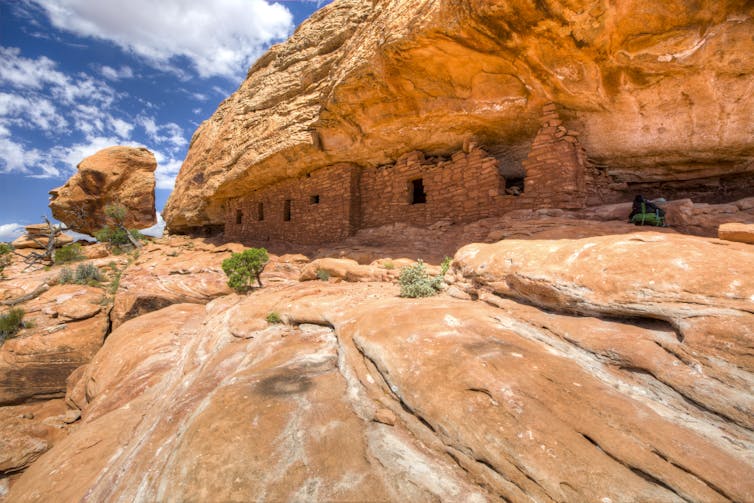
Cliff dwellings under the rim of a cliff
The Citadel Ruins are the remains of Anasazi cliff dwellings at Bears Ears National Monument in Utah. Bob Wick/Bureau of Land Management via Wikimedia Commons

An example is Bears Ears, an area of Utah that is considered significant to several tribes but also has uranium, gas and oil resources. In 2016, President Barack Obama designated Bears Ears a national monument. In 2017, President Donald Trump signed a proclamation reducing Bears Ears by 80% of its total designated size. The monument’s size and scope shifted a third time when President Joe Biden reestablished Bears Ears to the boundaries designated by Obama.

In the span of just over five years, the monument was created, reduced, then restored to the original monument designation.

The uncertainty about the long-term reliability of a designation makes it challenging for federal agencies to manage the land or assure Indigenous communities that the government will protect cultural, historical and ecological heritage.

Public lands can be economic engines

National parks and monuments can help fuel local economies.

A 2017 study by Headwaters Economics, a nonprofit research group, found that Western rural counties with more public land have had greater economic growth, including in jobs and personal income, than those with little public land. National monuments can also benefit neighboring counties by increasing population, income and employment opportunities.

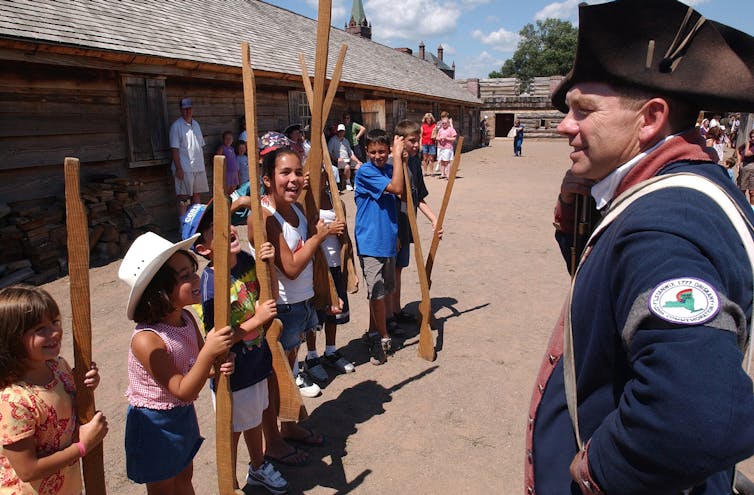
Kids and a worker in a soldier's uniform at Fort Stanwix, a reconstructed fort in the shape of star.
Even small national monuments provide economic benefits for their surrounding communities. Visitors to Fort Stanwix National Monument in Rome, N.Y., spent $5.3 million in nearby communities in 2023, according to a National Park Service report. National Park Service via Wikimedia Commons

While many counties adjacent to public lands may be dependent on natural resource extraction, the establishment of a national monument can open up new opportunities by expanding tourism and recreation. For example, four national parks and monuments in southeastern Utah, including Natural Bridges, drew about 2.4 million visitors who spent nearly US$400 million in surrounding communities.

However, when there is uncertainty over whether public lands will remain protected, communities may be hesitant to invest in that future, not knowing whether it will soon change.

What Congress and the courts could do

There are a few ways to increase the certainty around the future of national monuments.

First, lawsuits could push the courts to determine whether the president has the authority to reduce national monuments. Since the Antiquities Act doesn’t directly address presidential authority to reduce monument size, that’s an open question.

Advocacy groups sued the government over Trump’s authority to shrink Bears Ears National Monument, but their cases were put on hold after Biden expanded the monument again. The U.S. Supreme Court declined to hear other cases in 2024 that argued that a president’s authority to declare and expand national monuments should be far more limited under the law.

Second, Congress could permanently protect designated national monuments through legislation. That would require presidential approval, and the process would likely be slow and cumbersome. Creating White Clouds Wilderness in Idaho, for example, took decades and a public campaign to have it designated a national monument before Congress approved its wilderness designation.

Third, Congress could take new steps to protect public lands. For example, a bipartisan bill titled Public Lands in Public Hands Act could block privatization of public lands and increase and maintain access for recreation. One of the bill’s lead sponsors is U.S. Rep. Ryan Zinke, a Republican from Montana who served as Interior secretary during the first Trump administration. Whether the bill will pass and gain the president’s approval remains to be seen.

Public lands have widespread support

The Antiquities Act has led to the creation of 163 terrestrial and marine monuments and subsequently the protection of land and waters that hold cultural, scientific or historic significance.

These monuments tend to have broad support. During the first Trump administration, there were over 650,000 public comments on Trump’s review of national monument creation. An analysis found that 98% of the comments expressed broad support for both the creation and expansion of national monuments.

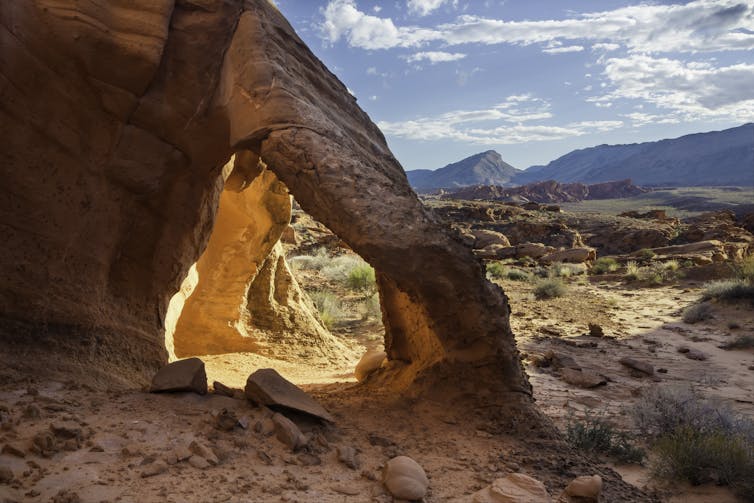
An arch in the Mojave Desert.
Gold Butte National Monument covers nearly 300,000 acres of remote and rugged desert landscape in southeastern Nevada and is popular with hikers. Bureau of Land Management

Public lands are more than just physical places. They are spaces where our ideals and values around public land unify us as Americans. They are quintessentially American – and in many ways define and shape the American identity.The Conversation

Monica Hubbard, Associate Professor of Public Policy and Administration, Boise State University and Erika Allen Wolters, Assistant Professor of Political Science, Oregon State University

This article is republished from The Conversation under a Creative Commons license. Read the original article.
Tuesday night fire damages building at Ceago Vinegarden

A fire damaged the “shop” building at Ceago Vinegarden in Nice, California, on the night of Tuesday, March 25, 2025. Photo courtesy of Jim Fetzer.

NICE, Calif. — A fire on Tuesday night damaged a building at a famed Northshore winery.

The fire at Ceago Vinegarden, located on Highway 20 between Nice and Lucerne, was dispatched just before 9 p.m. Tuesday.

Initial reports from the scene indicated one of the structures in the Ceago’s compound of buildings was fully involved when firefighters arrived on scene minutes after the initial dispatch.

Firefighters from Northshore Fire, Lakeport Fire and Cal Fire responded to the scene. Lakeport Fire sent its ladder truck to assist with the firefighting effort and the Northshore Fire Support Team was dispatched due to the incident being extended.

Ceago’s owner, Jim Fetzer, told Lake County News that his son, Barney, heard a loud boom before discovering the fire in what Fetzer called the “shop” building. Barney Fetzer then ran to his father’s residence shouting, “Fire! Fire!”

A view of the fire down a hallway at Ceago Vinegarden in Nice, California, on the night of Tuesday, March 25, 2025. Photo courtesy of Jim Fetzer.

The shop building, Jim Fetzer said, is not lived in, but has been used for events. It’s located at the back of the main building and is where Fetzer has plans for a commercial kitchen and restaurant venue.

There was no one in the building. “Everybody’s safe,” Fetzer said.

“You never imagine” an incident like the fire, he said.

The fire, which was kept to the shop building, was reported to be knocked down shortly before 10 p.m., but overhaul continued until early Wednesday morning.

Fetzer has owned the 163-acre property since 2001. He developed a biodynamic winery and farm there which he closed to the public in 2014 when he retired.

Email Elizabeth Larson at This email address is being protected from spambots. You need JavaScript enabled to view it.. Follow her on Twitter, @ERLarson, and on Bluesky, @erlarson.bsky.social. Find Lake County News on the following platforms: Facebook, @LakeCoNews; X, @LakeCoNews; Threads, @lakeconews, and on Bluesky, @lakeconews.bsky.social.


Firefighters work to control a fire at Ceago Vinegarden in Nice, California, on the night of Tuesday, March 25, 2025. Photo courtesy of Jim Fetzer.
  • 225
  • 226
  • 227
  • 228
  • 229
  • 230
  • 231
  • 232
  • 233
  • 234

Community

  • Lake County Wine Alliance offers sponsor update; beneficiary applications open 

  • Mendocino National Forest announces seasonal hiring for upcoming field season

Public Safety

  • Lakeport Police logs: Thursday, Jan. 15

  • Lakeport Police logs: Wednesday, Jan. 14

Education

  • Woodland Community College receives maximum eight-year reaffirmation of accreditation from ACCJC

  • SNHU announces Fall 2025 President's List

Health

  • California ranks 24th in America’s Health Rankings Annual Report from United Health Foundation

  • Healthy blood donors especially vital during active flu season

Business

  • Two Lake County Mediacom employees earn company’s top service awards

  • Redwood Credit Union launches holiday gift and porch-to-pantry food drives

Obituaries

  • Rufino ‘Ray’ Pato

  • Patty Lee Smith

Opinion & Letters

  • The benefits of music for students

  • How to ease the burden of high electric bills

Veterans

  • CalVet and CSU Long Beach team up to improve data collection related to veteran suicides

  • A ‘Big Step Forward’ for Gulf War Veterans

Recreation

  • Wet weather trail closure in effect on Upper Lake Ranger District

  • Mendocino National Forest seeking public input on OHV grant applications

  • State Parks announces 2026 Anderson Marsh nature walk schedule 

  • BLM lifts seasonal fire restrictions in central California

Religion

  • Kelseyville Presbyterian to host Ash Wednesday service and Lenten dinner Feb. 18

  • Kelseyville Presbyterian Church to hold ‘Longest Night’ service Dec. 21

Arts & Life

  • Auditions announced for original musical ‘Even In Shadow’ set for March 21 and 28

  • ‘The Rip’ action heist; ‘Steal’ grounded in a crime thriller

Government & Politics

  • Lake County Democrats issue endorsements in local races for the June California Primary

  • County negotiates money-saving power purchase agreement

Legals

  • March 3 hearing on ordinance amending code for commercial cannabis uses

  • Feb. 12 public hearing on resolution to establish standards for agricultural roads

How to resolve AdBlock issue?
Refresh this page