How to resolve AdBlock issue?
News
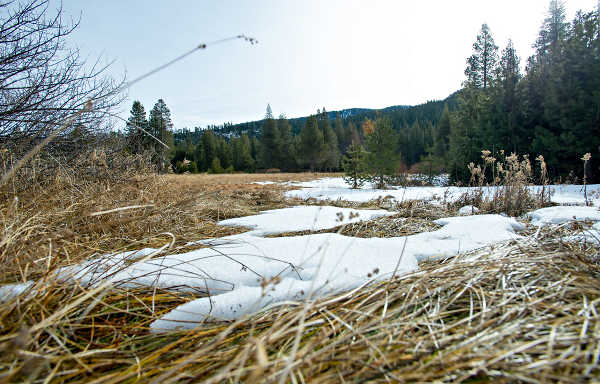
NORTHERN CALIFORNIA – The first snow survey of the winter season completed on Wednesday showed a below-average snowpack, although state water officials caution it’s still early in the water year.
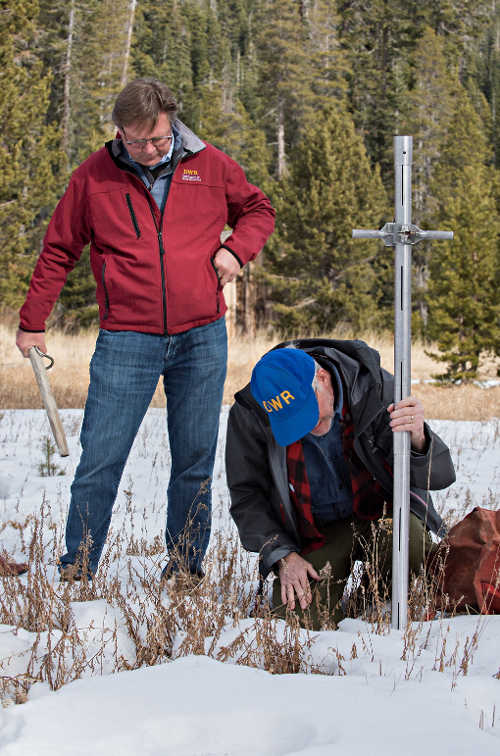
The California Department of Water Resources held the manual snow survey east of Sacramento in the Sierra Nevada, finding little snowpack, which was predictable after a dry December throughout California.
Measurements at Phillips Station revealed a snow water equivalent, or SWE, of 0.4 inches, 3 percent of the average SWE of 11.3 inches in early January at Phillips as measured there since 1964.
SWE is the depth of water that theoretically would result if the entire snowpack melted instantaneously.
“As we’re only a third of the way through California’s three wettest months, it’s far too early to draw any conclusions about what kind of season we’ll have this year,” DWR Director Grant Davis said. “California’s great weather variability means we can go straight from a dry year to a wet year and back again to dry. That’s why California is focusing on adopting water conservation as a way of life, investing in above- and below- ground storage, and improving our infrastructure to protect our clean water supplies against disruptions.”
More telling than a survey at a single location, however, are DWR’s electronic readings on Wednesday from 103 stations scattered throughout the Sierra Nevada.
Measurements indicate the SWE of the northern Sierra snowpack is 2.3 inches, 21 percent of the multi-decade average for the date.
The central and southern Sierra readings are 3.3 inches, 29 percent of average, and 1.8 inches 20 percent of average, respectively.
Statewide, the snowpack’s SWE is 2.6 inches, or 24 percent of the Jan. 3 average, the readings found.
“The survey is a disappointing start of the year, but it’s far too early to draw conclusions about what kind of a wet season we’ll have this year,” said Frank Gehrke, chief of the California Cooperative Snow Surveys Program who conducted today’s survey at Phillips. “There’s plenty of time left in the traditional wet season to reverse the dry trend we’ve been experiencing.”
California traditionally receives about half of its annual precipitation during December, January and February, with the bulk of this precipitation coming from atmospheric rivers.
So far this winter, an atmospheric high-pressure zone spanning the western United States has persistently blocked atmospheric rivers from reaching the state. If that zone were to move or break up, storms could deliver considerable rainfall and snow this winter.
Davis noted that forecasting accuracy falls off dramatically after just a week or 10 days into the future.
“Current technology and computer modeling can tell us what our weather might be weeks into the future, but we’re essentially blind to what the weather will be beyond the two-week mark,” he said. “That’s why we are putting in so much effort to improving medium- and long-range modeling.”
The Phillips snow course, near the intersection of Highway 50 and Sierra-at-Tahoe Road, is one of hundreds that will be surveyed manually throughout the winter.
Manual measurements augment the electronic readings from the snow pillows in the Sierra Nevada that provide a current snapshot of the water content in the snowpack.
California’s exceptionally high precipitation last winter and spring has resulted in above-average storage in 154 reservoirs tracked by the Department.
DWR estimates total storage in those reservoirs at the end of December amounted to 24.1 million acre-feet, or 110 percent of the 21.9 million acre-feet average for the end of the year.
One year ago, those reservoirs held 21.2 million acre-feet, 97 percent of average. End-of-year storage is now the highest since December 2012, when it was 24.3 million acre-feet, which was early in the first of five consecutive water years of drought in California.
On average, the snowpack supplies about 30 percent of California’s water needs as it melts in the spring and early summer.
The greater the snowpack water content, the greater the likelihood California’s reservoirs will receive ample runoff as the snowpack melts to meet the state’s water demand in the summer and fall.
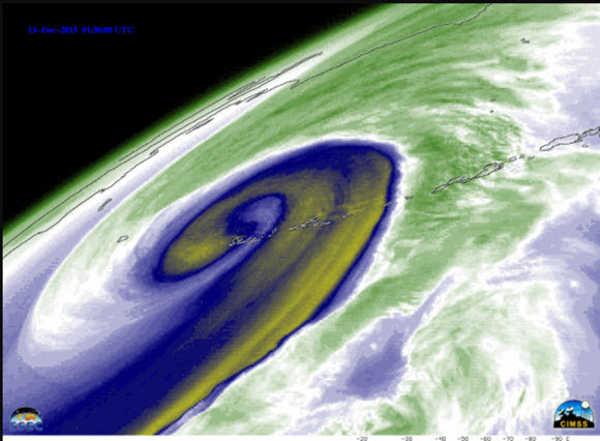
You may have heard or read about a storm undergoing "bombogenesis." What exactly does that weather term mean?
In simple terms, bombogenesis is a storm that undergoes rapid strengthening. The vast majority of such storms occur over the ocean. The storm can be tropical or non-tropical in nature.
Other common phrases for bombogenesis include weather bomb, or simply bomb.
The term bombogenesis comes from the merging of two words: bomb and cyclogenesis. All storms are cyclones, and genesis means the creation or beginning. In this case, bomb refers to explosive development. Altogether the term means explosive storm strengthening.
A cyclone (non-tropical storm or hurricane) is essentially a giant rising column of air that spins counterclockwise over the Northern Hemisphere.
When air rises, it produces a vacuum effect that results in lower atmospheric pressure.
When a storm strengthens, the column of air rises at a faster and faster rate and the pressure within the storm lowers.
Meteorologists use a barometer to measure the atmospheric pressure. Atmospheric pressure is often called barometric pressure.
Average storms in the winter have a low barometric pressure reading of 29.53 inches of mercury.
Some of the most intense storms may have the barometric pressure below 29.00 inches.
However, it is not the lowest pressure that defines bombogenisis but rather how quickly the pressure within the storm plummets.
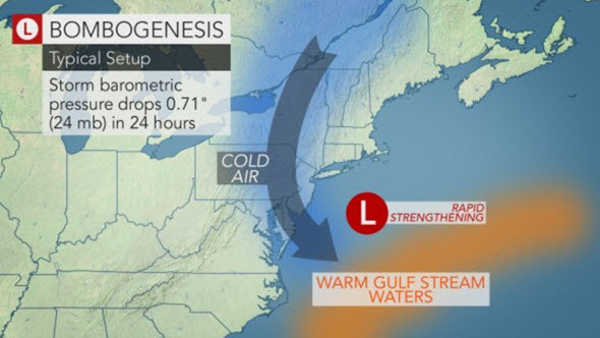
When the barometric pressure falls at least 0.71 of an inch (24 millibars) in 24 hours, a storm has undergone bombogenesis.
For example, a weak storm that began with a barometric pressure of 29.98 inches and ended up with a barometric pressure of 29.27 inches in 24 hours underwent bombogenesis.
The Superstorm of 1993 (Storm of the Century) from March 12-13 is a prime example of a storm that underwent bombogenesis. The storm strengthened from 29.41 inches (996 mb) to 28.45 inches (963 mb), or nearly 1.00 inch (33 mb), in 24 hours. Much of this strengthening occurred over land.
Other examples of storms that underwent bombogenesis are Hurricane Charley in 2004 and Hurricane Wilma in 2005. The Blizzard of 2015 (Jan. 26-27), the Bering Sea storm of December 2015 and the northeastern United States storm of late-October 2017 experienced bombogenesis.
Storms that undergo bombogenesis are among the most violent weather systems that affect a broad area. This is because the rapidly ascending air near the center of the storm must be replaced by air surrounding the storm. As these winds move toward the center of the storm at high speed, property damage can occur, trees may fall and the power may go out.
The western North Atlantic is one favored area for storms to undergo bombogenesis. This is a region where cold air from North America collides with warm air over the Atlantic Ocean. Warm waters of the Gulf Stream may also provide a boost in a festering storm.
As a result, some, but not all nor'easters may undergo bombogenesis.
The intense winds often create massive seas and may cause significant beach erosion.
In terms of precipitation, very heavy rain and/or snow may fall in the path of the storm undergoing bombogenesis.
Precipitation rate is produced from the rising column of air. When air rises, it cools and moisture condenses to form clouds and rain or snow. The faster the air rises and cools, the heavier the precipitation.
Alex Sosnowski is senior meteorologist for www.AccuWeather.com.
LAKEPORT, Calif. – Lake County’s last survivor of the 1941 Japanese attack on Pearl Harbor has died.
Wilbur Kenneth “Bill” Slater, 93, died on New Year’s Eve at his home in Lakeport.
Slater’s declining health had prevented him from attending the last Pearl Harbor commemoration event in Lakeport on Dec. 7.
He had been a fixture at the event over the years. With his quick wit and gift for storytelling, the “kid” of the local survivors group – as he had been dubbed – often had a bloody Mary in hand for the chilly morning commemorations, provided by his friends Ronnie and Janeane Bogner, who organized the gatherings.
Supervisor Rob Brown called Slater one of the most interesting men he’d ever met, and asked for a moment of silence for him at the first Board of Supervisors’ first meeting of the year on Tuesday morning.
“We were so fortunate to have him in Lake County along with the other Pearl Harbor survivors,” said Brown.
Born in Southern California, hard times during the Great Depression led to Slater’s family sending him and his siblings to an orphanage.
Slater would enlist in the Navy as a 17 year old. In October 1941 he joined the crew of the battleship USS Pennsylvania. He recalled thinking, “Man, I'm home free now,” when he was assigned to the big battleship, believing he would be safe.
The Pennsylvania was in dry dock at Pearl Harbor when the Japanese attacked on the morning of Sunday, Dec. 7, 1941.
In interviews with Lake County News over the years, Slater recalled that he was below decks when the bombs started to drop shortly before 8 a.m.
He said that at first he thought it was battle exercises. Then he heard the alarms go off, and the words, “Now hear this, all hands man battle stations,” coming over the ship’s address system.
At the battle station where he was assigned, Slater was an ammunition handler for a 3-inch anti-aircraft gun.
He was supposed to take shells from a locker and bring them out to the men loading the guns. However, that day, the hoist used to bring the shells to the deck had broken down, which led to Slater and other ammunition handlers having to bring the shells up manually from below deck.
Their efforts also were hampered because the ammunition was locked up and the sailor who set the fuses wasn't there.
However, they still managed to start quickly returning fire. Naval records show that the Pennsylvania was among the first of the ships to return fire on the Japanese.
“When we were down getting those shells manually the one bomb that hit the ship went right through where my battle station was,” he said.
He said the bomb killed 24 men; he was certain that he would have died as well had he still been on the deck.
“That's the most harrowing thing that happened to me that day,” he said.
Explaining how he felt afterward, Slater said, “Frightened isn't the word.”
Slater didn’t see the USS Arizona blow up but heard it. “You couldn't miss it otherwise,” because it blew up for quite a while. As he emerged from below deck he also saw that the USS Oklahoma had rolled over.
That night, he was given a rifle and two bandoliers of shells by a big Marine and told to patrol the area around the hospital.
Slater said wires had been put up to keep people off the lawns, and as he was patrolling that night he tripped over a wire and his rifle went up in the air and came down, hitting him on the head.
“The Japanese didn't get me that day but I did a pretty good job on myself,” he recalled with a laugh.
While the Pearl Harbor attack was frightening, it wasn’t the experience that scared Slater the most during his time at sea.
That event came years later, as he was preparing to leave the Navy in October 1945 and heading back to the states from Japan aboard the heavy cruiser USS Salt Lake City.
As the ship neared Astoria, Ore., it was hit by huge waves at the mouth of the Columbia River. The ship rolled to 47 degrees, short of the 55 degrees that would have capsized it, according to the Oct. 23, 1945, edition of The Oregonian newspaper, which recounted the incident in a front-page story.
“The worst day I ever had at sea – and I never had a bad day – was when we crossed the Columbia River bar, and I was for sure that g**damned ship, that old tub, was gonna capsize,” he said.
Slater was among nearly 450 enlisted men aboard the ship who were set for discharge, according to The Oregonian article.
He said he was afraid he was going to die on his last day in the service.
“It's funny now, but it sure wasn't funny then,” Slater said at the December 2013 Pearl Harbor commemoration.
Not long after Pearl Harbor Slater was on leave in San Francisco. There he met his future wife, Helen, working in a restaurant run by her sister on Market Street.
In a final interview with Lake County News on Dec. 3, Slater recalled that marrying Helen was one of the best things he ever did.
For many years he worked as a truck driver. He purchased land in Lakeport not far from the lake where he and Helen eventually would build a home and retire.
The couple were married for 60 years, until Helen’s death on July 25, 2007, the day before his 83rd birthday.
Slater lived the final years of his life in the home he and Helen built, with daughter Leslie and her husband living nearby.
His charm never dimmed. Friends called him “the chick magnet” for his ability to attract female admirers of all ages.
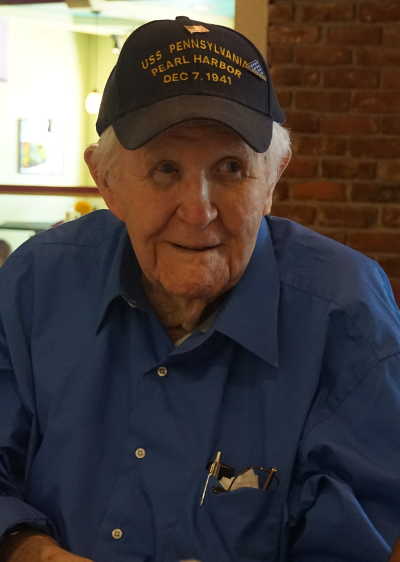
Up until a few years ago, he was a regular at Renee’s Cafe in Lakeport, where he liked to stop in for breakfast, wearing a Pearl Harbor ball cap.
What future generations think about Pearl Harbor was important to him.
He and another Pearl Harbor survivor, Henry Anderson, were on hand in June 2012 as remaining members of the Lake County Pearl Harbor Survivors Association in order to present a $10,000 check to the Lakeport Rotary to fund maintenance on the association’s memorial mast in Library Park. The event is commemorated in the video below.
Slater said at that time that they wanted people to remember what Dec. 7, 1941, was all about.
He was a firm believer in luck, which he felt had a lot to do with the course of his life – including surviving Pearl Harbor, marrying a good woman and leading what was, from all appearances, a contented existence.
Even as his health declined, Slater remained optimistic, unworried and grateful.
“I have everything I need and sometimes too damn much,” he said.
In recalling those lost in the war so many years ago, Slater wisely said, “I know one thing for sure – we owe a hell of a debt to all of the guys who are no longer with us. They're the real heroes.”
And, in truth, so was he.
Email Elizabeth Larson at
LAKEPORT, Calif. – The Lakeport City Council started off the new year by finalizing an ordinance to govern commercial marijuana activities in the city.
The half-hour meeting on Tuesday night dealt primarily with the new ordinance and with mayoral appointments on a variety of committees and boards.
Following a brief discussion, the council gave unanimous approval to the second and final reading of the ordinance governing commercial operations for marijuana, or cannabis. The ordinance and its accompanying staff report begin on page 13 of the agenda packet below.
The new rules had been the focus of extensive work by a working group of city staffers and council members as well as the Lakeport Planning Commission, which met numerous times throughout the fall to dig into the specifics of how the city would regulate recreational commercial use, which begins this year under state law.
The council held a lengthy discussion of the ordinance at its Dec. 19 meeting, at which it took comments from community members, the majority of whom had concerns about commercial marijuana activities. The primary request was not to allow storefront operations, especially in the city’s historic downtown.
At the Dec. 19 meeting, the council made several key changes to the proposed ordinance, including limiting cannabis retailer activities to delivery only, removing the restriction that cannabis retailers be limited to the possession of a maximum of 5 pounds of dried cannabis, eliminating the provision limiting the number of cannabis retailers within the city to two, removing the reference limiting storefront cannabis retailers to 1,500 square feet of retail area as all retail activities are now prohibited within the city, removing the reference limiting storefront cannabis retailers to 50 square feet or 10 percent of total retail area (whichever is less) for the display of cannabis paraphernalia and similar items as all retail activities are now prohibited within the city, and prohibiting retail cannabis delivery within the C2 zoning district.
Under the new rules, cannabis retail is now limited to the C3 and Industrial zoning districts only.
During public input Tuesday night, the council heard from retired Lakeport businessman Rick Kemp, who urged them to accept the ordinance.
Citing the billions in marijuana sales estimated to take place across the state, Kemp said the city needed to get in on the resulting sales tax revenue, which he suggested will help fund city improvements.
City Planning Commissioner Michael Green thanked the council for considering the ordinance. “A historic moment is upon us. We've never done this in the city of Lakeport.”
He acknowledged that cannabis has complicated issues of background checks and buffer zones. Pulling licenses for businesses and keeping them will be “crazy hard.”
Green added, “The ultimate goal is to make this a safer community,” and to tackle issues with cannabis consumption.
Councilman Kenny Parlet asked staff about the license renewal process and a provision for submitting an annual report, and if reminders would be sent so businesses don’t get shut down for inadvertently missing a deadline.
Community Development Director Kevin Ingram said staff keeps a master index to help it track of those issues. City Manager Margaret Silveira said it would be like how the city sends out renewal notices for business licenses.
Parlet thanked the staff, planning commission and the working group for all of the effort put into the new rules. “This was not an easy thing.”
Mayor Mireya Turner asked to have added to the “whereas” section of the ordinance a reference to AB 133, which the governor signed into law in September. The bill allows for a single physical location to hold multiple commercial cannabis license types, subject to local ordinances. AB 133 was considered an important fix to the state’s rules, which previously had required different commercial license types to have separate and distinct locations.
Parlet moved to approve the ordinance with Turner’s addition, with Councilman Tim Barnes seconding and the council voting 5-0. The final vote gained the council a round of applause from the small audience in attendance.
In other business, the council approved Turner’s appointments to act as liaisons to certain organizations and to act as council representatives on specific boards and committees. The council members also approved a resolution
The appointments are as follows:
– Lakeport Fire Protection District: Councilman Tim Barnes, liaison; Mayor Mireya Turner, alternate.
– Lake County Chamber of Commerce: Turner, liaison; Councilwoman Stacey Mattina, alternate.
– Lakeport Main Street Association: Councilman George Spurr.
– Lake County/City Area Planning Council (APC): Mattina and Councilman Kenny Parlet; Spurr, alternate.
– County of Lake Solid Waste Management Task Force: Spurr and Turner.
– SB 621 Indian Gaming Funds Committee: Spurr and Barnes.
– Local Agency Formation Commission: Parlet.
– Invasive Species Task Force Committee: Parlet.
– Clean Water Program Committee (formerly TMDL): Parlet.
– Lakeport Unified School District Committee: Mattina and Turner.
– Oversight Board of the Former Lakeport Redevelopment Agency: Mattina; Parlet, alternate.
– Lake County Abandoned Vehicle Abatement Service Authority: Parlet; Spurr, alternate.
– Lake County Airport Land Use Commission: Will appoint if needed.
The council also approved a resolution appointing Turner as voting delegate and Mattina as alternate to represent and vote on behalf of the city at the League of California Cities, Redwood Empire Division Business meetings and represent the city and vote at Division Legislative Committee meetings.
Email Elizabeth Larson at
010218 Lakeport City Council agenda packet by LakeCoNews on Scribd
LAKEPORT, Calif. – The Board of Supervisors started off the new year by electing its leadership for 2018, continued emergency proclamations and approved expediting the permit process for a fire-damaged property.
Outgoing Board Chair Jeff Smith led the election for the 2018 board chair and vice chair.
Supervisor Moke Simon moved to appoint Jim Steele, which was approved 3-0. Supervisors Tina Scott and Rob Brown were absent for the leadership votes. Brown arrived later in the meeting.
Steele nominated Scott for vice chair, which also was approved in a 3-0 vote.
Smith noted of the past year, “Again, we’ve done more with less,” and weathered another fire disaster.
Smith also nominated Steele as chair and Scott as vice chair of the Lake County Board of Equalization and the In-Home Supportive Services Authority.
In other news, the board continued proclamations of declarations of local emergencies pertaining to the Rocky, Jerusalem, Valley and Clayton fires, and the atmospheric river storm.
Administrative staff also gave the board an update regarding the Valley Fire Debris Insurance Collection Project, which as of Tuesday had collected 351 payments totaling $5,153,194. In the last month alone, it had received 33 payments totaling $579,488. It also has received 326 certifications of noncoverage for those who didn’t have insurance.
In other business, Water Resources Director Phil Moy asked the board for support to expedite the permitting process for the emergency placement of a stone rubble wall at Holiday Island Mobile Home Park.
“Holiday Island Mobile Home Park was severely affected by the Sulphur fire,” said Moy, adding that it wasn’t just the mobile homes that burned but also the park’s wooden retaining walls.
He asked to expedite the county’s permitting process to coincide with permitting process for the US Army Corps of Engineers.
The goal, said Moy, is to get the new wall in place to retain whatever soil, sediment or fill is there, which already is starting to crumble into the lake. That will protect water quality.
The two county departments it impacts in particular are the Community Development Department for permitting and Water Resources for lakebed encroachment, Moy said.
Smith said the wind hits that property particularly hard and erosion can happen in a short amount of time. With rainy weather ahead, it’s a concern and needs to be a priority.
Steele asked about time frame. Moy said there is a meeting scheduled at the site this week, and he’s already contacted the head of the Sacramento US Army Corps of Engineers office, which is expediting the permit under its emergency procedure.
Moy said he didn’t necessarily need board approval but was seeking the board’s confirmation of the intent to move forward quickly on the project.
Smith moved to approve the request that all involved departments expedite the permitting process for the wall’s emergency placement based on findings including that it’s in the best interest of the public for drinking water and water quality to move it forward as fast as possible. County Counsel Anita Grant also suggested the motion include the action was necessary to avoid potential peril to public health.
The board approved the motion 4-0.
Email Elizabeth Larson atThis email address is being protected from spambots. You need JavaScript enabled to view it. . Follow her on Twitter, @ERLarson, or Lake County News, @LakeCoNews.
Outgoing Board Chair Jeff Smith led the election for the 2018 board chair and vice chair.
Supervisor Moke Simon moved to appoint Jim Steele, which was approved 3-0. Supervisors Tina Scott and Rob Brown were absent for the leadership votes. Brown arrived later in the meeting.
Steele nominated Scott for vice chair, which also was approved in a 3-0 vote.
Smith noted of the past year, “Again, we’ve done more with less,” and weathered another fire disaster.
Smith also nominated Steele as chair and Scott as vice chair of the Lake County Board of Equalization and the In-Home Supportive Services Authority.
In other news, the board continued proclamations of declarations of local emergencies pertaining to the Rocky, Jerusalem, Valley and Clayton fires, and the atmospheric river storm.
Administrative staff also gave the board an update regarding the Valley Fire Debris Insurance Collection Project, which as of Tuesday had collected 351 payments totaling $5,153,194. In the last month alone, it had received 33 payments totaling $579,488. It also has received 326 certifications of noncoverage for those who didn’t have insurance.
In other business, Water Resources Director Phil Moy asked the board for support to expedite the permitting process for the emergency placement of a stone rubble wall at Holiday Island Mobile Home Park.
“Holiday Island Mobile Home Park was severely affected by the Sulphur fire,” said Moy, adding that it wasn’t just the mobile homes that burned but also the park’s wooden retaining walls.
He asked to expedite the county’s permitting process to coincide with permitting process for the US Army Corps of Engineers.
The goal, said Moy, is to get the new wall in place to retain whatever soil, sediment or fill is there, which already is starting to crumble into the lake. That will protect water quality.
The two county departments it impacts in particular are the Community Development Department for permitting and Water Resources for lakebed encroachment, Moy said.
Smith said the wind hits that property particularly hard and erosion can happen in a short amount of time. With rainy weather ahead, it’s a concern and needs to be a priority.
Steele asked about time frame. Moy said there is a meeting scheduled at the site this week, and he’s already contacted the head of the Sacramento US Army Corps of Engineers office, which is expediting the permit under its emergency procedure.
Moy said he didn’t necessarily need board approval but was seeking the board’s confirmation of the intent to move forward quickly on the project.
Smith moved to approve the request that all involved departments expedite the permitting process for the wall’s emergency placement based on findings including that it’s in the best interest of the public for drinking water and water quality to move it forward as fast as possible. County Counsel Anita Grant also suggested the motion include the action was necessary to avoid potential peril to public health.
The board approved the motion 4-0.
Email Elizabeth Larson at
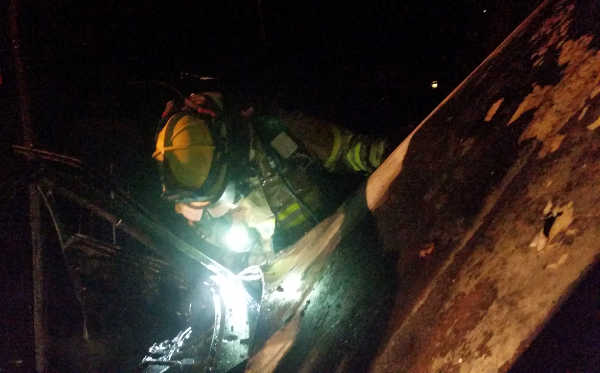
LUCERNE, Calif. – An early morning car fire may have been the result of arson.
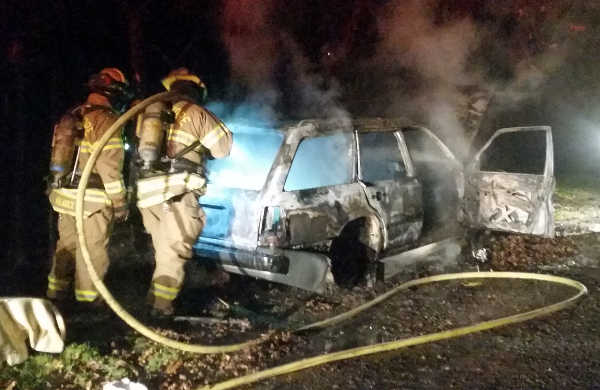
The fire in an alley between 12th and 13th avenues in Lucerne was first reported just after 1:30 a.m. Wednesday, according to radio reports.
Northshore Fire and the Lake County Sheriff’s Office responded to the incident.
The vehicle on fire was a station wagon that was on blocks, and had its license plates and VIN number removed. It appeared to have been set on fire intentionally, according to firefighters at the scene.
The car was directly beneath a tree, which also caught fire. A nearby fence additionally was reported to have been damaged.
Firefighters contained the blaze shortly after 2 a.m., and were on scene for another half hour for mop up.
John Jensen contributed to this report.
Email Elizabeth Larson at