LAKE COUNTY, Calif. – In May of 2017, about 114 Lake County High School seniors planned to attend institutions of higher learning to gain the much sought-after “college experience.”
These students have now completed their first semester in college and they’ve learned many lessons about what college truly is and how to succeed.
Lake County students Bryan Burkdoll, SammyJo Brassfield and Jordan Zabek shared some of the lessons they learned in their first semester of college.
One of the first things incoming freshmen learn is the importance of responsibility, which accounts for a great deal of one’s success, both in academics and in the dorm setting.
“Living with a roommate is a big change, you have to be more aware of everything you’re doing,” said Ethan Plettinck, a freshman at Baylor University. “There is really no one else to rely on besides yourself, in a way it's like a job. Feed yourself, clean your room and, of course, prepare for school.”
Plettinck has learned the important lesson that he is truly the only one responsible for his success and while at college he can only rely on himself.
Ethan Plettinck. Courtesy photo. Food is another important part of one’s college experience.
According to Middletown Christian School graduate Bryan Burkdoll, “The (dorm) food is good but it gets repetitive very quickly.”
Burkdoll, a mechanical engineering major and a freshman at LeTourneau University in Longview, Texas, has realized that one way to combat the monotony of cafeteria food is to have a stash of snacks in your dorm.
Sonoma State student Sammy Jo Brassfield suggested, “Always have snacks on hand, it gives you something to do while you work, keeps you awake, and then you don’t have to go anywhere.”
Snacks such as macaroni and cheese, Hot Pockets or the well-loved Top Ramen are perfect for a student tired of eating the same type of pizza for 11 days straight when studying for finals.
Of course, where you sleep and what you eat is only a fraction of the college experience.
Professors greatly affect the quality of one’s education and academic life. According to many students, communication is key.
Jordan Zabek. Courtesy photo. “My professors … have been really helpful and understanding. As long as you communicate and make yourself known to the professor, they will notice your efforts and do their best to help you succeed,” said Jordan Zabek, a graduate of Clear Lake High School who attends San Francisco State University.
Brandon Clemons is a freshman at Baylor University who has also had the privilege of being taught by great professors.
“The word that comes to mind when talking about my professors is approachable. They do a really good job at being available to see (students) outside of class, and communicating to us about changes that will occur in the learning environment.” Clemons said.
One of the most difficult parts of being a college student is moving away from home.
Brandon Clemons. Courtesy photo. Many students travel to the other side of the country to seek out their education. In situations such as these, it is important to rely on one’s resources and connections.
“One of the key ways to deal with the challenge of living away from home is realizing that you’re not alone in your isolation,” said Baylor freshman Noah Dellinger. "We’re gathered in a community in which everyone starts alone. … It’s crucial to reach out to others. Even if they don’t seem like they’re alone, talk to them. More than likely they feel the same as you.”
A student's first semester in college is a combination of excitement and terror, it’s a leap of faith that requires only the best of what one can offer.
Relying on loved ones back home and acting on the advice of others who have gone before is one of the simplest ways to ensure a successful college career.
Samuel Toback is from Middletown, where he attended Middletown Christian School. He is a journalism student at Baylor University in Waco, Texas.
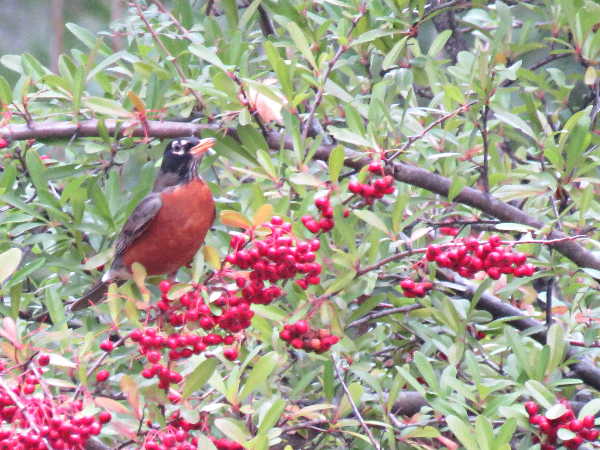
American robin dining on Toyon berries. Photo by Kathleen Scavone. "The sound of birds stops the noise in my mind."– Carly Simon
LAKE COUNTY, Calif. – Nature is the quintessential storyteller. Through her recurrent procession of seasons she tells us of the sagas of predator and prey, the succession of breeding and fruition.
Her ever-present themes of planetary progression, star-shine, moon phases and meteor showers are all daily or nightly dramas unfolding whether we choose to observe or not.
Within this bounty of stories that silently play all around us, we are most fortunate here in Lake County to witness a multitude of avian species that either make their homes here, or grace us with a fleeting observation during their annual migration.
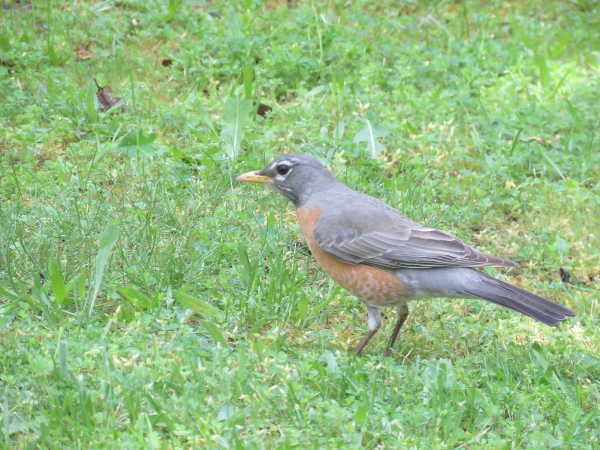
The American robin (Turdus migratorius), although a common bird, is, nonetheless a striking sight to behold.
Often seen after a rain, yanking up a juicy worm on the lawn, robins can be found around berry bushes as well.
These resourceful songbirds can be sighted dining on the bright red berries of the toyon bush. Toyon, native perennial shrub decorates the winter landscape with bright berries against leafy green leaves.
In fact, the toyon plant makes a good addition to gardens due to its drought tolerance. During summertime it displays delicate, white blooms. The toyon berry is a favorite of many berry loving birds, such as the varied thrush, turkey and pileated woodpecker.
The American robin definitely dominated the busy toyon bush when I was observing the comings and goings of the various birds in the vicinity of the bush.
Since the birds consume the berries whole and excrete the seeds unharmed in the process, they are great distributors of the plant. American robins wear a feather-coat of reddish-orange on their breast and grayish-brown heads and backs.
They are anywhere from 9 to 11 inches in length, with a wingspan of roughly a foot. They can be spotted hopping across the lawn, and then standing upright, looking proud.
They are found most everywhere, from yards, forests and woodlands to shrublands. They are active most of the day, with a diet of berries, bugs, grubs, earthworms and fruit. Their predators include snakes, hawks and cats.
These beautiful birds breed across North America all the way up to Alaska, and south to Mexico as well as Florida.
This popular songbird who sings both before and after a storm, is the state bird of three states: Wisconsin, Connecticut and Michigan.
Ornithologists have determined that the American robin has a number of calls, or songs which are quite complex. These vocalizations communicate calls to announce the presence of predators to the flock, to defend their nest during nesting season and at dawn when they arise.
Kathleen Scavone, M.A., is a retired educator, potter, writer and author of “Anderson Marsh State Historic Park: A Walking History, Prehistory, Flora, and Fauna Tour of a California State Park” and “Native Americans of Lake County.” She also formerly wrote for NASA and JPL as one of their “Solar System Ambassadors.” She was selected “Lake County Teacher of the Year, 1998-99” by the Lake County Office of Education, and chosen as one of 10 state finalists the same year by the California Department of Education.
LAKE COUNTY, Calif. – This week the county of Lake will begin holding a series of community visioning forums in an effort to solicit input from county residents on their priorities regarding government services and finances.
County Administrative Officer Carol Huchingson said the forums are meant to help the county government prioritize serves and financial needs in the face of difficult budgetary decisions that the county is facing.
The meetings are being held in the evenings to ensure that those who work can attend.
Residents are encouraged to come and share their ideas and ask their questions.
Each of the forums will be attended by the district’s supervisor: District 1, Moke Simon; District 2, Jeff Smith; District 3, Jim Steele; District 4, Tina Scott; and District 5, Rob Brown.
Also in attendance will be county administrators and department heads from major county government agencies.
The first forum, in Kelseyville, will take place at 7 p.m. Monday, Jan. 8, at Kelseyville Presbyterian Church, 5340 Third St.
That will be followed later in the week by the forum in Clearlake, which takes place at 7 p.m. Wednesday, Jan. 10, at the Clearlake Community Center, 3245 Bowers Ave., and the Northshore forum at 7 p.m., Thursday, Jan. 11, at Robinson Rancheria Hotel, 1545 Highway 20 in Nice.
Next week, the Lakeport forum will be held at 7 p.m. Wednesday, Jan. 17, at the Soper Reese Community Theater, 275 S. Main St.
The final forum in Middletown will be held the last week of the month. It will take place at 7 p.m. Monday, Jan. 29, at Twin Pine Event Center, 22223 Highway 29.
For more information, call the County Administrative Office, 707-263-2580, and ask for Matthew.
LAKE COUNTY, Calif. – Lake County Animal Care and Control has seven adult dogs ready for their new homes.
The dogs offered adoption this week include mixes of cattle dog and pit bull.
Dogs that are adopted from Lake County Animal Care and Control are either neutered or spayed, microchipped and, if old enough, given a rabies shot and county license before being released to their new owner. License fees do not apply to residents of the cities of Lakeport or Clearlake.
If you're looking for a new companion, visit the shelter. There are many great pets hoping you'll choose them.
The following dogs at the Lake County Animal Care and Control shelter have been cleared for adoption (additional dogs on the animal control Web site not listed are still “on hold”).
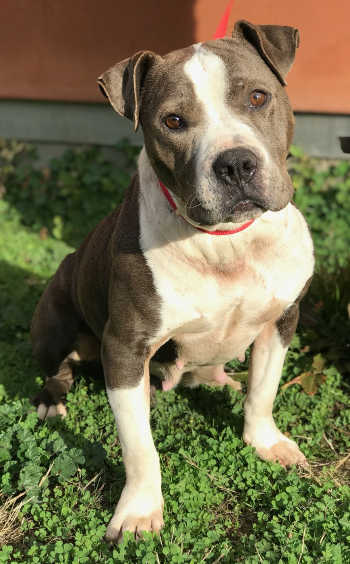
This male pit bull terrier is in kennel No. 6, ID No. 9173. Photo courtesy of Lake County Animal Care and Control. Male pit bull terrier
This male pit bull terrier has a short tri-colored coat.
He’s in kennel No. 6, ID No. 9173.
This female pit bull terrier is in kennel No. 10A, ID No. 9197. Photo courtesy of Lake County Animal Care and Control. Female pit bull terrier
This female pit bull terrier has a short gray and white coat.
She’s in kennel No. 10A, ID No. 9197.
This female pit bull terrier is in kennel No. 10B, ID No. 9198. Photo courtesy of Lake County Animal Care and Control. Female pit bull terrier
This female pit bull terrier has a short black and white coat.
She’s in kennel No. 10B, ID No. 9198.
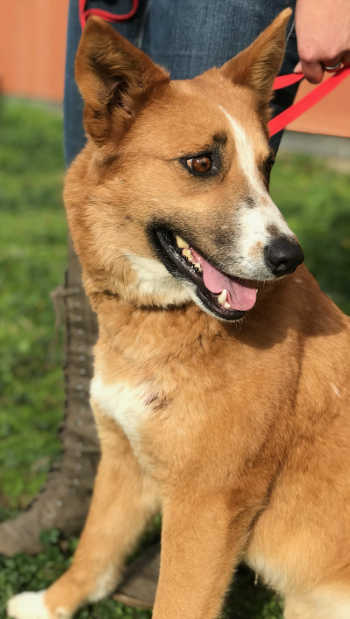
“Roxy” is a female cattle dog mix in kennel No. 18, ID No. 9196. Photo courtesy of Lake County Animal Care and Control. ‘Roxy’
“Roxy” is a female cattle dog mix.
She has a short brown coat with white markings.
She’s in kennel No. 18, ID No. 9196.
“Romeo” is a male pit bull terrier in kennel No. 19, ID No. 9075. Photo courtesy of Lake County Animal Care and Control. ‘Romeo’
“Romeo” is a male pit bull terrier.
He has a short gray and white coat.
He’s in kennel No. 19, ID No. 9075.
This male pit bull terrier is in kennel No. 27, ID No. 9201. Photo courtesy of Lake County Animal Care and Control. Male pit bull terrier
This male pit bull terrier has a short blue coat with white markings.
He’s in kennel No. 27, ID No. 9201.
This male pit bull terrier is in kennel No. 30, ID No. 9192. Photo courtesy of Lake County Animal Care and Control. Male pit bull terrier
This male pit bull terrier has a short tan coat.
He’s in kennel No. 30, ID No. 9192.
Lake County Animal Care and Control is located at 4949 Helbush in Lakeport, next to the Hill Road Correctional Facility.
Office hours are Monday through Friday, 11 a.m. to 5 p.m., and 11 a.m. to 3 p.m., Saturday. The shelter is open from 11 a.m. to 4 p.m. Monday through Friday and on Saturday from 11 a.m. to 3 p.m.
For more information call Lake County Animal Care and Control at 707-263-0278.
Email Elizabeth Larson at This email address is being protected from spambots. You need JavaScript enabled to view it.. Follow her on Twitter, @ERLarson, or Lake County News, @LakeCoNews.
For the first time, scientists have shown through direct satellite observations of the ozone hole that levels of ozone-destroying chlorine are declining, resulting in less ozone depletion.
Measurements show that the decline in chlorine, resulting from an international ban on chlorine-containing manmade chemicals called chlorofluorocarbons, or CFCs, has resulted in about 20 percent less ozone depletion during the Antarctic winter than there was in 2005 — the first year that measurements of chlorine and ozone during the Antarctic winter were made by NASA’s Aura satellite.
“We see very clearly that chlorine from CFCs is going down in the ozone hole, and that less ozone depletion is occurring because of it,” said lead author Susan Strahan, an atmospheric scientist from NASA’s Goddard Space Flight Center in Greenbelt, Maryland.
CFCs are long-lived chemical compounds that eventually rise into the stratosphere, where they are broken apart by the Sun’s ultraviolet radiation, releasing chlorine atoms that go on to destroy ozone molecules.
Stratospheric ozone protects life on the planet by absorbing potentially harmful ultraviolet radiation that can cause skin cancer and cataracts, suppress immune systems and damage plant life.
Two years after the discovery of the Antarctic ozone hole in 1985, nations of the world signed the Montreal Protocol on Substances that Deplete the Ozone Layer, which regulated ozone-depleting compounds. Later amendments to the Montreal Protocol completely phased out production of CFCs.
Past studies have used statistical analyses of changes in the ozone hole’s size to argue that ozone depletion is decreasing.
This study is the first to use measurements of the chemical composition inside the ozone hole to confirm that not only is ozone depletion decreasing, but that the decrease is caused by the decline in CFCs.
The study was published Jan. 4 in the journal Geophysical Research Letters.
The Antarctic ozone hole forms during September in the Southern Hemisphere’s winter as the returning sun’s rays catalyze ozone destruction cycles involving chlorine and bromine that come primarily from CFCs.
To determine how ozone and other chemicals have changed year to year, scientists used data from the Microwave Limb Sounder, or MLS, aboard the Aura satellite, which has been making measurements continuously around the globe since mid-2004.
While many satellite instruments require sunlight to measure atmospheric trace gases, MLS measures microwave emissions and, as a result, can measure trace gases over Antarctica during the key time of year: the dark southern winter, when the stratospheric weather is quiet and temperatures are low and stable.
The change in ozone levels above Antarctica from the beginning to the end of southern winter — early July to mid-September — was computed daily from MLS measurements every year from 2005 to 2016.
“During this period, Antarctic temperatures are always very low, so the rate of ozone destruction depends mostly on how much chlorine there is,” Strahan said. “This is when we want to measure ozone loss.”
They found that ozone loss is decreasing, but they needed to know whether a decrease in CFCs was responsible. When ozone destruction is ongoing, chlorine is found in many molecular forms, most of which are not measured.
But after chlorine has destroyed nearly all the available ozone, it reacts instead with methane to form hydrochloric acid, a gas measured by MLS. “By around mid-October, all the chlorine compounds are conveniently converted into one gas, so by measuring hydrochloric acid we have a good measurement of the total chlorine,” Strahan said.
Nitrous oxide is a long-lived gas that behaves just like CFCs in much of the stratosphere. The CFCs are declining at the surface but nitrous oxide is not.
If CFCs in the stratosphere are decreasing, then over time, less chlorine should be measured for a given value of nitrous oxide.
By comparing MLS measurements of hydrochloric acid and nitrous oxide each year, they determined that the total chlorine levels were declining on average by about 0.8 percent annually.
The 20 percent decrease in ozone depletion during the winter months from 2005 to 2016 as determined from MLS ozone measurements was expected.
“This is very close to what our model predicts we should see for this amount of chlorine decline,” Strahan said. “This gives us confidence that the decrease in ozone depletion through mid-September shown by MLS data is due to declining levels of chlorine coming from CFCs. But we’re not yet seeing a clear decrease in the size of the ozone hole because that’s controlled mainly by temperature after mid-September, which varies a lot from year to year.”
Looking forward, the Antarctic ozone hole should continue to recover gradually as CFCs leave the atmosphere, but complete recovery will take decades.
“CFCs have lifetimes from 50 to 100 years, so they linger in the atmosphere for a very long time,” said Anne Douglass, a fellow atmospheric scientist at Goddard and the study’s co-author. “As far as the ozone hole being gone, we’re looking at 2060 or 2080. And even then there might still be a small hole.”
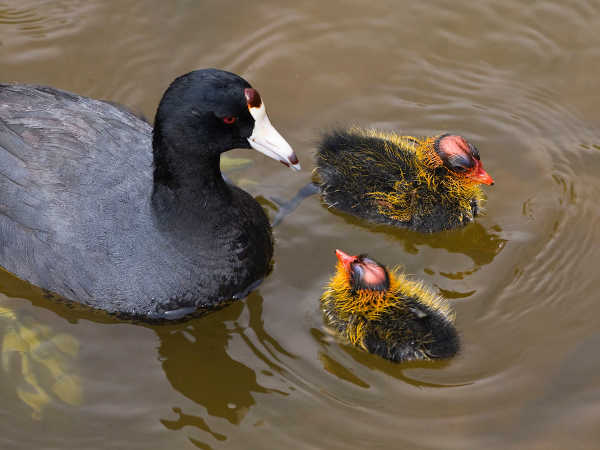
Coots can sometimes be brutal to their offspring, initially choosing favorites based on “chick ornaments,” those bright yellow-orange feathers that pop out at all angles like a fright-wig on the heads and necks of their chicks. The chick with the most bling, gets the most food. Public domain photo from Wikimedia Commons by Mike Baird.
NORTHERN CALIFORNIA – If you’ve been anywhere that has some kind of water habitat associated with it, you’ve no doubt seen the black American Coot (Fulica Americana) – and usually in large numbers.
A relative of rails, the coot is one of the most widespread and easily recognizable water birds in the state.
The females are slightly smaller than the males, and the males have more feathers on their head (their “ruff”) which they display in battle with other males.
Otherwise the sexes look alike: black or very dark grey bodies, yellow legs, and a stark white bill and forehead (the frontal shield) which has a dark red spot on the top of it between the eyes.
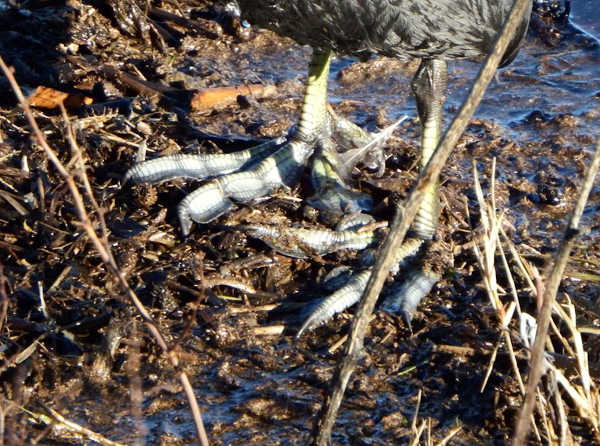
Their most remarkable feature, though, is their feet. Rather than having webbing between their toes like a duck, coots have blue-green toes with long movable lobes on them. The lobes help to push the coots through the water, but flatten down when the bird is on land, so they don’t interfere with its walking.
Both attributes are handy for the coot who spends time both in and out of the water on a regular basis.
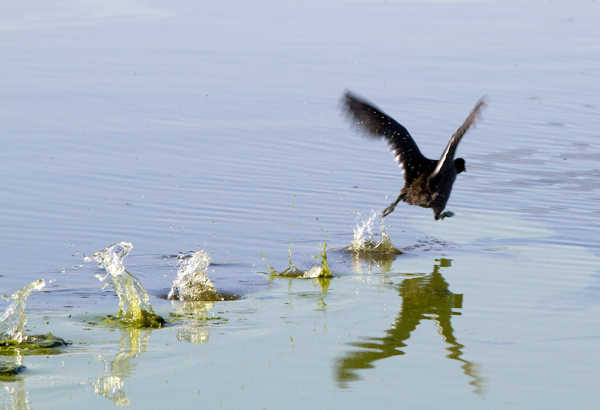
Taking off from the water is particularly cumbersome for coots. They have to flap their wings vigorously while they run across the top of the water for several feet before they can manage any kind of lift. Public domain photo from Wikimedia Commons by Greg Hume. Coots both dabble and dive for food in the water, and although they eat a variety of aquatic plants they will also graze on land for grains and terrestrial foliage like oak leaves and grasses.
Coots aren’t vegetarians, however; they also eat insects, snails and crayfish, small fish, tadpoles and salamanders. I once saw a coot trying to gobble up the pink entrails of another bird that had been downed by a hawk and fallen into the water.
Coot behavior is also varied. Often characterized as “grumpy and pugnacious,” real life Angry Birds, coots will aggressively defend their courtship and nesting platforms from interlopers, often rearing up in the water and smacking an opponent with their large lobed feet.
An aggravated coot will also sometimes try to force a rival onto its back, push it down under the surface of the water in an attempt to drown it.
Additionally, the females are known to be conspecific (“same species”) brood parasites: they will lay their eggs in the nests of other coots whenever the opportunity arises.
Coots can also be rather brutal to their offspring, initially choosing favorites based on “chick ornaments,” those bright yellow-orange feathers that pop out at all angles like a fright-wig on the head and neck of their chicks.
The chick with the most bling, gets the most food … Usually. Sometimes, however, if a runty chick with fewer ornaments demonstrates to its parents that it’s tough enough to survive even if it’s half-starved and its bigger siblings pick on it, the parents will do an about-face and make the runt their favorite, lavishing it with food and attention at the expense of the others in the brood.
On the plus side, coots are monogamous; they mate for life. And they are gregarious birds over the winter months when they’re not breeding, tolerating the closely proximity of neighbors, often forming into flocks that can number into the hundreds.
They will also cooperate with one another when danger is present. It’s not unusual to see coots group together into “covers” (on land) or “rafts” (in the water) in order to confuse and evade predators.
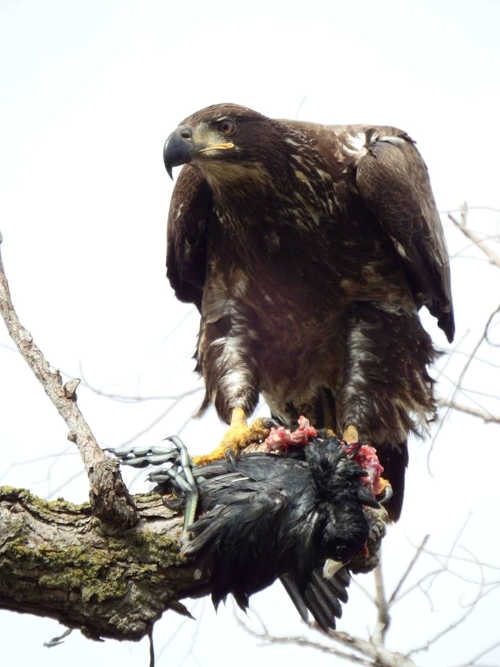
The coot’s remarkable lobe-toed feet help to push the coots through the water, and the lobes flatten down when the bird is on land, so they don’t interfere with its walking. Photo by Mary K. Hanson. I’ve witnessed flocks of coots form large rafts in the water and then swim as a synchronized unit, like a school of fish, this way and that along the surface, in response to the presence of bald eagles – one of the coots’ most fearsome predators. (Studies have indicated, in fact, that about 80 percent of a bald eagle’s diet is coot meat.)
Coots can fly, but usually only for short distances and somewhat low to the ground with their feet dangling – rather like chickens.
Taking off from the water is particularly cumbersome for them. They have to flap their wings vigorously while they run across the top of the water for several feet before they can manage to get any kind of lift. It’s during this kind of clumsy take-off that they are often open to attack.
One predator coots don’t have to worry too much about, though, is humans. Since coot meat is considered inedible – some say it tastes “swampy” – it’s not sought after by hunters.
And that can help the coots live longer than many of their waterfowl brethren, up to about 24 years in the wild.
Mary K. Hanson is a Certified California Naturalist, author and nature photographer. She will be co-teaching a naturalist course for the public through Tuleyome in early 2018. Tuleyome is a501(c)(3) nonprofit conservation organization based in Woodland, Calif. For more information, visit www.tuleyome.org.
One of the coots’ major predators is the bald eagle, like the one-year-old eagle seen in this photo. Studies have indicated, that about 80 percent of a bald eagle’s diet is made up of coots. Photo by Mary K. Hanson.
 How to resolve AdBlock issue?