 How to resolve AdBlock issue?
News
Enveloping our planet and protecting us from the fury of the Sun is a giant bubble of magnetism called the magnetosphere.
It deflects most of the solar material sweeping towards us from our star at 1 million miles per hour or more.
Without the magnetosphere, the relentless action of these solar particles could strip the Earth of its protective layers, which shield us from the Sun’s ultraviolet radiation.
It’s clear that this magnetic bubble was key to helping Earth develop into a habitable planet.
Compare Earth to Mars – a planet that lost its magnetosphere about 4.2 billion years ago. The Solar wind is thought to have stripped away most of Mars’ atmosphere, possibly after the red planet’s magnetic field dissipated.
This has left Mars as the stark, barren world we see today through the ‘eyes’ of NASA orbiters and rovers. By contrast, Earth’s magnetosphere seems to have kept our atmosphere protected.
Eftyhia Zesta of the Geospace Physics Laboratory at NASA’s Goddard Space Flight Center notes, “If there were no magnetic field, we might have a very different atmosphere left without life as we know it.”
Understanding our magnetosphere is a key element to helping scientists someday forecast space weather that can affect Earth’s technology. Extreme space weather events can disrupt communications networks, GPS navigation, and electrical power grids.
The magnetosphere is a permeable shield. The solar wind will periodically connect to the magnetosphere forcing it to reconfigure. This can create a rift, allowing energy to pour into our safe haven. These rifts open and close many times daily or even many times hourly. Most of them are small and short-lived; others are vast and sustained. With the Sun’s magnetic field connecting to Earth’s in this way, the fireworks start.
Zesta said, “The Earth’s magnetosphere absorbs the incoming energy from the solar wind, and explosively releases that energy in the form of geomagnetic storms and substorms.”
How does this happen? Magnetic lines of force converge and reconfigure, resulting in magnetic energy and charged-particles flying off at intense speeds.
Scientists have been trying to learn why this crisscrossing of magnetic field lines – called magnetic reconnection – triggers such a violent explosion, opening the rifts into the magnetosphere.
NASA’s Magnetospheric Multiscale Mission, or MMS, was launched in March 2015 to observe the electron physics of magnetic reconnection for the first time. Bristling with energetic particle detectors and magnetic sensors, the four MMS spacecraft flew in close formation to areas on the front side of Earth's magnetosphere where magnetic reconnection occurs. MMS has since been conducting a similar hunt in the magnetosphere’s tail.
MMS complements missions from NASA and partner agencies, such as THEMIS, Cluster, and Geotail, contributing critical new details to the ongoing study of Earth’s magnetosphere.
Together, data from these investigations not only help unravel the fundamental physics of space, but also help improve space weather forecasting.
For more on the active space that surrounds Earth, stay tuned to http://science.nasa.gov.
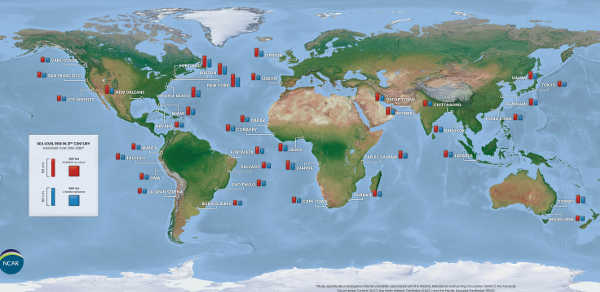
BOULDER, Colo. — Coastal cities worldwide would face a reduced threat from sea level rise if society reduced greenhouse gas emissions, with especially significant benefits for New York and other U.S. East Coast cities, new research indicates.
The study, by scientists at the National Center for Atmospheric Research, or NCAR, used a powerful computer model to tease out the ways that winds and currents in a warming world push ocean water around, lifting it in some regions and lowering it in others.
A larger version of the map show above is available here.
The scientists examined how these variations in sea level rise would change under two conditions: if emissions continue on their current trajectory, or if they are sharply reduced.
The results showed that, if society can implement cuts soon on emissions of carbon dioxide and other heat-trapping gases, the projected increases in sea level around the globe would be significantly less toward the end of the century.
This would help coastal cities in much of the world as they try to fend off rising waters, with the benefits most pronounced for cities on parts of the Atlantic and Indian oceans.
"Mitigating greenhouse gases will reduce sea level rise later this century, with some regions seeing especially significant benefits," said NCAR scientist Aixue Hu, the lead author of the new study. "As city officials prepare for sea level rise, they can factor in the compounding effect of local conditions, which are due to the winds and currents that cause internal variability in the oceans."
Hu and his co-author, NCAR scientist Susan Bates, caution that the modeling study presents an incomplete picture, because it does not include runoff from melting ice sheets and glaciers – two factors that scientists are just now incorporating into computer models.
Instead, it simulates the influence of climate change on variations in sea level worldwide to reveal which coastlines will benefit most from emission reductions associated with the additional heat absorbed by the ocean.
The study, published this month in the journal Nature Communications, was funded by the U.S. Department of Energy and by the National Science Foundation, which is NCAR's sponsor.
Global changes with local impacts
Sea level rise is one of the most consequential impacts of climate change, threatening to swamp low-lying islands and major coastal cities.
Sea levels in some regions are expected to rise by several feet by the end of this century, due to a combination of melting ice sheets and glaciers (which account for about two-thirds of sea level rise) along with thermal expansion, or ocean waters expanding as they warm (which accounts for the remaining one-third).
To study how changes in emissions would affect global sea level rise and local variations, Hu and Bates used two sets of computer simulations that are based on two different greenhouse gas scenarios.
In the business-as-usual scenario, with emissions from human activity continuing to increase at current rates, global temperatures by late this century would rise by about 5.4 degrees Fahrenheit (3 degrees Celsius) over late 20th century levels. In the moderate mitigation scenario, with society taking steps to reduce greenhouse gases, warming would be held to about 3.2 degrees F (1.8 degrees C).
The scientists found that reducing greenhouse gas emissions would not significantly restrain sea level rise for the next two decades.
The reason, in part, has to do with the inertia of the climate system (once heat enters the oceans, it is retained for a period of time).
In addition, winds and currents are naturally variable from year to year, pushing ocean water in different directions and making it hard to discern the full impact of planet-scale warming over the span of a decade or two.
But the scientists found that later in the century, from 2061 to 2080, reduced emissions would have a significant impact across almost the entire world.
The simulations showed that the extent of mean global sea level rise from thermal heat expansion (but not runoff from melting ice) was reduced by about 25 percent, from about 17.8 centimeters (7 inches) in the business-as-usual scenario to 13.2 centimeters (5.2 inches) in the moderate mitigation scenario.
Locally, winds and currents make a difference
For some cities, the benefits of the lower-emission scenario would be especially significant. New York City, where sea levels this century are expected to rise more than almost anywhere else in the world, would see a difference of 9.8 centimeters (3.9 inches). Other cities that would see a greater-than-average reduction include Boston (9.3 cm/3.7 in), London (8.3 cm/3.3 in), Dar es Salaam (6.8 cm/2.7 in), Miami (6.5 cm/2.6 in/), and Mumbai (5.8 cm/2.3 in).
On the other hand, some cities in South America (such as Buenos Aires), Asia (such as Bangkok and Jakarta), Australia (such as Melbourne), and the west coast of North America (such as Vancouver and San Francisco) would see lower-than-average benefits.
And reducing greenhouse gases would have no statistically significant effect on sea level rise along the western coasts of Australia and the Philippines.
The reason for the local differences in sea level rise has to do with the influence (or lack thereof) of a changing climate on major currents and on atmosphere-ocean interactions around the globe.
In the northern Atlantic, for example, warming temperatures are expected to weaken the Gulf Stream that transports warmer water from the subtropics to the Arctic. The powerful current draws water away from much of the east coast of the United States, and scientists have warned that a weakening current would send those waters back toward the coastline and significantly raise sea levels. If actions taken by society resulted in reduced emissions, the Gulf Stream would be less affected and, therefore, sea level rise in the north Atlantic would be less substantial.
In contrast, the currents in some other ocean basins appear to be less sensitive to climate change. Across much of the Pacific, for example, sea levels are influenced by the Pacific Decadal Oscillation, a phenomenon related to winds and sea surface temperatures.
Although climate change is affecting winds and causing sea surface temperatures to rise in the Pacific, it is not disrupting currents there as much as it is in the northern Atlantic.
As a result, climate change mitigation that reduces thermal expansion would generally have a less significant effect on Pacific sea levels.
The study also found greater variations in future sea level rise in different regions, including some cities where local sea levels are influenced by the Pacific Decadal Oscillation or by an Atlantic climate pattern known as the North Atlantic Oscillation. As a result, the projected sea level rise in the model varied more for London and Tokyo than for New York.
"City planners in some places will be able to make decisions based on more certain sea level projections, but for other places it's going to be more difficult to know what the sea levels will be," Bates said.
LAKEPORT, Calif. – The county of Lake is preparing to begin a major capital improvement project that has been years in the making.
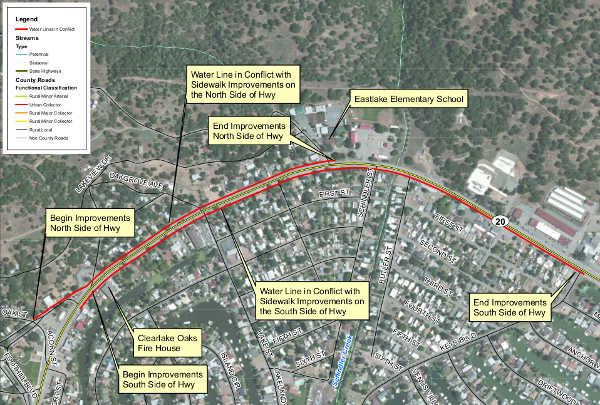
Beginning on Monday, and continuing through Oct. 26, the Safe Routes to School sidewalk project will be under way in Clearlake Oaks.
The construction of improved sidewalks will require restricted traffic along Highway 20 from Foothill Boulevard to Keys Boulevard from 7 a.m. to 3:30 p.m. Monday through Friday, according to the Lake County Public Works Department.
The complicated planning for the project has been going on for about a decade, according to Public Works Director Scott De Leon, who on Tuesday gave the Board of Supervisors a final update before construction starts.
The county secured funding for the project through the state and federal Safe Routes to School Programs in 2010, De Leon said in his memo to the board.
His memo for the meeting said the project was put out to bid in 2017, with the construction contract awarded to Granite Construction in September and the construction contract suspended for the winter.
De Leon’s memo also explained that the project’s scope includes curb, gutter and sidewalk improvements on the north side of Highway 20 from Foothill (near the Center Plaza) to High Valley Road and the East Lake Elementary School, and on the south side of the highway from the Clearlake Oaks Fire Station to Keys Boulevard.
De Leon reported on Tuesday that, at that point, despite the best efforts of the Clearlake Oaks County Water District, it had not been able to secure funding to improve or relocate some of its pipe infrastructure in the path of the new sidewalk, curb and gutter that the project will install.
“In a perfect world, the pipes are upgraded prior to the sidewalk but our funding source, as you’re aware, is expiring in September,” De Leon said.
That funding – which came from the California Department of Housing and Community Development’s Community Development Block Grant Program, or CDBG – has already been extended once, and so the county isn’t eligible for an additional extension, he said.
De Leon said that means that when the water district is able to move forward on its improvements, it will have to pay more.
In 2016, the Board of Supervisors directed staff to move forward on the project. De Leon said Tuesday’s update was to make sure the board understood the ramifications of work starting on Monday.
He said that in the 24 hours ahead of the meeting, county staff had worked directly with the water district’s design consultant and made good progress on issues including moving lateral service lines out of the construction footprint and other concerns the district had about the project.
Instead of discussing the issues with the water district, De Leon said that, with construction set to start, he wanted to focus on “the big picture.”
Though certainly not ideal, De Leon said one option was to not build the project. However, he said the board needed to understand that the funding sources have provided a lot of money so far for design and environmental work, and that they would want reimbursement for the many hundreds of thousands of dollars the county has received for the design work. The contractor also will want his profit.
While not building is an option, De Leon said it was expensive, and he didn’t recommend it.
County Administrative Officer Carol Huchingson said that so far the county has spent about $1 million on the project, about $280,000 of which had been reimbursed.
De Leon said Public Works staff already was working on the project in 2010, the year he came to work for the county.
For the people asking why it has taken so long, De Leon explained, “We have significant cultural resources in this corridor,” and the county has spent a lot of time and money getting environmental approvals.
He said Caltrans didn’t help any by overlaying the highway after the county had all the topographical work done and most of the design completed. “We basically had to start all over again with the designs.”
It’s also been a challenging project both from the design aspect as well as size. “It’s one of our larger capital improvement projects that we have done,” said De Leon, noting that it has a lot of moving parts, partners and utilities.
He added that he couldn’t overstate the importance or significance of the cultural resources in that area.
Board Chair Jim Steele said there are several thousand years of history there. He said he was glad the tribes were involved, and they had not held the project up any more than necessary due to the cultural resources’ significance.
“So it’s a huge project and it’s going to be a really big plus for the Clearlake Oaks community,” said Supervisor Jeff Smith, also noting, “It’s a huge amount of sidewalk.”
Smith said the water district has known for a long time that the project is going to happen and that it just needs to get done. He said abandoning the project would be a huge disservice to Clearlake Oaks.
Steele said all of the project’s pieces are lined up as well as they can be.
During public comment, Clearlake Oaks County Water District General Manager Alan Gardner said he appreciated De Leon’s cooperation and the progress they made in the previous 24 hours.
Gardner said they have had issues with communication over time and have worked to clean that up, and were working to clear their infrastructure issues on the south side of the highway, which is the portion of the project that involves the Community Development Block Grant money.
Email Elizabeth Larson at
LAKE COUNTY, Calif. – The Lake County Child Care Planning Council, administered through the Lake County Office of Education, has announced the nominees for the 2018 Early Childhood Educator Awards.
There are over 100 nominations, which includes 61 different nominees in nine different categories.
The winners will be announced during the Early Childhood Educator Awards dinner on May 4 at the Mt. Konocti Winery in Kelseyville.
Angela Cuellar-Marroquin, Lake County Office of Education's Child Care Planning Council Coordinator, explained the importance of these awards. “It’s a time that we recognize the hard work that the early educators do each and every day. Early education is the foundation of a successful academic career.”
“Research shows that quality early childhood education is associated with higher measures of early language and math development, preparing our youngest members of Lake County for kindergarten,” said Lake County Superintendent of Schools Brock Falkenberg.
This year’s nominees are listed below.
Alana Bowman
Aldo Rodriguez
Alejandra Ferguson
Amber Bishop
Amy Buchholz
Ana Rosa Montañez
Anellely Pantoja Guzman
Angie Galvani
Autumn Sparkman
Belinda Sanders
Blanca Mejia
Brian Merrier
Chelsea Ballew
Cherry McCracken
Cinthia Garcia
Connie Hodges
Crystal Davis
Darcie Jordan
Denise Briggs-Villalobos
Erika Alvarado
Erika Cacho
Heather Wichlaz
Jacqueline Martinez
Jacqui Joyce
Jami White
Janell Pike
Jessie Ralls
Jody Mederos
Jordan O’Hollaran
Kara Kile
Katrina Hickey
Keely Noble
Kim Beall
Kim Gentle
Letty Lopez
Lisa Gabazia
Louisa Nonato
Margie Mitten
Marilu Garcia
Martha Rose
Martyna Blissky
Mary Prather
Maryellen Bowman
Medina DeCosta
Megan McDonald
Melanie Sneathen
Nancy Eufracio
Nicole Biggs
Rachael Ferguson
Rachel Cumpston
Rosa Lopez
Rosa Mora
Sam Mucks
Savannah Koppenhauer
Shawna Sullivan
Shirley Littleton
Silvia Lopez
Slobodanka Toshcich
Stephanie Garcia
Tiffany Morris
Vanessa Goodrich
Cuellar-Marroquin was thrilled with the depth of this year’s nominees. “I’m especially excited that so many Family Child Care homes were nominated. We really enjoy being able to recognize those small businesses around the lake that are providing licensed child care in their homes.”
This year’s theme for the awards dinner is “Live. Love. Travel. Education is our passport to adventure.”
There is no cost to attend for the nominees and one guest each, and there is no cost to attend if you work or are studying to work in the early childhood education industry.
You must register on Eventbrite before April 15, 2018. All other guests may purchase tickets for $25 on Eventbrite.
For more information, you can go to www.lakecoe.org/calendar.
There are over 100 nominations, which includes 61 different nominees in nine different categories.
The winners will be announced during the Early Childhood Educator Awards dinner on May 4 at the Mt. Konocti Winery in Kelseyville.
Angela Cuellar-Marroquin, Lake County Office of Education's Child Care Planning Council Coordinator, explained the importance of these awards. “It’s a time that we recognize the hard work that the early educators do each and every day. Early education is the foundation of a successful academic career.”
“Research shows that quality early childhood education is associated with higher measures of early language and math development, preparing our youngest members of Lake County for kindergarten,” said Lake County Superintendent of Schools Brock Falkenberg.
This year’s nominees are listed below.
Alana Bowman
Aldo Rodriguez
Alejandra Ferguson
Amber Bishop
Amy Buchholz
Ana Rosa Montañez
Anellely Pantoja Guzman
Angie Galvani
Autumn Sparkman
Belinda Sanders
Blanca Mejia
Brian Merrier
Chelsea Ballew
Cherry McCracken
Cinthia Garcia
Connie Hodges
Crystal Davis
Darcie Jordan
Denise Briggs-Villalobos
Erika Alvarado
Erika Cacho
Heather Wichlaz
Jacqueline Martinez
Jacqui Joyce
Jami White
Janell Pike
Jessie Ralls
Jody Mederos
Jordan O’Hollaran
Kara Kile
Katrina Hickey
Keely Noble
Kim Beall
Kim Gentle
Letty Lopez
Lisa Gabazia
Louisa Nonato
Margie Mitten
Marilu Garcia
Martha Rose
Martyna Blissky
Mary Prather
Maryellen Bowman
Medina DeCosta
Megan McDonald
Melanie Sneathen
Nancy Eufracio
Nicole Biggs
Rachael Ferguson
Rachel Cumpston
Rosa Lopez
Rosa Mora
Sam Mucks
Savannah Koppenhauer
Shawna Sullivan
Shirley Littleton
Silvia Lopez
Slobodanka Toshcich
Stephanie Garcia
Tiffany Morris
Vanessa Goodrich
Cuellar-Marroquin was thrilled with the depth of this year’s nominees. “I’m especially excited that so many Family Child Care homes were nominated. We really enjoy being able to recognize those small businesses around the lake that are providing licensed child care in their homes.”
This year’s theme for the awards dinner is “Live. Love. Travel. Education is our passport to adventure.”
There is no cost to attend for the nominees and one guest each, and there is no cost to attend if you work or are studying to work in the early childhood education industry.
You must register on Eventbrite before April 15, 2018. All other guests may purchase tickets for $25 on Eventbrite.
For more information, you can go to www.lakecoe.org/calendar.
LAKE COUNTY, Calif. – Several Easter egg hunts to help children celebrate the season will take place this weekend, with an appearance of the Easter Bunny also planned.
The following is a list of Easter egg hunt events.
Saturday, March 31
Annual Clearlake Easter egg hunt
CLEARLAKE – The First Assembly of God will host its annual Easter egg hunt from 9 a.m. to 2 p.m. at Austin Park, 14077 Lakeshore Drive.
The event is free, and includes free hot dogs, face painting and games.
Easter Eggstravaganza
MIDDLETOWN – Twin Pine Casino will hold its Easter Eggstravaganza from 11 a.m. to 2 p.m.
The free community event will include Easter baskets (while supplies last), a jump house and a photo with the Easter Bunny.
Twin Pine Casino is located at 22223 Highway 29.
Upper Lake annual Easter egg hunt
UPPER LAKE – Upper Lake’s annual Easter egg hunt will take place beginning at 1 p.m. at the Upper Lake Middletown School field, 725 Old Lucerne Road.
Bring your own basket and join the fun.
Sunday, April 1
Kelseyville Presbyterian Church Easter egg hunt
KELSEYVILLE – Kelseyville Presbyterian Church’s 10 a.m. Easter service will be followed by an Easter egg hunt for the children, and coffee and refreshments for the adults in Friendship Hall.
Kelseyville Presbyterian Church is located at 5340 Third St., behind Westamerica Bank in Kelseyville. For more information, call the church office at 707-279-1104.
Lakeport Christian Center Easter egg hunt
LAKEPORT – Lakeport Christian Center’s 10:30 a.m. Sunday Easter service will be followed by an Easter egg hunt for all the children.
The public is invited and welcome at all services and activities at Lakeport Christian Center.
The church is located near the fairgrounds at 455 S. Forbes St. For more information call 707-263-4514, or visit www.lcchub.com or www.facebook.com/lcconline .
First Lutheran Church Easter egg hunt
LUCERNE. – First Lutheran Church’s 11 a.m. Easter service will be followed by a lunch and an Easter egg hunt for the children at 1 p.m.
First Lutheran Church is located at 3863 Country Club Drive. For more information call 707-274-5572.
Lakeport Rotary Club Easter egg hunt
LAKEPORT – The 93rd annual Lakeport Rotary Easter Egg Hunt will take place rain or shine at the Lake County Fairgrounds, 401 Martin St. It is free to the public.
Gates open at 1:15 p.m. with the hunt to begin promptly at 1:30 p.m. Everyone is urged to be in place early because the hunt takes place quickly.
The annual hunt, ongoing since 1926, will feature 2,880 hidden eggs, plus 300 “special pay” eggs.
There are three age groups: birth to age 3, ages 4 to 8, and ages 9 to 12.
The following is a list of Easter egg hunt events.
Saturday, March 31
Annual Clearlake Easter egg hunt
CLEARLAKE – The First Assembly of God will host its annual Easter egg hunt from 9 a.m. to 2 p.m. at Austin Park, 14077 Lakeshore Drive.
The event is free, and includes free hot dogs, face painting and games.
Easter Eggstravaganza
MIDDLETOWN – Twin Pine Casino will hold its Easter Eggstravaganza from 11 a.m. to 2 p.m.
The free community event will include Easter baskets (while supplies last), a jump house and a photo with the Easter Bunny.
Twin Pine Casino is located at 22223 Highway 29.
Upper Lake annual Easter egg hunt
UPPER LAKE – Upper Lake’s annual Easter egg hunt will take place beginning at 1 p.m. at the Upper Lake Middletown School field, 725 Old Lucerne Road.
Bring your own basket and join the fun.
Sunday, April 1
Kelseyville Presbyterian Church Easter egg hunt
KELSEYVILLE – Kelseyville Presbyterian Church’s 10 a.m. Easter service will be followed by an Easter egg hunt for the children, and coffee and refreshments for the adults in Friendship Hall.
Kelseyville Presbyterian Church is located at 5340 Third St., behind Westamerica Bank in Kelseyville. For more information, call the church office at 707-279-1104.
Lakeport Christian Center Easter egg hunt
LAKEPORT – Lakeport Christian Center’s 10:30 a.m. Sunday Easter service will be followed by an Easter egg hunt for all the children.
The public is invited and welcome at all services and activities at Lakeport Christian Center.
The church is located near the fairgrounds at 455 S. Forbes St. For more information call 707-263-4514, or visit www.lcchub.com or www.facebook.com/lcconline .
First Lutheran Church Easter egg hunt
LUCERNE. – First Lutheran Church’s 11 a.m. Easter service will be followed by a lunch and an Easter egg hunt for the children at 1 p.m.
First Lutheran Church is located at 3863 Country Club Drive. For more information call 707-274-5572.
Lakeport Rotary Club Easter egg hunt
LAKEPORT – The 93rd annual Lakeport Rotary Easter Egg Hunt will take place rain or shine at the Lake County Fairgrounds, 401 Martin St. It is free to the public.
Gates open at 1:15 p.m. with the hunt to begin promptly at 1:30 p.m. Everyone is urged to be in place early because the hunt takes place quickly.
The annual hunt, ongoing since 1926, will feature 2,880 hidden eggs, plus 300 “special pay” eggs.
There are three age groups: birth to age 3, ages 4 to 8, and ages 9 to 12.

LAKEPORT, Calif. – The Lake County Sheriff’s Office said that a Lakeport man is under investigation for fatally stabbing his father and also injuring his mother early Thursday morning.
Steven Michael Fredericks, 48, was taken into custody not long after deputies arrived at the scene, as Lake County News has reported.
Lt. Corey Paulich told Lake County News that the two victims are Steven Fredericks’ parents, David Mackenzie Fredericks, 72, and Judy Ann Fredericks, 71.
Sheriff’s deputies responded to a report of a stabbing in the 6300 block of Lyons Road in the unincorporated area of Lakeport just after 6:30 a.m., Paulich said.
Witnesses told deputies that Steven Fredericks had assaulted family members at the location, and when they arrived the deputies found David Fredericks dead from apparent stab wounds, according to Paulich.
Judy Fredericks suffered lacerations to her neck that did not appear to be life-threatening. Paulich said she was taken to Sutter Lakeside Hospital for treatment.
Paulich said Steven Fredericks ran into the woods with a knife before the deputies got on scene, but he later came out and surrendered to deputies.
He said Fredericks had lacerations to his wrists that did not appear to be life-threatening and he also was taken to Sutter Lakeside Hospital for treatment.
Major Crimes Unit responded to process and investigate the scene early Thursday, Paulich said.
Paulich indicated that the investigation is continuing.
Email Elizabeth Larson at