KELSEYVILLE, Calif. – At approximately 3:07 p.m. on Wednesday, March 21, what for some people in Lake County will be remembered as a historic moment occurred: The sale of Konocti Harbor Resort and Spa was recorded in the Lake County Recorder’s Office.
Konocti Harbor has been shuttered since the fall of 2009, and hopes for its reopening and rebirth have been a consistent theme amongst the resort’s longtime fans as well as local businesses and government that benefited from the economic engine that it was for the county.
Even before Konocti Harbor closed, potential buyers had come and gone, each with a vision to revitalize the resort, infuse millions of dollars into its renovation and give a momentous boost to Lake County’s economy.
Those hopes were strongest as Lake County took a pounding in the Great Recession.
Now, with the county building back and having the best employment rates in 30 years, there’s more hopeful news: The resort is under the ownership of a Bay Area group that says it wants to be part of the community, help jumpstart a new round of economic growth and be a good partner.
They have in their hands what is considered to be one of Lake County’s premier and most prized properties.
A spokesman for the buyers released a statement to Lake County News giving some initial details of the plans for the property.
Clear Lake Resort Services LLC, a limited liability corporation registered with the Secretary of State’s Office in January, is reported as the purchaser of the property, according to Russ Hamel, Konocti Harbor’s new managing director.
Hamel revealed that the resort will begin a two- to five-year phased undertaking that will include new construction and upgrades to many of the existing facilities.
The initial renovation phase, Hamel said, will focus on the waterfront area with new docks and slips, a fuel depot, boat storage and a marina supply retail shop.
New studio suites will replace the older waterfront hotel units, and improved retail and restaurant venues that will highlight the main lodge will be added, Hamel reported.
Hamel said that, working with Lake County government officials, agencies and local businesses, the new owners plan to breathe life back into the resort.
He said visitors can look forward once again to a full-service vacation getaway next to the waters of Clear Lake with amenities for water sports, boating, dining and quality entertainment.
The families behind the purchase
While Hamel said Clear Lake Resort Services LLC is Konocti Harbor’s new owner, that LLC differs from the names on the grant deed recorded for the property on March 21.
The grant deed shows the purchasers as Shekou Management LLC, the 50-percent owner, with Andy and Zaida Saberi holding 30 percent and their son, attorney Thomas Saberi, the remaining 20 percent.
State business records show that the Joe and Heidi Shekou Family Trust is listed as Shekou Management LLC’s sole manager or director.
The Saberis own a number of transportation and petroleum businesses, primarily based in the Bay Area, according to state business records.
Hamel did not respond to questions about the new Clear Lake Resort Services LLC, whose agent for service is listed as Thomas Saberi, but such entities are commonly used to hold real estate investments.
Joe Shekou is a Bay Area real estate developer who, along with his wife, Heidi, came to the United States in 1978 with their two small children as refugees from the Iranian revolution, according to an online post by their son-in-law, Bob Herbst, who works with them.
The couple, who Herbst said trained in Iran as engineers, partnered with fellow Iranians to develop a mini storage and industrial park in San Rafael, and their real estate firm owns and manages other office and industrial space around the Bay Area.
The Shekous, who have been frequently featured on society pages in Bay Area publications, have over the past decade and a half met resistance from Marin County residents and environmental groups over planned developments such as a soccer complex they had proposed to build on land Joe Shekou owns near the San Rafael Airport.
In that case, he sued two activists for what he claimed was encroachment for building docks over his property line. The activists and their supporters in turn accused Shekou of filing the suit to silence them.
In December, the Shekous were among a group of property owners who sued the city of Richmond and Mayor Thomas Butt, alleging that he violated state law that protects against politicians' conflicts of interest by secretly working to block their project in what is known as the Freethy Industrial Park, where they had planned to build industrial and office space, restaurants and other facilities.
The city of Richmond has placed a moratorium on that proposed industrial park – which is part of a larger 100-acre area near the water and home to tidal marshes – while it looks at a general plan designation to change it to open space, parks and recreation, agriculture and public, cultural and institutional uses, according to the city’s Web site.
That suit also names gubernatorial candidate Gayle McLaughlin, a former Richmond mayor and councilwoman, as well as the current council members.
Another individual who has been named as a possible party in Konocti Harbor’s purchase is Kay Hakakian, based on court filings in relation to a federal lawsuit against the union which for decades owned the resort.
Hakakian is an East Coast-based businessman whose LinkedIn profile lists him as managing director for Sisko Enterprises LLC, an “investment vehicle for various start ups and other investments” as well as a managing director for Eurodesign group of Smolensk, Russia.
His background also includes a master’s degree in civil engineering from the University of Tehran and a PhD from the University of Paris, later working and teaching in Iran before coming to the United States.
With the grant deed not mentioning Hakakian, is it not yet clear from the Clear Lake Resort Services LLC filings with state officials whether he is still involved with the resort.
Separately, Hamel did not respond to a question from Lake County News about whether Hakakian remains part of the buyers group.
History and closure
Konocti Harbor Resort’s possible sale has been an almost-constant source of speculation and rumor since before its November 2009 closure.
The scale of the interest correlated to its local importance both economically and culturally.
It was owned for nearly six decades by Local 38 of the United Association of Plumbers, Pipefitters and Journeymen’s Lakeside Haven convalescent trust fund.
While the resort began as an affordable vacation spot for union members, its popularity grew to the point that it became a major Northern California vacation spot.
For decades, it had been Lake County’s only full-service lakeside resort, offering indoor and outdoor venues that were favorite concert spots not just for Lake County residents but for thousands of visitors to the county. It annual “Summerfest” series was a favorite, and at one time it also hosted the “Boardstock” extreme water sports event.
During the last five years the resort was open, it was the focus of a 2004 US Department of Labor lawsuit filed against Local 38.
In its suit the Department of Labor alleged that Local 38's current and former trustees violated federal law by diverting more than $36 million from retirement, health, scholarship, apprenticeship, and vacation and holiday funds to renovate and operate Konocti Harbor.
Department of Labor officials later told Lake County News after the suit’s settlement that the union had likely diverted millions more to the resort than the lawsuit stated, as Lake County News has reported.
The federal suit was settled in 2007. The settlement called for the union to repay the trust funds through proceeds earned from selling the resort.
When the suit was settled, Page Mill Properties of Palo Alto had been identified in court documents as a possible buyer for a reported amount of $25 million. That sale fell through, as did other potential sales over the next several years.
Despite the resort not selling, the Department of Labor confirmed to Lake County News that the union repaid the trust funds as it was required to do, which was restated in recently filed documents associated with the case.
Other individuals who were interested at various times in purchasing the resort included lobbyist and developer Darius Anderson, who now is a managing member of Sonoma Media Investments, which the Santa Rosa Press Democrat and the Sonoma Index-Tribune.
Before the federal lawsuit settled Anderson had been looking at the purchase, with his plans at that time reported to include Indian gaming as was reported at the time by Lake County News.
He pulled out of consideration after the Board of Supervisors passed an anti-gaming resolution in February 2007 related to the resort. The board rescinded that resolution in July 2008 at the request of longtime resort General Manager Greg Bennett, who asked the supervisors to be open to any and all potential buyers for the resort.
As a result of the federal court case, WhiteStar Advisors of Boca Raton, Fla., was appointed the resort’s independent fiduciary and tasked with overseeing its operations until it was sold.
In court documents filed earlier this month, James Bishop of WhiteStar Advisors stated that the company decided to close the resort in 2009 because of its inability “to operate profitably.”
“Although the closure was necessary to reduce the continuing losses attributable to the ownership of the property, it also has made its sale more difficult. Most buyers of resort properties prefer to purchase a resort with ongoing profitable operations. In addition, due to the shut down of Konocti, a number of its shuttered facilities have not received regular maintenance,” the document stated.
When Konocti Harbor closed on Nov. 11, 2009, laying off hundreds of employees, Lake County was still grappling with the impacts of the recession.
The closure of one of the county’s largest employers and one of its largest tax-revenue generators was a considerable blow to Lake County. In fact, transient occupancy tax rates in Lake County still have not recovered to pre-closure levels.
In the private sector, it had a long-term impact on other businesses that had also benefited from the resort’s events including smaller resorts, motels, vacation rentals, inns, as well as stores, restaurants, wine tasting rooms, marine businesses and even gas stations.
Following the closure, more potential buyers came forward, with the resort listed at high one point at $15 million.
One of the most promising potential buyers had appeared to be a partnership led by Resort Equities President Grant Sedgwick, who for nearly a year tried to acquire and redevelop Konocti Harbor Resort & Spa, with plans including a new hotel and fourplexes, renovations, removing some buildings and building new boat slips, and offering timeshare and fractional ownership units.
Sedgwick’s effort came to an end in May 2014 after he determined that acceptable financing for the resort's planned acquisition and $100 million redevelopment did not appear to be available.
Since 2015, Konocti Harbor has opened its doors to fire and flood survivors through agreements arranged through the county of Lake. Most recently, in October it offered additional accommodations to Sulphur fire survivors.
About two-dozen county residents displaced by flood and fire are reported to still be living there now, according to District 5 Supervisor Rob Brown.
Hamel did not respond to questions about the fire and flood survivors’ presence at the resort nor about reports of anticipated layoffs of existing staff at the resort.
A successful purchase effort
The documents submitted by WhiteStar to the federal court late in February give a timeline of how the successful purchase ultimately came about.
Based on the documents, the two men leading the effort on the purchasers’ side were Joe Shekou and Kay Hakakian.
A memorandum written by Bishop on Jan. 15 – but filed in February – explained: “On May 21, 2017, an agreement for the purchase and sale of the Konocti Harbor Resort and Spa was executed between Joe Shekou and Kay Hakakian, and the U.A. Local 38 Convalescent Trust, buyer and seller respectively. The contract purchase price was $7 million and the contract provided for a 120-day due diligence period. The purchase agreement also provided for a deposit in the amount of $100,000 which would be refundable during the due diligence period.”
The memo said the purchase agreement provided that the due diligence period could be extended up to 60 days upon once the initial $100,000 deposit was released and another deposit of the same amount was made with the escrow agent. “Prior to the execution of the purchase agreement, WhiteStar required the buyer to produce proof of adequate funds to close, and the buyer provided the required documentation.”
Bishop’s memo said that, prior to the expiration of the initial due diligence period, the proposed buyers notified WhiteStar that they would exercise the option to extend the due diligence period.
“A few days prior to the expiration of the extended due diligence period, the buyer notified WhiteStar it would not proceed with the transaction because upon completion of its inspection the buyer had determined the water and sewer treatment systems would require more work than anticipated for the buyer’s purpose and the property would require materially more in the way of upgrades and renovations than the buyer had anticipated,” Bishop wrote.
“Over the course of approximately two weeks, WhiteStar and the buyer strongly negotiated the points and the seller’s reluctance to entertain any price reduction. Eventually, the parties agreed to a reduced price of $5 million, in consideration of among other things: the work required on the water and sewer systems, the additional upgrades to the property overall to bring much of it to a condition where the facilities would meet current resort operating standards, the impact the recent massive fires have had on a large area around the property, the highly unlikely approval of Native American gaming on the property (a key element to many potential buyers), the fact that with respect to the previous purchase agreements no buyer has proceeded this far with the transaction, and the seller’s continuing carrying cost if the property had to be re-marketed,” the memo said.
At that point, Bishop said the closing of escrow was set for the end of February.
At the time of the 2007 consent decree issued in the federal suit, all of the parties anticipated that Konocti Harbor’s sale price would be at least $10 million, according to the court documents. “The sharp reduction in the value of Konocti over the past 10 years was not foreseen nor was it anticipated at the time the Consent Decree was entered into.”
After the court record on the case showing nearly five years of no filings, WhiteStar filed new documents in February and earlier this month seeking a modification to the consent decree because its terms are no longer feasible due to the change in market and reduced sale price.
Rather than having $4 million in sales proceeds go to both Local 38 and $6 million to its pension trust fund, the change in consent decree seeks to establish that all of the sales proceeds will now go to benefit the pension trust fund.
The documents stated that while WhiteStar had tried numerous times to sell Konocti Harbor, efforts that had failed due to factors the company said include that the market for resort properties in Lake County “declined markedly between 2007 and the present,” adding, “One of the largest impediments to the sale of Konocti is that it resides in a part of Lake County that has experienced enormous wildfire devastation over the course of the last few years.”
Ultimately, WhiteStar concluded that the $5 million sales price for Konocti Harbor is “fair and reasonable.”
Bishop’s statement said Shekou and Hakakian are independent third parties and have no relationship to the federal court case defendants.
The grant deed for Konocti Harbor – acquired by Lake County News from the Lake County Recorder’s Office – was signed by Bishop on March 9, the date of his last filing with the court.
It lists six parcels totaling 85.3 acres: 8710, 8727, 8770, 8780, 8790 and 8800 Soda Bay Road.
The assessor’s office gives the assessed net value of all of properties – including structures – as $13,784,833.
With the purchase now accomplished, Hamel has emphasized the buyers’ desire to be part of the Lake County community and to contribute to it.
“Collaborating with the local community and making a contribution to its economic vitality is important to us. Bringing more recreational and entertainment options to the area promotes tourism and creates much-needed employment and business opportunities,” said Hamel. “We’re excited to begin the revitalization of this iconic Lake County landmark; we’re fortunate to have the chance to work in this beautiful landscape.”
Email Elizabeth Larson at This email address is being protected from spambots. You need JavaScript enabled to view it.. Follow her on Twitter, @ERLarson, or Lake County News, @LakeCoNews.
LAKEPORT, Calif. – The Board of Supervisors is set to get updates on fire recovery and discuss a Safe Routes to School project on the Northshore.
The board will meet beginning at 9 a.m. Tuesday, March 27, in the board chambers on the first floor of the Lake County Courthouse, 255 N. Forbes St., Lakeport.
The meeting can be watched live on Channel 8 and online at https://countyoflake.legistar.com/Calendar.aspx. Accompanying board documents, the agenda and archived board meeting videos also are available at that link.
In timed items, at 9:10 a.m. the board will consider termination the proclamation of a local health emergency by the Lake County health officer, and get an update and hold a discussion on Sulphur fire recovery.
At 9:15 a.m. the board will get a status update on the Hoberg’s Valley fire cleanup.
Also on the agenda, at 9:30 a.m. the supervisors will discuss and consider giving direction to staff regarding the Clearlake Oaks Safe Routes to School Sidewalk Project, which is set to begin next week.
The full agenda follows.
CONSENT AGENDA
7.1 Approve right-of-way and temporary construction agreement with Digital Path Inc. on Buckingham Peak and authorize the chair to sign.
7.2: Approve Amendment No. 1 to the Agreement between the county of Lake and Modesto Residential LLC for adult residential support services and specialty mental health services for Fiscal Year 2017-18 for a decrease of $20,000 for a new contract maximum of $5,000 and authorize the board chair to sign the amendment.
7.3: Approve Amendment No. 2 to the agreement between the county of Lake and Crestwood Behavioral Health for adult residential support and specialty mental health services for Fiscal Year 2017-18 for an increase of $350,000 for a new contract maximum of $1,300,000 and authorize the board chair to sign the amendment.
7.4: Approve Amendment No. 1 to equipment repair and service contract between the county of Lake and Peterson Tractor Co. for an increased amount of $125,000 and authorize the chair to sign.
7.5: (a) Waive the formal bidding process, per Ordinance #2406, Purchasing Code 38.2, as it is not in the public interest due to the unique nature of goods or services; and (b) authorize the sheriff/coroner, assistant purchasing agent to issue a purchase order to Watchguard for 5 MAV's (Mobile Audio Video) in the amount of $32,255.
7.6: Approve the sealed bid award for the purchase of 47 portable radios to Motorola Solutions in the amount of $83,143.
7.7: (a) Approve first amendment to lease agreement between Ronn and Montie Westhart and the county of Lake for warehouse and workshop space at 15890 Kugelman St., Unit D, Lower Lake, extending the term through June 30, 2021, for an annual lease rate of $9,075 and authorize the chair to sign; (b) approve first amendment to lease agreement between Ronn and Montie Westhart and the county of Lake for warehouse and workshop space at 15890 Kugelman St., Unit 1, Lower Lake, extending the term through June 30, 2021, for an annual lease rate of $12,650 and authorize the chair to sign.
7.8: Adopt resolution authorizing the chairman of the board to approve and direct the tax collector to sell, at public auction via Internet, tax defaulted property which is subject to the power to sell in accordance with Chapter 7 of Part 6 of Division 1, of the California Revenue and Taxation Code and approving sales below minimum price in specified cases.
TIMED ITEMS
8.2, 9:10 a.m.: (a) Consideration of termination of a proclamation of a local health emergency by the Lake County health officer; and (b) update and discussion on Sulphur fire recovery.
8.3, 9:15 a.m.: Report/status update on Hoberg’s Valley fire clean-up.
8.4, 9:30 a.m.: Discussion and consideration of direction to staff regarding the Clearlake Oaks Safe Routes to School Sidewalk Project.
8.5, 10 a.m.: Presentation of annual report by Lake County PEG TV.
UNTIMED ITEMS
9.2: Presentation/discussion on trash issues in District 3 with possible direction to staff.
9.3: Consideration of revision to Personnel Rules 400 through 800 regarding county recruitment processes and applicable definitions in Rule 100.
CLOSED SESSIONS
10.1: 10:30 a.m., employee grievance complaint pursuant to Gov. Code sec. 54957.
10.2: Employee Disciplinary Appeal (EDA 16-04) pursuant to Gov. Code sec. 54957.
10.3: Conference with legal counsel: Decision whether to initiate litigation pursuant to Gov. Code sec. 54956.9(d)(4): County of Lake v. PG&E.
Email Elizabeth Larson at This email address is being protected from spambots. You need JavaScript enabled to view it.. Follow her on Twitter, @ERLarson, or Lake County News, @LakeCoNews.
CLEARLAKE, Calif. – Clearlake Animal Control is offering six dogs to new homes this week.
The available dogs are Evander, Ivy, Kira, Paco, Poppy and Robbie.
To meet the animals, call Clearlake Animal Control at 707-994-8201 and speak to Marcia at Extension 103 or call Extension 118, 9 a.m. to 3 p.m. Monday through Thursday, or leave a message at any other time.
“Evander.” Courtesy photo.
‘Evander’
“Evander” is a 1-year-old male Labrador Retriever mix who has an all-black coat and weighs about 45 pounds.
He is good with both children and adults, and shelter staff said they are currently working on his socializing skills.
Evander is healing nicely from wounds “inflicted by a female dog in heat when she denied his unwanted advances,” shelter staff reported.
“Ivy.” Courtesy photo.
‘Ivy’
“Ivy” is a 2- to 3-year-old female husky mix that weighs about 45 pounds.
She is good with other dogs and people.
An assessment of her found her energetic and wanting to play with other dogs, and also loving attention from people.
Her adopter will be offered four free sessions with a socialization playgroup.
“Kira.” Courtesy photo.
‘Kira’
“Kira” is a 2-year-old female Husky mix, weighing about 45 pounds.
Shelter staff said a dominating and assertive female, which is true to her breed. She responds well to other dogs and made appropriate corrections when necessary. She would be stable with other stable dogs.
Kira is very smart, sweet and vocal, and shelter staff suggested she would do best with an experienced husky household.
“Paco.” Courtesy photo.
‘Paco’
“Paco” is a 1- to 2-year-old male Chihuahua mix, weighing 12 pounds and with a short brown coat.
Shelter staff said he is good with other dogs, as well as older, respectful children. He is a little shy at first but warms up quickly. He may need a housetraining refresher.
“Paco would love to be an armchair companion, with a quick walk or two and his life would be complete,” according to staff. “He is fun-sized, making him an easy keeper.”
Paco is vaccinated and ready for adoption.
“Poppy.” Courtesy photo.
‘Poppy’
“Poppy” is a calm, lovable year-and-a-half-old shepherd mix, weighing 40 pounds.
She is good with other dogs; shelter staff said she is a dominant female and has taken corrections appropriately when introduced to or playing with other dogs.
They said she also is a little insecure and needs some confidence building; practicing skills will make her a good solid dog.
She is recommended for a home without small livestock.
“Robbie.” Courtesy photo.
‘Robbie’
“Robbie” is a young and happy-go-lucky mix – possibly Labrador Retriever and Rottweiler.
Shelter staff said is he around a year and a half old and weighs 50 pounds.
He walks well on a leash, makes friends with other dogs, and is playful but not super active.
Robbie is vaccinated, was neutered and had a full dental cleaning.
He recently was diagnosed with heartworm, so he is undergoing treatment. If adopted or taken to rescue, he will need a quiet place to recover.
Email Elizabeth Larson at This email address is being protected from spambots. You need JavaScript enabled to view it.. Follow her on Twitter, @ERLarson, or Lake County News, @LakeCoNews.
NORTH COAST, Calif. – The Sonoma County Sheriff’s Office reported that one of its deputies arrested a 65-year-old Cloverdale man for animal abuse after finding a dead horse and nearly a dozen other horses neglected and emaciated.
Joseph Rafael was arrested following an investigation that began last week, according to Sgt. Spencer Crum.
Crum said the sheriff’s office received a call on Wednesday when a neighbor reported that Rafael was boarding about a dozen horses on his property and they were in such bad shape that she started bringing them food sporadically and supplemental feeding them herself.
On Wednesday, when she went to Raphael’s property to feed his horses, she found one lying down deceased. The horse showed signs of emaciation and neglect, according to Crum’s report.
Crum said the deputy went to Rafael’s property, located in the 25800 block of River Road in Cloverdale, and noticed the dead horse had severe signs of malnourishment with bones showing through its skin. The deputy also found eleven other horses on the property standing in nearly knee high mud, some showing signs of malnourishment.
The deputy contacted Sonoma County Animal Control and together they contacted Rafael, who Crum said knew about the malnourished horses and the muddy conditions. He was trying different options to put weight on the animals but agreed that he would try harder to get them healthy.
The deputy then contacted neighbors and got statements that showed what Crum said was “a longtime pattern of under nourishing his animals.” The animal control officer took pictures of the malnourished horses to a local vet who gave an opinion that these horses were indeed underfed, emaciated and in immediate jeopardy.
The deputy and Sonoma County Animal Control worked with a non-profit called “CHANGE,” which stands for Coins to Help Abandoned and Neglected Equines, Crum said.
Together, they went back to Raphael’s home on Thursday where CHANGE volunteers were able to trailer the remaining 11 horses and move them to an appropriate shelter facility where they hope to be restored to full health, according to Crum.
Crum said the deceased horse was also taken for transport to UC Davis for a necropsy to determine a cause of death.
The deputy arrested Rafael and booked him on 12 counts of felony animal abuse. He has since been released on a $10,000 bail bond, Crum said.
A great blue heron is carrying a stick to its nest in Lake County, Calif. Courtesy photo.
LAKE COUNTY, Calif. – The Redbud Audubon Society will present its annual Heron Days boat tour event the last weekend in April and the first weekend in May with registration through the Society’s Web site to begin on March 31.
Planners of the event were concerned about the level of Clear Lake being high enough, but it was decided the lake level is sufficiently high to move forward with the event.
There may be some areas that will be inaccessible, but the main viewing areas for birds and wildlife should be fine, a spokesperson noted.
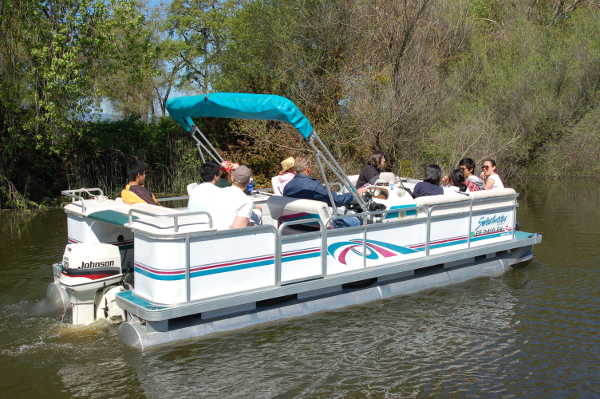
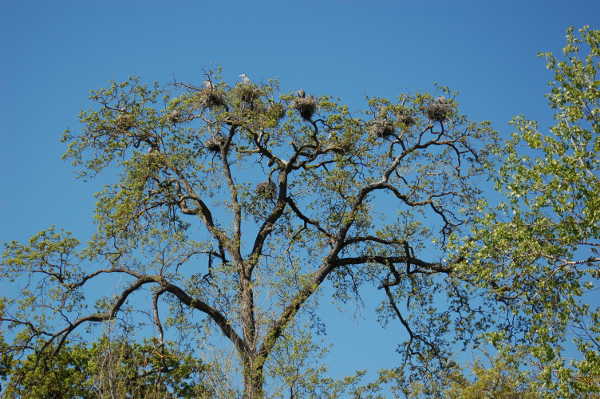
The Redbud Audubon Society has held this event for more than 20 years; it includes taking visitors on pontoon boats to different sites on Clear Lake to see nesting great blue herons, egrets, and double-crested cormorants.
Pontoon boats take visitors to fabulous wildlife areas on Clear Lake in Lake County, Calif. Courtesy photo.
Often seen on the boat rides are numerous other wildfowl, most notably the Western and Clarkes Grebes that often put on grand displays of “dancing,” across the water as part of their courtship ritual. Grebes too are often on their nests that are formed on tules along the shoreline in certain areas of the lake.
Boats are careful not to disturb wildlife and visitors are often treated to unexpected sightings such as otters, muskrats, and even bald eagles.
Last year the event was changed somewhat to increase the opportunity for participation for everyone by presenting the boat tours over two weekends. This was a successful approach and will be repeated.
The first weekend of boat tours will be held on April 28 and 29 with tours leaving from Lakeside County Park to view great blue heron rookeries and other areas of interest along the shoreline between the county park and south of Lakeport.
The following weekend, May 5 and 6, tours will leave from the Clear Lake Campground on Cache Creek (formerly Shady Acres Campground) and will visit a nesting site in Anderson Marsh State Park along Cache Creek as well as touring other areas of the marsh.
A juvenile bald eagle spotted on one Heron Days adventure in Lake County, Calif. Courtesy photo.
Boat tours will be leaving from 8 a.m. until 11 p.m. from both sites.
Registration and payment will be available at the Redbud Audubon Society Web site at www.redbudaudubon.org starting on March 31.
Boat tickets for an approximately 90 minute tour are $30 with well-behaved children age 8 and over welcome. No pets are allowed.
The Redbud Audubon Society is a local conservation organization that has been operating in Lake County for 40 years. The society holds monthly programs and field trips from September through May and has been presenting Heron Days for 22 years.
The public is cordially invited to take advantage of the fabulous opportunity to view the amazing wildlife on Clear Lake.
Herons on nests along the lakeshore on Clear Lake in Lake County, Calif. Courtesy photo.
A warning of polio at a home. Public domain image.
Poliomyelitis, or polio, has spread its malignant roots through every age of humankind.
The disease is older than recorded history, as much a part of what it means to be human as animal domestication and creating the written word.
In ancient Egypt, a grave marker dated to the second millennium B.C. depicts a priest with a crutch and a foot deformity commonly seen in patients with polio.
How many victims did polio claim between the dawn of recorded history and the modern era? It’s anyone’s guess, really. The ancients were so used to death and disease that it was futile to differentiate between one and the other.
Only in modern times have people felt the need to name the exact ailment that was in the process of killing them, as if calling it out reduced its danger.
Actually, it eventually did, and scientists began identifying diseases with the hope of curing them.
But it was a long process.
It took several thousand years for us to pinpoint polio and formally describe it in all its ghastly manifestations.
The first detailed case of the disease took place in 1773 when Sir Walter Scott, the Scottish poet, contracted it as a young boy.
His doctor at the time identified the ailment as a “teething fever,” but from detailed accounts describing his sickness, we can safely say it was in fact polio.
Sixteen years later, the English physician Michael Underwood provided the first clinical description of the disease.
Another half century went by before further descriptions were made and a detailed analysis conducted on the disease’s effect on the spinal cord.
It eventually received its name, Poliomyelitis.
The name itself describes its effects: it is derived from the Greek words for Gray and Marrow (referring to the spinal cord) and inflammation.
Polio frequently strikes the young, becoming endemic in the hot summer months. Most of its victims survive the ordeal without any permanent side effects, but others aren’t so lucky.
Such patients are left with permanent evidence of Polio’s malignant touch, in the form of partial or complete paralysis of the spine. In addition to spinal paralysis, the disease can cause paralysis of the lungs.
The first epidemic of polio in America occurred in 1894 in Vermont. From then on, the disease swept through cities every few years, becoming a macabre boogeyman for parents of young children to worry about.
The most visible historic case of the disease is of course President Franklin D. Roosevelt, who contracted polio in 1921.
For the rest of his life, FDR would be a benefactor for polio victims. In 1927, he formed the Warm Springs Foundation in Georgia, a rehabilitation center. A few years later, he organized a party on his birthday to raise funds to support the foundation.
In the depth of the Great Depression, celebrities and wealthy New York socialites attended these galas and gave freely of their money. By the time he became president, these birthday balls had become so successful, that he formed a national foundation: the National Foundation for Infantile Paralysis, now known as the March of Dimes.
FDR might be the most public victim of the disease, and the most prominent benefactor when we think about it today, but in reality, there were many others working to raise money for research and to support rehabilitation.
The march towards first dealing with, and then eradicating the disease began soon after the first major epidemics, but stalled shortly thereafter.
In 1908, a scientist identified the type of virus that caused polio. Two decades later, the iron lung was invented to help those patients suffering from lung paralysis.
Milestones in the study of viruses eventually played a pivotal role in finding the cure for the disease.
In 1931, Dr. William J. Elford developed a porcelain filter small enough to trap viruses. This also proved that viruses were solid particles, not liquid as had been suggested before. And so, bit by bit, discovery after discovery, the world came closer to eradicating this ancient disease.
By the 1930s, various teams of scientists were working to develop a vaccine for polio. In 1935, two such experiments ended with disastrous consequences, with many of the tests subjects contracting the disease and others dying.
World War II delayed any further extensive studies into Polio, but immediately after scientists were back on the track.
The man to finally meet with success was Dr. Jonas Salk. A research scientist at the University of Pittsburgh, Dr. Salk was able to grow an inactivated (dead), controlled form of the virus.
You see, like all vaccines and inoculations, the tested polio vaccines contained small amounts of the virus itself. These served to allow the patient’s immune system to overcome the enfeebled virus, thus growing immunity from future contractions.
On March 26, 1953, Dr. Salk announced to the world that he had successfully tested a polio vaccine. Within months, schoolchildren throughout the country were receiving the vaccinations.
Between 1955 and 1957, the cases of polio in the U.S. dropped 85 to 90 percent.
After millennia of suffering and centuries of fighting, we finally had a tool to eradicate the hurt and suffering of polio.
But the most extraordinary thing about this story?
When asked who held the patent on the vaccine, Dr. Salk replied, “Well, the people, I would say. There is no patent. Could you patent the Sun?”
Antone Pierucci is curator of history at the Riverside County Park and Open Space District and a freelance writer whose work has been featured in such magazines as Archaeology and Wild West as well as regional California newspapers.
An ancient Egyptian grave marker depicting a priest with what appears to be signs of polio. Public domain/Wikimedia Commons image, https://commons.wikimedia.org/wiki/File%3AAncient_Egyptian_polio_Roma2.jpg .
 How to resolve AdBlock issue?