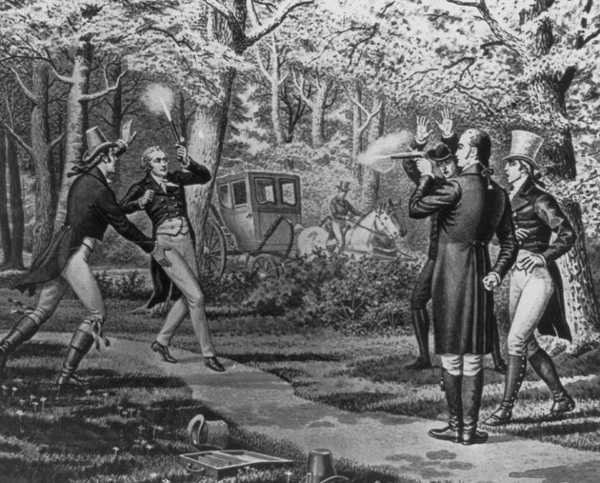
The duel between Alexander Hamilton and Aaron Burr. Public domain image.
It was the morning of July 11, 1804, and Aaron Burr Jr. awoke with a start.
The soft gray light of predawn bled through the wood shutters covering the windows, bringing with it the quiet sounds of his upscale New York City neighborhood.
Lying still on the couch he had fallen asleep on, America’s third vice-president mentally went over his daily schedule.
In reality, only one appointment occupied his mind: his 7 a.m. “interview” with an impertinent political rival.
His lips tightened into a stern line across his face.
With a sigh, he swung his legs to the floor and, elbows resting on his silk pants, the 48-year-old pushed back the lank mass of dark hair that receded from his forehead. He straightened his vest and picked off an errant piece of lint from the cuff of his bone-white shirt.
He usually didn’t sleep in his clothes, but then again he usually didn’t sleep on his couch. He was giddy with anticipation.
After a quick bite to eat and a strong cup of tea, he called for his carriage and set out towards the docks on the banks of the Hudson River. After a brief, clattering ride through the already-crowded streets, the carriage clattered to a stop in front of Burr’s aid and protégé William Van Ness.
The younger man had secured their transportation: a low wood skiff that rocked with the waves and bumped against the stone pier. Lowering themselves into the small boat, the two men shuffled unsteadily along the bench before settling down.
Burr stared blankly at the distant shore of New Jersey. He hated New Jersey. But then, he really didn’t like any place other than his home of New York. With an irritated flick of his wrist, he urged the oarsman to begin the journey across the still surface of the Hudson. No point in delaying the inevitable.
Meanwhile, along a different part of the New York City shore, near modern-day Wall Street, another party of men had just arrived at a different skiff.
At the head of this group was a short, delicate-looking man of middle age. Even in the relative warmth of a New York summer morning, this man’s face looked pale around the eyes and mouth, as if sapped of blood from cold. But his cheeks flushed a warm red, a color to match what remained of the red hair in his fast-greying mane.
His small stature and delicate features belied a fierce character and unwavering will. He wasn’t called the Little Lion for nothing. Joining this red-haired gentleman in the skiff were his physician Dr. David Hosack and his good friend Nathaniel Pendleton. With little more than an exchange of glances, his companions grabbed the oars and began the trek over the river towards New Jersey.
The plan, thoroughly sketched out and agreed upon by both parties, was for Burr to arrive first at 7 a.m., which he did with his usual promptness, his small skiff running aground and its occupants clambering out.
The site of the “interview” was an isolated ledge overlooking the river near Weehawken, New Jersey. This was a favorite site for “interviews” since the location was relatively isolated and inaccessible, deterring most who happened to see it from the river. After picking their way up the bank from the river, Burr and Van Ness walked out onto a ledge roughly 10-feet-wide and 40-feet-long.
The second party arrived just as Van Ness began to clear away brush and tall weeds from the grounds. Their journey across the river had been spent in animated conversation, the red-haired man running through his plans for the next week and his friends adding their two cents of advice.
When they had arrived at the site, the doctor stayed in the boat while the other two proceeded up the slope to the ledge. Pendleton stepped forward in front of his red-haired companion and conferred with Van Ness.
All of this was done with textbook formality. After all, there were specific rules for this sort of “interview.” Of course, this was no “interview,” at least not in the normal sense of the word. “Interview” was a euphemism.
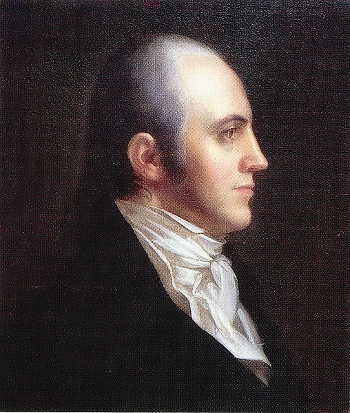
Aaron Burr. Public domain image.
This was to be a duel.
Once the particulars were sorted out, Pendleton and Van Ness directed their respective friends to the proper positions. Because he had made the initial challenge, Burr was not able to choose which side of the field he stood on (part of the rules).
Oddly, his opponent chose the side facing the rising sun. Not one to question good fortune, Burr settled himself into a standing position opposite.
With his right shoulder facing his opponent, Burr sucked in his stomach to try to create as small a target as possible. He hefted the weight of the flintlock dueling pistol. The two opponents faced each other across roughly 10 yards of sun-parched weeds and dirt.
Warily, the two opponents eyed one another, waiting for the signal to commence. More than two decades of animosity, fear, and political differences electrified the space, crystalizing these two enemies into a moment that defined a nation.
In a voice loud enough to carry over the wind that scoured the ledge, Pendleton shouted “PRESENT!” and the concussive retort of first one shot and then another ripped apart the tranquility of the morning. The red-haired gentleman had fired his own bullet first, but intentionally shot over Burr’s head. Burr, on the other hand, had more lethal intentions in mind.
The half-inch lead ball raced across the gap between the two men at a rate of roughly 1,000 feet per second. Weighing about as much as two modern quarters, the 52-caliber ball hit the man opposite Burr in the lower abdomen, just above the right hip.
Lead is a soft metal, a quality that made it gruesomely effective on this morning. As the bullet ricocheted off the victim’s second or third false rib it mushroomed out, expanding to nearly twice its original size and causing devastating damage to internal organs. Finally, the now deformed lead mass lodged in the man’s vertebrae.
A grunt, an exhale of breath, and the red-haired man collapsed. He was dying, he knew that when he hit the ground. When Dr. Hosack rushed up the hill from the boat and to his fallen friend, the dying man calmly informed him, “This is a mortal wound, doctor.”
Before the smoke from the pistols cleared, Burr realized that his opponent had never intended to shoot him. “Damn,” he thought and started forward towards him. We’ll never know what he hoped to say to the man he had just killed because before he reached him, Van Ness stopped Burr short and hurried him away from the scene.
The red-haired man, Alexander Hamilton, died later that day, surrounded by his family and friends.
Antone Pierucci is curator of history at the Riverside County Park and Open Space District and a freelance writer whose work has been featured in such magazines as Archaeology and Wild West as well as regional California newspapers.
Jules Stout, owner/director/teacher at Pine Summit Seedlings Preschool, and her daughter and student Cassidy, at the center’s play structure in Cobb, Calif. Courtesy photo.
LAKE COUNTY, Calif. – Pine Summit Seedlings Preschool, a family child care in Cobb, received a Tier 4 rating on the Quality Counts California matrix, which measures the quality of child care programs in California.
A Tier 5 rating is the highest achievable.
Pine Summit Seedlings Preschool is Lake County’s first family child care to be rated. In December 2017, eight Lake County Office of Education State Preschools each earned a Tier 4 rating.
The Quality Counts California matrix measures the effects of the Quality Rating and Improvement System, or QRIS, a voluntary statewide program introduced into Lake County in 2015 through the Lake County Office of Education, or LCOE.
The primary focus of QRIS is to enhance program quality for all children involved in participating child care programs, and focuses on providing information, resources, and support to early care and education programs, in a consistent, statewide manner.
Angela Cuellar-Marroquin, LCOE’s coordinator for the Lake County QRIS and the Child Care Planning Council, and her staff performed the rating.
Cuellar-Marroquin explained, “When a child care site chooses to participate, they go through a process of coaching, improving and rating.”
Each program participating in the QRIS program is rated on child development and school readiness, social and emotional development, effective teacher-child interactions, classroom environments, professional development, and family engagement.
Jules Stout is the owner, director and teacher at Pine Summit Seedlings Preschool. She opened the center in March 2016 after the Valley Fire, when she recognized there was a need for child care in the Cobb Mountain area after Sugar Pine Preschool was destroyed.
“Jules is extremely passionate in her desire to provide high quality care to the children in her program. She takes pride in her work and the service she provides to the families in her program,” said Angel Coppa, QRIS coach from LCOE.
Stout has a master’s degree in child development. She received the “Family Child Care Provider of the Year” award in 2016 at the Early Childhood Educator Awards, hosted by Lake County Child Care Planning Council, a program administered through LCOE.
Coppa added, “Jules is a committed early childhood educator and I look forward to continuing our work together in our second year of this partnership.”
“I am pleased that our QRIS program under the strong direction of Cuellar-Marroquin is being introduced to so many early childhood educators (ECE) in Lake County,” said Lake County Superintendents of Schools Brock Falkenberg says. “Research shows that quality ECE is associated with higher measures of early language and math development, preparing our youngest members of Lake County for kindergarten.”
If you would like more information about the Quality Rating and Improvement System or about joining the Child Care Planning Council, please contact Angela Cuellar-Marroquin, LPC/QRIS Coordinator at 707-262-4162 or via email at This email address is being protected from spambots. You need JavaScript enabled to view it..
Find out more about the Pine Summit Seedlings Preschool on Facebook.
LAKE COUNTY, Calif. – Lake County Animal Care and Control has a big group of handsome dogs ready for meet you.
Dogs available for adoption this week include mixes of border collie, boxer, heeler, husky, German Shepherd, Labrador Retriever, mastiff, pit bull, shepherd and spaniel.
Dogs that are adopted from Lake County Animal Care and Control are either neutered or spayed, microchipped and, if old enough, given a rabies shot and county license before being released to their new owner. License fees do not apply to residents of the cities of Lakeport or Clearlake.
If you're looking for a new companion, visit the shelter. There are many great pets hoping you'll choose them.
The following dogs at the Lake County Animal Care and Control shelter have been cleared for adoption (additional dogs on the animal control Web site not listed are still “on hold”).
This young male border collie is in kennel No. 11, ID No. 10334. Photo courtesy of Lake County Animal Care and Control. Male border collie
This young male border collie has a short black and white coat.
He’s in kennel No. 11, ID No. 10334.
This young male shepherd-husky mix is in kennel No. 18, ID No. 10379. Photo courtesy of Lake County Animal Care and Control. Shepherd-husky mix
This young male shepherd-husky mix has a short brown and black coat.
He is in kennel No. 18, ID No. 10379.
This male spaniel-border collie mix is in kennel No. 19, ID No. 10380. Photo courtesy of Lake County Animal Care and Control. Spaniel-border collie
This male spaniel-border collie mix has a black and white coat.
He’s in kennel No. 19, ID No. 10380.
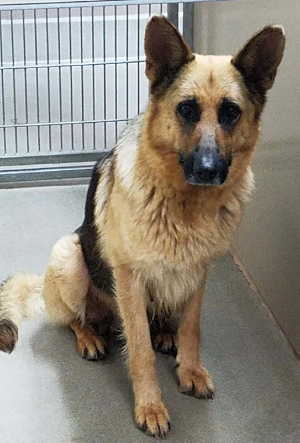
This young female German Shepherd is in kennel No. 20, ID No. 10378. Photo courtesy of Lake County Animal Care and Control. German Shepherd
This young female German Shepherd has a short black and brown coat.
She’s in kennel No. 20, ID No. 10378.
This male border collie-heeler is in kennel No. 21, ID No. 10414. Photo courtesy of Lake County Animal Care and Control. Border collie-heeler
This male border collie-heeler has a medium-length black and tan coat.
He is in kennel No. 21, ID No. 10414.
This female boxer is in kennel No. 24, ID No. 10337. Photo courtesy of Lake County Animal Care and Control. Female boxer
This female boxer has a short brown and white coat.
She’s in kennel No. 24, ID No. 10337.
This male pit bull terrier is in kennel No. 25, ID No. 10377. Photo courtesy of Lake County Animal Care and Control. Pit bull terrier
This male pit bull terrier has a short blue and white coat.
He’s in kennel No. 25, ID No. 10377.
This male mastiff mix is in kennel No. 26, ID No. 10191. Photo courtesy of Lake County Animal Care and Control. Male mastiff mix
This male mastiff mix has a short tan and white coat.
He’s in kennel No. 26, ID No. 10191.
This male mastiff mix is in kennel No. 27, ID No. 10192. Photo courtesy of Lake County Animal Care and Control. Male mastiff mix
This male mastiff mix has a short tan and white coat.
He’s in kennel No. 27, ID No. 10192.
“Yogi” is a male Labrador Retriever-pit bull mix is in kennel No. 31, ID No. 10082. Photo courtesy of Lake County Animal Care and Control. ‘Yogi’
“Yogi” is a male Labrador Retriever-pit bull mix with a medium-length brown and black coat.
He already has been neutered.
He’s in kennel No. 31, ID No. 10082.
“Lala” is a female German Shepherd in kennel No. 32, ID No. 10420. Photo courtesy of Lake County Animal Care and Control. ‘Lala’
“Lala” is a female German Shepherd with a brown and black coat.
She’s in kennel No. 32, ID No. 10420.
“Kumo” is a male pit bull terrier in kennel No. 34, ID No. 10424. Photo courtesy of Lake County Animal Care and Control. ‘Kumo’
“Kumo” is a male pit bull terrier with a short blue and white coat.
He’s in kennel No. 34, ID No. 10424.
Lake County Animal Care and Control is located at 4949 Helbush in Lakeport, next to the Hill Road Correctional Facility.
Office hours are Monday through Friday, 11 a.m. to 5 p.m., and 11 a.m. to 3 p.m., Saturday. The shelter is open from 11 a.m. to 4 p.m. Monday through Friday and on Saturday from 11 a.m. to 3 p.m.
For more information call Lake County Animal Care and Control at 707-263-0278.
Email Elizabeth Larson at This email address is being protected from spambots. You need JavaScript enabled to view it.. Follow her on Twitter, @ERLarson, or Lake County News, @LakeCoNews.
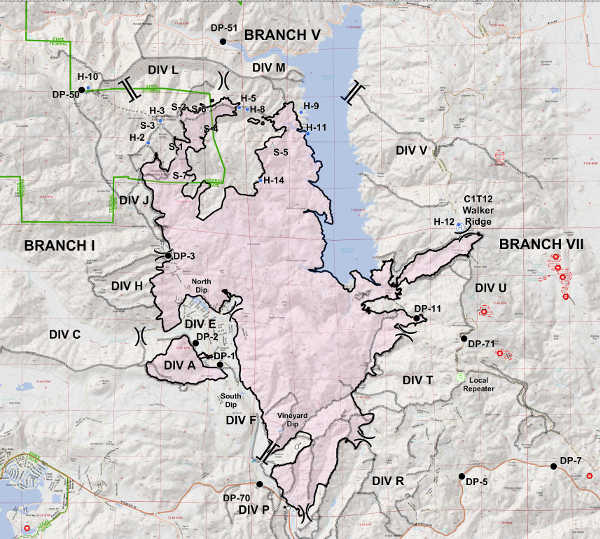
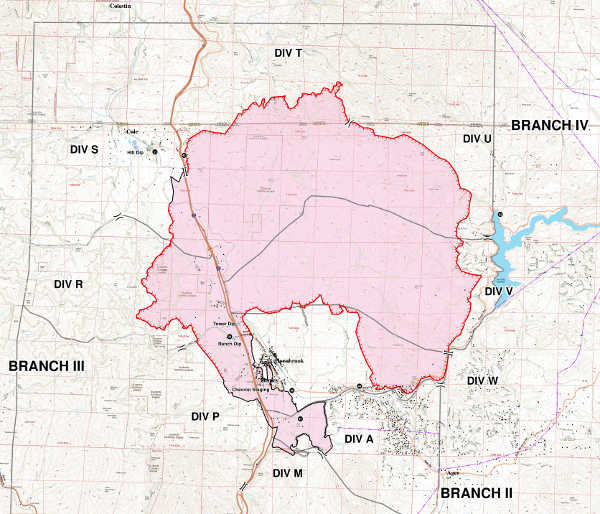
The final map of the Pawnee fire in Lake County, Calif. Map courtesy of Cal Fire. LAKE COUNTY, Calif. – Officials reported Sunday night that the Pawnee fire has been fully contained, while firefighters continue to work on major incidents around the region and state.
The Pawnee fire’s full containment comes two days ahead of when Cal Fire had estimated it would be fully hemmed in by fire line.
It began on the evening of June 23 northeast of Clearlake Oaks in the Spring Valley Lakes subdivision, burning to the east and eventually over Indian Valley Reservoir and Walker Ridge, entering Colusa County.
It burned 15,185 acres, and destroyed 22 structures and damaged five others in Spring Valley Lakes, based on a damage assessment.
Evacuations were in effect for several days during the fire’s first week for both Spring Valley and the Double Eagle Ranch subdivision to the east, off of Highway 20.
Those evacuations were called off and then the fire had a major flareup on June 30, which caused a renewed mandatory evacuation order for the Double Eagle Ranch, as Lake County News has reported.
Two engines are reported to still be assigned to the incident for the purpose of patrolling and maintaining perimeter, Cal Fire said.
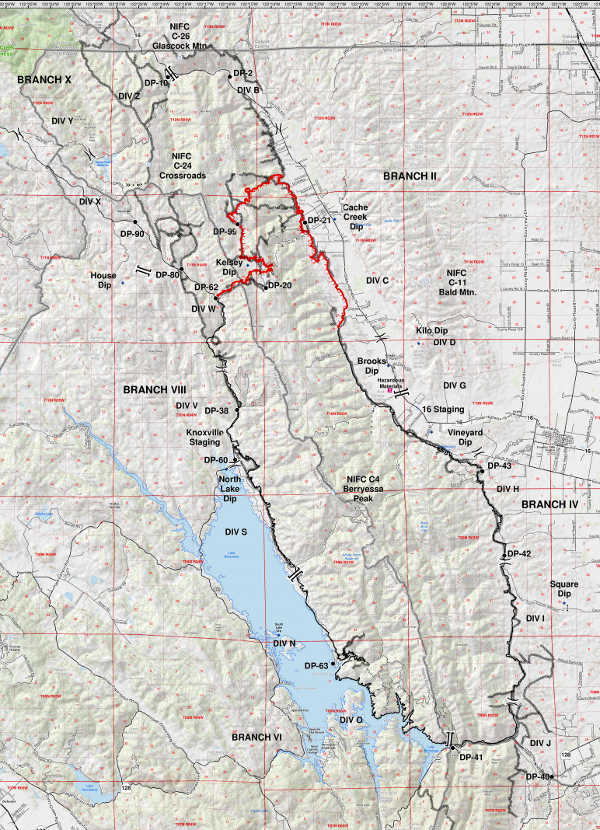
To the southeast, the County fire, burning in Napa and Yolo counties, grew by nearly 2,000 acres on Sunday, reaching 90,288 acres on Sunday evening with 65 percent containment. Cal Fires said the fire is expected to be fully contained on Thursday.
The County fire in Napa and Yolo counties, Calif. Map courtesy of Cal Fire.
The latest County fire damage assessment puts the number of destroyed structures at 16 and damaged structures at three, according to Cal Fire.
Cal Fire said the assigned resources on the County fire – which have continued to be reduced due to needs in other parts of the state – stand at 2,667 personnel, 153 engines, 42 water tenders, 23 helicopters, 54 hand crews and 28 dozers.
Reports from the scene indicated that a firing operation was taking place on the fire beginning Saturday night and continuing into Sunday.
That operation caused some south Lake County residents to see smoke and flames, which resulted in an early morning smoke check that resulted in no local fires being located, according to radio traffic.
The causes of both the Pawnee and County fires remain under investigation.
To the north, the Klamathon fire near Hornbrook in Siskiyou County continues to burn, with evacuation orders remaining in place.
Cal Fire said the fire, which began Thursday, had burned 35,000 acres and 72 structures by Sunday evening, with one fatality and two reported injuries. It is 25-percent contained.
In other fire-related news, on Sunday afternoon and evening fire resources were being redirected to other parts of the state, including Livermore in Santa Clara where a fire was burning along Interstate 580 and had closed the highway.
A small grass fire also was knocked down in the area of County Road 85 in Yolo County Sunday, evening, according to radio reports.
Email Elizabeth Larson at This email address is being protected from spambots. You need JavaScript enabled to view it.. Follow her on Twitter, @ERLarson, or Lake County News, @LakeCoNews.
The Klamathon fire in Siskiyou County, Calif. Map courtesy of Cal Fire.
North Coast Opportunities disaster case managers with Katherine Ramos and daughter-in-law (center). Courtesy photo. LAKE COUNTY, Calif. – After the devastation of the 2015 Valley fire, 2016 Clayton fire and the 2017 Sulphur fire, Lake County is dotted with fire survivors.
While many have been able to secure permanent housing, others still find themselves unable to rebuild.
Hammers for Hope, the Hope Crisis Response Network, North Coast Opportunities Inc. (NCO), private contractors, and modular home companies work in collaboration to support these fire survivors through disaster case management services, home rebuilding, volunteer support, and the CalHome Loan Program.
Katherine Ramos lost her home during the Valley fire. She is a senior citizen living on a fixed income and was completely uninsured during the time of the fire.
Thanks to the CalHome Loan Program and other collaborative partners, Ramos will move into her new Homes Direct manufactured home by late summer.
“The CalHome Loan Program has been a lifesaver,” said Ramos. “I’ve been here 33 years and I’m very grateful to be able to return to my property. If it wasn’t for this opportunity, I would not be getting a house and I’m very thankful. It means I don’t have to continue moving around. I can put my roots down again! After meeting with my case manager, I felt like I had some hope. Otherwise I do not know where I would be.”
There are currently 24 active CalHome loans nearly ready to fund. Approximately 10 prospects are also in the pipeline, which will hopefully result in funded loans later this summer.
The CalHome Loan Program is funded through the California Department of Housing and Community Development, or HCD. It’s sometimes used to cover the gap between an insurance payout and the cost of rebuilding.
The program targets low to moderate income households who owned or rented a home destroyed by one of the recent fires. It provides a 30-year deferred loan with zero percent interest and is significantly easier to qualify for than a traditional mortgage or loan.
Volunteer rebuilding projects are also being processed. As CalHome loans close, Hope City provides the materials, resources, and volunteer labor needed to oversee the rebuilding process.
Hope Crisis Response Network is a nonprofit organization dedicated to disaster recovery and home rebuilding. They have provided recovery assistance in Lake County since September 2015.
"Hope City is the name we give our rebuilding projects as we bring together local businesses, organizations, government leaders, and our volunteer teams to bring hope to the community," said Valerie Cox, NCO disaster case manager and Hope City representative.
In May 2018, Hope City staff and volunteers completed three homes. There are currently seven homes under construction, with more home dedications set later this summer.
Hope City makes home rebuilding possible for low-income clients due to the enormous volunteer labor they contribute, which significantly reduces rebuilding costs.
"We are honored to serve in Lake County,” adds Cox. “Our volunteer teams come every week from across the U.S. and Canada and give their time to help Lake County recover. We're moving forward, step by step." Additionally, one more home was completed by Lake County Contractors at the beginning of March.
Hammers for Hope was awarded a grant from HCD for $4.6 million, and NCO is the program operator.
The grant is being drawn down in small amounts as applications and projects are approved. Funds are still available and new applications are being accepted.
“We encourage fire survivors in need of housing to apply for a CalHome Loan,” said Hammers for Hope Board Member Mark Borghesani. “Funds are still available and it’s our goal to help as many people return home as possible.”
Hammers for Hope aims to assist seniors, low to moderate income individuals and families, and people with disabilities, in making minor home repairs to improve their comfort and safety.
After the fires, Hammers for Hope shifted focus to help those in need of rebuilding. Hammers for Hope is a collaborative effort made possible by the work of local contractors and community volunteers with major funding provided by Calpine Corp. and assistance from Kelseyville Lumber.
“Disaster Case Managers are available to assist fire survivors,” adds NCO Executive Director Patty Bruder. “In partnership with Team Lake County, NCO connects fire survivors to resources. We work with individuals, address their needs, and direct them to the best available resources.”
For more information about the CalHome Loan Program or to complete a preliminary application contact a Disaster Case Manager at 707-994-2910.
For more information about Hammers for Hope or to apply for assistance, donate or volunteer, visit www.hammersforhope.org. Learn more about NCO by calling 707-467-3200 or by visiting www.ncoinc.org.
Robyn Bera is a staffer at North Coast Opportunities.
LAKE COUNTY, Calif. – Firefighting resources continue to fan out across the state in response to destructive new incidents, while those in Lake County and neighboring counties approach full containment.
The Pawnee fire northeast of Clearlake Oaks remained at 15,185 acres on Saturday evening, with containment up to 96 percent, Cal Fire said.
Cal Fire said the 417 personnel, 10 engines, eight water tenders, one helicopter, two hand crews and one dozer that remain assigned to the incident are working on patrolling and monitoring the fire area.
Early Saturday evening, a firefighter working on the Pawnee fire was reported to have suffered head trauma and was transported to the hospital, based on scanner traffic.
In neighboring Napa and Yolo counties, the County fire was up to 88,425 acres and 55 percent containment on Saturday night, Cal Fire said.
Cal Fire said 2,858 personnel, 176 engines, 51 water tenders, 23 helicopters, 61 hand crews and 48 dozers are working the fire.
The incident’s updated damage assessment showed that it has destroyed 15 structures and damaged three others.
The Napa County Sheriff’s Office said Saturday evening that, with containment lines continuing to grow and many hazards being mitigated, it was lifting evacuation orders for the areas along the eastern shore of Lake Berryessa, east to the Napa/Yolo County Line, north of State Highway 128, and south of the intersection of East Side Road and Knoxville Berryessa Road, including residences served by East Side Road, South of Knoxville Berryessa Road.
Officials said the road closure on Knoxville Berryessa Road at the Pope Creek Bridge remains in effect, however residents of east side road will be allowed to pass with identification.
In Siskiyou County, the battle against the Klamathon fire continued on Saturday.
The fire, which began on Thursday afternoon, has so far burned 22,00 acres and is 20 percent contained.
It’s reported to have killed one person, resulted in two other injuries, and Cal Fire’s Saturday night report said it has destroyed 72 structures.
More than 2,300 firefighters have joined the effort to contain the incident, Cal Fire said.
Elsewhere in California, the West fire in San Diego County has destroyed 18 structures, burned 504 acres and was 81-percent contained on Saturday night, while the Holiday fire in Santa Barbara County was 100 acres and 80-percent contained and the Irish fire in Amador County reached 790 acres and 80-percent containment, according to Cal FIre.
On Saturday, Gov. Jerry Brown issued an emergency proclamation for Santa Barbara County due to the effects of the Holiday fire.
Earlier this week, Gov. Brown declared a state of emergency for the counties of San Diego and Siskiyou due to fires, and last month issued a declaration for Lake County due to the Pawnee fire.
Email Elizabeth Larson at This email address is being protected from spambots. You need JavaScript enabled to view it.. Follow her on Twitter, @ERLarson, or Lake County News, @LakeCoNews.
 How to resolve AdBlock issue?