LAKE COUNTY, Calif. – Lake County Animal Care and Control has several big dogs waiting for homes at its shelter this week.
Dogs available for adoption this week include mixes of border collie, German Shepherd, Labrador Retriever, mastiff, pit bull and and spaniel.
Dogs that are adopted from Lake County Animal Care and Control are either neutered or spayed, microchipped and, if old enough, given a rabies shot and county license before being released to their new owner. License fees do not apply to residents of the cities of Lakeport or Clearlake.
If you're looking for a new companion, visit the shelter. There are many great pets hoping you'll choose them.
The following dogs at the Lake County Animal Care and Control shelter have been cleared for adoption (additional dogs on the animal control Web site not listed are still “on hold”).
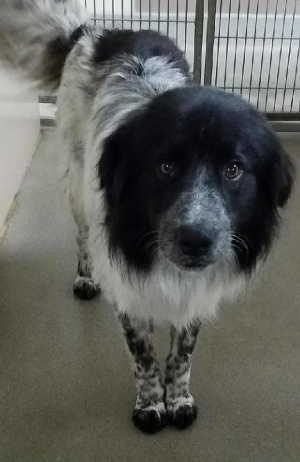
This young male border collie is in kennel No. 11, ID No. 10334. Photo courtesy of Lake County Animal Care and Control.
Male border collie
This young male border collie has a short black and white coat.
He’s in kennel No. 11, ID No. 10334.
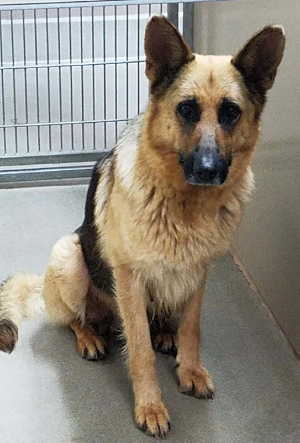
“Wrynn” is a female German Shepherd in kennel No. 17, ID No. 10433. Photo courtesy of Lake County Animal Care and Control.
‘Wrynn’
“Wrynn” is a female German Shepherd with a medium-length black and brown coat.
She’s in kennel No. 17, ID No. 10433.
This male spaniel-border collie mix is in kennel No. 19, ID No. 10380. Photo courtesy of Lake County Animal Care and Control.
Spaniel-border collie
This male spaniel-border collie mix has a black and white coat.
He’s in kennel No. 19, ID No. 10380.
This male mastiff mix is in kennel No. 26, ID No. 10191. Photo courtesy of Lake County Animal Care and Control.
Male mastiff mix
This male mastiff mix has a short tan and white coat.
He’s in kennel No. 26, ID No. 10191.
This male mastiff mix is in kennel No. 27, ID No. 10192. Photo courtesy of Lake County Animal Care and Control.
Male mastiff mix
This male mastiff mix has a short tan and white coat.
He’s in kennel No. 27, ID No. 10192.
“Yogi” is a male Labrador Retriever-pit bull mix is in kennel No. 31, ID No. 10082. Photo courtesy of Lake County Animal Care and Control. ‘Yogi’
“Yogi” is a male Labrador Retriever-pit bull mix with a medium-length brown and black coat.
He already has been neutered.
He’s in kennel No. 31, ID No. 10082.
“Lala” is a female German Shepherd in kennel No. 32, ID No. 10420. Photo courtesy of Lake County Animal Care and Control.
‘Lala’
“Lala” is a female German Shepherd with a brown and black coat.
She’s in kennel No. 32, ID No. 10420.
“Kumo” is a male pit bull terrier in kennel No. 34, ID No. 10424. Photo courtesy of Lake County Animal Care and Control.
‘Kumo’
“Kumo” is a male pit bull terrier with a short blue and white coat.
He’s in kennel No. 34, ID No. 10424.
Lake County Animal Care and Control is located at 4949 Helbush in Lakeport, next to the Hill Road Correctional Facility.
Office hours are Monday through Friday, 11 a.m. to 5 p.m., and 11 a.m. to 3 p.m., Saturday. The shelter is open from 11 a.m. to 4 p.m. Monday through Friday and on Saturday from 11 a.m. to 3 p.m.
For more information call Lake County Animal Care and Control at 707-263-0278.
Email Elizabeth Larson at This email address is being protected from spambots. You need JavaScript enabled to view it.. Follow her on Twitter, @ERLarson, or Lake County News, @LakeCoNews.
BERKELEY, Calif. – Human activity is causing the planet’s mammals to flee daylight for the protection of night, according to a new study from UC Berkeley.
The study, published in the journal Science, and supported in part by the National Science Foundation, represents the first effort to quantify the global effects of human activity on the daily activity patterns of wildlife.
Its results highlight the powerful and widespread process by which animals alter their behavior alongside people: human disturbance is creating a more nocturnal natural world.
“Catastrophic losses in wildlife populations and habitats as a result of human activity are well documented, but the subtler ways in which we affect animal behavior are more difficult to detect and quantify,” said Berkeley PhD candidate and study lead author Kaitlyn Gaynor.
Gaynor, along with co-authors Justin Brashares and Cheryl Hojnowski of UC Berkeley, and Neil Carter of Boise State University, applied a meta-analysis approach, using data for 62 species across six continents to look for global shifts in the timing of daily activity of mammals in response to humans.
These data were collected by various approaches, including remotely triggered cameras, GPS and radio collars, and direct observation. For each species in each study site, the authors quantified the difference in animal nocturnality under low and high human disturbance.
On average, mammals were 1.36 times more nocturnal in response to human disturbance. This means that an animal that naturally split its activity evenly between the day and night increased its nighttime activity to 68 percent around people.
This finding was consistent across carnivore and herbivore species of all body sizes greater than 1 kg (small mammals were not included in the study).
The pattern also held across different types of human disturbance, including activities such as hunting, hiking, mountain biking, and infrastructure such as roads, residential settlement, and agriculture.
“While we expected to find a trend towards increased wildlife nocturnality around people, we were surprised by the consistency of the results around the world,” said Gaynor. “Animals responded strongly to all types of human disturbance, regardless of whether people actually posed a direct threat, suggesting that our presence alone is enough to disrupt their natural patterns of behavior.”
According to Brashares, a professor in the Department of Environmental Science, Policy, and Management and the study’s senior author, the consequences of the behavioral shift in wildlife can be seen through contrasting lenses.
“On the positive side, the fact that wildlife is adapting to avoid humans temporally could be viewed as a path for coexistence of humans and wild animals on an increasingly crowded planet,” said Brashares. “However, animal activity patterns reflect millions of years of adaptation – it’s hard to believe we can simply squeeze nature into the dark half of each day and expect it to function and thrive.”
The authors describe a range of potential negative consequences of the shifts they report in wildlife, including mismatches between the environment and an animal’s traits, disruption of normal foraging behavior, increased vulnerability to non-human predators, and heightened competition.
They point out, however, that while many of the studies included in their analysis documented a clear increase in nocturnal activity, few examined the consequences for individual animals, populations, or ecosystems.
“We hope our findings will open up new avenues for wildlife research in human-dominated landscapes. We still have a lot to learn about the implications of altered activity patterns for the management of wildlife populations, interactions between species, and even human-induced evolution,” said Gaynor.
Mackenzie Smith writes for the UC Berkeley News Center.
Although they’re beautiful and fascinating, these are NOT the kind of chestnuts you can eat. California Buckeye chestnuts contain a neurotoxic glucoside called “aesculin”, among other compounds, that can cause severe stomach pains, disorientation, muscle weakness and death in both animals and humans. Photo by Mary K. Hanson.
NORTHERN CALIFORNIA – You’ve probably seen them leafing out and blossoming all over the region, their newly formed leaves a bright chartreuse that will eventually turn darker green and take on a kind of fuzzy matt finish.
They’re trees that ignore the pre-set seasons so strictly adhered to by other trees: they wake up in the winter and settle down to sleep in the late summer.
They’re California Buckeyes (Aesculus californica), a species endemic to California – meaning that they grow here and nowhere else on earth.
The buckeye tree can grow up to 20 feet tall and have a branch-span of about 30 feet. When planted from seed it can sprout up 10 inches each year, and has the capacity to live for over 250 years. And it’s this tree’s seeds that are so spectacular.
Getting as a large as a fist, the dark chestnuts look like polished mahogany when they’re released from their leathery husks. The chestnuts drop to the ground in the wettest part of winter.
Each one sends out a long pinkish taproot that bores into the earth, and also releases a finely leafed sprout that forms above ground on a rose-colored stem. If it survives, this sprout will become the new tree.
Although they’re beautiful and fascinating, these are not the kind of chestnuts you can eat.
Sweet chestnuts are actually an entirely different species: Castanea sativa.
California Buckeye chestnuts contain a neurotoxic glucoside called “aesculin,” among other compounds, that can cause severe stomach pains, disorientation, muscle weakness and death in mammals, including humans.
Ingestion of the sprouts, leaves and seeds is also known to be linked to the spontaneous abortion of calves in grazing cattle.
Adult California ground squirrels, however, have a natural immunity to the toxins – just as they have a natural immunity to rattlesnake venom.
In the winter, you’ll often see the forest floor and areas around the squirrels’ burrows littered with chewed up, half-eaten Buckeye chestnuts.
Mule deer and Steller’s Jays have also been known to eat the leaves and chestnuts, but only in very small quantities.
In the spring, the California Buckeye trees display long four to eight inch panicles of small, sweet-scented flowers which attract a wide variety of pollinators. The blossoms are a favorite of the Tiger Swallowtail butterflies, and the trees are also hosts to the caterpillars of the Echo Blue Butterfly. Photo by Mary K. Hanson.
Although not good as shade trees because they lose their leaves in the summer, California Buckeyes are great at binding the soil with their roots and are often used for erosion control. They can also thrive in drought stricken areas and in nutrient-poor soils where other trees fail.
In the spring, they display long 4- to 8-inch panicles of small, sweet-scented flowers (white or pink) which attract a wide variety of pollinators.
The blossoms are a favorite of the tiger swallowtail butterflies, and the trees are also the hosts to the caterpillars of the echo blue butterfly (Celastrina argiolus).
Care has to be taken not to plant the trees near apiaries, however, because the blossoms’ inviting nectar and pollen are poisonous to European honeybees.
Additionally, according to the USDA, “Human beings have been poisoned by eating honey made from California Buckeye.”
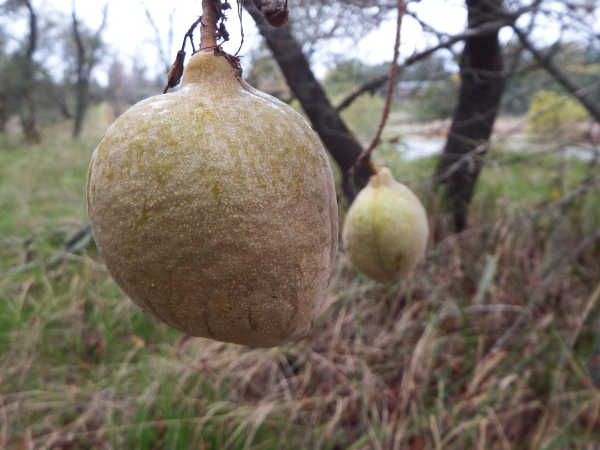
Of all of the flowers displayed on its panicles, only one will survive to actually develop into a chestnut. In the later summer months, you can see single chestnuts dangling here and there from branches of the trees like leathery bobs on pendulum strings.
As we mentioned before, the California Buckeye is one of the few trees in our state that “estivates” in summer.
All of its leaves shrivel and turn golden brown, and most fall off as the tree goes dormant. It’s this summer leaf-drop that can add fuel for wildfires in some of the trees’ natural range.
The chestnuts ripen in the fall, and then fall to the ground in the winter, starting the cycle from tree, to flower, to seed all over again.
Mary K. Hanson is a Certified California Naturalist, author, nature photographer and blogger (https://chubbywomanwalkabout.com/). She also teaches naturalist classes through Tuleyome, a501(c)(3) nonprofit conservation organization based in Woodland, Calif. For more information, visit www.tuleyome.org.
Of all of the flowers displayed on its panicles, only one will survive to actually develop into a chestnut. In the summer months, you can see single chestnuts dangling here and there from branches of the trees like leathery bobs on pendulum strings. Photo by Mary K. Hanson.
LAKE COUNTY, Calif. – With temperatures expected to climb early next week, the National Weather Service issued a heat advisory for Lake County and other portions of Northern California.
The National Weather Service said the advisory will be in effect from noon to Sunday to 8 p.m. Monday.
A heat advisory means that a prolonged period of hot temperatures is expected and will create a situation in which heat illnesses are possible.
Forecasters said building high pressure will bring hot temperatures over the weekend with daytime highs from 10 to as much as 15 degrees above normal.
The specific Lake County forecast calls for temperatures topping the century mark on Monday, and remaining in the high 90s throughout much of the week.
The National Weather Service said thunderstorms are possible in the mountains at that time.
Close to next weekend, temperatures will drop as cloudy conditions arrive, according to the forecast.
Email Elizabeth Larson at This email address is being protected from spambots. You need JavaScript enabled to view it.. Follow her on Twitter, @ERLarson, or Lake County News, @LakeCoNews.
NORTHERN CALIFORNIA – As major wildland fires around Northern California neared full containment on Friday, a new incident erupted in Chico, threatening dozens of homes.
The County fire in Napa and Yolo counties is expected to be fully contained on Sunday and the Klamathon fire in Siskiyou County also rose in containment, while the Stoney fire in Chico began Thursday night.
Cal Fire said the County fire, remaining at 90,288 acres, reached 97 percent containment on Friday night.
The fire began on June 30 near Guinda. Cal Fire investigators said it began as a result of an improperly installed electric fencing unit.
The Klamathon fire grew to 37,900 acres on Friday, with containment up to 85 percent, Cal Fire said.
The fire began July 5, and has killed one civilian, injured three firefighters and destroyed 82 structures, according to Cal Fire.
In Chico, the Stoney fire near Bidwell Park began late Thursday night, burning more than 600 acres overnight and causing the evacuation of about 50 homes, according to Cal Fire.
By Friday night, Cal Fire said the Stoney fire was up to 700 acres, with containment at 40 acres.
The Stoney fire evacuations were lifted on Friday, officials said.
Email Elizabeth Larson at This email address is being protected from spambots. You need JavaScript enabled to view it.. Follow her on Twitter, @ERLarson, or Lake County News, @LakeCoNews.
NORTH COAST, Calif. – A paraglider escaped injury after authorities say he crashed at Del Rio Woods Beach east of Healdsburg Friday.
At approximately 9:20 a.m. Friday, Misti Harris of the Sonoma County Sheriff’s Office said the agency received a call of a paraglider crash at Del Rio Woods Beach, just off of South Fitch Mountain Road.
A Geyserville man was paragliding south from Geyserville. He clipped some power lines near Del Rio Woods Beach and crash landed on the beach, Harris said.
Harris said power was shut off in the area due to the damaged power lines.
The man was not hurt. He removed the parachute from the trees and walked away, according to Harris
Local fire and medical crews responded, including Healdsburg Fire Department. Harris said the man was medically evaluated and released at the scene.
PG&E crews responded and repaired the lines, Harris said.
 How to resolve AdBlock issue?