 How to resolve AdBlock issue?
News

About four billion years ago, when the planet Earth was still in its infancy, the axis of a black hole about one billion times more massive than the sun happened to be pointing right to where our planet was going to be on September 22, 2017.
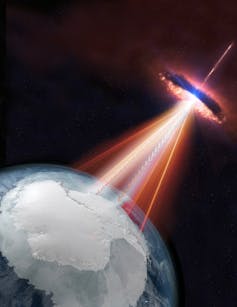
Along the axis, a high-energy jet of particles sent photons and neutrinos racing in our direction at or near the speed of light. The IceCube Neutrino Observatory at the South Pole detected one of these subatomic particles – the IceCube-170922A neutrino – and traced it back to a small patch of sky in the constellation Orion and pinpointed the cosmic source: a flaring black hole the size of a billion suns, 3.7 billion light years from Earth, known as blazar TXS 0506+056. Blazars have been known about for some time. What wasn’t clear was that they could produce high-energy neutrinos. Even more exciting was such neutrinos had never before been traced to its source.
Finding the cosmic source of high-energy neutrinos for the first time, announced on July 12, 2018 by the National Science Foundation, marks the dawn of a new era of neutrino astronomy. Pursued in fits and starts since 1976, when pioneering physicists first tried to build a large-scale high-energy neutrino detector off the Hawaiian coast, IceCube’s discovery marks the triumphant conclusion of a long and difficult campaign by many hundreds of scientists and engineers – and simultaneously the birth of a completely new branch of astronomy.
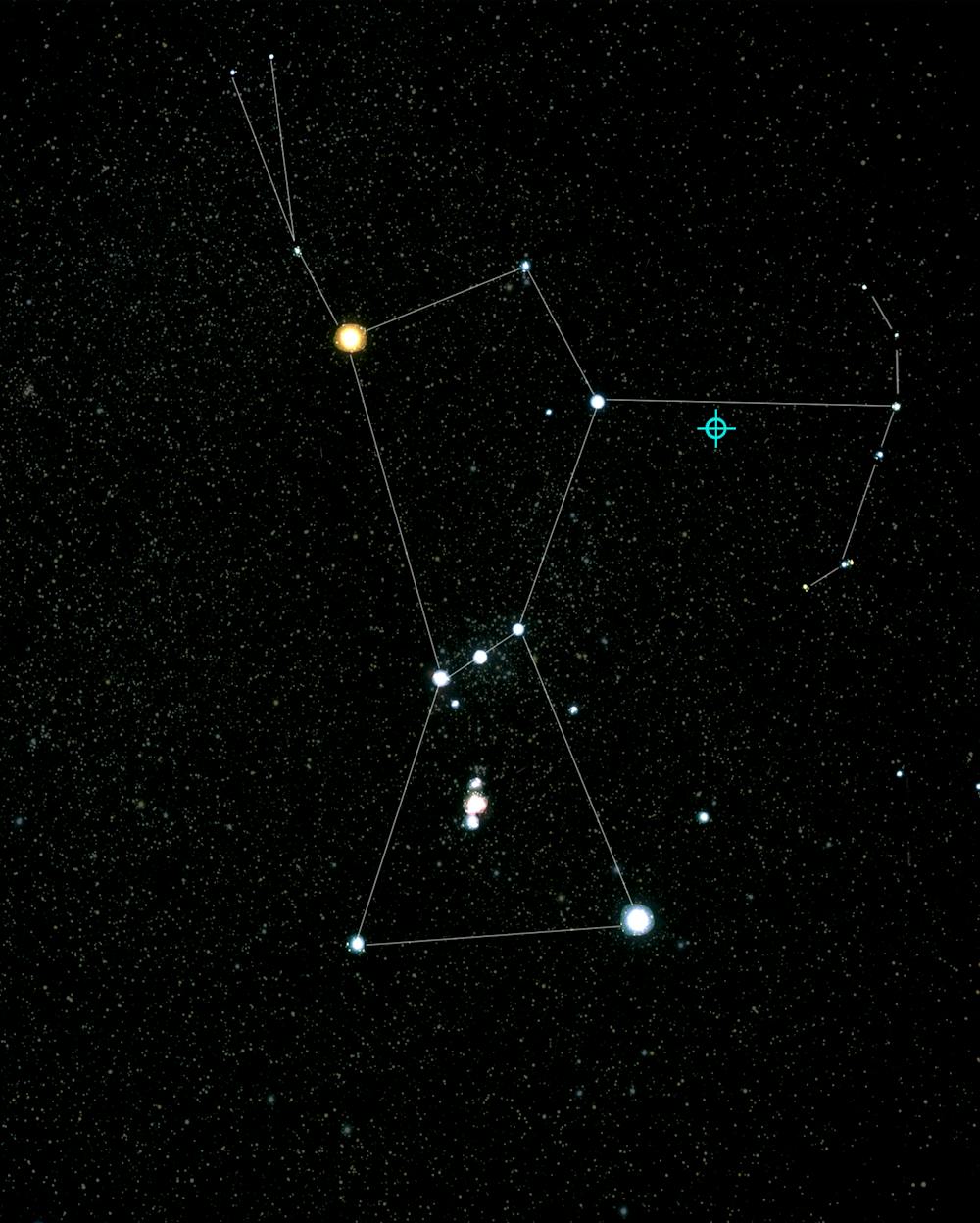
The detection of two distinct astronomical messengers -– neutrinos and light –- is a powerful demonstration of how so-called multimessenger astronomy can provide the leverage we need to identify and understand some of the most energetic phenomena in the universe. Since its discovery as a neutrino source less than a year ago, blazar TXS 0506+056 has been the subject of intensive scrutiny. Its associated stream of neutrinos continues to provide deep insights into the physical processes at work near the black hole and its powerful jet of particles and radiation, beamed almost directly toward Earth from its location just off the shoulder of Orion.
As three scientists in a global team of physicists and astronomers involved in this remarkable discovery, we were drawn to participate in this experiment for its sheer audacity, for the physical and emotional challenge of working long shifts at in a brutally cold location while inserting expensive, sensitive equipment into holes drilled 1.5 miles deep in the ice and making it all work. And, of course, for the thrilling opportunity to be the first people to peer into a brand new kind of telescope and see what it reveals about the heavens.
A remote, frigid neutrino detector
At an altitude exceeding 9,000 feet and with average summertime temperatures rarely breaking a frigid -30 Celsius, the South Pole may not strike you as the ideal place to do anything, aside from bragging about visiting a place that is so sunny and bright you need sunscreen for your nostrils. On the other hand, once you realize that the altitude is due to a thick coat of ultrapure ice made from several hundred thousand years of pristine snowfall and that the low temperatures have kept it all nicely frozen, then it might not surprise you that for neutrino telescope builders, the scientific advantages outweigh the forbidding environment. The South Pole is now the home of the world’s largest neutrino detector, IceCube.
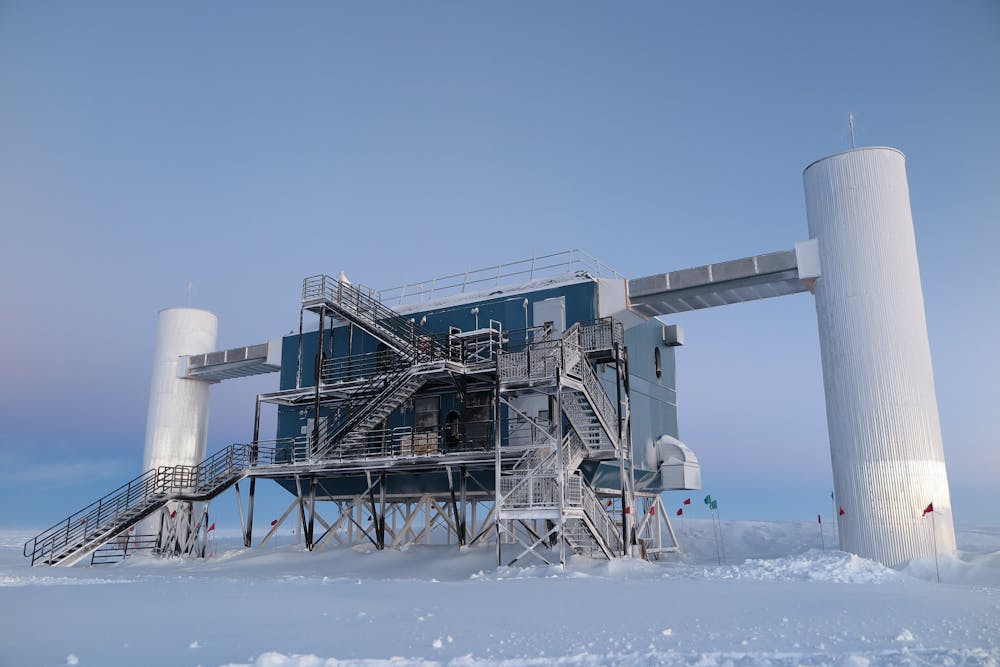
It may seem odd that we need such an elaborate detector given that about 100 billion of these fundamental particles sashay right through your thumbnail each second and glide effortlessly through the entire Earth without interacting with a single earthly atom.
In fact, neutrinos are the second most ubiquitous particles, second only to the cosmic microwave background photons left over from the Big Bang. They comprise one-quarter of known fundamental particles. Yet, because they barely interact with other matter, they are arguably the least well understood.
To catch a handful of these elusive particles, and to discover their sources, physicists need big – kilometer-wide – detectors made of an optically clear material – like ice. Fortunately Mother Nature provided this pristine slab of clear ice where we could build our detector.

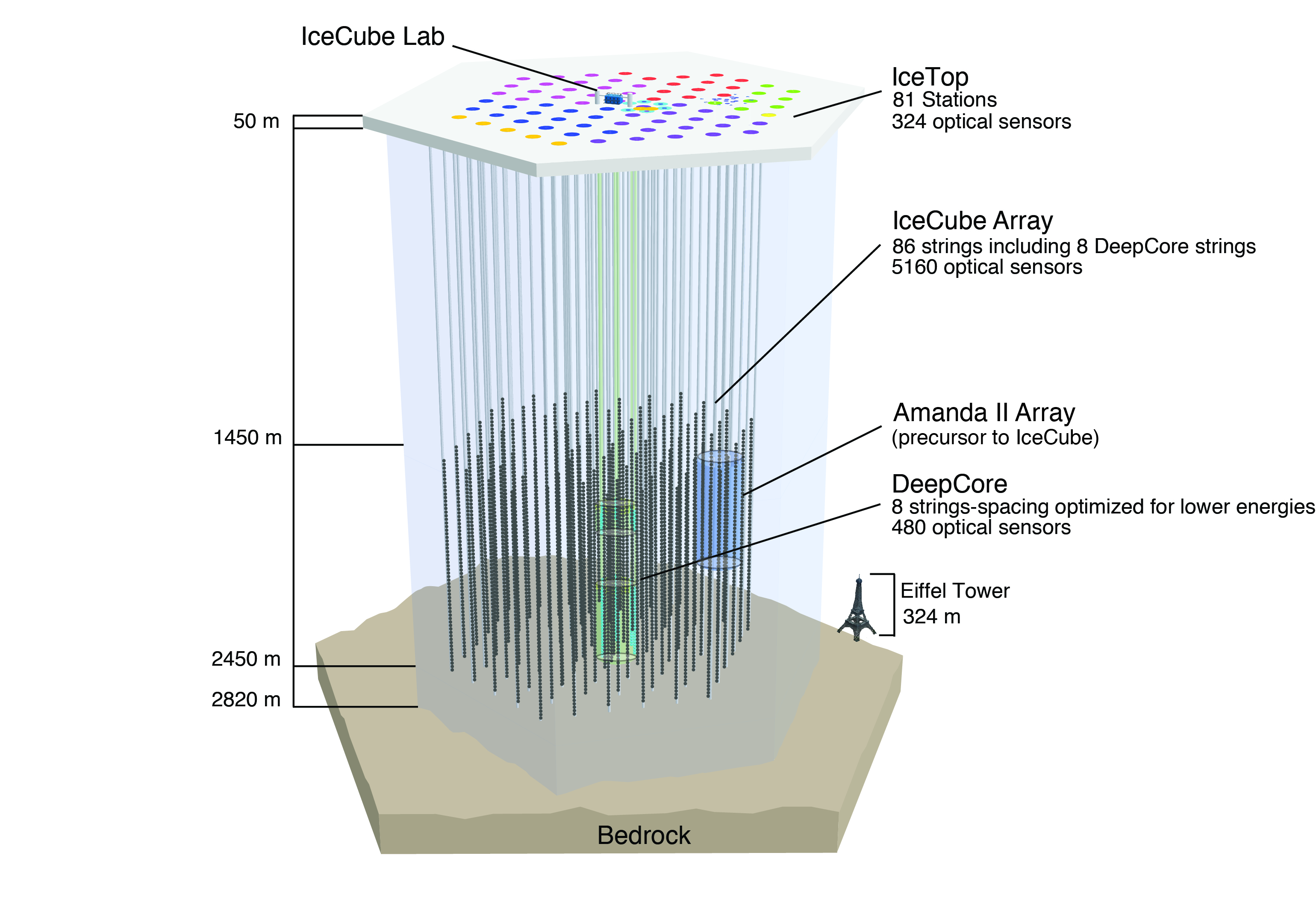
At the South Pole several hundred scientists and engineers have constructed and deployed over 5,000 individual photosensors in 86 separate 1.5-mile-deep holes melted in the polar ice cap with a custom-designed hot-water drill. Over the course of seven austral summer seasons we installed all the sensors. The IceCube array was fully installed in early 2011 and has been taking data continuously since.
This array of ice-bound detectors can sense with great precision when a neutrino flies through and interacts with a few Earthly particles that generate dim patterns of bluish Cherenkov light, given off when charged particles move through a medium like ice at close to light speed.
Neutrinos from the cosmos
The Achilles’ heel of neutrino detectors is that other particles, originating in the nearby atmosphere, can also trigger these patterns of bluish Cherenkov light. To eliminate these false signals, the detectors are buried deep in the ice to filter out interference before it can reach the sensitive detector. But in spite of being under nearly a mile of solid ice, IceCube still faces an onslaught of about 2,500 such particles every second, each of which could plausibly have been due to a neutrino.
With the expected rate of interesting, real astrophysical neutrino interactions (like incoming neutrinos from a black hole) hovering at about one per month, we were faced with a daunting needle-in-a-haystack problem.
The IceCube strategy is to look only at events with such high energy that they are exceedingly unlikely to be atmospheric in origin. With these selection criteria and several years of data, IceCube discovered the astrophysical neutrinos it had long been seeking, but it could not identify any individual sources – such as active galactic nuclei or gamma-ray bursts – among the several dozen high-energy neutrinos it had captured.
To tease out actual sources, IceCube began distributing neutrino arrival alerts in April 2016 with help from the Astrophysical Multimessenger Observatory Network at Penn State. Over the course of the next 16 months, 11 IceCube-AMON neutrino alerts were distributed via AMON and the Gamma-ray Coordinates Network, just minutes or seconds after being detected at the South Pole.
A new window on the universe
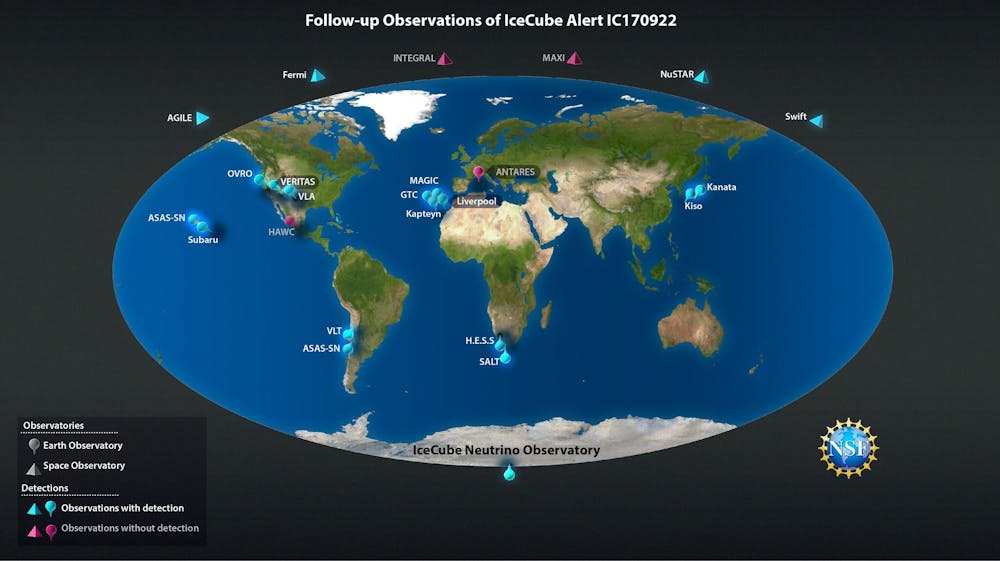
The alerts triggered an automated sequence of X-ray and ultraviolet observations with NASA’s Neil Gehrels Swift Observatory and led to further studies with NASA’s Fermi Gamma-Ray Space Telescope and Nuclear Spectroscopic Telescope Array, and 13 other observatories around the world.
Swift was the first facility to identify the flaring blazar TXS 0506+056 as a possible source of the neutrino event. The Fermi Large Area Telescope then reported that the blazar was in a flaring state, emitting many more gamma-rays than it had in the past. As the news spread, other observatories enthusiastically jumped on the bandwagon and a broad range of observations ensued. The MAGIC ground-based telescope noted our neutrino came from a region producing very high-energy gamma-rays (each about ten million times more energetic than an X-ray), the first time such a coincidence has ever been observed. Other optical observations completed the puzzle by measuring the distance to blazar TXS 0506+056: about four billion light years from Earth.
With the first-ever identification of a cosmic source of high-energy neutrinos, a new branch on the astronomy tree has sprouted. As high-energy neutrino astronomy grows with more data, improved inter-observatory coordination, and more sensitive detectors, we will be able to map the neutrino sky with better and better precision.
And we expect exciting new breakthroughs in our understanding of the universe to follow suit, such as: solving the century-old mystery of the origin of astoundingly energetic cosmic rays; testing if spacetime itself is foamy, with quantum fluctuations at very small distance scales, as predicted by certain theories of quantum gravity; and figuring out exactly how cosmic accelerators, like those around the TXS 0506+056 black hole, manage to accelerate particles to such breathtakingly high energies.
 For 20 years, the IceCube Collaboration had a dream to identify the sources of high-energy cosmic neutrinos – and this dream is now a reality.
Doug Cowen, Professor of Physics and Professor of Astronomy & Astrophysics, Pennsylvania State University; Azadeh Keivani, Frontiers of Science Fellow, Columbia University, and Derek Fox, Associate Professor of Astronomy and Astrophysics, Pennsylvania State University
This article was originally published on The Conversation. Read the original article.
CLEARLAKE, Calif. – On Thursday night, the Clearlake City Council gave its unanimous approval to the hire of the city’s new police chief.
With the 5-0 vote, the council directed City Manager Greg Folsom to appoint Andrew White to the job and to execute the proposed employment contract.
White, 33, who was not present for the meeting, is commander at the Suisun City Police Department in Solano County. He’s a 16-year law enforcement veteran and police academy instructor with a wide range of qualifications and experience that city officials decided made him the top choice for chief.
The city’s former chief, Craig Clausen, retired in December after being off work for two years due to an injury. Lt. Tim Celli had been acting chief since Clausen went off-duty in December 2015, and was named interim chief in December, upon Clausen’s retirement.
Folsom explained during Thursday night’s meeting that the city hired Ralph Andersen & Associates earlier this year to lead the executive search process for the new chief.
The recruiting firm met with Folsom, the city council, city department heads, Konocti Unified School District and Lake County Fire Protection District to develop the ideal candidate profile, Folsom said. The firm also held a public meeting in February to gather community input.
From there, Ralph Andersen & Associates created a brochure and began a confidential recruitment. Folsom said the process was kept confidential because most applicants have jobs and usually do not want their employers to know they are looking.
Folsom said the recruiter received more than 20 applications from throughout California and other states.
The recruiter did an initial screening and the top candidates were interviewed by a panel of community members, Clearlake Police Officers Association representatives and chiefs of similar sized communities, Folsom said.
That led to the top three candidates being interviewed by Folsom and the council, with White ultimately selected as the new chief.
Folsom said Suisun City has a population of about 30,000 residents and also has very similar challenges to Lake County.
White holds a bachelor’s degree in organizational management/IT from Union Institute and University, and has five certificates through the California Commission on Peace Officer Standards and Training.
He’s also serves as commander for the Solano County Mobile Field Force, is a member of the California Police Chiefs Association Technology Committee and chairs the Solano County Animal Control Authority.
Folsom said that among White’s many skills and qualifications, he’s extremely adept at technology.
White’s background investigation, and medical and psychological exams have all been completed, Folsom said.
“His background investigation showed him to be of extremely high character and intelligence and he is highly recommended by all contacts,” Folsom said
He added that White has purchased a house and plans to reside within the Clearlake city limits.
Folsom said the terms of the proposed contract between White and the city includes a $130,000 annual salary, noting that Clausen’s salary was $126,000 annually.
The contract also will have an initial three-year term with the ability to renew, six months’ severance, eligibility for a 5-percent POST Executive Certificate incentive pay after two years of employment, use of a vehicle, a cell phone allowance, a one-time $5,000 relocation expense and the city’s payment of dues and expenses for his professional development.
There were no questions about the hire or proposed contract from the council or community members.
Mayor Bruno Sabatier said some people had expressed concerns about the expense of the recruitment; the city’s contract with Ralph Andersen & Associates was for $24,500, with up to $1,500 in contract change orders.
Considering the number – and quality – of applications the city received from the recruitment, Sabatier said he felt it was well worth the expense.
“I’m really happy with the outcomes of this,” and hoped the rest of the council is as well, Sabatier said.
Councilman Russell Cremer moved to have Folsom appoint White as chief, with Councilman Phil Harris seconding and the council voting 5-0.
Folsom said White’s swearing-in ceremony will take place at the next regular council meeting, which will begin at 6 p.m., Thursday, July 26. The meeting will take place at the community and senior center, 3245 Bowers Ave., with a reception to follow.
Also on Thursday, the council approved a resolution granting consent to the county of Lake to operate a tourism improvement district within the city limits in an effort to help fund marketing and sales promotion efforts, and heard a presentation from Lisa Kaplan of the Middletown Art Center about its Resilience Project.
Email Elizabeth Larson at
The agencies said Lake County has had no West Nile virus, or WNV, or other mosquito-borne diseases detected yet in Lake County in 2018. Local mosquito activity is lower than average right now.
Statewide, WNV and St. Louis encephalitis virus, or SLEV, activity are increasing, which is typical for this time of the year.
In Lake County, WNV activity usually is detected two to three weeks after the Sacramento Valley. That’s because nights here are cooler and that slows the virus replication in the mosquitoes, and also lengthens the generation time for mosquitoes, so it takes longer for local virus activity to rise to detectable levels.
Lake County Public Health Officer, Dr. Sara Goldgraben notes “Warm weather is a great reason to be outdoors. West Nile Virus is transmitted to humans and animals by the bite of an infected mosquito. When outdoors, protection against mosquito bites is important to staying healthy and the best way to avoid West Nile Virus infection. ”
“The mosquitoes that carry West Nile virus come from backyard water sources like wading pools, ponds, buckets, swimming pools and spas that aren’t being maintained, and any other place where water sits for more than 3 days,” explained Jamesina Scott, Ph.D., district manager and research director for the Lake County Vector Control District. “You can protect your family from mosquito bites and West Nile virus by dumping out water where mosquitoes grow and keeping swimming pools and spas in working order. The district has free mosquito-eating fish for pools or spas that aren’t running, as well as water features and animal watering troughs.”
Scott added, “West Nile virus is found in local mosquitoes and dead birds every year. District staff are trapping mosquitoes throughout Lake County and testing them for West Nile and other viruses. Residents can help us detect West Nile virus by reporting dead birds to the State’s Dead Bird Hotline.”
Residents are urged to help reduce their risk of contracting mosquito-borne diseases by following these preventive guidelines:
– Dump or drain standing water on your property. Mosquitoes can't begin their lives without water.
– Defend yourself. Use mosquito repellent that contains one of these EPA-registered active ingredients: DEET, Picaridin, IR3535, Oil of Lemon Eucalyptus (OLE), or Para-menthane-diol (PMD) to avoid mosquito bites.
– Avoid being outdoors when mosquitoes are present, typically dawn and dusk.
– Maintain swimming pools and spas. Just one unmaintained swimming pool can produce more than 1 million mosquitoes and affect people up to five miles away.
– Report dead birds to the state dead bird hotline: 1-877-968-2473 or www.westnile.ca.gov. You can also visit the California Department of Public Health's Web site at http://www.westnile.ca.gov/report_wnv.php. All reports are crucial to our West Nile virus surveillance program.
Since 2004, nine Lake County residents have been diagnosed with West Nile. For a current list of West Nile virus activity in Lake County this year, visit the district's Web site at www.LCVCD.org and for statewide information, visit the California Department of Public Health’s West Nile Virus Web site at http://www.westnile.ca.gov/.
The Lake County Vector Control District, is an independent special district and public health agency which serves all of Lake County.
Call the Vector Control District if you are being bit by mosquitoes or have questions about mosquitoes, ticks, or the diseases they transmit. The district can be reached at 707-263-4770 or request service online at http://www.LCVCD.org/Services/RequestService/index.html.
You can also visit the office between 7:30 a.m. and 4 p.m., Monday through Friday at 410 Esplanade in Lakeport to get free mosquitofish for ornamental ponds, livestock water troughs or neglected swimming pools.
NORTHERN CALIFORNIA – Northern California’s two biggest fires are nearing full containment, officials said Thursday night.
The County fire, in Napa and Yolo counties, and the Klamathon fire in Siskiyou County have together burned more than 126,000 acres over the past two weeks.
At 90,288 acres, the County fire was at 95-percent containment on Thursday night, with Cal Fire expecting it to be fully contained by Sunday.
The fire, which has destroyed 20 structures and damaged three others, began on June 30 near Guinda in Yolo County. Cal Fire investigators ruled it was due to an improperly installed electric fencing unit.
On the Klamathon incident, since it began July 5 it has been the cause of one civilian death and three firefighter injuries, destroyed 82 structures and burned 36,500 acres near the community of Hornbrook.
On Thursday night the Klamathon fire was 75-percent contained, Cal Fire reported.
Fire officials said the fire became less active on its northern flank Thursday afternoon. At the same time, crews finished constructing hand-line on the north flank and all containment lines have been tied in and are holding to the current perimeter with a minimal chance of increased fire activity.
Cal Fire said mop up and strengthening of control lines will continue on all other flanks of the fire including fire suppression repairs.
Email Elizabeth Larson at
Harold Edward Domingue, 36, was convicted in June of felony pandering, according to the Napa County District Attorney’s Office.
On Thursday, Napa County Superior Court Judge Mark Boessenecker sentenced Domingue to six years in state prison, District Attorney Allison Haley reported.
Haley’s office said Dominge’s conviction stemmed from an October investigation into his role in controlling and profiting from a woman in Napa County who was involved in prostitution.
The investigation revealed that Domingue transported the sex worker in and around the county and financially benefited from her prostitution by using her income to pay his rent and utilities, authorities said.
Domingue’s moniker, “Fame,” was tattooed on the woman’s body, along with the words, “Money Maker,” the District Attorney’s Office said.
Hailey’s office, along with the Napa Special Investigations Bureau, handled the case investigation.
Late on Thursday, Haley followed up by reporting on her handling of other human trafficking cases.
“Of the seven human trafficking cases presented to the DA’s Office for prosecution, two offenders have pleaded guilty and accepted state prison sentences, one has pleaded guilty and is awaiting sentencing to state prison, three are pending in the court system, and one has an outstanding arrest warrant,” a message from Haley said on her agency’s Facebook page.
“We aren't messing around when it comes to human trafficking cases,” Haley added.

LAKE COUNTY, Calif. – A body found Sunday in Cache Creek has been identified as that of a young Southern California man.
The remains are those of 18-year-old Noe Figueroa, confirmed following an autopsy this week, according to Lt. Corey Paulich of the Lake County Sheriff’s Office.
On Sunday afternoon a kayaker on Cache Creek found the body, which the sheriff’s office recovered approximately a half mile from the dam, on the lake side, as Lake County News has reported.
Through the investigation into Figueroa’s death, detectives learned that he came to the Ukiah area recently to visit family and made his way to the Lower Lake area where he had been staying for the past week at an unknown location, Paulich said.
Paulich said detectives are continuing to investigate the circumstances surrounding Figueroa’s death.
The preliminary cause of death is drowning pending toxicology results, according to Paulich.
Sheriff’s detectives are asking anyone with information about Figueroa’s activities in Lake County from July 1 to 8, or anyone who may know where Figueroa was living, to contact Det. Richard Kreutzer at 707-262-4233, or email at