How to resolve AdBlock issue?
Refresh this page
How to resolve AdBlock issue?
Refresh this page
Lake County News,California
  • Home
    • Registration Form
  • News
    • Education
    • Veterans
    • Community
      • Obituaries
      • Letters
      • Commentary
    • Police Logs
    • Business
    • Recreation
    • Health
    • Religion
    • Legals
    • Arts & Life
    • Regional
  • Calendar
  • Contact us
    • FAQs
    • Phones, E-Mail
    • Subscribe
  • Advertise Here
  • Login

News

Helping Paws: This week’s new dogs

“Silvy.” Photo courtesy of Animal Care and Control.

LAKE COUNTY, Calif. — Lake County Animal Care and Control has more dogs at the shelter this week waiting for their new families.

The dogs available for adoption this week include mixes of bulldog, Catahoula leopard dog, cattle dog, German shepherd, husky, Labrador Retriever, pit bull terrier and terrier.

Dogs that are adopted from Lake County Animal Care and Control are either neutered or spayed, microchipped and, if old enough, given a rabies shot and county license before being released to their new owner. License fees do not apply to residents of the cities of Lakeport or Clearlake.

Those dogs and the others shown on this page at the Lake County Animal Care and Control shelter have been cleared for adoption.

Call Lake County Animal Care and Control at 707-263-0278 or visit the shelter online for information on visiting or adopting.

The shelter is located at 4949 Helbush in Lakeport.

Email Elizabeth Larson at This email address is being protected from spambots. You need JavaScript enabled to view it.. Follow her on Twitter, @ERLarson, and on Bluesky, @erlarson.bsky.social. Find Lake County News on the following platforms: Facebook, @LakeCoNews; X, @LakeCoNews; Threads, @lakeconews, and on Bluesky, @lakeconews.bsky.social.


Toby's preview photo
Toby

Mister's preview photo
Mister

Lady's preview photo
Lady

Argo's preview photo
Argo

Marjorie's preview photo
Marjorie

Lisa's preview photo
Lisa

Maggie's preview photo
Maggie

Winnie's preview photo
Winnie

 
Bertha's preview photo
Bertha

Gunther's preview photo
Gunther

Bruno's preview photo
Bruno

Scrappy's preview photo
Scrappy

Low Low's preview photo
Low Low

Chip's preview photo
Chip

Priscilla's preview photo
Priscilla

Ranger's preview photo
Ranger

Ruger's preview photo
Ruger

Kennel#14a's preview photo
Kennel#14a

Kennel#14b's preview photo
Kennel#14b

Buster Brown's preview photo
Buster Brown

Rome's preview photo
Rome

American Red Cross to host open house and ribbon cutting at Lakeport office May 14

LAKEPORT, Calif. — The American Red Cross California Gold Country Region is planning a special event this month to welcome the community to its Lakeport office and share volunteer opportunities.

The Red Cross will host an open house at its Lakeport office, 140 Nine St., Lakeport, on Wednesday, May 14, from 10 a.m. to noon.

A ribbon cutting will take place at 10:30 a.m.

This family-friendly event, which will include refreshments, is an opportunity for the community to meet local Red Cross volunteers and staff and learn about the wide range of services their volunteers provide in the Lakeport area and throughout the organization’s 26-county region.

Red Cross will also share information on how to become a Red Cross volunteer.

“It is a critical time for us to expand our volunteer workforce in Lakeport — especially those who serve as disaster response volunteers — so we can address the needs of people who experience home fires, as well as those who may be displaced during wildfires and other disasters,” Red Cross said in a statement.

The Red Cross will also host two volunteer information open houses at the Lakeport office on May 20 and 27. Refreshments will be served.

Bees, fish and plants show how climate change’s accelerating pace is disrupting nature in 2 key ways


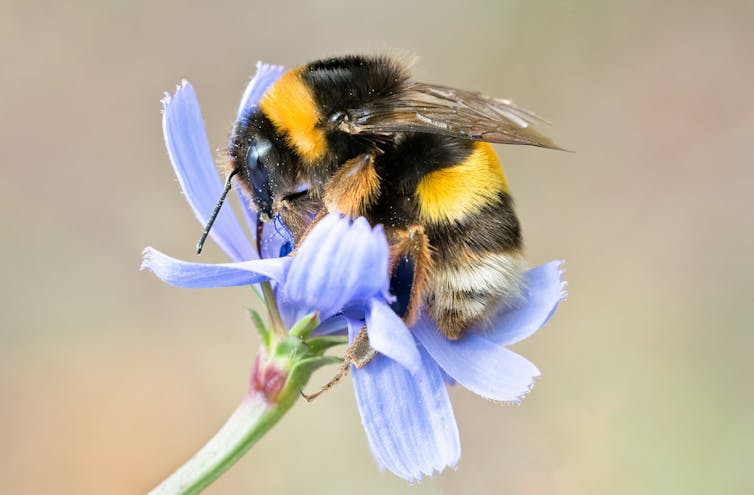
A bee enjoys lunch on a flower in Hillsboro, Ore. HIllsboro Parks & Rec, CC BY-NC-ND

The problem with climate change isn’t just the temperature – it’s also how fast the climate is changing today.

Historically, Earth’s climate changes have generally happened over thousands to millions of years. Today, global temperatures are increasing by about 0.36 degrees Fahrenheit (0.2 degrees Celsius) per decade.

Imagine a car speeding up. Over time, human activities such as burning fossil fuels have increased the amount of greenhouse gases in the atmosphere. These gases trap heat from the Sun. This is like pressing the gas pedal. The faster the driver adds gas, the faster the car goes.

The 21st century has seen a dramatic acceleration in the rate of climate change, with global temperatures rising more than three times faster than in the previous century.

The faster pace and higher temperatures are changing habitat ranges for plants and animals. In some regions, the pace of change is also throwing off the delicate timing of pollination, putting plants and pollinators such as bees at risk.

Some species are already migrating

Most plant and animal species can tolerate or at least recover from short-term changes in climate, such as a heat wave. When the changes last longer, however, organisms may need to migrate into new areas to adapt for survival.

Some species are already moving toward higher latitudes and altitudes with cooler temperatures, altering their geographic territory to stay within their optimal climate. Fish populations, for example, have shifted toward the poles as ocean temperatures have risen.

Pollinators such as bees can also shift their ranges.

Bumblebees, for example, are adapted for cooler regions because of their fuzzy bodies. Some bumblebee populations have been disappearing from the southern parts of their geographic range and have been found in cooler regions to the north and in more mountainous areas. That could increase competition with existing bumblebee populations.

Plants and pollinators can get out of sync

Plants and their pollinators face another problem as the rate of climate change increases: Many plants rely on insects and other animals for seed and pollen dispersal.

Much of that pollen dispersal is accomplished by native pollinators. About 75% of plant species in North America require an insect pollinator – bees, butterflies, moths, flies, beetles, wasps, birds and bats. In fact, 1 in 3 bites of food you eat depend on a pollinator, according to the U.S. Department of Agriculture.

So, even if a species successfully migrates into a new territory, it can face a mismatch of pollination timing. This is known as phenological mismatch.

A butterfly on a flower.
Monarch butterflies migrate each year and rely on plants blooming along their path to provide food. Clint Wirick/U.S. Fish and Wildlife Service

During the winter, insects go into a hibernation known as diapause, migrate or take up shelter underground, under rocks or in leaf litter. These insect pollinators use temperature and daylight length as cues for when to emerge or when to migrate to their spring and summer habitats.

As the rate of climate change increases, the chances of a timing mismatch between pollinators and the plants they pollinate rise.

With an increase in temperature, many plants are blooming earlier in the spring. If bees or other pollinators emerge at their “normal” time, flowers may already be blooming, reducing their chance for pollination.

If pollinators emerge too early, they may struggle to survive if their normal food sources are not yet available. Native bees, for example, rely on pollen for much of the protein they need for growing and thriving.

Wild bees are emerging earlier

This kind of shift in timing is already happening with bees in the U.S.

Studies have shown that the date wild bees emerge in the U.S. has shifted by 10.4 days earlier over the past 130 years, and the pace is accelerating.

One study found wild bees across species have been changing their phenology, or timing of seasonal activities, and over the past 50 years the emergence date is four times faster. That means wild bees were emerging roughly eight days earlier in 2020 than they did in 1970.

A bee on a large white blossom.
A bee pollinates an almond tree in an orchard. David Kosling/U.S. Department of Agriculture, CC BY

This trend of earlier emergence is generally consistent across organisms with the accelerating rate of climate change. If the timing mismatches continue to worsen, it could exacerbate the decline of pollinator populations and result in inadequate pollination for plants that rely on them.

Pollinator decline and inadequate pollination already account for a 3% to 5% decline in global fruit, vegetable, spice and nut production annually, a recent study found.

Without pollinators, ecosystems are less resilient − they are unable to absorb disturbances such as wildfires, adapt to changes, and recover from environmental stressors such as pollution, drought or floods.

Managing climate change

Pollinators face many other risks from human activities, including habitat loss from development and harm from pesticide use. Climate change adds to that list.

Taking steps to reduce the activities driving global warming can help keep these species thriving and carrying out their roles in nature into the future.The Conversation

Courtney McGinnis, Professor of Biology, Medical Sciences and Environmental Sciences, Quinnipiac University

This article is republished from The Conversation under a Creative Commons license. Read the original article.

Space News: What’s up for May 2025


What’s up for May? Four bright planets, morning and night, a chance of meteor showers, and waiting for a nova.

For planet watching this month, you'll find Mars and Jupiter in the west following sunset. Mars sticks around for several hours after it gets dark out, but Jupiter is setting by 9:30 or 10 p.m., and getting lower in the sky each day. The first quarter Moon appears right next to the Red Planet on the 3rd. Find them in the west during the first half of the night that evening.

In the morning sky, Venus and Saturn are the planets to look for in May. They begin the month appearing close together on the sky, and progressively pull farther apart as the month goes on.

For several days in late May, early risers will enjoy a gathering of the Moon with Saturn and Venus in the eastern sky before dawn. Watch as the Moon passes the two planets while becoming an increasingly slimmer crescent. You'll find the Moon hanging between Venus and Saturn on the 23rd.

Early May brings the annual Eta Aquarid meteor shower. These are meteors that originate from Comet Halley. Earth passes through the comet’s dust stream each May, and again in October. Eta Aquarids are fast moving, and a lot of them produce persistent dust trains that linger for seconds after the meteor’s initial streak.

This is one of the best annual showers in the Southern Hemisphere, but tends to be more subdued North of the Equator, where we typically see 10 to 20 meteors per hour. On the peak night this year, the Moon sets by around 3 a.m., leaving dark skies until dawn, for ideal viewing conditions. While the peak is early on the morning of May 6th, the two or three nights before that are also decent opportunities to spy a few shooting stars.

Astronomers have been waiting expectantly for light from a distant explosion to reach us here on Earth. An event called a nova is anticipated to occur sometime in the coming months. Some 3,000 light years away is a binary star system called T Coronae Borealis, or “T CrB.”

It consists of a red giant star with a smaller white dwarf star orbiting closely around it. Now the giant’s outer atmosphere is all puffed up, and the dwarf star is close enough that its gravity continually captures some of the giant’s hydrogen. About every 80 years, the white dwarf has accumulated so much of the other star’s hydrogen, that it ignites a thermonuclear explosion. And that’s the nova.

T Coronae Borealis is located in the constellation Corona Borealis, or the “Northern Crown,” and it’s normally far too faint to see with the unaided eye. But it's predicted the nova will be as bright as the constellation’s brightest star, which is about as bright as the North Star, Polaris. You’ll find Corona Borealis right in between the two bright stars Arcturus and Vega, and you can use the Big Dipper’s handle to point you to the right part of the sky. Try having a look for it on clear, dark nights before the nova, so you’ll have a comparison when a new star suddenly becomes visible there.

Now, you may have heard about this months ago, as astronomers started keeping watch for the nova midway through 2024, but it hasn't happened yet. Predicting exactly when novas or any sort of stellar outburst will happen is tricky, but excitement began growing when astronomers observed the star to dim suddenly, much as it did right before its previous nova in 1946.

When the nova finally does occur, it won't stay bright for long, likely flaring in peak brightness for only a few days. And since it's not predicted again for another 80 years, you might just want to join the watch for this super rare, naked eye stellar explosion in the sky!

Preston Dyches works for NASA's Jet Propulsion Laboratory.

Clear Lake named one of best U.S. fishing lakes for 2025

Clear Lake has once again been named among the nation’s top fishing lakes. Photo by Elizabeth Larson/Lake County News.


LAKE COUNTY, Calif. — Clear Lake is receiving a new honor as one of the nation’s best fishing lakes.

From sprawling lakes teeming with walleye and salmon to reservoirs full of trophy bass and crappie, America is home to some of the most exciting freshwater fishing in the world.

But even though there are thousands of places where you can cast your line, some stand out more than others.

For 2025, FishingBooker — billed as the world’s largest platform for booking fishing trips — has released its list of the Best Fishing Lakes in the U.S., and Clear Lake has earned its place among the top freshwater fishing destinations in the country.

Why did Clear Lake make the cut?

Known as the “Bass Capital of the West,” Clear Lake is one of California’s most prolific largemouth destinations.

Fishing enthusiasts consider it a best-of-both-worlds type of fishery because it produces excellent numbers of bass and lunker-level specimens.

One of Clear Lake’s benefits is that the hottest spots typically lie close to shore. Bass weighing around 4 pounds are very common, but anglers will have a very decent shot at catching bigger ones, too.

To add a bit of diversity into the mix, anglers can also target crappie and catfish out here.

The full list of the 18 Best Fishing Lakes in the U.S. for 2025 includes:

• Clear Lake (California).
• Lake Okeechobee (Florida).
• Lake Fork (Texas).
• Lake St. Clair (Michigan).
• Lake of the Woods (Minnesota/Ontario).
• Guntersville Lake (Alabama).
• Chickamauga Lake (Tennessee).
• Devils Lake (North Dakota).
• Lake Champlain (New York/Vermont).
• Table Rock Lake (Missouri).
• Lake Texoma (Texas/Oklahoma).
• Toledo Bend Reservoir (Texas/Louisiana).
• Mille Lacs Lake (Minnesota).
• Lake Tahoe (California/Nevada).
• Santee Cooper Lakes (South Carolina).
• Blue Mesa Reservoir (Colorado).
• Naknek Lake (Alaska).
• Great Lakes.

More than 100 lawmakers reintroduce Medicare for All

This week, U.S. Senator Alex Padilla (D-Calif.) joined Senator Bernie Sanders (I-Vt.) and over 100 lawmakers in reintroducing the Medicare for All Act, historic legislation that would guarantee health care as a fundamental human right to all people in the United States regardless of income or background.

Despite spending twice as much per person on health care as other wealthy nations, more than 85 million Americans are uninsured or underinsured, one out of every four Americans cannot afford their prescription drugs, over half a million people go bankrupt due to medically-related debt, and more than 60,000 die because they cannot afford to go to a doctor.

“Every American deserves access to high quality, affordable health care, regardless of their zip code or tax bracket,” said Sen. Padilla. “As the Trump Administration recklessly attacks essential public health services that millions of Californians and Americans across the country depend on, guaranteeing the fundamental right to health care is more important than ever. No American should go bankrupt because of medical costs, and Congress must do better to ensure that everyone has equitable access to care.”

“The American people understand, as I do, that health care is a human right, not a privilege and that we must end the international embarrassment of the United States being the only major country on earth that does not guarantee health care to all of its citizens,” said Sen. Sanders. “It is not acceptable to me, nor to the American people, that over 85 million people today are either uninsured or underinsured. Today, there are millions of people who would like to go to a doctor but cannot afford to do so. This is an outrage. In America, your health and your longevity should not be dependent on your wealth. Health care is a human right that all Americans, regardless of income, are entitled to and they deserve the best health care that our country can provide.”

Under this legislation, Medicare would provide comprehensive health care to every American with no premiums, no co-payments, and no deductibles.

It would also expand Medicare to include dental, hearing, and vision care, and it would give every American the freedom to choose their doctors without endless paperwork or fighting their insurance company.

The Congressional Budget Office has estimated that Medicare for All would save the U.S. health care system $650 billion a year. Further, researchers at Yale University have estimated that Medicare for All would save 68,000 lives a year.

Senator Sanders, Ranking Member of the Senate Committee on Health, Education, Labor, and Pensions (HELP), and Representatives Pramila Jayapal (D-Wash.-07) and Debbie Dingell (D-Mich.-06) lead the legislation. Including Senator Padilla, the legislation has 16 cosponsors in the Senate and 104 cosponsors in the House. The total number of cosponsors represents an increase from last Congress and also includes Senators Tammy Baldwin (D-Wis.), Richard Blumenthal (D-Conn.), Cory Booker (D-N.J.), Kirsten Gillibrand (D-N.Y.), Martin Heinrich (D-N.M.), Mazie Hirono (D-Hawaii), Ben Ray Luján (D-N.M.), Ed Markey (D-Mass.), Jeff Merkley (D-Ore.), Brian Schatz (D-Hawaii), Adam Schiff (D-Calif.), Elizabeth Warren (D-Mass.), Peter Welch (D-Vt.), and Sheldon Whitehouse (D-R.I.).

“Nurses see the failure of our country’s profit-driven health care system every time we clock in to work,” said Nancy Hagans, president of National Nurses United. “In the richest country on earth, nobody should be forced to choose between taking their medications and putting food on the table. Yet countless families are pushed to the breaking point while greedy corporations charge astronomical, ludicrous fees for care that our patients have every right to receive. Nurses are fighting for a future in which our patients’ health is put first always and that’s why we are proud to continue our support for Medicare for All. When we guarantee health care for all, corporations and billionaires will no longer be able to deny anyone the care that they need.”

“We are long overdue for a universal health care system that guarantees care for all — free of copays, deductibles, and job-based coverage restrictions,” said Dr. Diljeet K. Singh, M.D., Dr.P.H., and president of Physicians for a National Health Program. “With the passage of the Medicare for All Act, physicians can focus on healing patients, not battling insurers over denials and delays. Patients will finally be able to seek care without the constant fear of crushing medical bills. Physicians for a National Health Program proudly stands with our legislators in the fight to make excellent health care a reality for everyone in America.”
  • 199
  • 200
  • 201
  • 202
  • 203
  • 204
  • 205
  • 206
  • 207
  • 208

Community

  • Lake County Wine Alliance offers sponsor update; beneficiary applications open 

  • Mendocino National Forest announces seasonal hiring for upcoming field season

Public Safety

  • Lakeport Police logs: Thursday, Jan. 15

  • Lakeport Police logs: Wednesday, Jan. 14

Education

  • Woodland Community College receives maximum eight-year reaffirmation of accreditation from ACCJC

  • SNHU announces Fall 2025 President's List

Health

  • California ranks 24th in America’s Health Rankings Annual Report from United Health Foundation

  • Healthy blood donors especially vital during active flu season

Business

  • Two Lake County Mediacom employees earn company’s top service awards

  • Redwood Credit Union launches holiday gift and porch-to-pantry food drives

Obituaries

  • Rufino ‘Ray’ Pato

  • Patty Lee Smith

Opinion & Letters

  • The benefits of music for students

  • How to ease the burden of high electric bills

Veterans

  • CalVet and CSU Long Beach team up to improve data collection related to veteran suicides

  • A ‘Big Step Forward’ for Gulf War Veterans

Recreation

  • Wet weather trail closure in effect on Upper Lake Ranger District

  • Mendocino National Forest seeking public input on OHV grant applications

  • State Parks announces 2026 Anderson Marsh nature walk schedule 

  • BLM lifts seasonal fire restrictions in central California

Religion

  • Kelseyville Presbyterian to host Ash Wednesday service and Lenten dinner Feb. 18

  • Kelseyville Presbyterian Church to hold ‘Longest Night’ service Dec. 21

Arts & Life

  • Auditions announced for original musical ‘Even In Shadow’ set for March 21 and 28

  • ‘The Rip’ action heist; ‘Steal’ grounded in a crime thriller

Government & Politics

  • Lake County Democrats issue endorsements in local races for the June California Primary

  • County negotiates money-saving power purchase agreement

Legals

  • March 3 hearing on ordinance amending code for commercial cannabis uses

  • Feb. 12 public hearing on resolution to establish standards for agricultural roads

How to resolve AdBlock issue?
Refresh this page