How to resolve AdBlock issue?
Refresh this page
How to resolve AdBlock issue?
Refresh this page
Lake County News,California
  • Home
    • Registration Form
  • News
    • Education
    • Veterans
    • Community
      • Obituaries
      • Letters
      • Commentary
    • Police Logs
    • Business
    • Recreation
    • Health
    • Religion
    • Legals
    • Arts & Life
    • Regional
  • Calendar
  • Contact us
    • FAQs
    • Phones, E-Mail
    • Subscribe
  • Advertise Here
  • Login

News

California sues Trump administration for dismantling AmeriCorps

The state of California has joined nearly two dozen other states in suing the Trump administration over the efforts of the so-called Department of Government Efficient, or DOGE, to dismantle AmeriCorps — the federal agency vital to supporting volunteer and service efforts in California and across the country.

DOGE has taken action to terminate AmeriCorps grants and dismantle the agency through an 85% reduction of its workforce, effectively ending the agency’s ability to continue administering the programs, operations, and funding that make its important work possible.

AmeriCorps is an independent federal agency tasked with engaging Americans in meaningful community-based service that directly addresses the country’s educational, public safety and environmental needs.

Every year, AmeriCorps provides opportunities for more than 200,000 Americans to serve their communities.

AmeriCorp’s work in Lake County has included work in schools, food drives, and projects with parks, nonprofits and local agencies.

“Service sits at the very core of who we are as Americans,” said Gov. Gavin Newsom. “California is suing the Trump administration to defend thousands of hardworking service members and the communities they serve. These actions by President Trump and Elon Musk not only threaten our funding — they vandalize our values. We’re going to fight to stop them.”

In the complaint filed on Tuesday, California Attorney General Rob Bonta and a multistate coalition argue that by abruptly canceling critical grants and gutting AmeriCorps’ workforce, the Trump administration is effectively shuttering the national volunteer agency and ending states’ abilities to support AmeriCorps programs within their borders.

The coalition establishes that the Trump administration has acted unlawfully in its gutting of AmeriCorps, violating both the Administrative Procedures Act and the separation of powers under the U.S. Constitution. Congress has created AmeriCorps and the programs it administers, and the president cannot incapacitate the agency’s ability to administer appropriated grants or carry out statutorily assigned duties.

Further, by dismantling AmeriCorps and its programs, which are creations of Congress, the Trump Administration has violated the Executive Branch’s obligation to take care that the law is faithfully executed, the lawsuit alleges.

“AmeriCorps volunteers bring out the best in America and in our communities. By abruptly canceling critical grants and gutting AmeriCorps’ workforce and volunteers, DOGE is dismantling AmeriCorps without any concern for the thousands of people who are ready and eager to serve their country — or for those whose communities are stronger because of this public service,” said Attorney General Bonta. “In California, AmeriCorps volunteers build affordable housing, clean up our environment, and address food insecurity in communities across our state. California has repeatedly taken action to hold the Trump Administration and DOGE accountable to the law — and we stand prepared to do it again to protect AmeriCorps and the vital services it provides.”

AmeriCorps supports national and state community service programs by providing opportunities for Americans to serve their communities and by awarding grants to local and national organizations and agencies which use funding to address critical community needs. These organizations and agencies use AmeriCorps funding to recruit, place, and supervise AmeriCorps members nationwide.

AmeriCorps members and volunteers have connected veterans to essential services, fought the opioid epidemic, helped older adults age with dignity, rebuilt communities after disasters, and improved the physical and mental well-being of millions of Americans.

In early February, the Trump Administration issued an executive order directing every federal agency to plan to reduce the size of its workforce and prepare to initiate large-scale reductions in force. Since then, AmeriCorps has placed at least 85% of its workforce on administrative leave immediately and notified employees that they would be terminated effective June 24, 2025.

On April 25, California received notice from the federal government of termination of its AmeriCorps grant programs which support volunteer and service efforts. Grant cancellations and program termination notices were sent to approximately 1,031 programs nationwide.

“DOGE isn’t just cutting jobs — they’re attacking the very people who keep California strong,” said GO-Serve Director Josh Fryday. “They’re coming after the service members who responded to the LA fires, the tutors helping our kids and the young leaders caring for our seniors. It’s outrageous, it’s illegal and we won’t back down. In California, we’re not just defending service — we’re strengthening it. California is doubling down, and we trust the courts will strike this down and uphold the values we fight for every day.”

As the federal government cuts AmeriCorps programs, officials said the state is recruiting for the California Service Corps program — already the largest service corps in the nation, surpassing the size of the Peace Corps.

AmeriCorp’s California impact

AmeriCorps funds support California public agencies and nonprofits that provide critical services to low-income communities.

In 2024, at least 6,150 California members served at at least 1,200 locations, including schools, food banks, homeless shelters, health clinics, youth centers, veterans’ facilities, and other nonprofit and faith-based organizations.

AmeriCorps invested more than $133 million in federal funding to California last year to support cost-effective community solutions, working with local partners on the ground to help communities, who most intimately understand their needs, tackle their toughest challenges.

When the devastating fires struck Los Angeles earlier this year, AmeriCorps members were on the ground, distributing supplies and supporting families. The agency’s shutdown ends these efforts.

California Service Corps is the largest service force in the nation, consisting of four paid service programs: CaliforniansForAll College Corps, California Climate Action Corps, Youth Service Corps and AmeriCorps California.

Combined, the California Service Corps is a force larger than the Peace Corps and is mobilized at a time when California is addressing post-pandemic academic recovery, rebuilding from the LA fires and planning for the future of the state’s workforce.

In the 2023-24 service year, AmeriCorps members in California:

• Provided 4,397,674 hours of service;
• Tutored/mentored 73,833 students;
• Supported 17,000 foster youth with education and employment;
• Planted 39,288 trees;
• Members helped 26,000 households impacted by the LA fires and packed 21,000 food boxes.

In bringing Tuesday’s lawsuit Attorney General Bonta and the attorneys general of Maryland, Delaware, and Colorado lead the attorneys general of Arizona, Connecticut, Hawaii, Illinois, Maine, Massachusetts, Michigan, Minnesota, Nevada, New Jersey, New Mexico, New York, North Carolina, Oregon, Rhode Island, Vermont, Washington, Wisconsin, the District of Columbia and the states of Kentucky and Pennsylvania.

Environmental panel approves bill calling for tribal input on water projects

A bill requiring the State Water Quality Control Board or regional water quality control board to describe and consider the impact on tribes of proposed water projects subject to their approval was approved today by the Assembly Committee on Environmental Safety and Toxic Materials.

Assemblymember James C. Ramos (D-San Bernardino) introduced the bill, AB 362, that also requires the state and local boards to adopt, when applicable, water quality standards to protect reasonable protections of tribal water uses.

“Under current law State and Regional Water Boards are not required to work with tribal communities even though the state’s First People have managed the land and its resources for centuries,” Ramos said. “Tribes are committed to the health and safety of delicate eco systems and a tradition of responsibility and stewardship. This long history and deep knowledge by our tribes deserves to be respected, and put to good use as we work to wisely manage our natural resources.

“We appreciate and applaud Committee Chair Damon Connolly and the committee members’ leadership today in voting to expedite the equitable protection of tribal uses of water,” said bill sponsor Shingle Springs Band of Miwok Indians’ Vice Chairperson Malissa Tayaba said. “By moving this critical issue forward, it shows a recognition of the need to finally elevate tribal beneficial uses to the same level as other beneficial uses that were codified decades ago. Designation and implementation of tribal uses statewide is long overdue. It’s time that California finally acts to put tribal uses of water on equal footing with other beneficial uses.”

In managing water quality and access, the State Water Board designates certain uses such as recreation, navigation, and preservation and protection of aquatic resources and wildlife as beneficial uses of water that are defined in the California Code of Regulations.

Also supporting AB 362 are Audubon California, Blue Lake Rancheria Tribe of California, Buena Vista Rancheria of Me-Wuk Indians, California Environmental Voters, California Indian Environmental Alliance, California Nations Indian Gaming Association, Clean Water Action, Colfax Todds Valley Consolidated Tribe of the Colfax Rancheria, Defenders of Wildlife, Friends of the River, Hopland Band of Pomo Indians, La Jolla Band of Luiseño Indians, Restore the Delta, San Francisco Baykeeper, Santa Rosa Rancheria Tachi Yokut Tribe, Santa Ynez Band of Chumash Indians, Save California Salmon, Sierra Club, Sierra Consortium Suscol Intertribal Council, The Climate Reality Project, California State Coalition, The Sierra Fund, Water Climate Trust and Wilton Rancheria.

AB 362 will head next to the Assembly Appropriations Committee.

Clearlake City Council to consider abatement cases

CLEARLAKE, Calif. — The Clearlake City Council this week will discuss appeals of abatement actions against several properties.

The council will meet at 6 p.m. Thursday, May 1, in the council chambers at Clearlake City Hall, 14050 Olympic Drive.

The agenda can be found here.

The meeting will be broadcast live on the city's YouTube channel or the Lake County PEGTV YouTube Channel.

Community members also can participate via Zoom. The webinar ID is 882 1128 7564, the pass code is 893215. One tap mobile is available at +16694449171,,82771053751#, or join by phone at 669-444-9171 or 646-931-3860.

On Thursday, the council will host presentations of proclamations declaring May 11 to 17 as Police Week, May 4 to 10 as Public Service Recognition Week and May 12 to 16 as Military Appreciation Week.

The council also will receive a presentation on the Annual Public, Education and Government Channel Board report.

On Thursday’s agenda are two public hearings regarding abatements.

The first is to hear and act upon appeals of orders to abate for properties at 15893 33rd Ave., 16721 Cache Creek Lane, 4800 Old Highway 53, 4782 Yarrington Court, 4030 Hayward Ave., 14042 Woodland Drive, 3228 Third St., 3297 Third St., 3152 Ninth St., 3426 12th St., 3307 13th St., 3188 14th St., 3059 Eastlake Drive and 3223 Eastlake Drive.

Staff is asking the council to adopt a resolution denying the appeals.

The second public hearing also will be to consider appeals of an order to abate for a property at 6725 Old Highway 53.

In that case, the council also is being asked to adopt a resolution denying the appeals.

The cases in question for the two hearings were initiated between 2019 and 2024, staff reported.

On the meeting's consent agenda — items that are considered routine in nature and usually adopted on a single vote — are warrants and council minutes.

The council also will hold a closed session for a performance evaluation of City Manager Alan Flora.

Email Elizabeth Larson at This email address is being protected from spambots. You need JavaScript enabled to view it.. Follow her on Twitter, @ERLarson, and on Bluesky, @erlarson.bsky.social. Find Lake County News on the following platforms: Facebook, @LakeCoNews; X, @LakeCoNews; Threads, @lakeconews, and on Bluesky, @lakeconews.bsky.social.

Training equips new commercial tobacco cessation facilitators for Lake and Mendocino counties

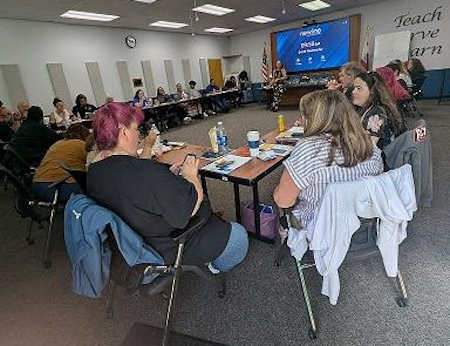
Participants at a training for commercial tobacco cessation facilitators. Photo courtesy of Hope Rising.

LAKE COUNTY, Calif. — Efforts to improve Lake County’s health by reducing smoking and vaping took another step forward recently.

Hope Rising Lake County organized and hosted a commercial tobacco smoking and vaping cessation facilitator training that resulted in 28 newly trained facilitators across Lake and Mendocino counties.

The class, led by Lou Moerner — a nationally recognized expert in commercial tobacco cessation — is a major milestone in the ongoing work to improve community health.

The training was a direct outcome of the Lake County Innovation Summit, held in the fall of 2024, where addressing commercial tobacco use was identified as a top priority for improving the county’s health outcomes.

Participants from a diverse group of organizations came together to complete the training, including Adventist Health Clear Lake, Blue Zones Project Lake County, Sutter Lakeside Hospital, Lake County Public Health, Kno'Qoti Native Wellness Inc., Lake County Office of Education, Mendocino County Public Health, Lakeview Health Center and Konocti Unified School District.

The intensive workshop equipped attendees with the tools to:

• Understand the power of nicotine addiction and its hold on users
• Teach the risks associated with tobacco use and the life-changing benefits of quitting
• Guide participants in preparing personalized quit plans
• Offer strategies to prevent relapse
• Educate on cessation therapy aids, including how medications work and proper usage.

“This initiative marks a significant step toward empowering our local organizations to help individuals break free from commercial tobacco and vaping addiction,” said Christina Braden, project manager for Hope Rising / Adventist Health Clear Lake. “Thanks to Hope Rising’s leadership, led by Executive Director Laurie Allen, and the momentum generated at the Innovation Summit, we are building a stronger foundation for public health in our communities.”

Tobacco use in Lake County: A persistent challenge

Lake County faces some of the highest commercial tobacco use rates in California.

In 2021, nearly 20% of adults in Lake County reported smoking cigarettes, compared to the statewide average of around 10%, according to the California Department of Public Health.

Commercial tobacco-related illnesses remain a leading cause of preventable death, driving up healthcare costs and lowering quality of life.

With these newly trained facilitators now ready to lead cessation classes throughout Lake and Mendocino counties, the region is better equipped than ever to offer hope and real solutions to individuals ready to quit smoking and vaping.

For more information about upcoming cessation classes or to learn how to get involved, contact Christina Braden, This email address is being protected from spambots. You need JavaScript enabled to view it..

New event to raise funds for animal rescue organizations

LAKEPORT, Calif. — A new event set for May will raise funds to support animal rescue organizations.

The inaugural “It’s for the Dogz … and Catz” fun run and fundraiser will take place on Saturday, May 17.

Send Rover on Over will host the one-mile fun run and 5k fundraiser at 2945 Reeves Lane in Lakeport.

The pre-run festivities begin at 9 a.m., with the walk and run starting at 9:30 a.m.

For a suggested tax-deductible donation of $25, attendees will enjoy entry to the race and access to exciting festivities.

Come early for breakfast treats and hydration (available for purchase), meet rescue founders, and connect with vendors supporting the cause.

Proceeds will benefit several vital local organizations including A Home for Rover Inc., Street Dawgs, Clearlake Animal Association, Lake County Dog Crisis and Mendo Shelter Pets Rescue.

Funds will support spaying/neutering, feeding pets in need, trapping loose dogs, fostering and community outreach efforts.

Attendees can also look forward to raffle prizes generously donated by local businesses.

For more details, contact 805-794-6372 or email This email address is being protected from spambots. You need JavaScript enabled to view it..

Cancer research in the US is world class because of its broad base of funding − with the government pulling out, its future is uncertain


Without federal support, the lights will turn off in many labs across the country. Thomas Barwick/Stone via Getty Images

Cancer research in the U.S. doesn’t rely on a single institution or funding stream − it’s a complex ecosystem made up of interdependent parts: academia, pharmaceutical companies, biotechnology startups, federal agencies and private foundations. As a cancer biologist who has worked in each of these sectors over the past three decades, I’ve seen firsthand how each piece supports the others.

When one falters, the whole system becomes vulnerable.

The United States has long led the world in cancer research. It has spent more on cancer research than any other country, including more than US$7.2 billion annually through the National Cancer Institute alone. Since the 1971 National Cancer Act, this sustained public investment has helped drive dramatic declines in cancer mortality, with death rates falling by 34% since 1991. In the past five years, the Food and Drug Administration has approved over 100 new cancer drugs, and the U.S. has brought more cancer drugs to the global market than any other nation.

But that legacy is under threat. Funding delays, political shifts and instability across sectors have created an environment where basic research into the fundamentals of cancer biology is struggling to keep traction and the drug development pipeline is showing signs of stress.

These disruptions go far beyond uncertainty and have real consequences. Early-career scientists faced with unstable funding and limited job prospects may leave academia altogether. Mid-career researchers often spend more time chasing scarce funding than conducting research. Interrupted research budgets and shifting policy priorities can unravel multiyear collaborations. I, along with many other researchers, believe these setbacks will slow progress, break training pipelines and drain expertise from critical areas of cancer research – delays that ultimately hurt patients waiting for new treatments.

A 50-year foundation of federal investment

The modern era of U.S. cancer research began with the signing of the National Cancer Act in 1971. That law dramatically expanded the National Cancer Institute, an agency within the National Institutes of Health focusing on cancer research and education. The NCI laid the groundwork for a robust national infrastructure for cancer science, funding everything from early research in the lab to large-scale clinical trials and supporting the training of a generation of cancer researchers.

This federal support has driven advances leading to higher survival rates and the transformation of some cancers into a manageable chronic or curable condition. Progress in screening, diagnostics and targeted therapies – and the patients who have benefited from them – owe much to decades of NIH support.

The Trump administration is cutting billions of dollars of biomedical research funding.

But federal funding has always been vulnerable to political headwinds. During the first Trump administration, deep cuts to biomedical science budgets threatened to stall the progress made under initiatives such as the 2016 Cancer Moonshot. The rationale given for these cuts was to slash overall spending, despite facing strong bipartisan opposition in Congress. Lawmakers ultimately rejected the administration’s proposal and instead increased NIH funding. In 2022, the Biden administration worked to relaunch the Cancer Moonshot.

This uncertainty has worsened in 2025 as the second Trump administration has cut or canceled many NIH grants. Labs that relied on these awards are suddenly facing funding cliffs, forcing them to lay off staff, pause experiments or shutter entirely. Deliberate delays in communication from the Department of Health and Human Services have stalled new NIH grant reviews and funding decisions, putting many promising research proposals already in the pipeline at risk.

Philanthropy’s support is powerful – but limited

While federal agencies remain the backbone of cancer research funding, philanthropic organizations provide the critical support for breakthroughs – especially for new ideas and riskier projects.

Groups such as the American Cancer Society, Stand Up To Cancer and major hospital foundations have filled important gaps in support, often funding pilot studies or supporting early-career investigators before they secure federal grants. By supporting bold ideas and providing seed funding, they help launch innovative research that may later attract large-scale support from the NIH.

Without the bureaucratic constraints of federal agencies, philanthropy is more nimble and flexible. It can move faster to support work in emerging areas, such as immunotherapy and precision oncology. For example, the American Cancer Society grant review process typically takes about four months from submission, while the NIH grant review process takes an average of eight months.

Crowd of people in white T-shirts reading 'RUN JEFF RUN' standing in front of a backdrop of a sign with the American Cancer Society logo and another sign reading 'CALL IN YOUR PLEDGE...'
Ted Kennedy Jr., right, and Jeff Keith raise money for the American Cancer Society in 1984. Mikki Ansin/Getty Images

But philanthropic funds are smaller in scale and often disease-specific. Many foundations are created around a specific cause, such as advancing cures for pancreatic, breast or pediatric cancers. Their urgency to make an impact allows them to fund bold approaches that federal funders may see as too preliminary or speculative. Their giving also fluctuates. For instance, the American Cancer Society awarded nearly $60 million less in research grants in 2020 compared with 2019.

While private foundations are vital partners for cancer research, they cannot replace the scale and consistency of federal funding. Total U.S. philanthropic funding for cancer research is estimated at a few billion dollars per year, spread across hundreds of organizations. In comparison, the federal government has typically contributed roughly five to eight times more than philanthropy to cancer research each year.

Industry innovation − and its priorities

Private-sector innovation is essential for translating discoveries into treatments. In 2021, nearly 80% of the roughly $57 billion the U.S. spent on cancer drugs came from pharmaceutical and biotech companies. Many of the treatments used in oncology today, including immunotherapies and targeted therapies, emerged from collaborations between academic labs and industry partners.

But commercial priorities don’t always align with public health needs. Companies naturally focus on areas with strong financial returns: common cancers, projects that qualify for fast-track regulatory approval, and high-priced drugs. Rare cancers, pediatric cancers and basic science often receive less attention.

Industry is also saddled with uncertainty. Rising R&D costs, tough regulatory requirements and investor wariness have created a challenging environment to bring new drugs to market. Several biotech startups have folded or downsized in the past year, leaving promising new drugs stranded in limbo in the lab before they can reach clinical trials.

Without federal or philanthropic entities to pick up the slack, these discoveries may never reach the patients who need them.

A system under strain

Cancer is not going away. As the U.S. population ages, the burden of cancer on society will only grow. Disparities in treatment access and outcomes persist across race, income and geography. And factors such as environmental exposures and infectious diseases continue to intersect with cancer risk in new and complex ways.

Addressing these challenges requires a strong, stable and well-coordinated research system. But that system is under strain. National Cancer Institute grant paylines, or funding cutoffs, remain highly competitive. Early-career researchers face precarious job prospects. Labs are losing technicians and postdoctoral researchers to higher-paying roles in industry or to burnout. And patients, especially those hoping to enroll in clinical trials, face delays, disruptions and dwindling options.

Protectors holding signs reading 'SUPPORT SCIENCE' and 'IN SCIECE WE TRUST,' among others
Researchers have been rallying to protect the future of science in the U.S. AP Photo/John McDonnell

This is not just a funding issue. It’s a coordination issue between the federal government, academia and industry. There are currently no long-term policy solutions that ensure sustained federal investment, foster collaboration between academia and industry, or make room for philanthropy to drive innovation instead of just filling gaps.

I believe that for the U.S. to remain a global leader in cancer research, it will need to recommit to the model that made success possible: a balanced ecosystem of public funding, private investment and nonprofit support. Up until recently, that meant fully funding the NIH and NCI with predictable, long-term budgets that allow labs to plan for the future; incentivizing partnerships that move discoveries from bench to bedside without compromising academic freedom; supporting career pathways for young scientists so talent doesn’t leave the field; and creating mechanisms for equity to ensure that research includes and benefits all communities.

Cancer research and science has come a long way, saving about 4.5 million lives in the U.S. from cancer from 1991 to 2022. Today, patients are living longer and better because of decades of hard-won discoveries made by thousands of researchers. But science doesn’t run on good intentions alone. It needs universities. It needs philanthropy. It needs industry. It needs vision. And it requires continued support from the federal government.The Conversation

Jeffrey MacKeigan, Professor of Pediatrics and Human Development, Michigan State University

This article is republished from The Conversation under a Creative Commons license. Read the original article.

  • 202
  • 203
  • 204
  • 205
  • 206
  • 207
  • 208
  • 209
  • 210
  • 211

Community

  • Lake County Wine Alliance offers sponsor update; beneficiary applications open 

  • Mendocino National Forest announces seasonal hiring for upcoming field season

Public Safety

  • Lakeport Police logs: Thursday, Jan. 15

  • Lakeport Police logs: Wednesday, Jan. 14

Education

  • Woodland Community College receives maximum eight-year reaffirmation of accreditation from ACCJC

  • SNHU announces Fall 2025 President's List

Health

  • California ranks 24th in America’s Health Rankings Annual Report from United Health Foundation

  • Healthy blood donors especially vital during active flu season

Business

  • Two Lake County Mediacom employees earn company’s top service awards

  • Redwood Credit Union launches holiday gift and porch-to-pantry food drives

Obituaries

  • Rufino ‘Ray’ Pato

  • Patty Lee Smith

Opinion & Letters

  • The benefits of music for students

  • How to ease the burden of high electric bills

Veterans

  • CalVet and CSU Long Beach team up to improve data collection related to veteran suicides

  • A ‘Big Step Forward’ for Gulf War Veterans

Recreation

  • Wet weather trail closure in effect on Upper Lake Ranger District

  • Mendocino National Forest seeking public input on OHV grant applications

  • State Parks announces 2026 Anderson Marsh nature walk schedule 

  • BLM lifts seasonal fire restrictions in central California

Religion

  • Kelseyville Presbyterian to host Ash Wednesday service and Lenten dinner Feb. 18

  • Kelseyville Presbyterian Church to hold ‘Longest Night’ service Dec. 21

Arts & Life

  • Auditions announced for original musical ‘Even In Shadow’ set for March 21 and 28

  • ‘The Rip’ action heist; ‘Steal’ grounded in a crime thriller

Government & Politics

  • Lake County Democrats issue endorsements in local races for the June California Primary

  • County negotiates money-saving power purchase agreement

Legals

  • March 3 hearing on ordinance amending code for commercial cannabis uses

  • Feb. 12 public hearing on resolution to establish standards for agricultural roads

How to resolve AdBlock issue?
Refresh this page