How to resolve AdBlock issue?
Refresh this page
How to resolve AdBlock issue?
Refresh this page
Lake County News,California
  • Home
    • Registration Form
  • News
    • Education
    • Veterans
    • Community
      • Obituaries
      • Letters
      • Commentary
    • Police Logs
    • Business
    • Recreation
    • Health
    • Religion
    • Legals
    • Arts & Life
    • Regional
  • Calendar
  • Contact us
    • FAQs
    • Phones, E-Mail
    • Subscribe
  • Advertise Here
  • Login

News

Police, county health agencies conduct outreach at encampments

CLEARLAKE, Calif. — The Clearlake Police Department reported on its latest effort, in collaboration with county agencies, to address encampments through outreach and referrals to services.

On Wednesday, the department conducted a multi-agency outreach operation in collaboration with Lake County Behavioral Health Services and Lake County Adult Protective Services.

Police said the goal of the operation was to assess unlawful encampments, abandoned vehicles and debris accumulation, while simultaneously providing vital support services to individuals in need.

The operation focused on multiple locations, east of Walmart, a region known for illegal campsites, large-scale dumping and a history of fire hazards, police said.

During the operation, approximately 13 individuals were contacted. Police said all of the contacted individuals were provided with printed resource guides for housing, mental health and social service programs available throughout Lake County, along with care packages.

At the unoccupied encampments, the printed resource materials and care packages were left, so that the occupants would have access to them when they return, the department reported.

The city of Clearlake thanked Lake County Behavioral Health Services and Adult Protective Services for their assistance. “Their presence and expertise during this operation was instrumental in providing meaningful, person-centered outreach,” the city said.

Police said additional operations of this nature are planned throughout the city as part of an ongoing effort to address illegal encampments, reduce public health risks, fire hazards and connect individuals with services that promote improved quality of life.

Some travel, entertainment, recreation related industries back from pandemic downturn by 2022

At the height of the COVID-19 pandemic U.S. offices and entertainment venues shuttered, dealing a financial blow to travel and many other recreation-related industries.

As people started returning to work and recreation, many of these industries began to recover, with some reaching pre-pandemic levels as early as 2022, two years after the pandemic struck the United States.

In this article, we use U.S. Census Bureau employment and revenue data available to show how quickly selected recreation, travel, entertainment and other related industries rebounded from the pandemic.

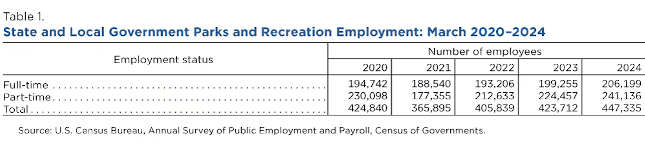
Table 1. State and Local Government Parks and Recreation Employment: March 2020-2024


Parks and recreation, hunting and fishing

The Census Bureau’s Annual Survey of Public Employment & Payroll (ASPEP) shows that the number of full- and part-time people employed by state and local governments at parks and recreational facilities (golf courses, camping grounds, public pools, marinas, etc.) initially declined from 2020 to 2021, but grew steadily the next three years (Table 1).

The ASPEP publishes annual public sector employment estimates for the pay period that includes March 12. These estimates give us timely pre-pandemic numbers, considering this reporting period was just days before the start of pandemic shutdowns.

State and local governments employed 365,895 parks and recreation workers in 2021, down 13.9% from 2020.

Most of the job loss was among part-time employees; about 22.9% of part-time employees were let go or left compared to 3.2% of full-time employees.

As residents increasingly engaged in outdoor activities, parks and recreation-related employment grew by 10.9% to 405,839 in 2022 and by 4.4% to 423,712 in 2023.

In the latest release of ASPEP data, parks and recreation employment grew by 5.6% to 447,335 employees in 2024, surpassing its pre-pandemic level.

Unlike many other recreation sectors, hunting and fishing license fee collections actually grew from 2020 to 2024. According to the Census Bureau’s Annual Survey of State Tax Collections, these totaled $1.8 billion in 2020, up 7.8% from 2019.

As other activities reopened, fee collections still grew but at a slower pace: up 3.4% in 2021, 0.1% in 2022, 1.4% in 2023 and 0.7% to $1.9 billion in 2024.


Travel and transportation

Air and sea travel

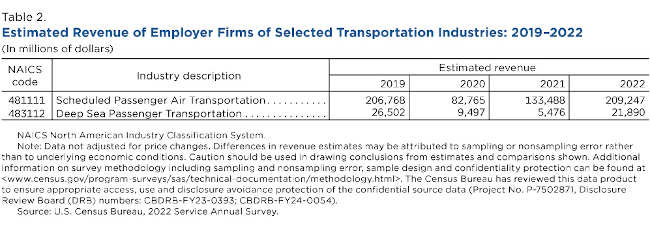
Revenue of Scheduled Passenger Air Transportation dropped 60.0% from $206.8 billion in 2019 to $82.8 billion in 2020 (Table 2), according to the Census Bureau’s 2022 Service Annual Survey (SAS) – which provides estimated revenues for employer firms across services.

The industry (which covers transportation of passengers and/or cargo over regular routes and on regular schedules) started to recover in 2021, with revenue climbing to $133.5 billion. It did not rebound to 2019 levels until 2022.

While the Deep Sea Passenger Transportation industry began to recover in 2022, it was still behind 2019 pre-pandemic levels (Table 2). This industry provides deep sea transportation of passengers to and from foreign ports.

According to the SAS, the revenue of this industry dropped 64.2% from $26.5 billion in 2019 to $9.5 billion in 2020. It continued to fall, dropping 42.3% to $5.5 billion in 2021.

In 2022, it soared 299.7% to $21.9 billion, a significant jump but still 17.4% lower than 2019 revenue levels ($26.5 billion). That year (2022), the Centers for Disease Control and Prevention (CDC) updated its pandemic cruise ship restrictions, allowing individual cruise lines to monitor their own COVID-19 protocols. But most major cruise lines did not drop testing requirements until fall 2022.


Taxi, charter bus and limousine services

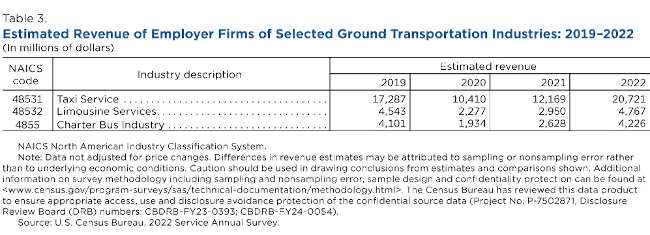
In 2019, the Taxi Service industry thrived with revenues of $17.3 billion, according to the SAS (Table 3). By the end of 2020, however, revenues had dropped 39.8% to $10.4 billion. The taxi service industry eventually surpassed its 2019 revenue by 19.9% to $20.7 billion in 2022.

The Charter Bus Industry and Limousine Services followed similar year-to-year revenue trajectories (Table 3).

In 2019, the charter bus industry had annual revenues of $4.1 billion. Revenues dropped 52.8% in 2020 to $1.9 billion but increased in 2021 and returned to pre-pandemic levels ($4.2 billion) in 2022.

Limousine Services had $4.5 billion in revenue in 2019, which fell 49.9% to about $2.3 billion in 2020. Revenues increased 29.6% in 2021, followed by another 61.6% in 2022.


Entertainment: Promoters of performing arts, sports and similar events

During the COVID pandemic, many live entertainment events were cancelled or postponed for over a year. According to Oxford Economics, a leading global economic advisory firm, concerts and other live entertainment significantly drive economic activity across the United States, also contributing to off-site spending in places like local bars, restaurants, transportation, lodging, parking and retail.

The New York Times reported that in 2020, the sports industry and music festivals faced one of their largest economic challenges in a decade.

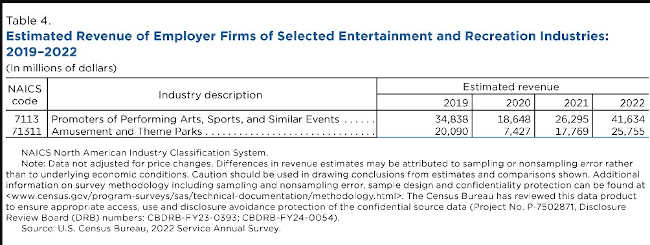
According to the SAS, the Promoters of Performing Arts, Sports, and Similar Events industry experienced a 46.5% decrease in revenue from $34.8 billion in 2019 to $18.6 billion in 2020 (Table 4).

But from 2021 to 2022, revenue went up 58.3% from $26.3 billion to $41.6 billion, surpassing 2019 levels.

The Amusement and Theme Parks industry also bounced back (Table 4).

This industry’s revenue fell 63.0% from $20.1 billion in 2019 to $7.4 billion in 2020. In 2021, revenues rose 139.2% to $17.8 billion and in 2022 by 44.9% to $25.8 billion, exceeding pre-pandemic levels.

Maria Villarreal is a survey statistician in the Census Bureau’s Accommodations, Entertainment, and Consumer Services Branch of the Economy-Wide Statistics Division. Letha Rubin is a supervisory survey statistician in the Census Bureau’s Healthcare and Educational Services Branch of the Economy-Wide Statistics Division. Laura Tilley is a survey statistician in the Census Bureau’s Information and Business Services Branch of the Economy-Wide Statistics Division. Sandra Cooke-Hull is an economist in the Census Bureau’s Public Sector Programs Office of the Economy-Wide Statistics Division

Whooping cough is making a comeback, but the vaccine provides powerful protection


Infants can get vaccinated against whooping cough starting at 6 weeks of age. Hill Street Studios/Corbis via Getty Images

Whooping cough, a bacterial infection that can be especially dangerous for babies and young children, is on the rise. Already in 2025 the U.S. has recorded 8,485 cases. That’s compared with 4,266 cases during the same period in 2024.

Like measles, which is also spreading at unprecedented levels, whooping cough, more formally known as pertussis, can be prevented by a safe and effective vaccine. But with anti-vaccine sentiment increasing and cuts to immunization services, vaccination rates for whooping cough over the past two years have declined in children.

The Conversation asked epidemiologist Annette Regan to explain why pertussis has become so prevalent and how families can protect themselves from the disease.

What is pertussis and why is it dangerous?

Pertussis is a vaccine-preventable disease caused by the bacterium Bordetella pertussis. Researchers in France first identified the B. pertussis bacterium in 1906. The first recorded epidemic of pertussis is thought to have occurred in Paris in 1578.

Infection can cause an acute respiratory illness characterized by severe and spasmodic coughing spells. The classic symptom of pertussis is a “whoop” sound caused by someone trying to breath during a bad cough. Severe complications of pertussis include slowed or stopped breathing, pneumonia and seizures. The disease is most severe in young babies, although severe cases and deaths can also occur in older children and adults.

Some doctors call pertussis “the 100-day cough” because symptoms can linger for weeks or even months.

The World Health Organization estimates that 24.1 million pertussis cases and 160,700 deaths occur worldwide in children under 5 each year. Pertussis is highly contagious. Upon exposure, 80% of people who have not been previously exposed to the bacterium or vaccinated against the disease will develop an infection.

Fortunately, the disease is largely preventable with a safe and effective vaccine, which was first licensed in the U.S. in 1914.

Whooping cough causes violent fits of coughing that can make it difficult to inhale.

How do cases last year and this year compare with past years?

During the COVID-19 pandemic between 2020 and 2022, pertussis cases were lower than usual. This may have been a result of limited social contact due to social distancing, masking, school closures and lockdown measures, which reduced the spread of disease overall.

In the past two years, however, pertussis cases have surpassed figures from before the pandemic. In 2024, local and state public health agencies reported 35,435 pertussis cases to the Centers for Disease Control and Prevention – a rate five times higher than the 7,063 cases reported in 2023 and nearly double the 18,617 cases reported in 2019 prior to the pandemic.

Between October 2024 and April 2025, at least four people in the U.S. have died of pertussis: two infants, one school-age child and one adult.

Why are pertussis cases rising?

Although vaccines have resulted in a dramatic decline in pertussis infections in the U.S., incidence of the disease has been rising since the 1990s, except for a brief dip during the COVID-19 pandemic.

Before the start of routine childhood vaccination for pertussis in 1947, its rates hovered between 100,000 and 200,000 cases per year. With vaccines, rates plunged under 50,000 annually by the late 1950s and under 10,000 per year in the late 1960s. They reached a low of 1,010 cases in 1976.

Starting in the 1980s and 1990s, however, the U.S. and several other countries have been seeing a steady resurgence of pertussis cases, which have exceeded 10,000 cases in the U.S. every year from 2003 to 2019. They dropped again during the pandemic until last year’s resurgence.

There is no single explanation for why cases have been rising recently, but several factors probably contribute. First, pertussis naturally occurs in cyclic epidemics, peaking every two to five years. It is possible that the U.S. is headed into one of these peaks after a period of low activity between 2020 and 2022. However, some scientists have noted that the increase in cases is larger than what would be expected during a usual peak.

Man holding up two test tubes of blood in a laboratory
A public health worker processes blood samples during a whooping cough outbreak in Ohio in December 2010. National Institute for Occupational Safety and Health

Some scientists have noted that this apparent resurgence correlates with a change in the type of vaccine used in children. Until the 1990s, the pertussis vaccine contained whole, killed B. pertussis bacteria cells. Whole-cell vaccine can stimulate a long-lasting immune response, but it is also more likely to cause fever and other vaccine reactions in children.

In the 1990s, national vaccine programs began to transition to a vaccine that contains purified components of the bacterial cell but not the whole cell. Some scientists now believe that although this partial-cell vaccine is less likely to cause high fevers in children, it provides protection for a shorter time. Immunity after whole-cell vaccination is thought to last 10-12 years compared with three to five years after the partial-cell vaccine. This means people may become susceptible to infection more quickly after vaccination.

Vaccination rates are also not as high as they should be and have started falling in children since 2020. In the U.S., the percent of kindergartners who are up to date with recommended pertussis vaccines has declined from 95% during the 2019-20 school year to 92% in the 2023-24 school year. Even fewer adolescents receive a booster dose.

How can people protect themselves and their families?

Routine vaccination for children starting in infancy followed by booster doses in adolescents and adults can help keep immunity high.

Public health experts recommend that children receive five doses of the pertussis vaccine. According to the recommendations, they should receive the first three doses at 2, 4 and 6 months of age, then two additional doses at 15 months and 4 years of age, with the aim of providing protection through early adolescence.

Infants younger than 6 weeks are not old enough to get a pertussis vaccine but are at the greatest risk of severe illness from pertussis. Vaccination during pregnancy can offer protection from birth due to antibodies that pass from the mother to the developing fetus. Many countries, including the U.S., now recommend that women receive one dose of pertussis vaccine between the 27th and 36th week of every pregnancy to protect their babies.

To maintain protection against pertussis after childhood, a booster dose of pertussis vaccine is recommended for adolescents at 11 to 12 years of age. The CDC recommends that all adults receive at least one booster dose.

Young boy receives a vaccine
The pertussis vaccine’s protction wanes over time, so public health experts recommend a booster around age 11 or 12. SELF Magazine via flickr, CC BY

Because immunity declines over time, people who are in contact with infants and other high-risk groups, such as caregivers, parents and grandparents, may benefit from additional booster doses. When feasible, the CDC also recommends a booster dose for adults 65 years and older.

Vaccine safety studies over the past 80 years have proven the pertussis vaccine to be safe. Around 20% to 40% of vaccinated infants experience local reactions, such as pain, redness and swelling at the vaccination site, and 3% to 5% of vaccinated infants experience a low-grade fever. More severe reactions are much less common and occur in fewer than 1% of vaccinated infants.

The vaccine is also highly effective: For the first year after receiving all five doses of the pertussis vaccine, 98% of children are protected from pertussis. Five years after the fifth dose, 65% of vaccinated children remain protected.

Booster vaccination during adolescence protects 74% of teens against pertussis, and booster vaccination during pregnancy protects 91% to 94% of immunized babies against hospitalization due to pertussis.

Families can talk to their regular health care providers about whether a pertussis vaccine is needed for their child, themselves or other family members.The Conversation

Annette Regan, Adjunct Associate Professor of Epidemiology, University of California, Los Angeles

This article is republished from The Conversation under a Creative Commons license. Read the original article.


Clearlake Animal Control: ‘Halo’ and the dogs

“Halo.” Photo courtesy of Clearlake Animal Control.

CLEARLAKE, Calif. — Clearlake Animal Control has more new dogs from a variety of breeds ready for new homes.

The shelter has 52 adoptable dogs listed on its website.

This week’s dogs include “Halo,” a male Karakachan dog mix with a long black and white coat.

The shelter is located at 6820 Old Highway 53. It’s open from 9 a.m. to 6 p.m. Tuesday through Saturday.

For more information, call the shelter at 707-762-6227, email This email address is being protected from spambots. You need JavaScript enabled to view it., visit Clearlake Animal Control on Facebook or on the city’s website.

This week’s adoptable dogs are featured below.

Email Elizabeth Larson at This email address is being protected from spambots. You need JavaScript enabled to view it.. Follow her on Twitter, @ERLarson, and on Bluesky, @erlarson.bsky.social. Find Lake County News on the following platforms: Facebook, @LakeCoNews; X, @LakeCoNews; Threads, @lakeconews, and on Bluesky, @lakeconews.bsky.social.

Judge in Scotts Valley Pomo’s Vallejo casino lawsuit rules against allowing other tribes to intervene

NORTHERN CALIFORNIA — A judge in a federal lawsuit over a Lake County tribe’s efforts to move forward with a casino in Vallejo has ruled that other tribes from the area cannot intervene in the case, although amicus briefs will be allowed.

Judge Trevor McFadden handed down the decision on April 23 in the Scotts Valley Pomo’s lawsuit against the Department of the Interior.

“This ruling gives us momentum and keeps distractions out of court,” said Scotts Valley Tribal Chairman Shawn Davis. “Now we will keep pressing forward to defend our land and our rights. We are moving forward to building economic opportunities for our members and the entire Vallejo community.”

In January, the Department of Interior, while still under the Biden Administration, approved the Lakeport-based Scotts Valley Pomo’s fee-to-trust proposal for a $700 million, 400,000-square-foot mega casino complex, along with 24 homes and an administrative building, on a 128-acre site near I-80 and Highway 37.

That approval came over the objections of tribes and other community leaders and residents in and around Vallejo.

Among those opposing the casino plan are the Yocha Dehe Wintun Nation, which owns Cache Creek Casino in Yolo County, and the Kletsel Dehe Band of Wintun Indians, a nongaming tribe based in Colusa County.

Those two tribes filed a lawsuit on March 24 against the Department of the Interior, challenging the decision to allow the casino to go forward.

Days later, the Department of Interior informed Scotts Valley in a letter that it was rescinding the gaming eligibility determination granted to the tribe under the Biden Administration in January in order for it to be reconsidered.

That, in turn, led to Scotts Valley suing the Department of the Interior on April 1, claiming that the agency’s decision to rescind the determination violates federal law and trust obligations, and was motivated by “unfounded opposition from competitors.”

As the different cases move forward, the Yocha Dehe Wintun Nation, Kletsel Dehe Wintun Nation and United Auburn Indian Community had sought to intervene in Scotts Valley’s lawsuit against the government.

Judge McFadden, who also is presiding over the lawsuit filed by the Yocha Dehe and Kletsel Dehe, denied the three tribes’ efforts to intervene, deciding they lacked legal standing in the matter.

Additionally, McFadden found that adding more parties “would unduly delay consideration here by tangling a web of unnecessary legal problems.”

The judge said that “nearly tripling the number of parties involved and bloating the briefing with layers of tangential issues” would cause challenges, especially in light of Scott Valley’s pending emergency motion for injunctive relief and the Department of the Interior’s “understandable claim that it would struggle to keep to the expedited brief schedule should additional parties be added.”

McFadden also noted that the interventor tribes “have filed related cases and they will have their turn to raise concerns in their own cases. For now, fairness to the existing parties in this case counsels against more chefs in the kitchen. The proposed intervenors are, however, welcome to file amicus briefs.”

Those briefs are due later in May, according to court records.

“We appreciate Judge McFadden’s invitation to file a friend-of-the-court brief and we look forward to providing the court with the benefit of Yocha Dehe’s perspective,” said Yocha Dehe Wintun Nation Chairman Anthony Roberts.

Scotts Valley said it will continue to pursue its claims “to restore certainty and fairness to the federal decision-making process and secure long-promised opportunities for self-determination and economic growth.”

That tribe said a decision in its case against the Department of the Interior could come as early as May.

Email Elizabeth Larson at This email address is being protected from spambots. You need JavaScript enabled to view it.. Follow her on Twitter, @ERLarson, and on Bluesky, @erlarson.bsky.social. Find Lake County News on the following platforms: Facebook, @LakeCoNews; X, @LakeCoNews; Threads, @lakeconews, and on Bluesky, @lakeconews.bsky.social.

Police seek missing at-risk adult

Ronald Lambert. Courtesy photo.

UPDATE: As of 12:30 p.m. Wednesday, police said Lambert has been located.

CLEARLAKE, Calif. — The Clearlake Police Department is asking for the community’s help in locating an at-risk adult reported missing earlier this week.

Police are working to locate Ronald Lambert.

Lambert was last seen in Clearlake by Old Highway 53 on Monday at approximately 6 p.m.

At that time, he was wearing a light-colored shirt tucked into his blue jeans, a plastic watch, a copper bracelet and a belt buckle.

He is described as 5 feet 8 inches tall and 158 pounds. Lambert has blue eyes, is bald and has a long white beard. He has not taken his medication.

If you have any knowledge of Lambert’s whereabouts please contact Clearlake Police Department at 707-994-8251, Extension 1.
  • 201
  • 202
  • 203
  • 204
  • 205
  • 206
  • 207
  • 208
  • 209
  • 210

Community

  • Lake County Wine Alliance offers sponsor update; beneficiary applications open 

  • Mendocino National Forest announces seasonal hiring for upcoming field season

Public Safety

  • Lakeport Police logs: Thursday, Jan. 15

  • Lakeport Police logs: Wednesday, Jan. 14

Education

  • Woodland Community College receives maximum eight-year reaffirmation of accreditation from ACCJC

  • SNHU announces Fall 2025 President's List

Health

  • California ranks 24th in America’s Health Rankings Annual Report from United Health Foundation

  • Healthy blood donors especially vital during active flu season

Business

  • Two Lake County Mediacom employees earn company’s top service awards

  • Redwood Credit Union launches holiday gift and porch-to-pantry food drives

Obituaries

  • Rufino ‘Ray’ Pato

  • Patty Lee Smith

Opinion & Letters

  • The benefits of music for students

  • How to ease the burden of high electric bills

Veterans

  • CalVet and CSU Long Beach team up to improve data collection related to veteran suicides

  • A ‘Big Step Forward’ for Gulf War Veterans

Recreation

  • Wet weather trail closure in effect on Upper Lake Ranger District

  • Mendocino National Forest seeking public input on OHV grant applications

  • State Parks announces 2026 Anderson Marsh nature walk schedule 

  • BLM lifts seasonal fire restrictions in central California

Religion

  • Kelseyville Presbyterian to host Ash Wednesday service and Lenten dinner Feb. 18

  • Kelseyville Presbyterian Church to hold ‘Longest Night’ service Dec. 21

Arts & Life

  • Auditions announced for original musical ‘Even In Shadow’ set for March 21 and 28

  • ‘The Rip’ action heist; ‘Steal’ grounded in a crime thriller

Government & Politics

  • Lake County Democrats issue endorsements in local races for the June California Primary

  • County negotiates money-saving power purchase agreement

Legals

  • March 3 hearing on ordinance amending code for commercial cannabis uses

  • Feb. 12 public hearing on resolution to establish standards for agricultural roads

How to resolve AdBlock issue?
Refresh this page