 How to resolve AdBlock issue?
News
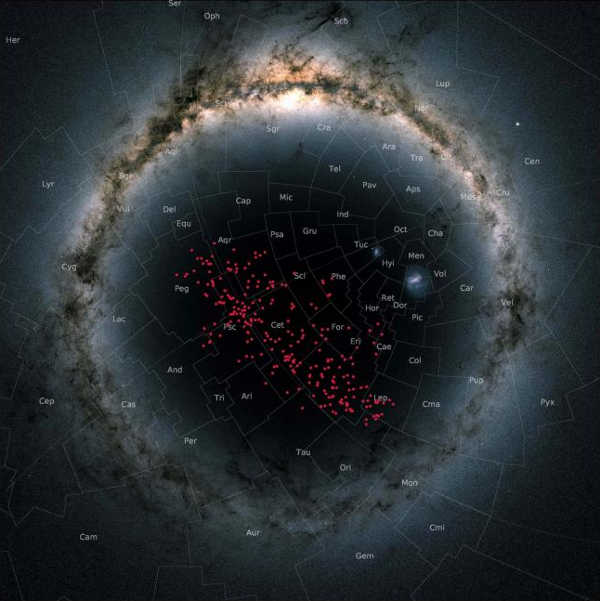
Astronomy & Astrophysics publishes the work of researchers from the University of Vienna, who have found a river of stars, a stellar stream in astronomical parlance, covering most of the southern sky.
The stream is relatively nearby and contains at least 4,000 stars that have been moving together in space since they formed, about 1 billion years ago.
Due to its proximity to Earth, this stream is a perfect workbench on which to test the disruption of clusters, measure the gravitational field of the Milky Way, and learn about coeval extrasolar planet populations with upcoming planet-finding missions. For their search, the authors used data from the ESA Gaia satellite.
Our own host galaxy, the Milky Way, is home to star clusters of variable sizes and ages. We find many baby clusters within molecular clouds, fewer middle-age and old age clusters in the Galactic disk, and even fewer massive, old globular clusters in the halo.
These clusters, regardless of their origin and age, are all subject to tidal forces along their orbits in the Galaxy. Given enough time, the Milky Way gravitational forces relentlessly pull them apart, dispersing their stars into the collection of stars we know as the Milky Way.
"Most star clusters in the Galactic disk disperse rapidly after their birth as they do not contain enough stars to create a deep gravitational potential well, or in other words, they do not have enough glue to keep them together. Even in the immediate solar neighborhood, there are, however, a few clusters with sufficient stellar mass to remain bound for several hundred million years. So, in principle, similar, large, stream-like remnants of clusters or associations should also be part of the Milky Way disk." says Stefan Meingast, lead author of the paper published in Astronomy & Astrophysics.
Thanks to the precision of the Gaia measurements, the authors could measure the 3D motion of stars in space. When carefully looking at the distribution of nearby stars moving together, one particular group of stars, as yet unknown and unstudied, immediately caught the eye of the researchers. It was a group of stars that showed precisely the expected characteristics of a cluster of stars born together but being pulled apart by the gravitational field of the Milky Way.
"Identifying nearby disk streams is like looking for the proverbial needle in a haystack. Astronomers have been looking at, and through, this new stream for a long time, as it covers most of the night sky, but only now realize it is there, and it is huge, and shockingly close to the Sun" says João Alves, second author of the paper. "Finding things close to home is very useful, it means they are not too faint nor too blurred for further detailed exploration, as astronomers dream."
Due to sensitivity limitations of the Gaia observations, their selection only contained about 200 sources. An extrapolation beyond these limits suggests the stream should have at least 4000 stars, thereby making the structure more massive than most know clusters in the immediate solar neighborhood.
The authors also determined the stream's age to be around one billion years. As such, it already has completed four full orbits around the Galaxy, enough time to develop the stream-like structure as a consequence of gravitational interaction with the Milky Way disk.
"As soon as we investigated this particular group of stars in more detail, we knew that we had found what we were looking for: A coeval, stream-like structure, stretching for hundreds of parsecs across a third of the entire sky,” said Verena Fürnkranz, co-author and Masters student at the University of Vienna. "It was so thrilling to be part of a new discovery" she adds.
This newly discovered nearby system can be used as a valuable gravity probe to measure the mass of the Galaxy. With follow-up work, this stream can tell us how galaxies get their stars, test the gravitational field of the Milky Way, and, because of its proximity, become a wonderful target for planet-finding missions. The authors hope to unravel even more such structures in the future with the help of the rich Gaia database.
Based on the article by Meingast et al. 2019, A&A, 622, L13.
LAKEPORT, Calif. – On Thursday, the Clearlake man charged with setting 16 fires around Lake County – including the August 2016 Clayton fire – returned to court for his preliminary hearing.
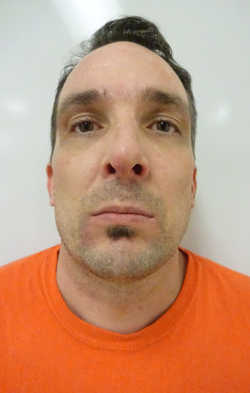
Damin Anthony Pashilk, 43, appeared before Lake County Superior Court Judge Andrew Blum for the proceeding.
Pashilk is facing 23 charges and three special allegations for setting a total of 16 fires – and trying to set another small fire that extinguished on its own – between July 2015 and August 2016 in the Clearlake, Clearlake Oaks and Lower Lake areas.
Prosecutors say Pashilk set two small roadside fires on the morning of July 2, 2015 – the Judge fires No. 1 and 2 – leading to larger incidents, including the three-acre Arrowhead fire on Aug. 25, 2015, in the city of Clearlake and the five-acre Morgan fire on Morgan Valley Road on July 21, 2016.
After the Morgan fire, Pashilk is alleged to have set seven more fires before, on Aug. 13, 2016, it’s alleged that he set the Clayton fire new Lower Lake, which burned more than 3,900 acres and 300 structures, including just over 200 homes.
Pashilk, who by the time of the Clayton fire had been under surveillance by Cal Fire for a year, was arrested two days after the Clayton fire began. He’s remained in custody ever since, with bail set at $5 million.
He entered not guilty pleas to all of the charges in September 2016.
Pashilk, who for his safety has been kept at an out-of-county facility for most of his time in custody, was returned to Lake County this week for the preliminary hearing. On the first day, four bailiffs were present in the courtroom.
When Pashilk came to court on Thursday, his appearance had notably changed. Rather than long hair and a beard, he was clean shaven, with his dark hair cut short. He wore a green and white jail jumpsuit, and Judge Blum said that his wrist and ankle shackles could be removed for the proceedings.
While most preliminary hearings run only a few hours, or sometimes as long as a day, Pashilk’s is anticipated to run over the course of up to seven court days spaced over several weeks, extending into early March.
Chief Deputy District Attorney Richard Hinchcliff, who is prosecuting the case, said he originally had anticipated as many as 12 days, but now thinks he can present it in half that time.
Hinchcliff explained that the length of the preliminary hearing is a matter of the case’s complexity as well as its age. He said he believes it’s one of the most complicated and challenging cases to ever be tried in Lake County.
Representing Pashilk is veteran local defense attorney Mitchell Hauptman, who has a record of navigating difficult cases and getting acquittals.
He was not Pashilk’s original attorney. That was J. David Markham, who a year ago became a Lake County Superior Court judge, necessitating finding a new attorney for Pashilk.
Calling the case’s first witnesses
Beginning on Thursday morning and continuing after a lunch break until mid afternoon, Hinchcliff presented his first series of witnesses, all of them Cal Fire employees.
They included Capt. Kelly Blue of the Sonoma-Lake-Napa Unit; Battalion Chief Sims Hawkins, who also is a Cal Fire peace officer out of Butte County; Engineer Cameron McFadden of the Sonoma-Lake-Napa Unit; Robert Little, a state urban forester; Capt. Charlie Laird of the Sonoma-Lake-Napa Unit’s Fire Prevention Bureau, also a law enforcement officer with the agency; and Capt. Kyle Steis, also a peace officer.
Besides being Cal Fire staff, all of them had been involved in investigating or responding to the fires that Pashilk is alleged to have set.
During the several hours of testimony, Hinchcliff questioned each of them as he laid the case foundation, seeking to show through the evidence and their conclusions that Pashilk is a serial arsonist.
Capt. Kelly Blue, working at Cal Fire’s Wilbur Springs station, responded to both the Judge fire No. 1 and No. 2 on the morning of July 2, 2015.
He got the call on the first fire just after 7:30 a.m., getting there by 7:45 a.m. to discover a roadside spot that was about a tenth of an acre in size burning on the north side of a fence on the north side of Highway 20. He said two pedestrians – one with a shovel, the other using his foot – were trying to put it out.
That fire burned annual grasses, not brush, and was set about 30 feet off the highway, off a dirt turnout. Blue said they used a hose lay to control it.
While on scene, he was notified by a passing female motorist of the second fire, located off Walker Ridge Road to the west of the first fire, and the bigger of the two blazes. Blue said that fire also burned in grass, and he said it would have spread uphill had there been wind on it and if it had occurred later in the day, when temperatures were higher and humidity lower. He said early morning was an odd time for a fire.
Blue said the Judge fire No. 2 was about 50 yards down Walker Ridge Road, on the northside of Highway 20. It also was about a tenth of an acre, although he said it was bigger than the first. The second fire, located near a dirt lot that Caltrans uses for staging, also was controlled with a hose lay.
Blue – who conducted the preliminary investigation, with Steis doing the final investigation – said the area where the second fire occurred was not visible from Highway 20 due to an embankment and a wooded hill.
During cross-examination, Hauptman asked about ignition sources.
“Sometimes the ignition source is very obvious,” said Blue.
He said he couldn’t exclude the fire having been caused by a vehicle due to tire tracks and close proximity to the roadway. “In my estimation, it wouldn't be a very likely source but I couldn't exclude it.”
Blue said the dirt lot where the Judge fire No. 2 occurred had a lot of garbage accumulation. But in his preliminary investigation he found no obvious arson or ignition devices.
Also during his testimony, Blue said as he’s thought more about it, he thinks the second fire actually started before the first due to it being slightly bigger. However, he added, “I can't be certain. I wouldn't gamble anything on it.”
He acknowledged having investigated fires where there was no discernable ignition source because the ignition device – such as a lighter – was taken from the scene.
Cal Fire puts Pashilk under surveillance
Battalion Chief Sims Hawkins was involved in the investigation of the Arrowhead fire, which burned three acres on the afternoon of Aug. 25, 2015, in the area of East Lake Drive and Acacia Street in Clearlake.
He said Lake County Fire Protection District Chief Willie Sapeta told him of a couple who lived a few houses down from the fire who had surveillance video which they shared with him.
The cameras had views of Acacia Street. In examining the video, Hawkins spotted an early 1990s green Subaru Legacy four-door station wagon traveling southbound on Acacia with both passenger side windows rolled down. He said it matched the 1991 Subaru that investigators knew had been driven by Pashilk because of other surveillance video.
Earlier in August 2015, Hawkins had become involved in investigating the serial arson case involving Pashilk, with about half a dozen Cal Fire personnel having Pashilk under surveillance at that time and meeting regularly to discuss the surveillance activities, he said.
He said that the video cameras from the couple who lived near the Arrowhead fire had a time stamp of 3:47 p.m., while a GPS tracker that investigators had attached to Pashilk’s vehicle recorded it traveling southbound on Acacia, away from the fire at 3:45 p.m. The two-minute discrepancy was attributed to an incorrect time stamp on the cameras. Hawkins said he couldn’t determine who was driving and couldn’t see passengers on the passenger side, but couldn’t confirm if there was someone sitting behind the driver’s seat.
Hawkins also spoke to a woman who discovered what was believed to be slopover or a spot fire from the Arrowhead fire later in the evening on the same day in August 2015.
Engineer Cameron McFadden was dispatched to the Long fire in the area of New Long Valley Road and Highway 20 just after 8:30 p.m. July 29, 2015. The quarter-acre fire burned at a slow rate of spread up a hill in grasses along a wide turnout just east of New Long Valley Road.
In his investigation, McFadden said he couldn’t eliminate the cause as being a vehicle or arson, and couldn’t identify an ignition source because of general damage to the area, including people going in and out of it.
State Urban Forester Robert Little runs the State Urban Forest Program, supervising seven regional urban foresters and working with grantees, cities and nonprofits, became involved in investigating the series of Lake County fires in 2015.
Little was asked to review video footage from cameras Cal Fire had set up at various areas around Lake County in order to look for a Subaru with a specific license plate number on certain days and in certain time periods.
He spotted that vehicle on footage taken at 7:43 a.m. July 2, 2015; at 8:25 p.m. July 29, 2015; at 1:54 p.m. Aug. 8, 2015; and at 8:04 p.m. Aug. 14, 2015.
Capt. Charlie Laird also was involved in the surveillance of Pashilk, and assisted in the investigation of the Arrowhead fire on Aug. 25, 2015. He said he identified a 6-foot by 6-foot origin area and was able to rule out possible causes including a campfire, debris burning, electrical, equipment, lightning, children playing with fire, smoking/cigarettes, vehicles, spontaneous combustion, glass refraction and shooting.
The following year, on Aug. 15, 2016 – the same day that Pashilk was arrested – Laird assisted with searching and processing evidence from another vehicle Pashilk owned, a Chrysler Sebring.
Items seized and documented from the vehicle that investigators believed could have been used as fuel or ignition sources included a shop towel, paper product, a torch, a paper cup, paper and plastic material, a paper napkin, a lighter, a torn paper cup and burned paper matches.
During his cross-examination, Hauptman asked Laird if he found marijuana joints in the car. Laird said yes. Hauptman then asked if he was aware that joints are often lit with matches, to which Laird also responded in the affirmative.
Hinchcliff countered by asking Laird if, in his training, he’d found that wildland fires are often lit by matches. Laird said yes.
Capt. Kyle Steis was assigned to do the origin and cause investigation of the Judge fire No. 2 near Walker Ridge Road in July 2015 as well as the Morgan fire on Morgan Valley Road in Lower Lake on July 21, 2016. Both fires were set near road turnouts. The Morgan fire was larger, burning five acres.
Steis and another investigator worked on the Morgan fire, identifying an origin area measuring 5 feet by 3 feet that was located 15 feet off of Morgan Valley Road in a gravel turnout.
He said they concluded that fire was caused by arson, and that it had been brought to his attention that a 1997 Chrysler Sebring that had been seen in other parts of Lake County where fires had occurred also had been seen at some point in the area where the Morgan Valley fire burned.
Hauptman asked Steis, “Standing alone, is there anything about that particular fire that led you to believe it was arson” if the idea of a serial arsonist was removed.
Steis said he tested the hypothesis, noting it was near a turnout on a road that isn’t highly traveled.
He also stated during his testimony that there was no evidence of the fire having been started by a vehicle.
Testimony will continue on Friday.
Email Elizabeth Larson at
LAKEPORT, Calif. – A local hazard mitigation plan is being developed by the city of Lakeport, which plans to hold a meeting this month on risk assessment.
The meeting will take place from 1 to 2:30 p.m. Tuesday, Feb. 19, at in the council chambers at Lakeport City Hall, 225 Park St.
Fires, drought, floods and severe weather are just a few of the hazards to be addressed in the plan.
While hazards such as these cannot be prevented, a hazard mitigation plan forms the foundation for a community's long-term strategy to reduce disaster losses by breaking the repeated cycle of disaster damage and reconstruction.
Additionally, only communities with a FEMA-approved hazard mitigation plan are eligible to apply for both pre- and post-disaster mitigation grant funding.
Nationwide, taxpayers pay billions of dollars annually helping communities, organizations, businesses, and individuals recover from disaster. Some disasters are predictable and, in many cases, much of the damage can be reduced or even eliminated through hazard mitigation planning.
The people most aware of potential hazards are the people who live and work in the affected community.
In addition to plan participation by local, state and federal agencies, the city is seeking all interested community members to hear more about the local hazard mitigation planning project.
City officials encourage attendance and participation from the general public at the Feb. 19 meeting.
For additional information, please contact Michelle Humphrey at 707-263-3578 or email atThis email address is being protected from spambots. You need JavaScript enabled to view it. .
The meeting will take place from 1 to 2:30 p.m. Tuesday, Feb. 19, at in the council chambers at Lakeport City Hall, 225 Park St.
Fires, drought, floods and severe weather are just a few of the hazards to be addressed in the plan.
While hazards such as these cannot be prevented, a hazard mitigation plan forms the foundation for a community's long-term strategy to reduce disaster losses by breaking the repeated cycle of disaster damage and reconstruction.
Additionally, only communities with a FEMA-approved hazard mitigation plan are eligible to apply for both pre- and post-disaster mitigation grant funding.
Nationwide, taxpayers pay billions of dollars annually helping communities, organizations, businesses, and individuals recover from disaster. Some disasters are predictable and, in many cases, much of the damage can be reduced or even eliminated through hazard mitigation planning.
The people most aware of potential hazards are the people who live and work in the affected community.
In addition to plan participation by local, state and federal agencies, the city is seeking all interested community members to hear more about the local hazard mitigation planning project.
City officials encourage attendance and participation from the general public at the Feb. 19 meeting.
For additional information, please contact Michelle Humphrey at 707-263-3578 or email at
On Thursday, Congressman Mike Thompson (CA-05) announced that his 90/10 federal cost sharing language was included in the upcoming federal funding bill.
This bipartisan language requires that the federal government cover at least 90 percent of the cost for debris removal and essential assistance for 2018 federally-declared disasters in areas where there were fires.
This will assist with debris removal and recovery from the Mendocino Complex fires in Thompson’s Northern California district and all other 2018 California wildfires that were federally-declared disasters, including Paradise’s Camp fire, and the Carr and Woolsey fires. Typically, that cost share is split between the federal and state governments 75-25 percent.
“Our local governments are working around the clock to help our communities recover from last year’s fires deserve every resource that the federal government can provide. That’s why I am proud that my language to increase the federal cost sharing of that recovery to 90 percent was included in this spending bill,” said Thompson. “I worked closely with my colleague Representative Lucille Roybal-Allard, Chair of the Homeland Security Appropriations Subcommittee, to ensure this bipartisan language was included. We must secure every federal dollar and resource possible to help our communities rebuild. We will continue to come back even stronger.”
The Mendocino Complex Fire was the largest recorded fire complex in California history. It was a large complex of two wildfires, the River fire and Ranch fire, which burned in Mendocino, Lake, Colusa, and Glenn counties, with the Ranch fire being California's single-largest recorded wildfire.
First reported on July 27, 2018, both fires burned a combined total of 459,123 acres.
The fires collectively destroyed 280 structures while damaging 37 others; causing at least $267 million in damages, including $56 million in insured property damage and $201 million in fire suppression costs.
Thompson represents California’s Fifth Congressional District, which includes all or part of Contra Costa, Lake, Napa, Solano and Sonoma counties.
This bipartisan language requires that the federal government cover at least 90 percent of the cost for debris removal and essential assistance for 2018 federally-declared disasters in areas where there were fires.
This will assist with debris removal and recovery from the Mendocino Complex fires in Thompson’s Northern California district and all other 2018 California wildfires that were federally-declared disasters, including Paradise’s Camp fire, and the Carr and Woolsey fires. Typically, that cost share is split between the federal and state governments 75-25 percent.
“Our local governments are working around the clock to help our communities recover from last year’s fires deserve every resource that the federal government can provide. That’s why I am proud that my language to increase the federal cost sharing of that recovery to 90 percent was included in this spending bill,” said Thompson. “I worked closely with my colleague Representative Lucille Roybal-Allard, Chair of the Homeland Security Appropriations Subcommittee, to ensure this bipartisan language was included. We must secure every federal dollar and resource possible to help our communities rebuild. We will continue to come back even stronger.”
The Mendocino Complex Fire was the largest recorded fire complex in California history. It was a large complex of two wildfires, the River fire and Ranch fire, which burned in Mendocino, Lake, Colusa, and Glenn counties, with the Ranch fire being California's single-largest recorded wildfire.
First reported on July 27, 2018, both fires burned a combined total of 459,123 acres.
The fires collectively destroyed 280 structures while damaging 37 others; causing at least $267 million in damages, including $56 million in insured property damage and $201 million in fire suppression costs.
Thompson represents California’s Fifth Congressional District, which includes all or part of Contra Costa, Lake, Napa, Solano and Sonoma counties.

SACRAMENTO – California has seen the cost of fighting wildfires grow to record highs over the past decade.
On Thursday, State Sen. Bill Dodd, Insurance Commissioner Ricardo Lara and Treasurer Fiona Ma proposed a new model to reduce wildfire risk with California Disaster Insurance, Senate Bill 290.
SB 290 authorizes the governor, insurance commissioner and treasurer to enter into an insurance policy that pays out when California has unexpected costs for disaster response.
California Disaster Insurance would function like home insurance, but for the state – allowing the state to pay a premium using a portion of existing emergency funds that would trigger a payment to the state in the event of a disaster.
“Rising wildfire suppression costs can strain California’s financial resources and threaten cuts to critical programs,” said Sen. Dodd, D-Napa. “As climate change continues to contribute to devastating infernos, we need a strategy to reduce the pressure on state and community coffers. This bill would do just that, allowing the state to invest in an insurance policy to ensure budget predictability and reduce taxpayers’ exposure to increasing costs associated with disasters, especially wildfires.”
“In seven of the last 10 years, our firefighting costs have exceeded our budget projections – by $450 million in 2017 alone,” said Insurance Commissioner Ricardo Lara. “California Disaster Insurance is a better solution that gives taxpayers the benefit of predictable costs, so we can invest in a safer future. As we confront destructive climate-drive events, we need to be open to new models that reduce risk to our communities and budgets. California Disaster Insurance is our first response.”
“This policy makes annual wildfire suppression costs more predictable, protecting the taxpayers from the volatility that has been seen over the past several years and creating budget stability and preserving other investments,” said State Treasurer Fiona Ma. “It is time for California to be proactive and not reactive.”
California spent $947 million in 2017-18 through the emergency fund for firefighting – nearly $450 million more than budgeted, according to Cal Fire.
The costs of fighting wildfires have overrun Cal Fire’s emergency budget in seven of the last 10 years. Since 2007, California has experienced 11 of the top 20 most destructive fires in its history.
The federal government, the World Bank, and the state of Oregon have all used insurance to reduce the risk to taxpayers following disasters.
The state of Oregon has purchased insurance protection against ever-changing wildfire costs for nearly 40 years – spending $61 million on premiums and receiving $102 million in insurance payments.
California currently pays for wildfire disasters with available funds, and California Disaster Insurance will come from those same sources.
Giving California greater budget predictability can empower the state to invest to reduce future risks.
SB 290 must be in print for 30 days before it can be scheduled for a committee hearing.
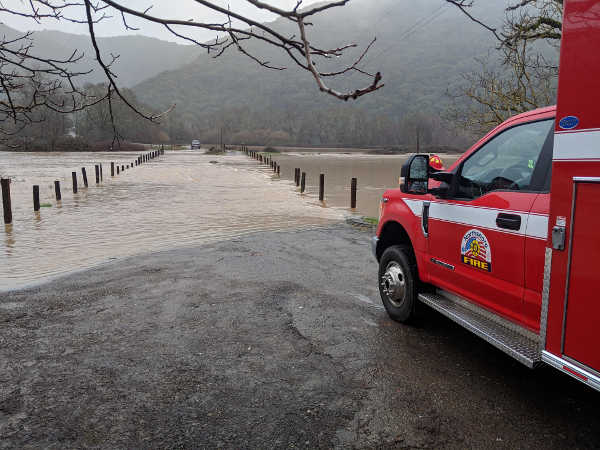
UPPER LAKE, Calif. – Three men escaped serious injury on Wednesday when the vehicle they were riding in was swept into Scotts Creek as they were trying to cross a flooded roadway.
The incident, which occurred in the area of Highway 20 just west of Saratoga Springs Road, was initially dispatched as a vehicle into the water at 3:40 p.m. Wednesday, according to radio reports.
The responding units from Northshore Fire had trouble finding it at first, and requested that the Northshore Dive Team and Cal Fire also respond, based on scanner traffic.
When firefighters arrived just before 4 p.m., they found one of the men out of the vehicle, trying to rescue the other two, according to California Highway Patrol Officer Joel Skeen.
Skeen said the CHP came on the scene after Northshore Fire, which performed the water rescue.
He said the vehicle involved was a Chevy Silverado pickup.
“The vehicle was swept away in the current and was not located,” Skeen said.
Skeen said none of the vehicle’s three male occupants would provide any identification.
He said two were transported to Sutter Lakeside Hospital on precaution for exposure but did not appear to be injured. The third man denied medical assistance, according to reports from the scene.
Skeen said the men had tried to cross a flooded private driveway on the south side of Highway 20 near Witter Springs Road.
The CHP reminds motorists not to drive across flooded roadways, as they’re more dangerous than they appear, as Wednesday’s incident illustrated.
Email Elizabeth Larson at