LAKE COUNTY, Calif. – A winter storm warning for Lake County due to chances of snow is set to expire on Sunday afternoon, but the National Weather Service is forecasting the possibility of snow again later this week.
The National Weather Service’s specific Lake County forecast said there could be snow showers from Sunday through Monday night, with a break for just rain on Tuesday.
The long-range forecast’s models indicate a cold system will drop out of the north, approaching Northern California on Tuesday and bringing widespread precipitation – rain in lower elevations and the potential for significant mountain snow.
Then, from Wednesday through Saturday, forecasters said there are again chances of snow showers along with rain, with another weather system arriving from the Gulf of Alaska.
Daytime temperatures this week will range between the low and high 40s, while the nighttime temperatures will hover in the 30s, the forecast said.
There also will be winds ranging up into the double-digits from Sunday night through Monday night, the National Weather Service reported.
Email Elizabeth Larson at This email address is being protected from spambots. You need JavaScript enabled to view it.. Follow her on Twitter, @ERLarson, or Lake County News, @LakeCoNews.
LAKE COUNTY, Calif. – With February marked as Teen Dating Violence Awareness Month, the Lake Family Resource Center is working to raise awareness in the community about the problem and highlight the importance of health relationships.
Abuse in teen relationships is a national problem impacting our youth in every community crossing all backgrounds. Teen dating violence is defined as the physical, sexual, psychological or emotional aggression within a dating relationship, including stalking. It can occur in person or electronically and might occur between a current or former dating partner.
One in three high school students experience either physical or sexual violence or both that is perpetrated by someone they are dating.
One in 10 high school students have been purposefully hit, slapped or physically hurt by a boyfriend or girlfriend, according to www.loveisrespect.org.
Teens receive messages about how to behave in relationships from peers, adults and the media. All too often these examples suggest that violence in a relationship is normal, but violence is never acceptable.
Recognizing the characteristics of healthy and unhealthy dating relationships, and how to get out of an abusive one, is incredibly important for healthy adolescent development.
Signs that a teenager might be in an unhealthy relationship could include being withdrawn from and uninterested in ordinary activities, unexpected and unexplained mood swings, demonstrated fear of upsetting their partner, reluctance to engage in activities without their partner for fear of retribution, low self-esteem and self-worth, drug and alcohol use, unexplained injuries, self-harming and/or suicidal behaviors.
Only 33 percent of teens who were in a violent relationship ever told anyone about the abuse.
Eighty-one percent of parents believe teen dating violence is not an issue or admit they don’t know if it is.
Though 82 percent of parents feel confident that they could recognize the signs if their child was experiencing dating abuse, a majority of parents (58%) could not correctly identify all the warning signs of abuse.
The top 10 abusive behaviors that every teen and parent can discuss include checking cell phones, emails or social media accounts without permission; constantly being ridiculed; displaying extreme jealousy or insecurities; having an explosive temper; isolating one from family or friends; making false accusations; mood swings; physical harm in any way; possessiveness and telling one what to do.
Lake Family Resource Center invites the public to become involved in awareness efforts and take the time to discuss healthy relationships with teenagers.
On. Tuesday, Feb. 12, the center invites community members to wear orange in observance of Teen Dating Violence Awareness Month. Tag your pictures with #LAKEFRC and #teenDVmonth so we can see your support.
On Thursday, Feb. 14, join Lake Family Resource Center and help them spread messages of love for the “Chalk About Love” event. Staffers will be using chalk to decorate the center’s parking lot at the Lakeport office, located at 896 Lakeport Blvd. at 4 p.m.
You can participate wherever you are and tag photos with #LAKEFRC and #teenDVmonth to share with your community.
If you are not feeling safe in your relationship, or you believe your teen may be in an unhealthy relationship, please seek out resources for support like a school counselor, or reach out to Lake Family Resource Center. Advocates are available to offer free and confidential help 24 hours a day, seven days a week, through the local Community Crisis Hotline, at 1-888-485-7733.
The National Teen Dating Abuse hotline is also available toll free at 1-866-331-9474. You can also text “loveis” to 22522, or log on to the interactive Web site, www.loveisrespect.org, and receive immediate, confidential assistance.
Lake Family Resource Center supports Lake County residents in achieving stable, self-sufficient, and healthy families and communities. Call 707-279-0563 to find out more about what the organization offers and how you can help.
Earth's global surface temperatures in 2018 were the fourth warmest since 1880, according to independent analyses by NASA and the National Oceanic and Atmospheric Administration, Or NOAA.
Global temperatures in 2018 were 1.5 degrees Fahrenheit (0.83 degrees Celsius) warmer than the 1951 to 1980 mean, according to scientists at NASA’s Goddard Institute for Space Studies, or GISS, in New York. Globally, 2018's temperatures rank behind those of 2016, 2017 and 2015. The past five years are, collectively, the warmest years in the modern record.
The year 2018 “is yet again an extremely warm year on top of a long-term global warming trend,” said GISS Director Gavin Schmidt.
Since the 1880s, the average global surface temperature has risen about 2 degrees Fahrenheit (1 degree Celsius). This warming has been driven in large part by increased emissions into the atmosphere of carbon dioxide and other greenhouse gases caused by human activities, according to Schmidt.
Weather dynamics often affect regional temperatures, so not every region on Earth experienced similar amounts of warming. NOAA found the 2018 annual mean temperature for the contiguous 48 United States was the 14th warmest on record.
Warming trends are strongest in the Arctic region, where 2018 saw the continued loss of sea ice. In addition, mass loss from the Greenland and Antarctic ice sheets continued to contribute to sea level rise. Increasing temperatures can also contribute to longer fire seasons and some extreme weather events, according to Schmidt.
“The impacts of long-term global warming are already being felt – in coastal flooding, heat waves, intense precipitation and ecosystem change,” said Schmidt.
NASA’s temperature analyses incorporate surface temperature measurements from 6,300 weather stations, ship- and buoy-based observations of sea surface temperatures, and temperature measurements from Antarctic research stations.
These raw measurements are analyzed using an algorithm that considers the varied spacing of temperature stations around the globe and urban heat island effects that could skew the conclusions. These calculations produce the global average temperature deviations from the baseline period of 1951 to 1980.
Because weather station locations and measurement practices change over time, the interpretation of specific year-to-year global mean temperature differences has some uncertainties. Taking this into account, NASA estimates that 2018’s global mean change is accurate to within 0.1 degree Fahrenheit, with a 95 percent certainty level.
NOAA scientists used much of the same raw temperature data, but with a different baseline period and different interpolation into the Earth’s polar and other data poor regions. NOAA’s analysis found 2018 global temperatures were 1.42 degrees Fahrenheit (0.79 degrees Celsius) above the 20th century average.
NASA’s full 2018 surface temperature data set – and the complete methodology used to make the temperature calculation – are available here.
GISS is a laboratory within the Earth Sciences Division of NASA’s Goddard Space Flight Center in Greenbelt, Maryland. The laboratory is affiliated with Columbia University’s Earth Institute and School of Engineering and Applied Science in New York.
NASA uses the unique vantage point of space to better understand Earth as an interconnected system. The agency also uses airborne and ground-based monitoring, and develops new ways to observe and study Earth with long-term data records and computer analysis tools to better see how our planet is changing. NASA shares this knowledge with the global community and works with institutions in the United States and around the world that contribute to understanding and protecting our home planet.
LAKE COUNTY, Calif. – Lake County Animal Care and Control has several big dogs and a little dog waiting to go to new homes.
Dogs available for adoption this week include mixes of Boxer, Catahoula Leopard Dog, German Shepherd, mastiff, pit bull and Shih Tzu.
Dogs that are adopted from Lake County Animal Care and Control are either neutered or spayed, microchipped and, if old enough, given a rabies shot and county license before being released to their new owner. License fees do not apply to residents of the cities of Lakeport or Clearlake.
If you're looking for a new companion, visit the shelter. There are many great pets hoping you'll choose them.
The following dogs at the Lake County Animal Care and Control shelter have been cleared for adoption (additional dogs on the animal control Web site not listed are still “on hold”).
“Alaki” is a male pit bull terrier in kennel No. 11, ID No. 6386. Photo courtesy of Lake County Animal Care and Control. ‘Alaki’
“Alaki” is a male pit bull terrier.
He has a short brindle coat with white markings. He already has been neutered.
He’s in kennel No. 11, ID No. 6386.
This male Male Catahoula Leopard Dog is in kennel No. 14, ID No. 11737. Photo courtesy of Lake County Animal Care and Control. Male Catahoula Leopard Dog
This male Male Catahoula Leopard Dog has a short blue and brown coat.
He’s in kennel No. 14, ID No. 11737.
“Truely” is a female pit bull in kennel No. 15, ID No. 11645. Photo courtesy of Lake County Animal Care and Control.
‘Truely’
“Truely” is a female pit bull with a short white and tan coat.
She’s in kennel No. 15, ID No. 11645.
This male boxer is in kennel No. 16, ID No. 11738. Photo courtesy of Lake County Animal Care and Control. Male boxer
This male boxer has a short brown and black coat.
He’s in kennel No. 16, ID No. 11738.
“Ewok” is a male Shih Tzu in kennel No. 22c, ID No. 11679. Photo courtesy of Lake County Animal Care and Control. ‘Ewok’
“Ewok” is a male Shih Tzu has a shaved white and brown coat.
He’s in kennel No. 22c, ID No. 11679.
“Smokey” is a male pit bull terrier in kennel No. 28a, ID No. 11646. Photo courtesy of Lake County Animal Care and Control. ‘Smokey’
“Smokey” is a male pit bull terrier with a short fawn and white coat.
He already has been neutered.
He’s in kennel No. 28, ID No. 11646.
“Rogue” is a male mastiff in kennel No. 31, ID No. 11732. Photo courtesy of Lake County Animal Care and Control. ‘Rogue’
“Rogue” is a male mastiff with a short brindle coat.
He’s in kennel No. 31, ID No. 11732.
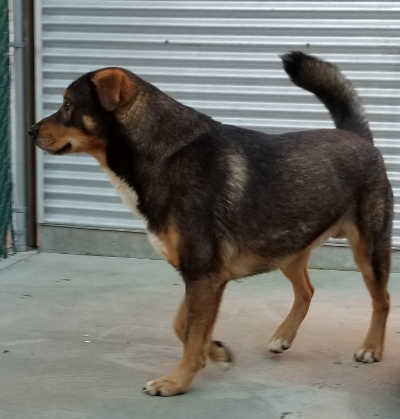
This male German Shepherd is in kennel No. 33, ID No. 11564. Photo courtesy of Lake County Animal Care and Control. Male German Shepherd
This male German Shepherd has a medium-length tricolor coat.
He’s in kennel No. 33, ID No. 11564.
Lake County Animal Care and Control is located at 4949 Helbush in Lakeport, next to the Hill Road Correctional Facility.
Office hours are Monday through Friday, 11 a.m. to 5 p.m., and 11 a.m. to 3 p.m., Saturday. The shelter is open from 11 a.m. to 4 p.m. Monday through Friday and on Saturday from 11 a.m. to 3 p.m.
For more information call Lake County Animal Care and Control at 707-263-0278.
Email Elizabeth Larson at This email address is being protected from spambots. You need JavaScript enabled to view it.. Follow her on Twitter, @ERLarson, or Lake County News, @LakeCoNews.
Reconstruction of a living Mirarce eatoni perched on the horns of the ceratopsian dinosaur Utahceratops gettyi, an animal that lived in Utah during the late Cretaceous 75 million years ago. Brian Engh illustration. BERKELEY, Calif. – During the late Cretaceous period, more than 65 million years ago, birds belonging to hundreds of different species flitted around the dinosaurs and through the forests as abundantly as they flit about our woods and fields today.
But after the cataclysm that wiped out most of the dinosaurs, only one group of birds remained: the ancestors of the birds we see today. Why did only one family survive the mass extinction?
A newly described fossil from one of those extinct bird groups, cousins of today’s birds, deepens that mystery.
The 75-million-year-old fossil, from a bird about the size of a turkey vulture, is the most complete skeleton discovered in North America of what are called enantiornithines (pronounced en-an-tea-or’-neth-eens), or opposite birds.
Discovered in the Grand Staircase-Escalante area of Utah in 1992 by University of California, Berkeley, paleontologist Howard Hutchison, the fossil lay relatively untouched in University of California Museum of Paleontology at Berkeley until doctoral student Jessie Atterholt learned about it in 2009 and asked to study it.
Atterholt and Hutchison collaborated with Jingmai O’Conner, the leading expert on enantiornithines, to perform a detailed analysis of the fossil.
Based on their study, enantiornithines in the late Cretaceous were the aerodynamic equals of the ancestors of today’s birds, able to fly strongly and agilely.
“We know that birds in the early Cretaceous, about 115 to 130 million years ago, were capable of flight but probably not as well adapted for it as modern birds,” said Atterholt, who is now an assistant professor and human anatomy instructor at the Western University of Health Sciences in Pomona, California. “What this new fossil shows is that enantiornithines, though totally separate from modern birds, evolved some of the same adaptations for highly refined, advanced flight styles.”
The fossil’s breast bone or sternum, where flight muscles attach, is more deeply keeled than other enantiornithines, implying a larger muscle and stronger flight more similar to modern birds. The wishbone is more V-shaped, like the wishbone of modern birds and unlike the U-shaped wishbone of earlier avians and their dinosaur ancestors. The wishbone or furcula is flexible and stores energy released during the wing stroke.
If enantiornithines in the late Cretaceous were just as advanced as modern birds, however, why did they die out with the dinosaurs while the ancestors of modern birds did not?
“This particular bird is about 75 million years old, about 10 million years before the die-off,” Atterholt said. “One of the really interesting and mysterious things about enantiornithines is that we find them throughout the Cretaceous, for roughly 100 million years of existence, and they were very successful. We find their fossils on every continent, all over the world, and their fossils are very, very common, in a lot of areas more common than the group that led to modern birds. And yet modern birds survived the extinction while enantiornithines go extinct.”
One recently proposed hypothesis argues that the enantiornithines were primarily forest dwellers, so that when forests went up in smoke after the asteroid strike that signaled the end of the Cretaceous – and the end of non-avian dinosaurs – the enantiornithines disappeared as well. Many enantiornithines have strong recurved claws ideal for perching and perhaps climbing, she said.
“I think it is a really interesting hypothesis and the best explanation I have heard so far,” Atterholt said. “But we need to do really rigorous studies of enantiornithines' ecology, because right now that part of the puzzle is a little hand-wavey.”
Atterholt, Hutchison and O’Connor, who is at the Institute of Vertebrate Paleontology and Paleoanthropology in Beijing, China, published an analysis of the fossil today in the open-access journal PeerJ.
Theropod dinosaurs evolved into birds
All birds evolved from feathered theropods – the two-legged dinosaurs like T. rex – beginning about 150 million years ago, and developed into many lineages in the Cretaceous, between 146 and 65 million years ago.
Hutchison said that he came across the fossil eroding out of the ground in the rugged badlands of the Kaiparowits formation in the Grand Staircase-Escalante National Monument in Garfield County, Utah, just inside the boundary of the recently reduced monument.
Having found bird fossils before, he recognized it as a late Cretaceous enantiornithine, and a rare one at that. Most birds from the Americas are from the late Cretaceous (100-66 million years ago) and known only from a single foot bone, often the metatarsus. This fossil was almost complete, missing only its head.
“In 1992, I was looking primarily for turtles,” Hutchison said. “But I pick up everything because I am interested in the total fauna. The other animals they occur with tells me more about the habitat.”
According to Hutchison, the area where the fossil was found dates from between 77 and 75 million years ago and was probably a major delta, like the Mississippi River delta, tropical and forested with lots of dinosaurs but also crocodiles, alligators, turtles and fish.
Unlike most bird fossils found outside America, in particular those from China, the fossil was not smashed flat. The classic early Cretaceous bird, Archaeopteryx, was flattened in sandstone, which preserved a beautiful panoply of feathers and the skeletal layout. Chinese enantiornithines, mostly from the early Cretaceous, are equally beautiful and smashed flatter than a pancake.
“On one hand, it's great – you get the full skeleton most of the time, you get soft tissue preservation, including feathers. But it also means everything is crushed and deformed,” she said. “Not that our fossils have zero deformation, but overall most of the bones have really beautiful three-dimensional preservation, and just really, really great detail. We see places where muscles and tendons were attaching, all kinds of interesting stuff to anatomists.”
Once Hutchison prepared the fossils and placed them in the UC Museum of Paleontology collection, they drew the attention of a few budding and established paleontologists, but no one completed an analysis.
“The stuff is legendary. People in the vertebrate paleontology community have known about this thing forever and ever, and it just happened that everyone who was supposedly working on it got too busy and it fell by the wayside and just never happened,” Atterholt said. “I was honored and incredibly excited when Howard said that I could take on the project. I was over the moon.”
Her analysis showed that by the late Cretaceous, enantiornithines had evolved advanced adaptations for flying independent of today’s birds. In fact, they looked quite similar to modern birds: they were fully feathered and flew by flapping their wings like modern birds. The fossilized bird probably had teeth in the front of its beak and claws on its wings as well as feet. Some enantiornithines had prominent tail feathers that may have differed between male and female and been used for sexual display.
“It is quite likely that, if you saw one in real life and just glanced at it, you wouldn't be able to distinguish it from a modern bird,” Atterholt said.
This fossil bird is also among the largest North American birds from the Cretaceous; most were the size of chickadees or crows.
“What is most exciting, however, are large patches on the forearm bones. These rough patches are quill knobs, and in modern birds they anchor the wing feathers to the skeleton to help strengthen them for active flight. This is the first discovery of quill knobs in any enantiornithine bird, which tells us that it was a very strong flier.”
Atterholt and her colleagues named the species Mirarce eatoni (meer-ark’-ee ee-tow’-nee). Mirarce combines the Latin word for wonderful, which pays homage to “the incredible, detailed, three-dimensional preservation of the fossil,” she said, with the mythical Greek character Arce, the winged messenger of the Titans. The species name honors Jeffrey Eaton, a paleontologist who for decades has worked on fossils from the Kaiparowits Formation. Eaton first enticed Hutchison to the area in search of turtles, and they were the first to report fossils from the area some 30 years ago.
Thousands of such fossils from the rocks of the Kaiparowits Formation, many of them dinosaurs, contributed to the establishment of the Grand Staircase-Escalante National Monument in 1996.
“This area contains one of the best Cretaceous fossil records in the entire world, underscoring the critical importance of protecting and preserving these parts of our natural heritage,” Atterholt said. “Reducing the size of the protected area puts some of our nation’s most valuable natural and scientific resources at risk.”
Hutchison’s field work was supported by the Annie M. Alexander endowment to the UCMP.
Robert Sanders writes for the UC Berkeley News Center.
LAKEPORT, Calif. – A state grant will help the city of Lakeport purchase new equipment and train staff in containing hazardous materials spills.
On Tuesday, the council voted to approve a resolution accepting $35,000 in grant funds from the California Department of Fish and Wildlife, Office of Spill Prevention and Response, for oil spill response equipment.
At the same time, the council authorized City Manager Margaret Silveira to sign a purchase order with Global Diving & Salvage Inc. for the construction and delivery of an oil spill response trailer.
The discussion begins at the 1:07.00 mark in the video above, and the staff report begins on page 61 of the agenda packet below.
Ron Ladd, a parks lead worker in the city’s Public Works Department, introduced the item to the council.
“We're always looking for alternative funding sources to offer better services in Lakeport,” Ladd said.
Ladd, who is known for being something of a wizard when it comes to maintaining city facilities and equipment, came across the grant opportunity for the trailer through the California Department of Fish and Wildlife.
He said the city can receive up to $35,000, with no need for matching funds, through the program.
That funding would pay for a spill response trailer specific to Lakeport and its geography. Ladd said the trailer would be a fully stocked custom trailer for a basic response to a spill. In addition, the grant would pay for staff training for up to 10 people.
That training, Ladd added, is not for the purpose of making staffers hazmat experts, but rather to teach them how to contain a spill and keep it from spreading.
“It’s one of the best grants I’ve seen,” Ladd said.
Councilman Kenny Parlet asked if there is a penalty when spills enter into waterways or sewer systems.
Public Works Director Doug Grider said it really depends on where the source point originates. If it originated from city equipment or facility, the city would definitely be on the hook.
He said the state is coming out with new enforcements, and it appears that the city will start being responsible for all of its drainage systems. So if a spill enters Clear Lake through one of the city’s conveyances, culverts or ditches, there could be liability for the city.
“We're still researching that. The smoke hasn't cleared on that,” Grider said.
Grider said the spill response trailer would be of great assistance to the city in being able to contain any kind of authorized spill.
He said the equipment it would have would be different than what the city already has on hand. While the city stocks a very large supply of spill response materials, they’ve been looking for an item called a “curtain.”
The booms they now use float on top of the water, but in windy or rough weather, there is so much movement that chemicals and spills can get under the booms, Grider explained.
Grider said the curtain has a tube on the top of the water with a piece that extends down 12 to 18 inches under it, and it won’t let spills get underneath the boom. The other absorbent materials can be used to contain the spill.
“That's why we're so excited we got this opportunity because the state's going to pay for it,” Grider said.
“Great job, Ron,” said Mayor Tim Barnes.
Councilwoman Mireya Turner moved to adopt the resolution to accept the grant, with Parlet seconding and the council approving the resolution 4-0. Councilman George Spurr was absent for the meeting.
It was noted during the meeting that the equipment would have been beneficial to have last month, when a spill closed several roadways within the northern part of the city.
On the morning of Jan. 9, an incident with a truck owned by a private company resulted in the spill of approximately 35 gallons of hydraulic fluid. It took much of the day for Lakeport Public Works staff to clean up the spill and reopen the roadways, as Lake County News has reported.
Email Elizabeth Larson at This email address is being protected from spambots. You need JavaScript enabled to view it.. Follow her on Twitter, @ERLarson, or Lake County News, @LakeCoNews.
 How to resolve AdBlock issue?