LAKE COUNTY, Calif. – Lake County Animal Care and Control’s kennels have once again filled up with a variety of dogs available to new families.
Dogs available for adoption this week include mixes of Boxer, German Shepherd, husky, mastiff, pit bull, Pomeranian and shepherd.
Dogs that are adopted from Lake County Animal Care and Control are either neutered or spayed, microchipped and, if old enough, given a rabies shot and county license before being released to their new owner. License fees do not apply to residents of the cities of Lakeport or Clearlake.
If you're looking for a new companion, visit the shelter. There are many great pets hoping you'll choose them.
The following dogs at the Lake County Animal Care and Control shelter have been cleared for adoption (additional dogs on the animal control Web site not listed are still “on hold”).
“Cricket” is a senior female Lhasa Apso in kennel No. 4, ID No. 11650. Photo courtesy of Lake County Animal Care and Control. ‘Cricket’
“Cricket” is a senior female Lhasa Apso with a long tan and white coat.
She’s in kennel No. 4, ID No. 11650.
“CoCo” is a young male pit bull terrier in kennel No. 5, ID No. 11763. Photo courtesy of Lake County Animal Care and Control. ‘CoCo’
“CoCo” is a young male pit bull terrier with a short brown and white coat.
He’s in kennel No. 5, ID No. 11763.
This male terrier is in kennel No. 6, ID No. 11756. Photo courtesy of Lake County Animal Care and Control. Male terrier
This male terrier has a short black and white coat.
He’s in kennel No. 6, ID No. 11756.
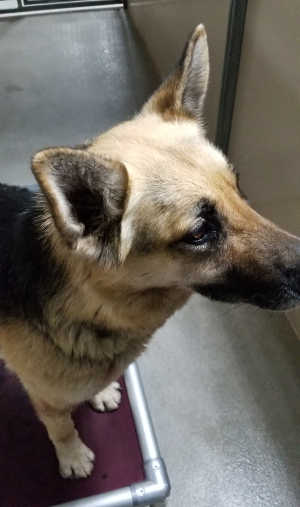
This female German Shepherd is in kennel No. 7, ID No. 11772. Photo courtesy of Lake County Animal Care and Control. Female German Shepherd
This female German Shepherd has a medium-length black and tan coat.
She’s in kennel No. 7, ID No. 11772.
This female shepherd is in kennel No. 8, ID No. 11770. Photo courtesy of Lake County Animal Care and Control.
Female shepherd
This female shepherd has a short tricolor coat.
She’s in kennel No. 8, ID No. 11770.
This young female Labrador Retriever is in kennel No. 9, ID No. 11720. Photo courtesy of Lake County Animal Care and Control. Female Labrador Retriever
This young female Labrador Retriever has a short black coat with white markings.
She already has been spayed.
She’s in kennel No. 9, ID No. 11720.
“Alaki” is a male pit bull terrier in kennel No. 11, ID No. 6386. Photo courtesy of Lake County Animal Care and Control. ‘Alaki’
“Alaki” is a male pit bull terrier.
He has a short brindle coat with white markings. He already has been neutered.
He’s in kennel No. 11, ID No. 6386.
“Truely” is a female pit bull in kennel No. 15, ID No. 11645. Photo courtesy of Lake County Animal Care and Control. ‘Truely’
“Truely” is a female pit bull with a short white and tan coat.
She’s in kennel No. 15, ID No. 11645.
This male boxer is in kennel No. 16, ID No. 11738. Photo courtesy of Lake County Animal Care and Control. Male boxer
This male boxer has a short brown and black coat.
He’s in kennel No. 16, ID No. 11738.
This female Labrador Retriever is in kennel No. 18, ID No. 11736. Photo courtesy of Lake County Animal Care and Control. Female Labrador Retriever
This female Labrador Retriever has a short black coat.
She already has been spayed.
She’s in kennel No. 18, ID No. 11736.
This male pointer is in kennel No. 21, ID No. 11771. Photo courtesy of Lake County Animal Care and Control. Male pointer
This male pointer has a short tricolor coat.
He’s in kennel No. 21, ID No. 11771.
“Scout” is a young male husky-shepherd mix in kennel No. 22, ID No. 11778. Photo courtesy of Lake County Animal Care and Control. ‘Scout’
“Scout” is a young male husky-shepherd mix.
He’s in kennel No. 22, ID No. 11778.
This female pit bull terrier is in kennel No. 23, ID No. 11777. Photo courtesy of Lake County Animal Care and Control. Female pit bull terrier
This female pit bull terrier has a short brown and white coat.
She’s in kennel No. 23, ID No. 11777.
This male Pomeranian is in kennel No. 24, ID No. 11776. Photo courtesy of Lake County Animal Care and Control. Male Pomeranian
This male Pomeranian has a long tan coat.
He’s in kennel No. 24, ID No. 11776.
“Smokey” is a male pit bull terrier in kennel No. 28a, ID No. 11646. Photo courtesy of Lake County Animal Care and Control. ‘Smokey’
“Smokey” is a male pit bull terrier with a short fawn and white coat.
He already has been neutered.
He’s in kennel No. 28, ID No. 11646.
“Rogue” is a male mastiff in kennel No. 31, ID No. 11732. Photo courtesy of Lake County Animal Care and Control. ‘Rogue’
“Rogue” is a male mastiff with a short brindle coat.
He’s in kennel No. 31, ID No. 11732.
This male German Shepherd is in kennel No. 33, ID No. 11564. Photo courtesy of Lake County Animal Care and Control. Male German Shepherd
This male German Shepherd has a medium-length tricolor coat.
He’s in kennel No. 33, ID No. 11564.
Lake County Animal Care and Control is located at 4949 Helbush in Lakeport, next to the Hill Road Correctional Facility.
Office hours are Monday through Friday, 11 a.m. to 5 p.m., and 11 a.m. to 3 p.m., Saturday. The shelter is open from 11 a.m. to 4 p.m. Monday through Friday and on Saturday from 11 a.m. to 3 p.m.
For more information call Lake County Animal Care and Control at 707-263-0278.
Email Elizabeth Larson at This email address is being protected from spambots. You need JavaScript enabled to view it.. Follow her on Twitter, @ERLarson, or Lake County News, @LakeCoNews.
Scientists who study the solar system tend to ask big questions: How was our solar system formed? Where did the building blocks of life come from? What hazards from above threaten life on our planet? To find answers, they’re looking more and more at small worlds.
What are small worlds? Asteroids for sure. Comets too. Also the many small satellites or moons that orbit large planets as well as the icy worlds at the distance of Pluto and beyond.
Some have combined, only to be broken apart later by collisions and tidal forces. Others have gone largely untouched since the dawn of the solar system. Some carry water and organic compounds, others are almost entirely composed of metal. And all hold keys to questions about our solar system and the origin of life on Earth.
Dr. Adriana Ocampo, program executive for NASA’s New Horizons mission, said, “Water is key to life as we know it. Learning where water is found in our solar system provides pieces to the puzzle of understanding the origins of life. New Horizons recently surprised us by discovering a large abundance of water ice at Pluto.”
More surprises are in store, as New Horizons transmits the data from its Jan. 1 flyby of the Kuiper Belt object 2014 MU69 back to Earth!
Small worlds can be found in a wide range of locations across the solar system, from the inner solar system all the way out to the Kuiper Belt. When they are studied together, these remnants of the early solar system can help tell the story of solar system formation.
Dawn recently completed a mission to the Main Asteroid Belt, visiting the dwarf planet Ceres and the Belt’s largest asteroid, Vesta.
OSIRIS-REx has arrived at Bennu, a near-Earth asteroid about 1650 feet (500 m) across, and will return to Earth in 2023 with a sample so scientists can begin to understand Bennu’s origin and history.
The Lucy mission will be traveling to six trojan asteroids, trapped in the orbit of Jupiter. These objects are the only remaining unexplored population of small worlds in the solar system. The Psyche mission will be visiting a metal object in the Main Asteroid Belt that could be the remnant core of a proto-planet similar in size to Vesta!
While those missions travel to their individual targets, NEOWISE, a repurposed space telescope in low-Earth orbit, has made infrared measurements of hundreds of near-Earth objects and tens of thousands of other small worlds in the solar system. These diverse worlds offer insights into how our solar system formed and evolved.
“This is not your grandparent’s solar system, and things are not as orderly as we once believed,” Dr. Tom Statler, Planetary Science Program scientist at NASA Headquarters, said. “The data we’ve gleaned from these objects so far have changed the way we think about the origin of the planets. For example, the small worlds in the Kuiper Belt are leading us to think that Uranus and Neptune formed much closer to the Sun than where they reside now, then gradually moved to their current orbits.”
The biggest misperception about small worlds? Their distance to each other. Statler explained, “In the movies, they always show an asteroid belt with millions of rocks almost touching each other, whereas in reality there is much more empty space. You have to travel hundreds of thousands of miles to get from one asteroid to another.”
Yet scientists are also looking closer to home. Determining the orbits and physical characteristics of objects that might impact Earth is critical to understanding the consequences of any such impact; and responding to an actual impact threat, if one is ever discovered.
NASA knows of no asteroid or comet currently on a collision course with Earth. But, to prepare for that scenario NASA is developing the Double Asteroid Redirection Test or DART mission as the first demonstration of the kinetic impact technique that could be used to change the motion of a hazardous asteroid away from Earth.
For more big stories about our solar system and how small worlds are yielding big answers, visit http://science.nasa.gov.
LUCERNE, Calif. – A woman was injured and her home was damaged in a Saturday afternoon fire in Lucerne that began due to a wood stove.
The fire was first reported just after noon on Saturday in the 7100 block of E. Highway 20 near Rosemont Drive, according to radio reports.
Firefighters arriving on scene minutes later reported finding heavy smoke coming from the two-story wood structure, which is located across the highway across from Clear Lake.
Northshore Fire Chief Mike Ciancio told Lake County News that the home’s resident was lighting her wood stove when it flashed on her.
“She sustained burns to her hand trying to put the fire out,” he said.
The woman later was transported to Sutter Lakeside Hospital, Ciancio said. Due to the weather, an air ambulance wasn’t available to fly her out of county.
Ciancio said the fire was difficult to access because the house is located on a steep hillside. So rather than being able to drive in, firefighters had to get to it by foot.
Shortly after arriving on scene, incident command requested that Highway 20 be closed both ways temporarily, according to scanner reports. The closure was in effect a little more than two hours due to the firefighting effort, with the highway reopened shortly before 2:30 p.m.
“We were drafting water out of the lake so we had hoses across the highway and that was the reason for asking CHP and Caltrans to shut the highway down in both directions,” Ciancio said.
Ciancio said it took about 45 minutes to contain the fire.
He said the home’s second story looks to be a total loss, and the house isn’t currently habitable.
In addition to Northshore Fire, Cal Fire and Lakeport Fire also were part of the firefighting response, Ciancio said. All units had been released by 3 p.m.
Email Elizabeth Larson at This email address is being protected from spambots. You need JavaScript enabled to view it.. Follow her on Twitter, @ERLarson, or Lake County News, @LakeCoNews.
Lakeport Public Works Department employees work on installing a temporary drainage liner under Hartley Street in Lakeport, Calif., on Thursday, February 14, 2019. Photo courtesy of the city of Lakeport. LAKE COUNTY, Calif. – With winter storms filling streams and Clear Lake, local officials are closely monitoring conditions in case there is a likelihood of flooding.
This month’s storms rain and snowstorms have caused streams to run high, quickly raising the level of Clear Lake.
The National Weather Service’s observation station network reported the following 72-hour rainfall totals through 12 a.m. Saturday, in inches:
– Bartlett Springs: 5.60. – Boggs Mountain: 8.97. – Colusa/Lake County line: 4.98. – Hidden Valley Lake: 7.48. – Indian Valley Reservoir: 4.89. – Kelseyville: 5.44. – Lakeport: 4.41. – Lower Lake: 6.15. – Lyons Valley: 2.81. – Soda Creek (near Lake Pillsbury): 5.61. – Upper Lake: 4.55. – Whispering Pines: 8.64.
The National Weather Service is forecasting rain through Sunday, a break with sunny skies until Tuesday. There is a forecast with a slight chance of rain and snow showers on Wednesday and Thursday before sunny skies return on Friday.
Clear Lake’s level reached the “full” mark – 7.56 feet Rumsey, the special measure used just for Clear Lake – Friday afternoon, according to the California Department of Water Resources’ Data Exchange Center.
The California Nevada River Forecast Center expects Clear Lake to reach the “monitor” stage of 8 feet Rumsey by Sunday afternoon.
Flood stage on the lake is 9 feet Rumsey, which it surpassed in early 2017.
David Cowan, Lake County’s Water Resources director, said there are so far no predictions when – or if – the lake will creep into flood stage.
In response to the high lake level and in anticipation of more inflows, Cowan said Yolo County Flood Control and Water Conservation District was releasing water the Cache Creek Dam.
The dam was releasing 2,670 cubic feet of water per second late Friday night, according to the US Geological Survey stream gauge at the dam.
The cities of Clearlake and Lakeport are both keeping a close eye on the situation in order to respond should the lake move toward flooding.
“The lake is rising rapidly but Clearlake is in a bit of a better situation than Lakeport in that the lake has to get a bit higher here than in Lakeport before we have problems,” City Manager Greg Folsom told Lake County News.
“We have to hit at least 8 feet Rumsey before we begin to have issues. At that point we will detach the docks at Thompson Harbor (Redbud Park) if the lake level is rising to avoid damaging the docks. We also start to have flooding issues on Lower Lakeshore between 8.0 feet and 8.5 Rumsey.”
If the lake hit flood level, Folsom said the city would close Lower Lakeshore to traffic. Around 10 feet Rumsey is when it begins to impact Lakeshore Drive near the Sulphur fire burn area.
“After 10.5 feet Rumsey we could start to have some real problems, but let’s hope we don’t go there. We are in communication with Yolo about keeping the water flowing through the dam at a substantial level,” Folsom said.
Folsom said the city hasn’t had any significant problems with infrastructure due to the winter storms so far, other than a road washout on Boyles Avenue and a small mudslide on San Joaquin Avenue. He credited a lot of work over the summer and fall, cleaning out drains and culverts, with preventing more damage.
In Lakeport, city officials have been closely monitoring the lake level, according to Lakeport Police Chief Brad Rasmussen. He said they’re ready to take protective measures if necessary.
He said they look at whether there could be damage to boat and launch facilities. As the lake gets higher, of particular concern are winds and wave action moving toward shore.
In the past, wave action has caused more damage to city and other property than the flooding itself, he said.
Heavy winds and the waves they created damaged the Library Park seawall to the extent that it now needs to be replaced, and also knocked over tables and benches, and damaged other park infrastructure, as Lake County News has reported.
The city has had some damage already because of the storms, Rasmussen said.
On Harley Street, south of the city limits, a drain infrastructure that goes under the road was damaged overnight Wednesday and into early Thursday, causing some undermining of the street base, he explained.
Rasmussen said Public Works crews were on the scene all day Thursday making emergency repairs, including placing a temporary liner for drainage to keep the water flowing and mitigate any further damage. “They’re going to have to go back later with a permanent fix.”
He said the storm action resulted in some damage to a dock from a sailboat that was tied up overlimit.
The city also had to close Martin Street twice since Monday due to flooding, and has also issued advisories due to standing water. “We don’t believe there’s any damage from that.”
As for reports of damage to private property, he said a sailboat that broke free of a mooring and slammed into the shoreline, and on Ninth Street on Wednesday a tree fell on a house on private property, causing significant damage. No one hurt, and while damaged the said the home wasn’t determined to be uninhabitable.
Email Elizabeth Larson at This email address is being protected from spambots. You need JavaScript enabled to view it.. Follow her on Twitter, @ERLarson, or Lake County News, @LakeCoNews.
LAKEPORT, Calif. – The prosecution on Friday continued to lay out the basics of its case in the preliminary hearing of the man accused of setting the Clayton fire that devastated Lower Lake in 2015 as well as 15 other wildland fires over the course of a year.
The Lake County District Attorney's Office has charged Damin Anthony Pashilk, 43, of Clearlake with 23 counts for setting 16 fires and attempting to start a 17th that self-extinguished between July of 2015 and August of 2016.
Testimony so far has confirmed that Pashilk was under surveillance for more than a year before authorities said he set the Clayton fire on Aug. 13, 2016. He was arrested two days later and has remained in custody – primarily in an out-of-county facility – for most of that time.
As it was on the proceeding's first day on Thursday, on Friday all of the witness testimony was offered by Cal Fire personnel involved with investigating the various fires Pashilk is accused of setting as well as keeping him under surveillance.
On Friday morning, Russell West, a fire captain and investigator; Bryan Dudley, a fire apparatus engineer in 2016; and Ryan Finn, a Cal Fire battalion chief, all took the stand.
West and Dudley testified about the cause and origin of the Western fire on Western Mine Road near Middletown on July 23, 2016, while Finn explained Cal Fire's surveillance activities.
They were followed by Cal Fire Battalion Chief John Schnaidt and Forester Damon Denman, who also is a law enforcement officer with the agency.
Friday’s testimony began to focus more on the Clayton fire, larger and more destructive than all of the other fires combined by orders of magnitude.
Tracking the suspect
Schnaidt was part of the team conducting surveillance of Pashilk's activities during 2016. He recounted tracking Pashilk's travels both by following him and by a GPS tracking device that investigators had put on Pashilk's Chrysler Sebring while it was parked at Twin Pine Casino in Middletown.
On Thursday, investigators had recounted looking for a green Subaru station wagon that Pashilk had been known to drive in 2015 on surveillance video. Hinchcliff told Lake County News that Pashilk later sold that car.
The other car that was key to the case was Pashilk's light gray two-door Chrysler Sebring, distinctive for its sunroof and large alloy wheels. Chief Deputy District Attorney Richard Hinchcliff, who is prosecuting the case, said he doesn't know the whereabouts of that car.
The GPS tracking device was installed once and then reinstalled twice more in order to refresh its batteries, which Schnaidt said they wanted to do every one to two weeks. The last time it was replaced was on Aug. 12, 2016, the day before the Clayton fire began.
During his testimony, Schnaidt explained that he was both following Pashilk and using the GPS tracker to monitor him on Aug. 9, 2016, the day the Canyon fire occurred.
That day, he followed Pashilk from Twin Pine Casino to Lower Lake. The GPS tracker then showed Pashilk's vehicle turn onto Seigler Canyon Road near Lower Lake. The Chrysler then turned around and headed back toward Lower Lake on Highway 29. Schnaidt said he could see Pashilk was alone in the car.
When Schnaidt drove down Seigler Canyon Road to check the area, he encountered the Canyon fire, which was pushing into a mobile home. He worked to get the residents evacuated.
He also was among several Cal Fire investigators tracking Pashilk on Aug. 13, 2016, the day the Clayton fire started
On that afternoon, just after 4:30 p.m., Schnaidt was at the Chevron gas station in Middletown where he saw Pashilk and his Chrysler. Pashilk, who was alone, went into the mini mart, then got back into his car and drove northbound on Highway 29 in the direction of Lower Lake.
Schnaidt, who followed a few miles behind Pashilk, said the GPS tracker showed that the Chrysler drove down Clayton Creek Road. According to his daily tracking log, at 4:55 p.m. he then drove down the road to see where the Chrysler had stopped and saw a fire, measuring 20 feet by 20 feet, on the east side of Clayton Creek Road.
Denman, who also was following Pashilk that day and monitoring him on the GPS tracker, was already at the scene, Schnaidt said he had four very large metal washers that he threw down at the four corners of the fire because he wanted to assist the investigating officer and be able to show where the fire was at, at a certain time.
Schnaidt said he tried to put out the fire but the flames already were tall and it took off, burning across a grass field with wind on it. He said he also couldn't get past a barbed wire fence quickly enough.
By the time he tried to knock it down, “The fire already was gone,” said Schnaidt, describing the beginning of a blaze that would in the days to come destroy 300 structures in Lower Lake and burn more than 3,900 acres.
While firefighters took over trying to stop the fire, Schnaidt continued to track Pashilk's movements, noting that after leaving the Clayton Creek Road area Pashilk's Chrysler was tracked to his home on Koloko in Clearlake just after 5:20 p.m. At 5:50 p.m., Pashilk was tracked driving alone down Lakeshore, where he went to the Flyer's Gas Station.
Then, minutes after 6:30 p.m., Schnaidt saw Pashilk and his vehicle parked on the west side of Highway 29, facing southbound, just south of Spruce Grove and Clayton Creek roads, in the fire area.
Defense attorney Mitch Hauptman noted during cross examination that the GPS on his phone sometimes shows him as being in a place that's different from his actual location. He questioned how fine-tuned the GPS tracker used by investigators actually is, with Schnaidt noting that it's very accurate, down to meters.
Hauptman asked if the information from the tracker and how it's relayed is at least partially dependent on cell signal, and Schnaidt confirmed it is.
Hauptman then said he assumed that Schnaidt had been driving around Lake County and was aware of spotty cell phone service in some areas. “How at all does that impact your surveillance and tracking?”
Schnaidt said that one of the trackers could pick up Pashilk's actions all the way through Big Canyon while others couldn't, and noted that when they retrieve the tracker they can download the real-time tracking information that will show his location even when cell service is lost.
Hauptman asked if there were any issues with satellite coverage, wooded areas or other factors that might interfere with the device. “It seemed like it was working fine,” said Schnaidt, even when the coverage wasn't always good.
Schnaidt said he had hoped to catch Pashilk in the act, but never did quite see him doing anything. Under Hauptman's questioning, Schnaidt said there were no other suspects in the fires.
He also said he had no issues with the GPS tracker on Aug. 9, when the Canyon fire started, or on Aug. 13, when the Clayton fire began. As for following a suspect as well as tracking them with GPS, Schnaidt said, “We always try to get eyes on the vehicle to corroborate that,” acknowledging there were times when Pashilk's vehicle was out of his view.
When Hinchcliff asked about the GPS tracker's performance, Schnaidt said it hadn't given wrong locations and it was always accurate and correct.
Another investigator also tracks Pashilk
During his testimony, Denman – who said he has done at least 10 arson investigations – explained that he does surveillance, for which he has taken a 40-hour course at the Cal Fire academy.
He began tracking Pashilk on July 23, 2016, the day the Western fire started near Middletown, and would track him every day of August 2016, leading up to Pashilk's arrest on Aug. 15, two days after the Clayton fire started.
Beginning that evening, he and another officer separately tracked Pashilk from the Twin Pine Casino parking lot toward Lower Lake, but they were not using the GPS tracking device. They then began following another light-colored car and realized they had passed Pashilk, who had turned off onto Western Mine Road.
They returned to Twin Pine Casino shortly before 7:30 p.m. and saw that Pashilk's Chrysler was back at that location, with no one in it. Just before 8:15 p.m., they saw the vehicle leave, heading northbound on Highway 29 toward Clearlake. Pashilk was in the front passenger seat and two white female adults – one driving, one in the backseat – were with him.
Denman also tracked Pashilk on July 25, 2016, when he also saw a woman riding with him and then Pashilk driving alone, and again on July 26, 2016, when he was again doing mobile surveillance.
On July 26, 2016, Denman was assigned to a prominent overlook on Sulphur Bank Road northwest of the city of Clearlake, in an area selected as an observation point due to a number of fires having occurred there. He said he was watching for the Chrysler or anyone else to go by.
Just after 4:34 p.m. that day, Denman saw a Chrysler Sebring traveling northwest on Sulphur Bank Road. It had a sunroof and notable tire rims, as Pashilk's vehicle had. Denham said he used his binoculars to view it from a quarter mile away. While he said it was the same make and model, he couldn't see a license plate from that distance, nor could he see Pashilk in the car.
As the car traveled along the road, it went into a tree-shrouded area at about 40 miles per hour. He said it didn't emerge back into sight in an open area further up the road. Instead, he heard a motor winding up and saw the Sebring heading back toward Clearlake at a high rate of speed – he estimated it was going 60-plus miles per hour.
After the Chrysler left, Denman said he didn't see any smoke, but he spotted a white utility pickup pull up nearby. Shortly after 4:45 p.m. Denman drove up to the area where the pickup was parked and met a man in a bright red construction workers' shirt standing next to a roadside ditch filled with leaves and other dry materials, using a shovel to put out a small fire and calling it in to 911 on his cell phone.
The man, whose last name was given as Luna, told Denman he had pulled up after seeing the fire, and that he was passed by another vehicle – which he thought was white – at a high rate of speed. The Chrysler, it was noted, was light-colored. Luna didn't remember anything about the driver.
Denman also testified to surveilling Pashilk on July 29, 2016, the date the North Branch fire occurred on Ogulin Canyon Road just north of the city of Clearlake.
He said he saw Pashilk driving his Chrysler slowly southbound on Lakeshore Drive, smoke a cigarette and looking out toward the smoke rising from the fire in Ogulin Canyon. Within 10 minutes he saw Pashilk again, pulled out into a wide spot 300 feet down Point Lakeview Road, where he could look across and see the smoke from that fire.
On Aug. 13, 2016, Denman – like Schnaidt – was conducting mobile surveillance of Pashilk, both following him in his vehicle and using the data from the GPS tracker that had been reinstalled on the Chrysler the previous day.
He had started following the Chrysler as it traveled north on Highway 29 toward Lower Lake just after 4:30 p.m. Denman estimated he was about two to three miles behind the Chrysler when he saw the icon for the vehicle on the GPS tracker signal that it had turned onto Clayton Creek Road's north entrance a few minutes before 5 p.m. and driven in about a quarter mile before turning around, returning to Highway 29 and continuing north.
Shortly after the Chrysler left, Denman turned onto Clayton Creek Road and drove about 1,000 feet. As he came around a corner he saw a fire on the lefthand side – or the east side – of the road, approximately 15 feet in diameter, burning in thigh high grass.
“It was burning aggressively,” Denman said, explaining that he pulled over and reported it to 911. Schnaidt pulled up behind him and marked the edges of the fire.
Denman said he didn't try to put it out. From his experience, it was well established and burning hot, with flames rising to 10 feet high. That was the start of the Clayton fire.
Hauptman questioned if Denman had actually seen the Chrysler on Clayton Creek. Denman said he didn't, he just saw it reported on the GPS tracker – and how long the car had actually been on that road. Denman estimated maybe two minutes.
Testimony will continue on Feb. 21. The preliminary hearing is anticipated to continue until early March.
Email Elizabeth Larson at This email address is being protected from spambots. You need JavaScript enabled to view it.. Follow her on Twitter, @ERLarson, or Lake County News, @LakeCoNews.
LAKE COUNTY, Calif. – In advancing the Department of the Interior’s commitment to reduce wildfire risk, the Bureau of Land Management on Friday released its Hazard Removal and Vegetation Management Project Programmatic Environmental Assessment.
This assessment covers approximately 551,000 acres of BLM-managed public land in central and northern California and streamlines the process for right-of-way holders, utility companies, and counties to treat vegetation and remove hazardous trees within 200 feet of critical infrastructure to reduce wildfire risk.
Significant increases in dead and dying trees are threatening public safety in high-use areas near roads, private property, utility lines, recreation areas and trails.
The BLM is taking action consistent with the direction of Executive Order 13855 to facilitate the removal of hazardous trees near critical infrastructure in California, as the effects of drought, bark beetle infestation and high tree densities continue to impact communities.
“When it comes to wildfires, we have to get out ahead of the problem,” said Acting Secretary of the Interior David Bernhardt. “In recent years, we have seen the sheer devastation that some fires can cause. Active forest management is the best way to address this pressing issue, and I am pleased with this latest step that the Bureau of Land Management is taking.”
“This plan helps reduce wildfire risk by actively managing forests and woodland areas,” said BLM California Acting State Director Joe Stout. “It streamlines environmental review for vegetation treatments to create defensible space near roads, utility lines, private property, recreation areas, and other critical infrastructure to reduce wildfire risk.”
The BLM estimates that between 2,500 and 20,000 acres of treatment will occur on an annual basis under this programmatic EA. Treatment strategies include removing dead and dying trees, clearing understory vegetation, and conducting prescribed pile and understory burns.
The EA covers eight BLM resource management plans spanning 35 northern and central California counties: Alpine; Amador; Butte; Calaveras; Colusa; El Dorado; Fresno; Glenn; Humboldt; Kern; Lake; Lassen; Madera; Mariposa; Mendocino; Modoc; Napa; Nevada; Placer; Plumas; Sacramento; San Benito; Santa Barbara; Shasta; Sierra; Siskiyou; Solano; Sonoma; Tehama; Trinity; Tulare; Tuolumne; Ventura; Yolo and Yuba.
The Hazard Removal and Vegetation Management Project Programmatic Environmental Assessment decision is subject to a 30-day appeal period. To review a copy of the EA and for more information visit: https://goo.gl/v3WCAe.
 How to resolve AdBlock issue?