 How to resolve AdBlock issue?
News
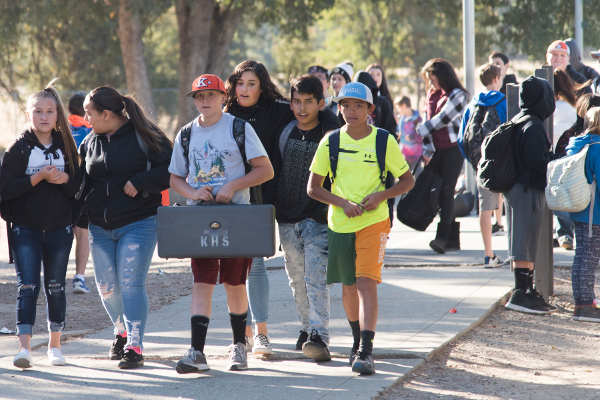
KELSEYVILLE, Calif. – The California Department of Education has released performance data for the 2017-18 school year, identifying Mountain Vista Middle School as one of six Lake County schools that meets the criteria for comprehensive support and improvement, or CSI.
CSI is based on four measures, both the raw numbers and the growth or decline they represent when compared to the previous year. The measures are English language arts test scores, math test scores, suspension rates, and chronic absenteeism rates.
The other local schools listed are Blue Heron School, Carlé Continuation High School and the Highlands Academy community day school in the Konocti Unified School District; Lakeport Elementary School; and Upper Lake Middle School, according to the California Department of Education.
This is the first year the state has used a new assessment tool to determine CSI status, and some California school administrators are concerned that the narrow, short-term focus does not accurately reflect a school’s overall performance, nor does it recognize performance trends over time.
However, at Kelseyville Unified School District, administrators say they welcome constructive criticism and view the CSI designation as an opportunity to keep improving.
“Mountain Vista Middle School offers students a great education,” said district Superintendent Dave McQueen. “With regard to the CSI designation, the Department of Education measures very specific criteria that concentrate on growth over a one-year period. A third of our students turn over every year at Mountain Vista Middle School – eighth graders move on to high school and we get a new batch of sixth graders – so a one-year comparison doesn’t really tell us much, there can be big fluctuations. However, that doesn’t mean we can’t improve. We can always improve, and once a school meets the criteria for CSI, it gets four years of additional federal funding under the Every Student Succeeds Act. This will allow us to improve even faster.”
McQueen described areas for improvement as well as Mountain Vista Middle School extracurricular and elective offerings that enrich the student experience but are not reflected in the State assessment.
He also noted that Mountain Vista Middle School test scores were higher than some schools that did not qualify for CSI, because the State considers not only the scores themselves, but whether they were better or worse than the previous year.
In describing the challenges facing Mountain Vista Middle School, McQueen highlighted the Lake County teacher shortage. A third of the school’s teachers were either new to the district or new to teaching last year.
“We have a strong mentoring program so new teachers have plenty of support, but there’s no substitute for experience. That will come with time. The good news is that we have so many enthusiastic new teachers,” Kelseyville Unified Director of Student Support Services Tim Gill said,
McQueen also pointed to the fact that 79.2 percent of Mountain Vista Middle School students are socioeconomically disadvantaged.
“We know that a solid education can help our students overcome poverty, but the struggles some of these kids face right now can make it hard to concentrate on school—can make it hard to even get to school,” he said.
Chronic absenteeism is defined as missing at least 10 percent of school per year. The Mountain Vista Middle School chronic absenteeism rate is 18 percent, which is double the state average.
McQueen suggested that the true measure of Mountain Vista Middle School should include not only the criteria measured by the Department of Education, but also the programs and services that enrich students both inside and outside the classroom, from electives that include a robotics class in partnership with the University of California at Davis to the AVID College and Career Readiness class, and from extracurriculars like sports and music to membership in the many clubs on campus.
“We believe one of the reasons graduation rates at Kelseyville High are going up is because of the AVID program at Mountain Vista Middle School,” McQueen said.
The school also utilizes a progressive approach to discipline that allows students to better understand their mistakes and to make amends, rather than simply being punished. Mountain Vista Middle School typically reserves suspension for students who engage in violent behavior or are guilty of drug offenses.
McQueen said, “We’ll continue to provide excellent training for our teachers and to give extra support to students who need it. Basically, we plan to work on the areas we need to improve and reinforce the areas where we’re doing well.”
CLEARLAKE, Calif. – On Thursday night the Clearlake City Council approved an urgency ordinance regarding the standards for manufactured and mobile homes which will place a hold on the placement of such structures that are more than 10 years old.
City Attorney Ryan Jones and Alan Flora, the city’s Community Development director and assistant city manager, took the urgency ordinance amending municipal code regarding residential housing standards for manufactured and mobile homes to the council.
Jones explained that, every so often, staff believes an urgency ordinance is necessary to protect the public safety, health and welfare of the community, and that the matter with mobile and modular homes was one of those instances.
Based on information from the city’s building inspector, the older mobile homes and manufactured homes that come into the city have safety issues. Specifically, Jones said the homes have aluminum electrical wiring which can cause fires, as well as poor insulation.
He said the goal is to be consistent with what the county of Lake is doing, adding the units coming into the city should be 10 years old or newer from the date the owner applies for a building permit.
Currently, someone who wants to place one of the structures only has to prove that the home is certified under the National Manufactured Home Construction and Safety Standards Act of 1974, Jones said.
The urgency ordinance will place a moratorium on mobile and modular homes older than 10 years while staff researches further possible regulations, measures which Jones said are important for community safety.
Flora noted that staffers are working on updating the city’s zoning ordinance, and that they have received comments from some people in the community about the mobile and modular home issue.
He said that city staff wants to further refine language regarding the structures in the updated zoning ordinance.
Councilmember Joyce Overton said that, when the matter is brought back to the council for further consideration, she wanted more details about the issues with aluminum wiring.
Flora said the city’s building inspector, who also is a member of the Lake County Fire Protection District, told them that the mobile home fires the district deals with in the city are due to aluminum wiring.
There was no public comment on the matter before Overton moved to approve the urgency ordinance, Councilman Dirk Slooten seconded and the council approved it, 4-0. Councilman Phil Harris was absent for the discussion.
The council also adopted an ordinance amending the Clearlake Municipal Code related to the issuance, handling, appeals, and penalties or administrative citations, amending the general penalty for violations, adjusting penalties for cannabis-related violations and providing for the immediate imposition of fines in specific circumstances.
Council members also honored retired District 2 Supervisor Jeff Smith; approved its 12th and final development agreement, this one with Erin McCarrick and Clearlake Ventures LLC for a commercial cannabis operation; approved a resolution authorizing staff to apply to the California Department of Housing and Community Development for the Community Development Block Grant program; and held off on finalizing a contract with Resource Environmental Inc. in the amount of $105,000 for the demolition of eight structures and the abatement of a ninth.
Email Elizabeth Larson at
Congressman Mike Thompson will host the summit from 7 to 9 p.m. Tuesday, Feb. 19, in the Board of Supervisors chambers at the Lake County Courthouse, 255 N. Forbes St. Lakeport.
The Mendocino Complex was California’s largest recorded wildfire, and officials said it is of great importance to address what actions are being taken to assist survivors of these fires in their recovery.
With the past four fire seasons having seen over 60 percent of Lake County’s landmass consumed, the time is now to highlight resiliency and wildfire mitigation efforts of many kinds.
Thompson’s summit will offer an opportunity to learn more about those ongoing efforts. He is coming to Lake County to hear about residents’ experiences and answer their questions.
If you or someone you know are interested in attending please RSVP at https://bit.ly/2RtpMvt .

KELSEYVILLE, Calif. – Thanks to the efforts of local individuals and organizations, there is a new nesting spot for the ospreys that live in and around Lakeside County Park.
The osprey nest tree at Lakeside County Park near Kelseyville was a popular osprey watching site for many who love this iconic bird of Clear Lake.
Sadly, the tree was deemed a hazard by the County of Lake and was cut down over the winter.
Faith Rigolosi, owner of Eyes on the Wild, a photography touring business here, brought the situation to the attention of Marilyn Waits, a board member of the local Redbud Audubon Society.
Waits, along with other Redbud board members, set about arranging the installation of a new pole for the osprey to call home.
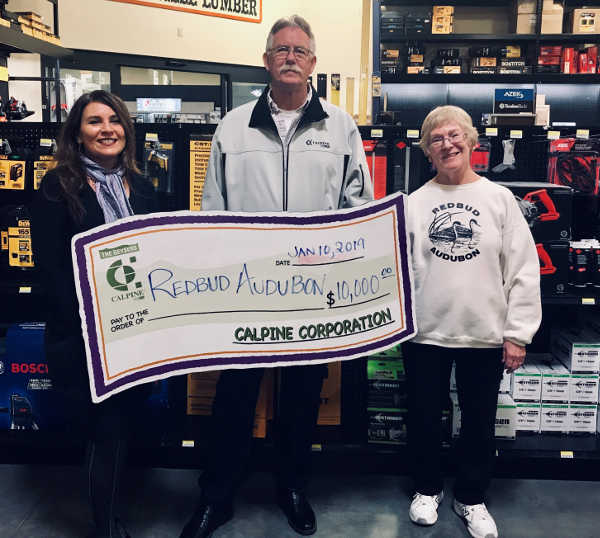
Calpine Corp. made a generous donation of $10,000 to Redbud Audubon’s Osprey Pole Fund, established decades ago to facilitate osprey pole replacement, and funds from this grant enabled Redbud to purchase the pole for the osprey nest and to hire the Lucchetti Excavating Co. of Ukiah to install it.
The Lake County Fish and Wildlife Advisory Committee also approved $5,000 for Redbud to purchase two osprey interpretive panels to be installed at Lakeside County Park, one in English and one in Spanish because so many Hispanic families use the park regularly. Outdoors columnist Terry Knight initiated the request for the interpretive panel funding from the Fish and Wildlife Advisory Committee.
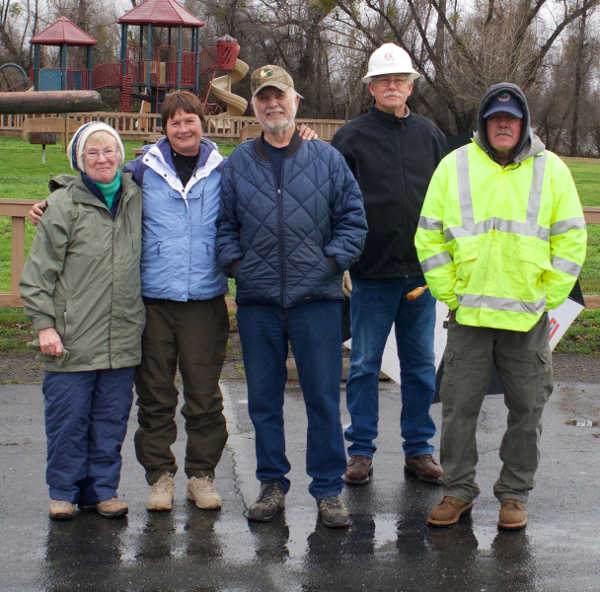
On Feb. 11, the Lucchetti Co. showed up at the park with their equipment and with help from Dan Cole, construction manager at Calpine, the Geysers and others, the pole was raised with the nesting disc attached to the top.
“The pole and the descriptive panels will provide a wonderful interpretive and wildlife viewing opportunity for both Lake County residents and visitors,” said Redbud Audubon President Roberta Lyons.
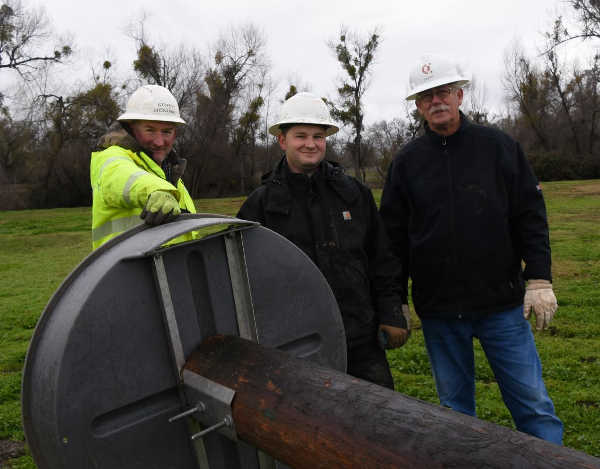
The osprey have already been spotted at the park and should start rebuilding their nest soon.
The Redbud Audubon Society is the oldest conservation group in Lake County. Founded in 1974, the Audubon Society offers monthly environmental programs from September through April, follows conservation related issues in the county and presents the yearly Heron Days event that takes visitors and residents alike along the shoreline in pontoon boats to view wildlife, including heron nesting sites on Clear Lake’s shoreline.
This year Heron Days will be held on the last weekend of April and the first weekend in May. Redbud Audubon will announce when registration for the boat rides is open.
For more information about Redbud or to become a member, go to www.redbudaudubon.org.

LAKEPORT, Calif. – The Lakeport Police Department reported that its officers arrested a man on Saturday for child endangerment after his young child was found running across Main Street.
Fabian Michael MorenoAmezcua, 34, of Lakeport was arrested in the case, according to a report from the department.
On Saturday at 4:30 p.m. Lakeport Police officers were dispatched to the area of South Main Street and Lily Cove to investigate the report of a toddler running across Main Street, the report explained.
Police said three officers responded and met with the reporting party who stated that he saw the toddler run into a residence on Lily Cove Avenue.
Officers went to the residence and began investigating. A female subject identified as a family member arrived on scene and said that she had earlier dropped the toddler, determined to be 3 years old, off with a subject later identified as MorenoAmezcua, the toddler’s father. However, she was unsure if MorenoAmezcua was at the residence with the child.
The officers attempted to contact MorenoAmezcua by telephone and also knocked on the doors and windows of the residence, the report said. Through a window, Officers could see the toddler in the residence but could not see any adults around.
Due to the circumstances and concern for the child’s safety, the officers made entry into the residence and located the toddler. During a further sweep of the residence, the officers located MorenoAmezcua hiding behind a door in a bedroom.
The department’s report said officers determined that MorenoAmezcua was under the influence of a controlled substance which they believed to be methamphetamine.
The officers found open containers of cannabis and smoking devices that were easily accessible to the toddler. Additionally, conditions in the residence were not believed to be suitable for the child, who was turned over to a family member.
Based on all the facts and circumstances, police said MorenoAmezcua was arrested and booked for felony child endangerment and being under the influence of a controlled substance, and transported to the Lake County Correctional Facility for booking.
Police said this case will also be sent to Child Protective Services for review.
“We appreciate the alertness of the reporting citizen and immediately contacting us to ensure the toddler’s safety,” the police department said in its report on the case.

No longer children but not yet adults, adolescents need opportunities to learn and prepare for their entrance into the broader society. But, as schooling increasingly extends the adolescent period and teenagers get dismissed as supposedly selfish and irresponsible, has society forgotten an important developmental need of our youth?
As a developmental scientist who focuses on adolescence, I reviewed dozens of studies and found that this age group has a fundamental need to contribute to others – to provide support, resources or help toward a shared goal. Contributing helps them achieve autonomy, identity and intimacy – important milestones on the way to adulthood.
As teenagers grow up, their brains are developing in ways that appear to support the increasingly complex ways of thinking and behaving that underlie giving to others. And being able to make meaningful contributions predicts better psychological and physical health among youth as well as adults. I believe it’s time to move away from outdated stereotypes of adolescents as only selfish and dangerous risk-takers and to consider how they are ripe for learning about contributing to others and their communities.
It’s human nature to give, even for adolescents
For decades, economists and other scientists have asked thousands of people to play experimental games that ask people to give and share money and other resources with one another. These studies have consistently shown that adults generally will provide some resources to others – some estimates put the average at around 30 percent of their allotments – even if they don’t know the recipients and expect nothing in return.
Adolescents are generous, too. Several labs around the world have reported on the tendency for youth to share at least some of their money or rewards with others in these games, even at a cost to themselves. Studies in the Netherlands suggested that adolescents aged 9 to 18 will make a costly donation to friends between 50 and 75 percent of the time. They’ll donate even to strangers at a cost to themselves between 30 and 50 percent of the time. In research our team has conducted, American adolescents agreed to give money to family at a loss to themselves about two-thirds of the time.
Add in the fact that teenagers consistently report their friends as their most frequent source of emotional and social support, and a picture emerges of adolescents as a group primed to contribute to others.
Brain developments for good
The adolescent brain gets blamed for a lot of bad behavior, such as delinquency and substance use. But this reputation is undergoing a rehabilitation.


Neuroscience research shows that brain regions related to reward – such as the ventral and dorsal striatum – become more sensitive during the teen years. At the same time, they’re strengthening connections to brain areas relevant for cognitive control, like the prefrontal cortex. Together these developments in the growing brain may be instrumental in the exploratory learning, creativity and cognitive flexibility essential to becoming an adult.
These regions and networks, as well as those relevant for thinking about other people, have been implicated in prosocial and giving behaviors. Our team’s studies have shown that several regions – such as the ventral and dorsal striatum and the dorsolateral and dorsomedial prefrontal cortex – are active when adolescents make costly donations to their family. Among youth who place great importance on helping family, we saw even more activation in additional regions related to social cognition and in the connections between them. Other researchers have obtained similar results.
These are the very same neural networks that undergo the most change during the adolescent years. The networks seem to be active during the complex decision-making – to whom, when, how much, do they really need it? – that can be involved in sharing resources, support and effort with others. It’s tricky to work through these kinds of difficult questions. The developing brain may enable youth to learn how to make the computations necessary to answer them.

Giving benefits the giver, too
Contribution helps givers and receivers. More and more evidence links giving and doing things for others with improved psychological and physical health. Volunteering and providing assistance has been correlated with lower mortality, fewer health problems and less depression.
And of course adolescents experience such benefits, as well. In an intriguing study, researchers randomly assigned one group of youths to participate in a program providing support and companionship to the elderly. Compared to a control group of teens, these adolescents later had lower circulating levels of inflammation – a marker known to be associated with a variety of chronic health problems.
Another study observed that helping others on a daily basis improved the mood of youth, particularly for those who suffered from higher levels of depressive symptoms. Our team even observed that adolescents were significantly happier on days in which they helped their families, due in part to their sense of fulfilling an important role in the family.
Helping meet the need to contribute
Providing youth with the opportunity to make contributions to others would seem to be a win-win: Youth gain skills and maintain well-being while communities benefit from their efforts. But are adolescents currently offered such opportunities in their daily lives?
First think about the home setting. Do families give adolescents a chance to participate in decision-making that affects themselves and their relatives? Do youth make instrumental contributions to their families, whether through daily chores or in more substantial ways like helping siblings with schoolwork?

In the school environment, do students feel as if their opinions are valued and their suggestions are considered? Are there enough slots in student leadership and extracurricular activities to give all students the opportunity to participate?
In the broader community, people must be welcoming of adolescents’ unique contributions, even when they may differ from the adults’. Are quality programs – those that allow youth to have a say – equitably available to the ethnically and economically diverse youth of today? Several national organizations such as Boys and Girls Clubs of America and 4-H aim to make it so, but limited resources can be a significant hurdle.
Figuring out ways to promote youth contribution can be challenging. Decisions need to be made about the appropriate type and amount, and responsible adults sometimes need to limit what adolescents can and should do. For example, participation in student governance would be positive, but taking on excessive job responsibilities that interfere with schooling and sleep would be detrimental. These decisions likely vary according to the norms and values of each community. And people must make a conscious effort to confront parochialism, by which adolescents and adults tend to give and do more for others like themselves.
Nevertheless, at a time in history when many economies no longer depend upon child and adolescent labor, perhaps the understandable desire to protect youth has led many people to forget an important ingredient in the period of life often called the “apprenticeship for adulthood.” Adolescents appear to be primed to give and contribute to others. They and our communities could benefit greatly if we collectively find more opportunities for them to do so in their daily lives.
Andrew J. Fuligni, Professor of Psychiatry & Psychology, University of California, Los Angeles
This article is republished from The Conversation under a Creative Commons license. Read the original article.