 How to resolve AdBlock issue?
News
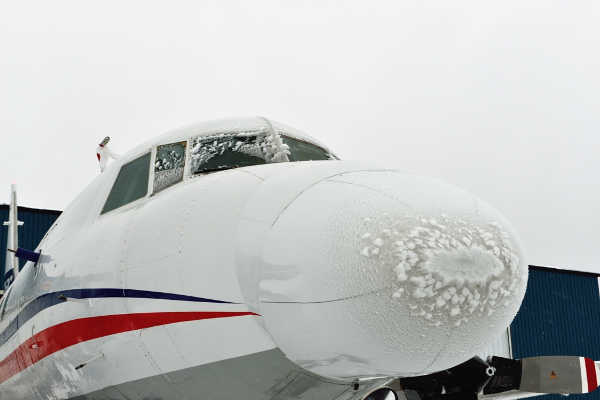
ROCKFORD, Ill. – Winter in the United States can produce some of the most dangerous weather for the aviation industry, including freezing rain, freezing drizzle, and sleet.
Those are the ideal conditions for a field campaign focused on collecting in-flight data in some of the most treacherous North American icing conditions.
The program is led by the Federal Aviation Administration, in partnership with the National Center for Atmospheric Research, or NCAR, and other organizations, and will help improve weather models and forecasts for those who work in aviation.
"Icy weather conditions are a hazard to pilots, crew, and passengers around the world," said Scott Landolt, an NCAR scientist and co-lead principal investigator for the field campaign. "This research will help make flight transportation safer, especially for smaller aircraft that fly at lower altitudes where they are at a higher risk of ice buildup during flight."
Scientists with the In-Cloud Icing and Large-Drop Experiment, or ICICLE, have been flying through extreme winter weather conditions since Jan. 28 using the National Research Council of Canada's Convair 580, a twin-engine research aircraft. Based in Rockford, Illinois, the scientists and Convair crew will travel to Wisconsin, Michigan, Iowa, and other neighboring states for another two weeks, chasing icy weather conditions.
This project is part of the FAA’s Aviation Weather Research Program, which sponsors research that will help minimize the impact of weather on the National Airspace System, including turbulence, ceiling and visibility, thunderstorms, and aircraft icing.
“Aviation users can only operate in icing conditions for which the aircraft is certified. If an aircraft demonstrates it can operate safely in a particular icing environment, it can become certified for flight into those icing environments," said Stephanie DiVito, the FAA ICICLE program lead and terminal area icing project lead. "Any icing environment outside of those provisions must be avoided. In order to avoid icing, the user must know it exists.”
“The data from ICICLE will help develop and validate icing diagnosis and forecast tools for the identification of icing conditions an aviation user may encounter, both in the terminal and en route environments, to enable safe operations in the National Airspace System,” said Danny Sims, the FAA in-flight icing weather project lead.
Ice in the sky
The data collected during ICICLE will be used to improve weather models and tools used in icing diagnosis and forecasting. Improving and drawing upon the strengths of these weather tools the aviation industry relies on could help pilots avert risky situations, like ice buildup.
Ice buildup on the surface of an aircraft can occur on the ground or in-flight. When it happens on the ground, an aircraft must be de-iced before takeoff. During a flight, ice can form when an aircraft flies through supercooled liquid water – water that remains liquid in the atmosphere at temperatures well below freezing.
“The risk to aviation in these conditions is that as soon as an airplane flies through this cloud, the supercooled droplets will freeze on impact,” said Julie Haggerty, who leads the in-flight icing program at NCAR and is co-lead principal investigator for ICICLE. “Airplanes are shaped to be aerodynamically functional, and when you add ice this changes the shape of the airplane and the airflow. Suddenly the airplane doesn’t fly as it is supposed to.”
The goal of the field campaign is to capture the various environments in which supercooled liquid water can exist in winter conditions aloft and to produce a data set that cannot be gathered from weather stations on the ground. The scientists are particularly interested in studying large water drops, typically bigger than what is seen in foggy weather.
“Getting something correct at the surface is insufficient. We need the observations in the sky as well because that is where the water droplets affect the airplanes once they are off the ground,” said Greg Thompson, an atmospheric scientist at NCAR who is working on ICICLE.
While the focus is on the in-cloud conditions, the scientists will be collecting data through the entire flight process, said Landolt. “We are trying to cover the full spectrum of what a pilot goes through when they are doing their planning – what the conditions are at their current airport location, what to expect during takeoff, en route, and then landing,” he said.
Throughout the field project, scientists and flight crew begin work on the flight plan in the early morning. Forecasters start looking at weather conditions as early as midnight and, through university partnerships, occasionally release weather balloons to analyze the cloud structure. The team uses the forecasts to plan the flight altitude and route to best capture the in-cloud conditions. Even if there is no precipitation, the crew will be flying.
“The majority of clouds you see outside aren’t producing precipitation, but when an aircraft takes off it has to fly through the cloud, and it will encounter ice-prone conditions there,” said Landolt.
Throughout takeoff, flight, and landing, instruments mounted on the airplane are collecting measurements. A suite of sensors, provided by the National Research Council of Canada and Environment and Climate Change Canada, measures a range of particle sizes while optical sensors count the number of droplets and ice crystals in the cloud along the flight path. In addition, an onboard cloud radar will allow the scientists to characterize the clouds above, below, and ahead of the aircraft.
This in-flight data will be compiled with NCAR’s Earth Observing Laboratory field catalog, a suite of tools that record ancillary data each day of the campaign. Scientists from around the world can use the catalog in real time and long after the field campaign is finished to help visualize the entirety of the project. The catalog includes maps, satellite and radar observations, and surface conditions among many other products.
ICICLE includes essential participation by NCAR, a major facility of the National Science Foundation, as active icing researchers in support of FAA icing projects and participating in ICICLE as support scientists, forecasters, and operations directors.
In addition, Ben Bernstein, a consultant with Leading Edge Atmospherics LLC is a critical part of the team, serving as science lead for the team and primary operations director, while providing expertise in identifying and sampling conditions that cause ice buildup.
ICICLE further includes collaborators from the National Oceanic and Atmospheric Administration as well as groups in England, France, and Germany.
Alexandra Branscombe writes for the National Center for Atmospheric Research/University Corporation for Atmospheric Research.

No matter how cold your winter has been, it's probably not as chilly as Mars. Check for yourself: The public can now get a daily weather report from NASA's InSight lander.
This public tool includes stats on temperature, wind and air pressure recorded by InSight. Last Sunday's weather was typical for the lander's location during late northern winter: a high of 2 degrees Fahrenheit (-17 degrees Celsius) and low of -138 degrees Fahrenheit (-95 degrees Celsius), with a top wind speed of 37.8 mph (16.9 m/s) in a southwest direction.
The tool was developed by NASA's Jet Propulsion Laboratory in Pasadena, California, with partners at Cornell University and Spain's Centro de Astrobiología. JPL leads the InSight mission.
Through a package of sensors called the Auxiliary Payload Subsystem (APSS), InSight will provide more around-the-clock weather information than any previous mission to the Martian surface.
The lander records this data during each second of every sol (a Martian day) and sends it to Earth on a daily basis. The spacecraft is designed to continue that operation for at least the next two Earth years, allowing it to study seasonal changes as well.
The tool will be geeky fun for meteorologists while offering everyone who uses it a chance to be transported to another planet.
"It gives you the sense of visiting an alien place," said Don Banfield of Cornell University, in Ithaca, New York, who leads InSight's weather science. "Mars has familiar atmospheric phenomena that are still quite different than those on Earth."
Constantly collecting weather data allows scientists to detect sources of "noise" that could influence readings from the lander's seismometer and heat flow probe, its main instruments. Both are affected by Mars' extreme temperature swings.
The seismometer, called the Seismic Experiment for Interior Structure, or SEIS, is sensitive to air pressure changes and wind, which create movements that could mask actual marsquakes.
"APSS will help us filter out environmental noise in the seismic data and know when we're seeing a marsquake and when we aren't," Banfield said. "By operating continuously, we'll also see a more detailed view of the weather than most surface missions, which usually collect data only intermittently throughout a sol."
APSS includes an air pressure sensor inside the lander and two air temperature and wind sensors on the lander's deck. Under the edge of the deck is a magnetometer, provided by UCLA, which will measure changes in the local magnetic field that could also influence SEIS. It is the first magnetometer ever placed on the surface of another planet.
InSight will provide a unique data set that will complement the weather measurements of other active missions, including NASA's Curiosity rover and orbiters circling the planet. InSight's air temperature and wind sensors are actually refurbished spares originally built for Curiosity's Rover Environmental Monitoring Station, or REMS.
These two east- and west-facing booms sit on the lander's deck and are called Temperature and Wind for InSight, or TWINS, provided by Spain's Centro de Astrobiología.
TWINS will be used to tell the team when strong winds could interfere with small seismic signals. But it could also be used, along with InSight's cameras, to study how much dust and sand blow around. Scientists don't know how much wind it takes to lift dust in Mars' thin atmosphere, which affects dune formation and dust storms – including planet-encircling dust storms like the one that occurred last year, effectively ending the Opportunity rover's mission.
APSS will also help the mission team learn about dust devils that have left streaks on the planet's surface. Dust devils are essentially low-pressure whirlwinds, so InSight's air pressure sensor can detect when one is near. It's highly sensitive – 10 times more so than equipment on the Viking and Pathfinder landers – enabling the team to study dust devils from hundreds of feet (dozens of meters) away.
"Our data has already shown there are a lot of dust devils at our location," Banfield said. "Having such a sensitive pressure sensor lets us see more of them passing by."

LAKE COUNTY, Calif. – What appeared to be a fatal crash on Highway 20 east of Clearlake Oaks on Thursday morning is being investigated as a homicide, according to the California Highway Patrol.
As Lake County News reported earlier this week, firefighters and the CHP responded to an area west of Walker Ridge Road on Highway 20 just after 7 a.m. Thursday on the report of a white van that had gone into a ditch.
Initially the crash did not appear unusual, but since then the investigation has revealed suspicious circumstances, according to CHP Clear Lake Area Office Commander Lt. Randy England.
“It’s a homicide,” England told Lake County News in a Saturday interview.
England identified the man whose body was found in the van as Patrick M. Weber, 41, of Santa Clarita.
England said a passing motorist reported seeing the white Dodge Sprinter van, a large cargo vehicle, in a ditch about two miles west of the Colusa County line and about a mile west of Walker Ridge Road. England said the call came in at 7:07 a.m.
The van had been traveling eastbound when it ran off the highway shoulder, went into a ditch and came to rest up against a tree, England said.
Radio traffic indicated firefighters were dispatched at 7:10 a.m. England said fire personnel arrived ahead of law enforcement and declared Weber deceased.
England said he and Sgt. Steve Krul responded to the scene that morning. While it looked like a case of someone falling asleep and driving off the road, “Something just didn’t seem right,” England said.
An additional report from the CHP said officers observed there were red paint transfer marks to the driver’s side of the vehicle, indicating a possible hit-and-run collision or an intentional act.
Sheriff Brian Martin also went out to the scene, England said. “He’s allocating all of the resources he has,” including a fingerprint specialist.
England also contacted Capt. Greg Baarts, a former commander of the Clear Lake Area office who now is with CHP’s Northern Division, based out of Redding. Baarts provided his Multidisciplinary Accident Investigation Team – also known as MAIT – to assist.
CHP incident logs about the crash indicated the MAIT team flew into Lampson Airport.
Later on Thursday evening, as the investigation of the scene was continuing, Weber’s body was moved and it was decided to have an autopsy performed immediately, England said.
The damage to the vehicle led to Weber’s cause of death not being immediately apparent. However, when the results of the autopsy came back, England said it was determined that Weber’s injuries were not consistent with a traffic crash, and it turned into a criminal investigation.
To protect the investigation, England said they are not yet releasing the exact cause of Weber’s death. They also are not commenting about what they found inside the van, which reports from the scene said was towed and stored as evidence.
“At this point right now, they’re writing search warrants, just trying to find any information about what he was doing up here, where he’s been, who he’s been contacting,” England said of Weber.
England said Weber’s family has been notified and investigators are working with them now to gather more information.
Investigators remain uncertain about when the incident occurred, the CHP said.
The investigation currently is a joint effort between the CHP Clear Lake Area office, the Northern Division Investigation Service Unit, the Northern Division MAIT and the Lake County Sheriff’s Office Major Crimes Investigation Unit.
Anyone with information about the crash, who saw any unusual activity along Highway 20 early Thursday or who has information about Weber and his whereabouts in the days leading up to the incident are urged to call the CHP’s Ukiah Dispatch Center at 707-467-4000. Calls during business hours may be made to the Clear Lake Area CHP office at 707-279-0103.
Email Elizabeth Larson atThis email address is being protected from spambots. You need JavaScript enabled to view it. . Follow her on Twitter, @ERLarson, or Lake County News, @LakeCoNews.
As Lake County News reported earlier this week, firefighters and the CHP responded to an area west of Walker Ridge Road on Highway 20 just after 7 a.m. Thursday on the report of a white van that had gone into a ditch.
Initially the crash did not appear unusual, but since then the investigation has revealed suspicious circumstances, according to CHP Clear Lake Area Office Commander Lt. Randy England.
“It’s a homicide,” England told Lake County News in a Saturday interview.
England identified the man whose body was found in the van as Patrick M. Weber, 41, of Santa Clarita.
England said a passing motorist reported seeing the white Dodge Sprinter van, a large cargo vehicle, in a ditch about two miles west of the Colusa County line and about a mile west of Walker Ridge Road. England said the call came in at 7:07 a.m.
The van had been traveling eastbound when it ran off the highway shoulder, went into a ditch and came to rest up against a tree, England said.
Radio traffic indicated firefighters were dispatched at 7:10 a.m. England said fire personnel arrived ahead of law enforcement and declared Weber deceased.
England said he and Sgt. Steve Krul responded to the scene that morning. While it looked like a case of someone falling asleep and driving off the road, “Something just didn’t seem right,” England said.
An additional report from the CHP said officers observed there were red paint transfer marks to the driver’s side of the vehicle, indicating a possible hit-and-run collision or an intentional act.
Sheriff Brian Martin also went out to the scene, England said. “He’s allocating all of the resources he has,” including a fingerprint specialist.
England also contacted Capt. Greg Baarts, a former commander of the Clear Lake Area office who now is with CHP’s Northern Division, based out of Redding. Baarts provided his Multidisciplinary Accident Investigation Team – also known as MAIT – to assist.
CHP incident logs about the crash indicated the MAIT team flew into Lampson Airport.
Later on Thursday evening, as the investigation of the scene was continuing, Weber’s body was moved and it was decided to have an autopsy performed immediately, England said.
The damage to the vehicle led to Weber’s cause of death not being immediately apparent. However, when the results of the autopsy came back, England said it was determined that Weber’s injuries were not consistent with a traffic crash, and it turned into a criminal investigation.
To protect the investigation, England said they are not yet releasing the exact cause of Weber’s death. They also are not commenting about what they found inside the van, which reports from the scene said was towed and stored as evidence.
“At this point right now, they’re writing search warrants, just trying to find any information about what he was doing up here, where he’s been, who he’s been contacting,” England said of Weber.
England said Weber’s family has been notified and investigators are working with them now to gather more information.
Investigators remain uncertain about when the incident occurred, the CHP said.
The investigation currently is a joint effort between the CHP Clear Lake Area office, the Northern Division Investigation Service Unit, the Northern Division MAIT and the Lake County Sheriff’s Office Major Crimes Investigation Unit.
Anyone with information about the crash, who saw any unusual activity along Highway 20 early Thursday or who has information about Weber and his whereabouts in the days leading up to the incident are urged to call the CHP’s Ukiah Dispatch Center at 707-467-4000. Calls during business hours may be made to the Clear Lake Area CHP office at 707-279-0103.
Email Elizabeth Larson at
LAKEPORT, Calif. – The investigators in the case against a man accused of setting a series of fires, including the 2016 Clayton fire, continued to describe their methods and findings during a court hearing on Friday.
Damin Anthony Pashilk, 43, of Clearlake returned to Lake County Superior Court on Friday for the fourth day of his preliminary hearing.
The preliminary hear is to determine if he will ultimately stand trial on 23 charges for setting the Clayton fire in August 2016 and 15 other fires between July of 2015 and August of 2016, as well as an attempted start of a 17th that self-extinguished.
In the proceedings so far, the testimony has come from a variety of Cal Fire personnel who were part of investigating the many fires and surveilling Pashilk for more than a year.
Michael Thompson, a battalion chief and law enforcement officer, returned to the stand on Friday after having testified much of Thursday.
Thompson, who had helped track Pashilk, described his interaction with Pashilk after his arrest on Aug. 15, two days after the Clayton fire – the last of the fires he’s accused of setting – began.
After he was taken into custody, Pashilk was taken to the Lake County Sheriff’s Office where a Cal Fire deputy chief and two detectives interviewed him, while Thompson watched the interview via video in another room.
Before that interview started, Thompson said he saw Pashilk reach into his sock, pull out something and swallow it. Pashilk later would admit that it was 2 grams of methamphetamine.
After the interview, Thompson placed Pashilk formally under arrest and searched him, finding a Bic lighter and some change. He then took Pashilk to Sutter Lakeside Hospital to be medically cleared for booking.
Thompson said he was at the hospital with Pashilk about an hour and a half, staying with him in the hospital room. In the room next door was a television newscast discussing the devastation of the Clayton fire. Pashilk heard it.
“His demeanor started to change,” said Thompson. “I witnessed him go from sitting in the upright position to starting to slouch into his chair and start sinking further and further down.”
Pashilk then began to tuck his chin to his shoulder, his shoulders started to bounce like he was crying, and Thompson said he saw tears, but Pashilk never made eye contact with him.
While at the hospital, Thompson said Pashilk asked him if he was religious. “I asked him what was the relevance,” and how it mattered, Thompson said. Pashilk replied, “I guess it doesn’t.”
Pashilk also asked if Thompson was Christian or Catholic. When Thompson responded that he’s a Christian, Pashilk asked about the afterlife, and if there is a heaven and hell. Pashilk then said he used to believe there was a heaven and hell but over the years his beliefs had changed.
At no time did Pashilk admit to setting the fires – throughout his interviews with Thompson he denied the allegations – and he eventually said he wanted to be taken to jail, Thompson said.
The following day, on Aug. 16, 2016, Thompson spoke again to Pashilk, who became upset. Pashilk also had told Thompson he didn’t want to live any more. Thompson said he told Pashilk it was important that people hear his side of the story. Pashilk told Thompson that a man had approached him in jail and said he should do a television interview, which Pashilk refused to do.
“I’m sure they're going to send me away for a long time but I’m going to do everything I can not to. They have a mountain of evidence,” Thompson recalled Pashilk saying, reading from his report on the investigation. Pashilk also told him, “I know I'm not a bad guy,” and Thompson replied that there were people willing to forgive him.
In his cross-examination, defense attorney Mitchell Hauptman asked Thompson about his findings at the scene of the Canyon fire on Aug. 9, 2016, on Seigler Canyon Road in Lower Lake. Thompson had testified on Thursday that he’d concluded that there was no ignition source – that it had been some material that had burned up – and Hauptman asked if it could have been a cigarette.
Thompson said a cigarette causing a fire in that manner and leaving no trace isn’t typical in his experience. “There would still be some remnants of that item there. From my experience, the filters don't completely burn.”
During Hinchcliff’s questioning, Thompson further explained that cigarettes don’t usually light vegetation fires, depending on fuel and humidity. He explained that most modern cigarettes have built in stops, and they're supposed to self extinguish if you’re not drawing on them, a safety fix in response to people falling asleep while smoking.
Thompson said he did find a cigarette filter at the site of a fire on Sulphur Bank Road near Clearlake on July 26, 2016, but determined it wasn’t the cause of that fire.
Following Thompson to the stand was Christopher Van Cor, an assistant chief of Cal Fire’s investigation unit. He also was involved in conducting surveillance of Pashilk in both 2015 and 2016.
In addition to following Pashilk, Van Cor helped place a GPS device tracking device on the Chrysler Sebring Pashilk was known to drive in 2016. Van Cor retrieved hard drives from surveillance cameras that had been set up around Lake County in areas where there had been fire activity. He also reviewed the footage.
On Aug. 13, 2016, Van Cor was one of several team members tracking Pashilk, who was seen going back and forth from his Clearlake home to Twin Pine Casino in Middletown. At 4:50 p.m. that day, he saw Pashilk turn down Clayton Creek Road – where the Clayton fire would begin shortly afterward. Van Cor said he didn’t turn down the road after Pashilk because he didn’t want to be seen. Later that evening, Van Cor saw Pashilk and a woman at Highway 29 and Spruce Grove Road, watching the fire.
Gary Uboldi, another Cal Fire peace officer assigned to Lake County, recounted investigating several of the fires, finding at one of the scenes a Twin Pine Casino matchbook. Pashilk was known to frequent that casino.
Like Van Cor, Uboldi was conducting surveillance of Pashilk on the day the Clayton fire began and he was one of the first people to arrive on the fire scene.
Uboldi investigated the fire’s cause, and in the grass in the origin area – just under 3 feet off the roadway – he found a 5- to 6-inch long and 1-inch wide food-type wrapper. It was clear and had illegible writing on it. One end had been burned and the other had melted but not burned.
He collected it for evidence and concluded it was used as the ignition source due to the fire spread indicators. He said he has seen plastic used as a source of ignition before.
On Aug. 15, 2016, two days after the Clayton fire started, Uboldi helped search Pashilk’s Koloko Street home in Clearlake, finding, packaging and securing numerous items of evidence from the home, the Chrysler and a nearby trailer. The items included a twisted white paper napkin – similar to one that Thompson had found at the scene of the Canyon fire six days earlier – along with numerous Twin Pine Casino matchbooks, a few lighters, a butane torch, a glass pipe, burned matches, more paper napkins and a torn paper cup.
Testimony will continue on Wednesday, Feb. 27.
Email Elizabeth Larson atThis email address is being protected from spambots. You need JavaScript enabled to view it. . Follow her on Twitter, @ERLarson, or Lake County News, @LakeCoNews.
Damin Anthony Pashilk, 43, of Clearlake returned to Lake County Superior Court on Friday for the fourth day of his preliminary hearing.
The preliminary hear is to determine if he will ultimately stand trial on 23 charges for setting the Clayton fire in August 2016 and 15 other fires between July of 2015 and August of 2016, as well as an attempted start of a 17th that self-extinguished.
In the proceedings so far, the testimony has come from a variety of Cal Fire personnel who were part of investigating the many fires and surveilling Pashilk for more than a year.
Michael Thompson, a battalion chief and law enforcement officer, returned to the stand on Friday after having testified much of Thursday.
Thompson, who had helped track Pashilk, described his interaction with Pashilk after his arrest on Aug. 15, two days after the Clayton fire – the last of the fires he’s accused of setting – began.
After he was taken into custody, Pashilk was taken to the Lake County Sheriff’s Office where a Cal Fire deputy chief and two detectives interviewed him, while Thompson watched the interview via video in another room.
Before that interview started, Thompson said he saw Pashilk reach into his sock, pull out something and swallow it. Pashilk later would admit that it was 2 grams of methamphetamine.
After the interview, Thompson placed Pashilk formally under arrest and searched him, finding a Bic lighter and some change. He then took Pashilk to Sutter Lakeside Hospital to be medically cleared for booking.
Thompson said he was at the hospital with Pashilk about an hour and a half, staying with him in the hospital room. In the room next door was a television newscast discussing the devastation of the Clayton fire. Pashilk heard it.
“His demeanor started to change,” said Thompson. “I witnessed him go from sitting in the upright position to starting to slouch into his chair and start sinking further and further down.”
Pashilk then began to tuck his chin to his shoulder, his shoulders started to bounce like he was crying, and Thompson said he saw tears, but Pashilk never made eye contact with him.
While at the hospital, Thompson said Pashilk asked him if he was religious. “I asked him what was the relevance,” and how it mattered, Thompson said. Pashilk replied, “I guess it doesn’t.”
Pashilk also asked if Thompson was Christian or Catholic. When Thompson responded that he’s a Christian, Pashilk asked about the afterlife, and if there is a heaven and hell. Pashilk then said he used to believe there was a heaven and hell but over the years his beliefs had changed.
At no time did Pashilk admit to setting the fires – throughout his interviews with Thompson he denied the allegations – and he eventually said he wanted to be taken to jail, Thompson said.
The following day, on Aug. 16, 2016, Thompson spoke again to Pashilk, who became upset. Pashilk also had told Thompson he didn’t want to live any more. Thompson said he told Pashilk it was important that people hear his side of the story. Pashilk told Thompson that a man had approached him in jail and said he should do a television interview, which Pashilk refused to do.
“I’m sure they're going to send me away for a long time but I’m going to do everything I can not to. They have a mountain of evidence,” Thompson recalled Pashilk saying, reading from his report on the investigation. Pashilk also told him, “I know I'm not a bad guy,” and Thompson replied that there were people willing to forgive him.
In his cross-examination, defense attorney Mitchell Hauptman asked Thompson about his findings at the scene of the Canyon fire on Aug. 9, 2016, on Seigler Canyon Road in Lower Lake. Thompson had testified on Thursday that he’d concluded that there was no ignition source – that it had been some material that had burned up – and Hauptman asked if it could have been a cigarette.
Thompson said a cigarette causing a fire in that manner and leaving no trace isn’t typical in his experience. “There would still be some remnants of that item there. From my experience, the filters don't completely burn.”
During Hinchcliff’s questioning, Thompson further explained that cigarettes don’t usually light vegetation fires, depending on fuel and humidity. He explained that most modern cigarettes have built in stops, and they're supposed to self extinguish if you’re not drawing on them, a safety fix in response to people falling asleep while smoking.
Thompson said he did find a cigarette filter at the site of a fire on Sulphur Bank Road near Clearlake on July 26, 2016, but determined it wasn’t the cause of that fire.
Following Thompson to the stand was Christopher Van Cor, an assistant chief of Cal Fire’s investigation unit. He also was involved in conducting surveillance of Pashilk in both 2015 and 2016.
In addition to following Pashilk, Van Cor helped place a GPS device tracking device on the Chrysler Sebring Pashilk was known to drive in 2016. Van Cor retrieved hard drives from surveillance cameras that had been set up around Lake County in areas where there had been fire activity. He also reviewed the footage.
On Aug. 13, 2016, Van Cor was one of several team members tracking Pashilk, who was seen going back and forth from his Clearlake home to Twin Pine Casino in Middletown. At 4:50 p.m. that day, he saw Pashilk turn down Clayton Creek Road – where the Clayton fire would begin shortly afterward. Van Cor said he didn’t turn down the road after Pashilk because he didn’t want to be seen. Later that evening, Van Cor saw Pashilk and a woman at Highway 29 and Spruce Grove Road, watching the fire.
Gary Uboldi, another Cal Fire peace officer assigned to Lake County, recounted investigating several of the fires, finding at one of the scenes a Twin Pine Casino matchbook. Pashilk was known to frequent that casino.
Like Van Cor, Uboldi was conducting surveillance of Pashilk on the day the Clayton fire began and he was one of the first people to arrive on the fire scene.
Uboldi investigated the fire’s cause, and in the grass in the origin area – just under 3 feet off the roadway – he found a 5- to 6-inch long and 1-inch wide food-type wrapper. It was clear and had illegible writing on it. One end had been burned and the other had melted but not burned.
He collected it for evidence and concluded it was used as the ignition source due to the fire spread indicators. He said he has seen plastic used as a source of ignition before.
On Aug. 15, 2016, two days after the Clayton fire started, Uboldi helped search Pashilk’s Koloko Street home in Clearlake, finding, packaging and securing numerous items of evidence from the home, the Chrysler and a nearby trailer. The items included a twisted white paper napkin – similar to one that Thompson had found at the scene of the Canyon fire six days earlier – along with numerous Twin Pine Casino matchbooks, a few lighters, a butane torch, a glass pipe, burned matches, more paper napkins and a torn paper cup.
Testimony will continue on Wednesday, Feb. 27.
Email Elizabeth Larson at
LAKE COUNTY, Calif. – A new series of storms heading for Northern California and Lake County is forecast to bring more rain as well as mountain snow.
The National Weather Service issued a winter storm watch for the northern third of Lake County – from Upper Lake north – from 6 p.m. Saturday to 11 a.m. Monday.
A winter storm watch means there is potential for significant snow, sleet or ice accumulations that may impact travel, the National Weather Service said.
The National Weather Service said the series of storms will bring mountain snow, gusty winds
and hazardous mountain travel to Northern California from the weekend and into next week.
The watch said locations above the 4,000-foot level are expected to see heavy snow accumulations.
Across Lake County, the specific forecast calls for chances of rain from Saturday through Friday. Rain is expected to be heavy at times on Monday and Tuesday.
Daytime temperatures over the coming week will range from the high 40s to mid 50s, and from the high 30s to low 40s at night, based on the forecast.
Light winds also are forecast for Saturday and Sunday.
Email Elizabeth Larson atThis email address is being protected from spambots. You need JavaScript enabled to view it. . Follow her on Twitter, @ERLarson, or Lake County News, @LakeCoNews.
The National Weather Service issued a winter storm watch for the northern third of Lake County – from Upper Lake north – from 6 p.m. Saturday to 11 a.m. Monday.
A winter storm watch means there is potential for significant snow, sleet or ice accumulations that may impact travel, the National Weather Service said.
The National Weather Service said the series of storms will bring mountain snow, gusty winds
and hazardous mountain travel to Northern California from the weekend and into next week.
The watch said locations above the 4,000-foot level are expected to see heavy snow accumulations.
Across Lake County, the specific forecast calls for chances of rain from Saturday through Friday. Rain is expected to be heavy at times on Monday and Tuesday.
Daytime temperatures over the coming week will range from the high 40s to mid 50s, and from the high 30s to low 40s at night, based on the forecast.
Light winds also are forecast for Saturday and Sunday.
Email Elizabeth Larson at
NORTHERN CALIFORNIA – This week, Assemblymember Cecilia Aguiar-Curry (D-Winters) – who represents Lake County – introduced Assembly Bill 958, to provide local, organic food to children in schools.
School meals with organic foods offer benefits for health, the environment, and California’s economy by increasing access to organic food for low-income children, decreasing pesticide exposure, increasing climate resilience, and supporting the organic market for California farmers.
California farmers grow food for the whole nation, and they grow more organic produce than any other state. Despite this, many low-income California communities do not have an adequate food supply of their own, and many children lack access to fresh, healthy food.
“Farm to School Programs are a great way to provide more local, fresh, organic produce to our children’s school meals,” said Aguiar-Curry. “In Winters where I live, our small, rural community surrounded by farms has been running a Farm to School Program for years. Over time, the community farms and school cafeterias have partnered to make local, fresh food available to our kids and their families, so they learn the importance of where their food comes from and why eating local is good for their health. And, we need to support our local farmers who produce sustainable, healthy foods.”
School meals provide a primary source of food and nutrition for millions of California public school students, and are a major support for low-income families struggling to make ends meet.
While cost and availability issues prevent many of California’s communities from accessing organic food, meals provided in the school setting are a practical way to increase children’s nutrition.
According to Allison Johnson, Sustainable Food Policy Advocate for the Natural Resources Defense Council, “Bringing more organic food to California’s schools is great for the health of our children, a win for climate, and a boost for innovative farming communities growing food without toxic pesticides.”
AB 958 will create the “California Organic-to-School Pilot Program” within the Office of Farm to Fork. This pilot program will allow school districts to apply for up to fifteen cents of additional funding on every school meal to purchase certified organic, California-grown foods.
Schools that serve a high percentage of children who qualify for free or reduced-price meals and are located in close proximity to agricultural production will be prioritized for the first grants.
By reporting information on the outcomes of the program back to the state, the goal of the California Organic-to-School Pilot Program is to demonstrate that providing kids with healthy local food is money well spent.
The benefits of bringing healthy, locally-grown, and organic foods to our schools stretch beyond internal health benefits. Through this program, school children will become more connected to both what they eat and where their food comes from.
Aguiar-Curry represents the Fourth Assembly District, which includes all of Lake and Napa Counties, parts of Colusa, Solano and Sonoma counties, and all of Yolo County except West Sacramento.
School meals with organic foods offer benefits for health, the environment, and California’s economy by increasing access to organic food for low-income children, decreasing pesticide exposure, increasing climate resilience, and supporting the organic market for California farmers.
California farmers grow food for the whole nation, and they grow more organic produce than any other state. Despite this, many low-income California communities do not have an adequate food supply of their own, and many children lack access to fresh, healthy food.
“Farm to School Programs are a great way to provide more local, fresh, organic produce to our children’s school meals,” said Aguiar-Curry. “In Winters where I live, our small, rural community surrounded by farms has been running a Farm to School Program for years. Over time, the community farms and school cafeterias have partnered to make local, fresh food available to our kids and their families, so they learn the importance of where their food comes from and why eating local is good for their health. And, we need to support our local farmers who produce sustainable, healthy foods.”
School meals provide a primary source of food and nutrition for millions of California public school students, and are a major support for low-income families struggling to make ends meet.
While cost and availability issues prevent many of California’s communities from accessing organic food, meals provided in the school setting are a practical way to increase children’s nutrition.
According to Allison Johnson, Sustainable Food Policy Advocate for the Natural Resources Defense Council, “Bringing more organic food to California’s schools is great for the health of our children, a win for climate, and a boost for innovative farming communities growing food without toxic pesticides.”
AB 958 will create the “California Organic-to-School Pilot Program” within the Office of Farm to Fork. This pilot program will allow school districts to apply for up to fifteen cents of additional funding on every school meal to purchase certified organic, California-grown foods.
Schools that serve a high percentage of children who qualify for free or reduced-price meals and are located in close proximity to agricultural production will be prioritized for the first grants.
By reporting information on the outcomes of the program back to the state, the goal of the California Organic-to-School Pilot Program is to demonstrate that providing kids with healthy local food is money well spent.
The benefits of bringing healthy, locally-grown, and organic foods to our schools stretch beyond internal health benefits. Through this program, school children will become more connected to both what they eat and where their food comes from.
Aguiar-Curry represents the Fourth Assembly District, which includes all of Lake and Napa Counties, parts of Colusa, Solano and Sonoma counties, and all of Yolo County except West Sacramento.