CLEARLAKE, Calif. – Clearlake Animal Control has added more dogs to its list of adoptable pets this week.
The kennels also have many dogs that need to be reunited with their owners. To find the lost/found pet section, click here.
The following dogs are ready for adoption.
“Bernard.” Photo courtesy of Clearlake Animal Control. ‘Bernard’
“Bernard” is a male Staffordshire Bull Terrier mix with a short brindle and white coat.
He already has been neutered.
He is No. 280.
“Buddy.” Photo courtesy of Clearlake Animal Control. ‘Buddy’
“Buddy” is a male dachshund with a short brindle coat.
He is No. 1740.
“Cadbury.” Photo courtesy of Clearlake Animal Control. ‘Cadbury’
“Cadbury” is a female Staffordshire Bull Terrier mix with a smooth medium-length beige coat.
She is No. 1215.
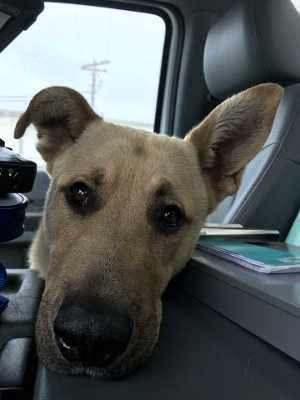
“Chase.” Photo courtesy of Clearlake Animal Control. ‘Chase’
“Chase” is a male shepherd mix with a medium-length brindle coat.
He is dog No. 2618.
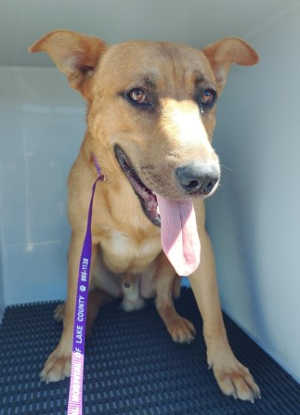
“Dexter.” Photo courtesy of Clearlake Animal Control. ‘Dexter’
“Dexter” is a male pit bull terrier mix with a short red coat.
He already has been neutered.
He is No. 2592.
“Frank.” Photo courtesy of Clearlake Animal Control. ‘Frank’
“Frank” is a male American Staffordshire Terrier mix with a short black and white coat.
He is No. 2345.
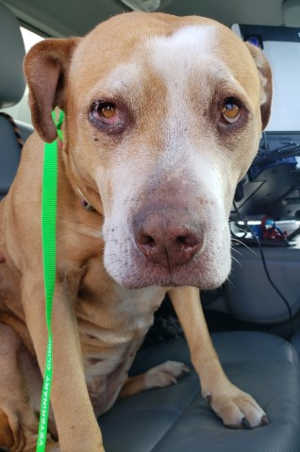
“Goldie.” Photo courtesy of Clearlake Animal Control. ‘Goldie’
“Goldie” is a senior female pit bull terrier mix with a blonde and white coat.
She is No. 2173.
“Hamilton.” Photo courtesy of Clearlake Animal Control. ‘Hamilton’
“Hamilton” is a male German Shepherd with a medium-length brown and black coat.
He is No. 2177.
“Lana.” Photo courtesy of Clearlake Animal Control. ‘Lana’
“Lana” is a female shepherd mix puppy with a smooth black and brown coat and one blue and one brown eye.
She has been spayed.
She is No. 2659.
“Melonie.” Photo courtesy of Clearlake Animal Control. ‘Melonie’
“Melonie” is a female American Pit Bull Terrier mix with a short red and white coat.
She is No. 2428.
“Samantha.” Photo courtesy of Clearlake Animal Control. ‘Samantha’
“Samantha” is a female dachshund mix with a short black and white coat.
She is No. 2546.
“Sturgill.” Photo courtesy of Clearlake Animal Control. ‘Sturgill’
“Sturgill” is a male Labrador Retriever mix with a medium-length yellow coat.
He is No. 2460.
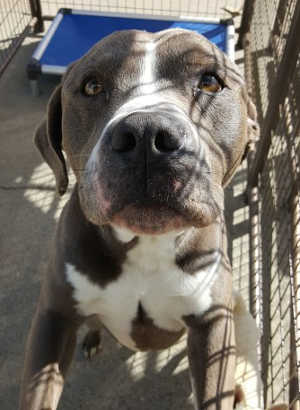
“Tyson.” Photo courtesy of Clearlake Animal Control. ‘Tyson’
“Tyson” is a male American Staffordshire terrier mix with a medium-length gray and white coat.
He is No. 1863.
“Wiley.” Photo courtesy of Clearlake Animal Control. ‘Wiley’
“Wiley” is a male German Shepherd mix with a medium-length black and brindle coat.
He is dog No. 2451.
Clearlake Animal Control’s shelter is located at 6820 Old Highway 53, off Airport Road.
Hours of operation area noon to 4 p.m. Tuesday through Saturday. The shelter is closed Sundays, Mondays and major holidays; the shelter offers appointments on the days it’s closed to accommodate people.
Call the Clearlake Animal Control shelter at 707-273-9440, or email This email address is being protected from spambots. You need JavaScript enabled to view it. to inquire about adoptions.
Visit Clearlake Animal Control on Facebook or at the city’s Web site.
Email Elizabeth Larson at This email address is being protected from spambots. You need JavaScript enabled to view it.. Follow her on Twitter, @ERLarson, or Lake County News, @LakeCoNews.
LAKE COUNTY, Calif. – A wildland fire incident made up of several roadside fires between Lower Lake and Kelseyville that began on Wednesday afternoon is fully contained.
Cal Fire said Thursday evening that the Glass fire is 100-percent contained at 28 acres.
The series of seven fires along Highway 29 near Diener Drive and DNA Ridge Rock Quarry was first reported shortly before 4:30 p.m. Wednesday, as Lake County News has reported.
The incident had initially required a closure of a portion of Highway 29 as heavy ground and air resources hit the fires as quickly as possible.
There were no injuries or threats to structures.
Cal Fire said the cause remains under investigation.
In its Thursday evening report, Cal Fire credited “teamwork, training and exceptional communication skills” among the agencies as aiding in bringing the incident to full containment.
The report said heavy equipment combined with fire personnel reinforced the containment lines to completion. The effort was helped by Thursday’s favorable weather.
Cal Fire said community members can expect to see fire personnel in the area checking these fires for the next several days.
Resources that remained assigned on Thursday night include 55 firefighters, four engines, two water tenders and one dozer, Cal Fire reported.
Email Elizabeth Larson at This email address is being protected from spambots. You need JavaScript enabled to view it.. Follow her on Twitter, @ERLarson, or Lake County News, @LakeCoNews.
Clearlake Police Records/Communications Supervisor Sherri Vannest, at left, is trained on new equipment that is helping convert the agency to a primary public safety answering point. Photo courtesy of the Clearlake Police Department. CLEARLAKE, Calif. – On Wednesday, the Clearlake Police Department took a key step in its plans to improve services to the community by beginning its function as a primary public safety answering point.
Before Wednesday, when individuals dialed 911 in the city of Clearlake, their calls were routed to the Lake County Sheriff’s Office Central Dispatch for police matters and then transferred to the Clearlake Police Department.
The circuitous process included delays and prevented dispatchers from accessing automated caller location information, including from cellular callers, with dispatchers having to then ask more questions to know whether the call was for police or fire, the latter being relayed to Cal Fire’s St. Helena dispatch.
At around noon on Wednesday, the department eliminated that delayed routing process by switching to state-of-the-art 911 call handling equipment.
Now, 911 landline callers within the city will be directly routed to a Clearlake Police dispatcher, who will handle their calls.
The department said that, in the coming weeks, the system will be further enhanced to provide direct routing of most cellular calls.
The changes are the result of the department receiving the state’s designation as a primary public safety answering point, which the Clearlake City Council approved pursuing last September at Chief Andrew White’s request, as Lake County News has reported.
In October, the Governor’s Office of Emergency Services, Public Safety Communications, California 9-1-1 Emergency Communications Branch notified the Clearlake Police Department that its application to become a public safety answering point had been approved.
As part of the state’s approval, it provided the Clearlake Police Department with $226,000, to be spread across five years, for the necessary equipment upgrades.
Clearlake Police Department staff and trainers prepare for the agency to become a primary public safety answering point. Photo courtesy of the Clearlake Police Department. The department said callers in the city will benefit from the new system’s full 911 capabilities, including automated location and number information, rapid transfers to the fire/medical dispatch with accompanying location/number information, and TDD for communication with the deaf.
There are still more upgrades to come, with the department reporting that new text-to-911 functionality will be implemented in the near future along with even more robust technology for locating wireless callers.
Last week, Clearlake Police dispatchers received extensive training on the fully computerized new system, which the department reported is fully integrated with the computer-aided dispatch system and the computers in the patrol vehicles.
Another benefit of the new system is that it is hardened against situations such as downed lines or equipment failures with redundant links to the public safety answering points at the Lake County Sheriff’s Office and Mendocino County Sheriff’s Office.
In emergency situations, such as an evacuation of a public safety answering point, calls can be seamlessly re-routed to another public safety answering point, the agency said.
“We would like to extend our sincere thanks to the California 9-1-1 Emergency Communications Branch, Lake County Sheriff's Office, Motorola Solutions, RIMS by Sun Ridge Systems and AT&T staff who all made this possible. We would also like to recognize our employees who put in extra time and effort to remodel our dispatch center and prepare it for the new system,” the department said in a Wednesday statement.
Email Elizabeth Larson at This email address is being protected from spambots. You need JavaScript enabled to view it.. Follow her on Twitter, @ERLarson, or Lake County News, @LakeCoNews.
An example of information available in the Clearlake Police Department’s new state-of-the-art dispatch system. Photo courtesy of the Clearlake Police Department.
LAKE COUNTY, Calif. – Coastal Cleanup Day is coming to Clear Lake on Saturday, Sept. 21.
This is the perfect opportunity for Lake County citizen volunteers to help clean shorelines, streams and creeks, and prevent trash from entering the lake and degrading the aquatic environment.
Coastal Cleanup Day involves more than marine beaches, as shorelines exist along any lake or waterbody, such as Clear Lake.
Started in 1985 by the California Coastal Commission, Coastal Cleanup Day is one of the largest volunteer events in the United States, involving more than 60,000 volunteers each year.
Since its inception, Coastal Cleanup Day has resulted in the removal of 23 million pounds of trash from California’s public beaches, lakes and waterways.
Last year’s Lake County Coastal Cleanup Day resulted in the removal of more than 500 pounds of trash collected by 41 dedicated volunteers. The county invites volunteers to beat those numbers this year.
Volunteers are encouraged to participate at any of the seven shoreline locations within the county and city of Clearlake. Materials such as gloves and trash bags will be provided.
Kayakers, boaters and waders are also strongly encouraged to participate, as trash can be found on land and in the water.
Want to go green? Bring your own bucket or reusable bags to help collect trash and save the landfill from more plastic.
If you or someone you know would like to participate in Coastal Cleanup Day, report to any of the following locations on Saturday, Sept. 21, from 9 a.m. to noon:
Upper Arm
– Keeling County Park, 3000 Carson St., Upper Lake. – Rodman Slough County Park, 1635 Nice-Lucerne Cutoff Road, Lakeport. – Nice-Lucerne Cutoff (Latitude, 39.119210, Longitude, -122.89622). – Highland Springs, 3500 E. Highland Springs Road, Lakeport.
Lower Arm
– Clear Lake Campground, 7805 Cache Creek Way, Clearlake. – Austin Park, 14295 Lakeshore Drive, Clearlake, starting at 8:30 a.m. – Borax Lake (Sulfur Bank Road, latitude, 38.978898, longitude, -122.67017) – meet at 7:30 a.m. at the park in front of Clearlake City Hall if you want direction to the cleanup site (if possible RSVP to site captain Edgar at 707-350-5152).
This event has been made possible by a partnership between Lake County Water Resources, City of Clearlake, Citizens Caring for Clear Lake, and the Clear Lake Environmental Research Center as well as local event sponsors C&S Waste Solutions, Caltrans and Lake County Public Services.
If you have questions or need more information please feel free to contact Lake County Water Resources at 707-263-2344, This email address is being protected from spambots. You need JavaScript enabled to view it. or message the agency on Facebook, @lakecountywater.
On Wednesday, Lake County’s two members of the House of Representatives along with 42 other members of the California Congressional delegation wrote President Donald Trump to condemn the transfer of $155 million from the Federal Emergency Management Agency’s Disaster Relief Fund to pay for Immigration and Customs Enforcement detention beds.
The Disaster Relief Fund is one of the nation’s go-to reserves for responding to natural disasters.
Rep. Mike Thompson (CA-05), who represents the southern half of Lake County, and Rep. John Garamendi (CA-03), who represents the county’s northern section, were among the signatories of the letter.
The letter raises concerns about “devastating, record breaking natural disasters,” adding that “to undercut FEMA's funding and its ability to respond at the height of fire season in California is unacceptable. Year after year California has been subject to devastating natural disasters, each larger and more deadly than the year before.”
It also noted the state’s deadly 2017 and 2018 fire seasons, explaining that, “ Through both of these terrible years FEMA disaster relief funding was imperative to disaster response effort in our state.”
The delegation said its members’ concerns go beyond California and wildfires, noting the importance of having FEMA funds available to respond to Hurricane Dorian and other disasters which are expected.
“This is why we vehemently oppose this reprogramming of funds and urge you ensure that no FEMA disaster relief funding is transferred,” the letter states.
Other letter signatures include representatives Zoe Lofgren (CA-19), Jared Huffman (CA-02), Mark DeSaulnier (CA-11), Adam B. Schiff (CA-28), Barbara Lee (CA-13), Grace F. Napolitano (CA-32), Katie Hill (CA-25), John Garamendi (CA-03), Salud Carbajal (CA-24), Julia Brownley (CA-26), Norma J. Torres (CA-35), Ro Khanna (CA-17), Scott Peters (CA-52), Josh Harder (CA-10), Katie Porter (CA-45), Alan Lowenthal (CA-47), Nanette Diaz Barragán (CA-44), Juan Vargas (CA-51), Ted W. Lieu (CA-33), Doris O. Matsui (CA- 06), TJ Cox (CA-21), Gilbert R. Cisneros (CA-39), Jr., Raul Ruiz (CA-36), Mike Levin (CA-49), Harley Rouda (CA-48), Linda T. Sánchez (CA-38), J. Luis Correa (CA-46), Anna G. Eshoo (CA-18), Jackie Speier (CA-14), Karen Bass (CA-37), Eric Swalwell (CA-15), Jimmy Gomez (CA-34), Ami Bera (CA-07), Brad Sherman (CA-30), Tony Cárdenas (CA-29), Susan A. Davis (CA-53), Jim Costa (CA-16), Maxine Waters (CA-43), Pete Aguilar (CA-31), Jimmy Panetta (CA-20), Jerry McNerney (CA-09), Judy Chu (CA-27) and Mark Takano (CA-41)
The full text of the letter is below.
The President The White House 1600 Pennsylvania Avenue Washington, DC 20500
Dear Mr. President:
As members of the California Congressional delegation, we write to condemn the recent action of your Administration to transfer $155 million dollars from the Federal Emergency Management Agency's (FEMA) disaster relief fund to pay for ICE detention beds and judicial hearing facilities. As you know, in the past few years we have seen devastating, record breaking natural disasters and to undercut FEMA's funding and its ability to respond at the height of fire season in California is unacceptable. Year after year California has been subject to devastating natural disasters, each larger and more deadly than the year before.
In 2017, California experienced what were, at the time, the most devastating fires in its history. Exasperated by longtime and widespread drought, the entire state felt the devastation and impact of the 2017 fire season. According to the California Department of Forestry and Fire Protection, these wildfires burned nearly 1,381,405 acres in California, destroyed 9,470 structures, causing billions of dollars in damage, and, most tragically, took the lives of 47 people.
In 2018 California experienced wildfires and natural disasters that shattered the record set by 2017. 2018 became the deadliest and most destructive wildfire season ever recorded in California, with a total of 8,527 fires burning an area of 1,893,913 acres, the largest area of burned acreage recorded in a fire season, according to the California Department of Forestry and Fire Protection. Through both of these terrible years FEMA disaster relief funding was imperative to disaster response effort in our state.
However, our concern goes beyond California and wildfires. As Hurricane Dorian threatens the Virgin Islands, Puerto Rico and the mainland United States it is imperative that FEMA has all the funds available to respond to dangerous and deadly disasters.
2019 will be no different than 2017 or 2018, California and the Country will experience more deadly natural disasters and wildfires in the coming month. FEMA must have all available funds in anticipation for forthcoming disasters. This is why we vehemently oppose this reprogramming of funds and urge you ensure that no FEMA disaster relief funding is transferred.
NORTHERN CALIFORNIA – Payments from the Wildfire Assistance Program funded by Pacific Gas and Electric Co. have begun to be delivered to people displaced by the 2017 Northern California wildfires and 2018 Camp fire.
The $105 million fund, approved by the judge in PG&E’s Chapter 11 cases, is intended to help those who are either uninsured or need assistance with alternative living expenses or other urgent needs.
An independent third-party administrator, Cathy Yanni, is overseeing disbursement of funds to eligible participants.
“Payments to eligible individuals and households started last Friday. We worked quickly to establish and file the eligibility criteria with the court so we could begin reviewing applications as soon as possible. We urge people displaced by the fires with unmet needs to apply, particularly those currently without adequate shelter,” Yanni said.
“We are committed to helping the victims and communities impacted by these wildfires recover and rebuild. Supporting them in their time of need is the right thing to do. We appreciate the work of the program administrator to ensure the funds get into the hands of those who need it most as quickly as possible,” said PG&E Corporation Chief Executive Officer and President Bill Johnson.
About 5,000 claims have been filed and about 20 percent are from Northern California, David Agretelis, Yanni’s assistant, told Lake County News.
He said he did not have drill-down data on how many Sulphur fire victims may have have applied as applicants aren’t being asked to identify the specific fires that impacted them.
Final payments are expected to be made by the end of the first quarter of 2020.
The administrator is actively reviewing claims and began sending payments on Friday, Aug. 30.
Applicants can request support for “Basic Unmet Needs,” which will provide each qualifying household with $5,000 for needs such as water, food, prescriptions, medical supplies and equipment, infant formula and diapers, personal hygiene items, and transportation fuels beyond what the Federal Emergency Management Agency covered in the days immediately following the declared disasters.
Those who receive basic payments may also qualify for a “Supplemental Unmet Needs” payment. These funds will be available, however, only after all basic payments have been issued. The administrator has been empowered to approve supplemental payments for households which currently face extreme or extraordinary circumstances.
To qualify for the payments, applicants’ primary residence must have been within the boundary of either the 2017 Northern California wildfires and 2018 Camp fire at the time of those events.
Applicants also must establish proof of identity and certify that they are not requesting payments for an expense already paid for by FEMA.
PG&E is providing $105 million for this fund from the company’s cash reserves and will not seek cost recovery from its customers.
 How to resolve AdBlock issue?