 How to resolve AdBlock issue?
News
Dogs available for adoption this week include mixes of Cane Corso mastiff, Catahoula Leopard Dog, Chihuahua, Labrador Retriever, pit bull and wirehaired terrier.
Dogs that are adopted from Lake County Animal Care and Control are either neutered or spayed, microchipped and, if old enough, given a rabies shot and county license before being released to their new owner. License fees do not apply to residents of the cities of Lakeport or Clearlake.
If you're looking for a new companion, visit the shelter. There are many great pets hoping you'll choose them.
The following dogs at the Lake County Animal Care and Control shelter have been cleared for adoption (additional dogs on the animal control Web site not listed are still “on hold”).
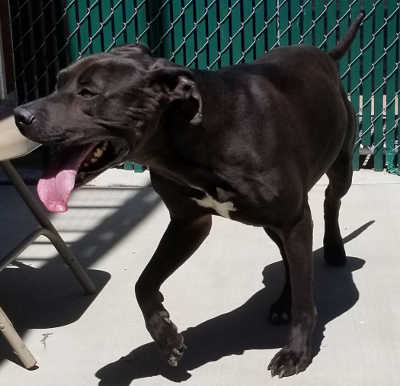
‘Cash’
“Cash” is a male pit bull terrier mix with a short black and white coat.
He needs a home as soon as possible – he has been marked as “urgent” because he has been at the shelter since June.
Shelter staff said Cash does well with others, loves people and walks well on a leash.
He has been neutered.
He’s in kennel No. 27, ID No. 12413.

Female Chihuahua-terrier mix
This female Chihuahua-terrier mix has a short tan and white coat.
She is in kennel No. 4, ID No. 12885.

‘Nova’
“Nova” is a female Cane Corso mastiff with a short black coat.
She is in kennel No. 17, ID No. 6579.
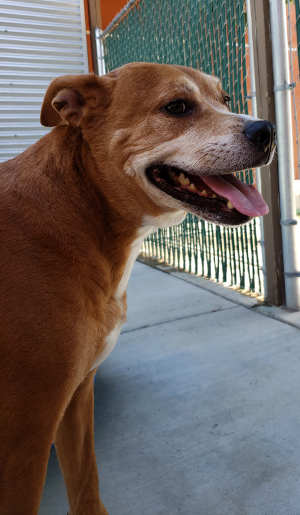
‘Koda’
“Koda” is a male pit bull terrier with a short red coat.
He already has been neutered.
He’s in kennel No. 18, ID No. 12609.
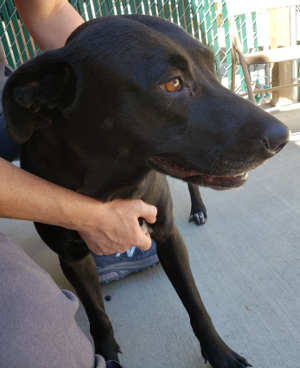
Female Labrador Retriever
This female Labrador Retriever has a short black.
She is in kennel No. 23, ID No. 12697.

‘Beau’
“Beau” is a male Catahoula Leopard Dog with a blue merle coat.
He’s in kennel No. 24, ID No. 12677.

Female wirehaired terrier
This female wirehaired terrier has a coarse brown and black coat.
She is in kennel No. 31, ID No. 12771.
Lake County Animal Care and Control is located at 4949 Helbush in Lakeport, next to the Hill Road Correctional Facility.
Office hours are Monday through Friday, 11 a.m. to 5 p.m., and 11 a.m. to 3 p.m., Saturday. The shelter is open from 11 a.m. to 4 p.m., Monday through Friday and on Saturday from 11 a.m. to 3 p.m.
Visit the shelter online at http://www.co.lake.ca.us/Government/Directory/Animal_Care_And_Control.htm .
For more information call Lake County Animal Care and Control at 707-263-0278.
Email Elizabeth Larson at

Many dream of what they would do had they a time machine. Some would travel 100 million years back in time, when dinosaurs roamed the Earth. Not many, though, would think of taking a telescope with them, and if, having done so, observe Saturn and its rings.
Whether our time-traveling astronomer would be able to observe Saturn’s rings is debatable. Have the rings, in some shape or form, existed since the beginnings of the solar system, 4.6 billion years ago, or are they a more recent addition? Had the rings even formed when the Chicxulub asteroid wiped out the dinosaurs?
I am a space scientist with a passion for teaching physics and astronomy, and Saturn’s rings have always fascinated me as they tell the story of how the eyes of humanity were opened to the wonders of our solar system and the cosmos.
Our view of Saturn evolves
When Galileo first observed Saturn through his telescope in 1610, he was still basking in the fame of discovering the four moons of Jupiter. But Saturn perplexed him. Peering at the planet through his telescope, it first looked to him as a planet with two very large moons, then as a lone planet, and then again through his newer telescope, in 1616, as a planet with arms or handles.
Four decades later, Christiaan Huygens first suggested that Saturn was a ringed planet, and what Galileo had seen were different views of Saturn’s rings. Because of the 27 degrees in the tilt of Saturn’s rotation axis relative to the plane of its orbit, the rings appear to tilt toward and away from Earth with the 29-year cycle of Saturn’s revolution about the Sun, giving humanity an ever-changing view of the rings.
But what were the rings made of? Were they solid disks as some suggested? Or were they made up of smaller particles? As more structure became apparent in the rings, as more gaps were found, and as the motion of the rings about Saturn was observed, astronomers realized that the rings were not solid, and were perhaps made up of a large number of moonlets, or small moons. At the same time, estimates for the thickness of the rings went from Sir William Herschel’s 300 miles in 1789, to Audouin Dollfus’ much more precise estimate of less than two miles in 1966.
Astronomers understanding of the rings changed dramatically with the Pioneer 11 and twin Voyager missions to Saturn. Voyager’s now famous photograph of the rings, backlit by the Sun, showed for the first time that what appeared as the vast A, B and C rings in fact comprised millions of smaller ringlets.
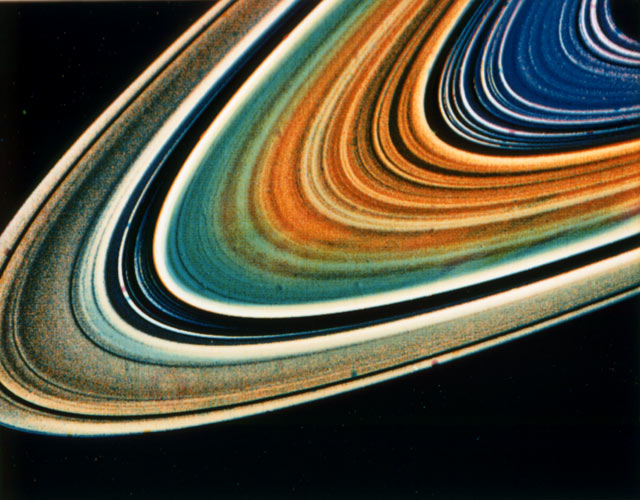
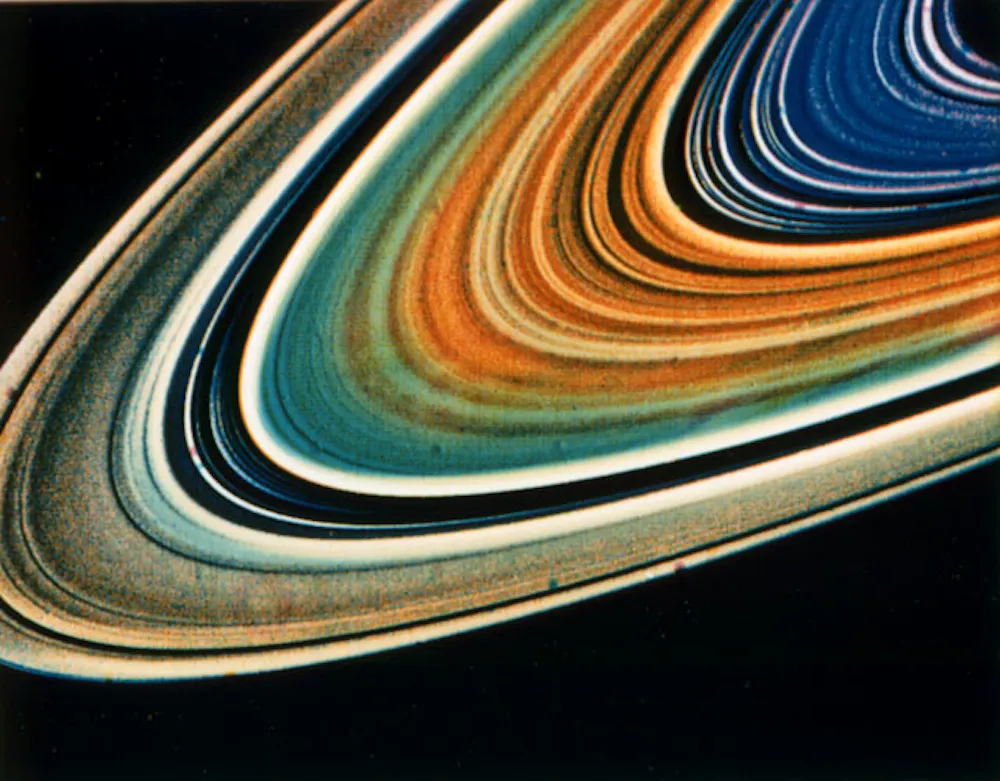
The Cassini mission to Saturn, having spent over a decade orbiting the ringed giant, gave planetary scientists even more spectacular and surprising views. The magnificent ring system of Saturn is between 10 meters and one kilometer thick. The combined mass of its particles, which are 99.8% ice and most of which are less than one meter in size, is about 16 quadrillion tons, less than 0.02% the mass of Earth’s Moon, and less than half the mass of Saturn’s moon Mimas. This has led some scientists to speculate whether the rings are a result of the breakup of one of Saturn’s moons or the capture and breakup of a stray comet.
The dynamic rings
In the four centuries since the invention of the telescope, rings have also been discovered around Jupiter, Uranus and Neptune, the giant planets of our solar system. The reason why the giant planets are adorned with rings and Earth and the other rocky planets are not was first proposed by Eduard Roche, a French astronomer in 1849.
A moon and its planet are always in a gravitational dance. Earth’s moon, by pulling on opposite sides of the Earth, causes the ocean tides. Tidal forces also affect planetary moons. If a moon ventures too close to a planet, these forces can overcome the gravitational “glue” holding the moon together and tear it apart. This causes the moon to break up and spread along its original orbit, forming a ring.
The Roche limit, the minimum safe distance for a moon’s orbit, is approximately 2.5 times the planet’s radius from the planet’s center. For enormous Saturn, this is a distance of 87,000 kilometers above its cloud tops and matches the location of Saturn’s outer F ring. For Earth, this distance is less than 10,000 kilometers above its surface. An asteroid or comet would have to venture very close to the Earth to be torn apart by tidal forces and form a ring around the Earth. Our own Moon is a very safe 380,000 kilometers away.
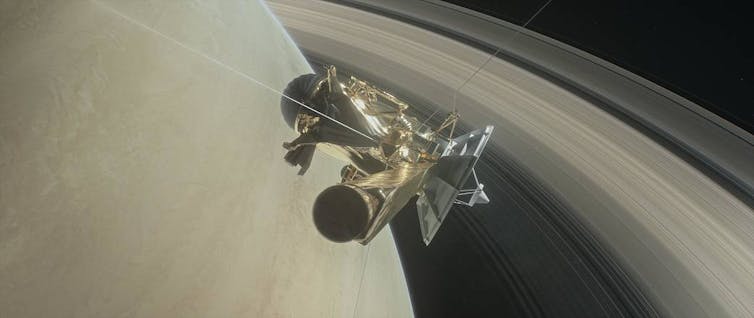
The thinness of planetary rings is caused by their ever-changing nature. A ring particle whose orbit is tilted with respect to the rest of the ring will eventually collide with other ring particles. In doing so, it will lose energy and settle into the plane of the ring. Over millions of years, all such errant particles either fall away or get in line, leaving only the very thin ring system people observe today.
During the last year of its mission, the Cassini spacecraft dived repeatedly through the 7,000 kilometer gap between the clouds of Saturn and its inner rings. These unprecedented observations made one fact very clear: The rings are constantly changing. Individual particles in the rings are continually jostled by each other. Ring particles are steadily raining down onto Saturn.
The shepherd moons Pan, Daphnis, Atlas, Pandora and Prometheus, measuring between eight and 130 kilometers across, quite literally shepherd the ring particles, keeping them in their present orbits. Density waves, caused by the motion of shepherd moons within the rings, jostle and reshape the rings. Small moonlets are forming from ring particles that coalesce together. All this indicates that the rings are ephemeral. Every second up to 40 tons of ice from the rings rain down on Saturn’s atmosphere. That means the rings may last only several tens to hundreds of millions of years.
Could a time-traveling astronomer have seen the rings 100 million years ago? One indicator for the age of the rings is their dustiness. Objects exposed to the dust permeating our solar system for long periods of time grow dustier and darker.
Saturn’s rings are extremely bright and dust-free, seeming to indicate that they formed anywhere from 10 to 100 million years ago, if astronomers’ understanding of how icy particles gather dust is correct. One thing is for certain. The rings our time-traveling astronaut would have seen would have looked very different from the way they do today.
This story has been corrected to reflect that it was Christiaan Huygens, not Giovanni Cassini, who first suggested that Saturn had rings.
[ Like what you’ve read? Want more? Sign up for The Conversation’s daily newsletter. ]
Vahe Peroomian, Associate Professor of Physics and Astronomy, University of Southern California – Dornsife College of Letters, Arts and Sciences
This article is republished from The Conversation under a Creative Commons license. Read the original article.
Cal Fire said in a Saturday evening report that the Oak fire has burned 53 acres and is 50-percent contained.
Multiple structures remain threatened, with one destroyed, Cal Fire reported.
The fire started at about 2 p.m. Saturday in the area of Live Oak Drive and Highway 29.
It prompted evacuations in the area of Live Oak Drive from the Gross Cutoff to Cruickshank Road, Cruickshank Road from Live Oak Drive to Highway 29, and Highway 29 from Cole Creek Road to Cruickshank Road.
The evacuation order for that area had been reduced to a warning on Saturday afternoon. Officials said no evacuation center has been opened.
Highway 29 remained closed from Live Oak Drive to Bottle Rock Road, with Live Oak Drive open to residents only, Cal Fire said Saturday evening.
Officials later opened Highway 29 shortly after 10:15 p.m.
The cause of the fire is so far unknown, Cal Fire said.
Cal Fire said that suppression efforts are continuing on the fire, which is burning in grass, brush and oak woodland.
Throughout the afternoon and evening Cal Fire and local fire agencies worked to get the fire under control while dealing with a west wind that helped the fire spot over the highway.
A large force of air tankers and helicopters were used on the fire, with some of them later diverted to work on other incidents around the state, including the Swedes fire near Oroville, based on radio traffic.
Resources assigned on Saturday evening include 17 engines, six air tankers, four water tenders, three helicopters, two hand crews, three dozers and 128 personnel, according to Cal Fire’s report.
Cooperating agencies include Cal Fire, Kelseyville Fire Protection District, South Lake Fire Protection District, Lakeport Fire District, Lake County Fire Protection District, Northshore Fire Protection District, UC Davis Fire Department, Willow Oak Fire Department, Williams Fire Department, the Lake County Sheriff’s Office, California Highway Patrol and Pacific Gas and Electric.
Email Elizabeth Larson at
This story is being updated on a rolling basis.
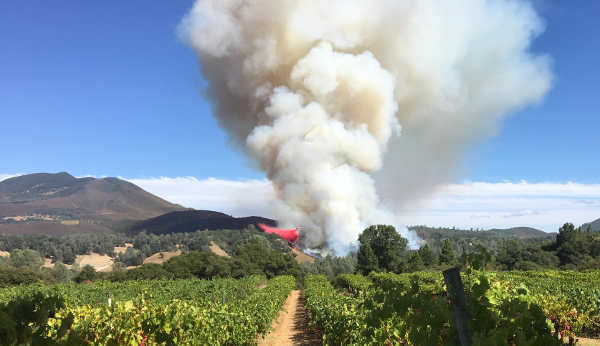
KELSEYVILLE, Calif. – Firefighters are trying to stop a vegetation fire in the Kelseyville area that has closed Highway 29 and led to a call for nearby evacuations.
The Oak incident was dispatched shortly before 2 p.m. Saturday in the 6800 block of Live Oak Drive near Cole Creek Road.
The large and expanding smoke column can be seen across Clear Lake.
First units on scene, which arrived within 10 minutes of dispatch, said the fire was five acres with a moderate rate of spread.
A short time later, Cal Fire air attack reported that the fire was 10 acres, with one structure completely involved and the fire moving toward other structures.
The fire’s building smoke is raising concerns for air support, as is the presence of seaplanes for the annual Clear Lake Seaplane Splash In in Lakeport.
By 2:30 p.m. the fire was reported to be 10 acres and moving toward Highway 29, which led to authorities closing the southbound lane of Highway 29 from Live Oak south through the fire area.
At 2:40 p.m., incident command reported there was a spot fire that had jumped Highway 29 and had burned a quarter-acre of vegetation on the east side of the highway. At that point, most of the fire remained on the highway’s west side.
Air attack reported that the fire was moving toward homes on a nearby ridge and that structure protection in the area was a priority, according to radio reports.
Incident command asked for two more air tankers and two more helicopters, adding to four tankers and three copters that previously had been requested, based on reports from the scene.
By 2:46 p.m., the fire was estimated to be between 15 and 20 acres, with a call out issued for three more engines from local fire agencies.
At 2:48 p.m., incident command directed evacuations begin taking place in the area of Live Oak and Cruickshank, with law enforcement called in to assist.
The California Highway Patrol reported that a hard road closure was instituted at Bottle Rock Road and Cole Creek Road just after 3 p.m.
At 3:28 p.m., the Lake County Sheriff’s Office issued notice of an evacuation order for the areas of Live Oak Drive between Gross Cutoff and Cruickshank, Highway between Cole Creek and Cruickshank, and Cruickshank between Live Oak and Highway 29. Residents are ordered to leave the area immediately.
The sheriff’s office followed up at 3:40 p.m. by issuing an evacuation warning for residents of the area east of Highway 29 between Cole Creek Road and Highway 175. Authorities urged those residents with nonambulatory family or animals to consider immediately leaving the area.
At 4:15 p.m., incident command reported that firefighters were making good progress, with a combination of hose lay and dozer line around a majority of the incident and Copter 104 from Boggs Helitack working one spot fire outside of the fire line.
At that time, incident command estimated that the fire remained at 20 acres with containment at 10 percent, and no additional resource orders expected.
On Saturday afternoon requests also were being made of incident command to begin releasing some air resources due to fires in other parts of the state, based on radio reports.
At 4:57 p.m., the sheriff's office said the evacuation order for the areas of Live Oak Drive between Gross Cutoff adn Cruickshank, Highway 29 between Cole Creek and Cruickshank, and Cruickshank between Live Oak and Highway 29 had been downgraded to an evacuation warning.
The California Highway Patrol reported shortly before 6:15 p.m. that the portion of Highway 29 in the fire area – between Live Oak Drive and Bottle Rock Road – is to remain closed for several more hours and possibly into the night.
Email Elizabeth Larson at
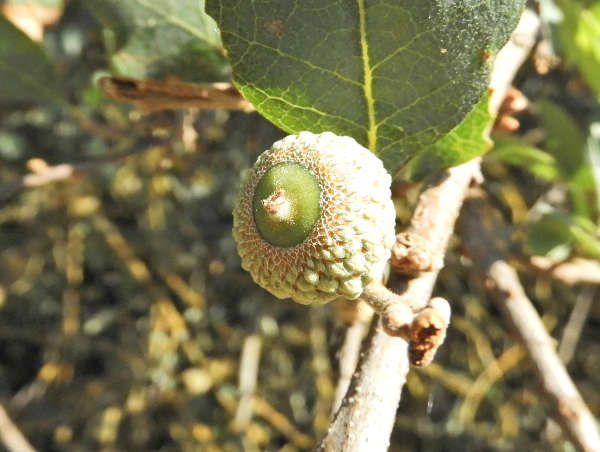
NORTHERN CALIFORNIA – We have a lot of different oak trees in the region, but for today let’s focus on one that has some pretty unique and interesting features, namely the interior live oak, Quercus wislizeni.
These trees can grow in a tall tree formation reaching heights of between 30 and 70 feet high or they can also grow in a low, scrubby shrub formation (between 6 and 20 feet tall) depending on their habitat. But unlike some of their oak cousins, the interior live oaks have relatively thin bark, so they don’t do as well in high-fire areas as, say, the Blue Oaks (Quercus douglasii).
They can, however, grow in some places where other oaks can’t, including areas where the soil is comprised of igneous rock (rocks made of molten material) or even granite. Part of the reason for that is that the interiors have the ability to dig down deep into the ground to find sources of water other oak trees may miss.
In fact, studies indicate that they have the deepest root structures of all oak trees across the globe. In Placer County the roots of one tree were traced down through over 24 feet of rock before they touched ground water!
The leaves of interior live oaks are pretty interesting, too. They are generally flat, thick (sclerophyllous) and evergreen. These thick leaves help the trees to retain moisture in the hot summer months.
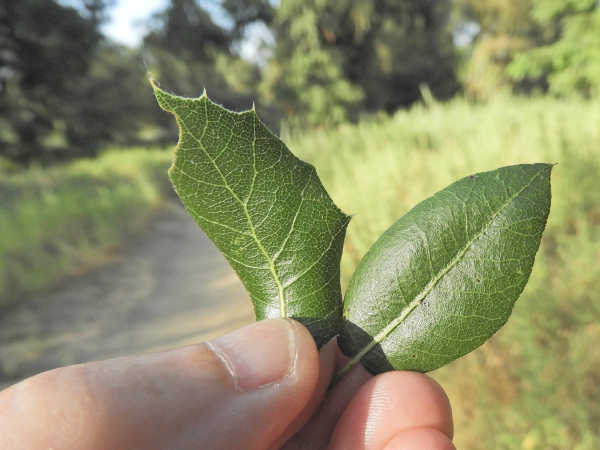
Another interesting fact about the Interior live oaks is that they actually sport two different leaf shapes on the same tree. New leaves re-sprouting from a root ball or growing on the lower branches of an established tree have a serrated edge and look almost like holly leaves. The more mature leaves further up into the crown of the tree have smooth edges. It’s believed that the serrated version of the leaves was an adaptation by the tree to try to discourage deer from eating the younger, more tender leaves.
Deer can really decimate young interior live oaks by their foraging, which is why in some reserves and refuges where there’s restoration work going on, you see the younger trees surrounded by chicken wire or some other defensive barrier. That’s to protect the young trees from being browsed to death before they can reach a height where they’re no longer so badly impacted by foraging animals.
Once established, the Interiors can live for about 200 years. Because they have the ability to re-sprout from the root stock after a wildfire, however, it’s believed that many of the trees we see actually have root systems that are much older (by several generations) than the above-ground trees themselves.
Interior live oaks are home to a variety of nesting birds and squirrels and are host trees to several different kinds of butterflies, like the California Sister. If you look carefully on the leaves of these oaks, you can also see that they build specialized galls to feed and protect the larvae of several different cynipid wasps.
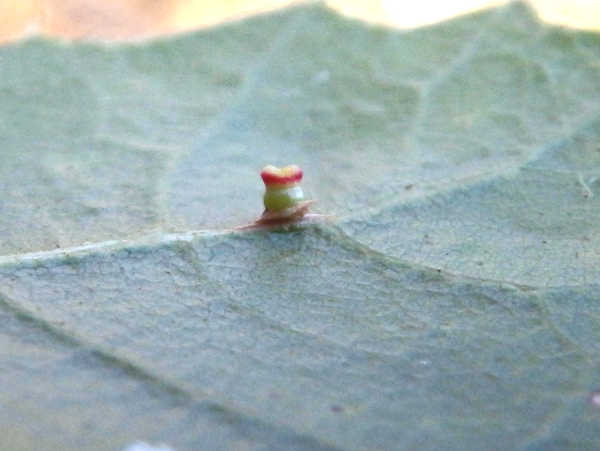
Some of galls you should be able to find right now are the tiny two-horned galls, pumpkin galls, and kernel galls (which look like little green jugs with a reddish-brown lid on them). The kernel galls form on the underside of the leaves along the mid-vein.
The interior live oak is a tree you probably see almost every day in our area, but it has some incredible adaptations and features that make it truly unique. And where both the interior live oak and the coast live oak (Quercus agrifolia) are native to California, it’s our interior live oak that is actually endemic to our state, found here and nowhere else on earth.
Mary K. Hanson is a Certified California Naturalist, author and nature photographer, living with terminal cancer. She developed and helps to teach the naturalist program at Tuleyome, a 501(c)(3) nonprofit conservation organization based in Woodland. For more information, see their website at http://tuleyome.org/.

NORTH COAST, Calif. – A Napa County woman was arrested on Thursday after authorities said she abducted a Clearlake woman’s child and also stole the woman’s vehicle.
Wanda Jean Cowan, 58, of American Canyon was arrested on Thursday evening, according to Sgt. James Wells of the Mendocino County Sheriff’s Office.
Wells said that at 5:25 p.m. Thursday deputies were dispatched to a possible stolen vehicle and child abduction at the Coyote Valley Casino in Redwood Valley.
When the deputies arrived at the scene they contacted a 40-year-old Clearlake woman who advised someone took her vehicle with her 16-month-old child inside it, Wells said.
The woman told deputies she had met the suspect, later identified as Wanda Cowan, the previous night and had traveled from Lake County to the Coyote Valley Casino on Thursday with her. Wells said that the woman reported that when she walked into the casino, Cowan left the area in her vehicle.
Wells said Cowan did not have permission to take the woman’s child or her vehicle from the casino area.
Deputies immediately issued a be on the lookout to surrounding law enforcement agencies for the vehicle and the child, Wells said.
Deputies were in the process of getting an AMBER Alert issued when Wells said a California Highway Patrol officer located the vehicle traveling on Highway 101 in Willits.
Wells said the CHP stopped the vehicle and the baby was located on the back seat, unrestrained.
The baby was not injured and was quickly reunited with her mother, Wells said.
Wells said Cowan was arrested for possession of stolen property, kidnapping and child endangerment.
Cowan was booked into the Mendocino County Jail without incident, where she was to be held in lieu of $250,000 bail, Wells said.