LAKE COUNTY, Calif. – Lake County Animal Care and Control has more new dogs for adoption this week.
Dogs available for adoption this week include mixes of boxer, Brussels Griffon, Kuvasz, Labrador Retriever, German Shepherd, Patterdale terrier/Fell terrier, pit bull, Rhodesian Ridgeback, shepherd and wirehaired terrier.
Dogs that are adopted from Lake County Animal Care and Control are either neutered or spayed, microchipped and, if old enough, given a rabies shot and county license before being released to their new owner. License fees do not apply to residents of the cities of Lakeport or Clearlake.
If you're looking for a new companion, visit the shelter. There are many great pets hoping you'll choose them.
The following dogs at the Lake County Animal Care and Control shelter have been cleared for adoption (additional dogs on the animal control Web site not listed are still “on hold”).
This male shepherd mix is in kennel No.5, ID No. 13219. Photo courtesy of Lake County Animal Care and Control. Shepherd mix
This male shepherd mix has a long tan coat.
He is in kennel No.5, ID No. 13219.
“Bella” is a female boxer in kennel No. 14, ID No. 13256. Photo courtesy of Lake County Animal Care and Control. ‘Bella’
“Bella” is a female boxer with a short brown coat.
She is in kennel No. 14, ID No. 13256.
This male Rhodesian Ridgeback has is in kennel No. 19, ID No. 13210. Photo courtesy of Lake County Animal Care and Control. Male Rhodesian Ridgeback
This male Rhodesian Ridgeback has a short tan coat with black markings.
He is in kennel No. 19, ID No. 13210.
“Athena” is a female boxer in kennel No. 20, ID No. 13213. Photo courtesy of Lake County Animal Care and Control. ‘Athena’
“Athena” is a female boxer with a medium-length brown and white coat.
She is in kennel No. 20, ID No. 13213.
This female pit bull terrier is in kennel No. 21, ID No. 13195. Photo courtesy of Lake County Animal Care and Control. Female pit bull terrier
This female pit bull terrier has a short black and white coat.
She is in kennel No. 21, ID No. 13195.
This male Patterdale terrier/Fell terrier is in kennel No. 23, ID No. 13194. Photo courtesy of Lake County Animal Care and Control. Patterdale terrier/Fell terrier
This male Patteradle or Fell terrier has a short brown and white coat.
He is in kennel No. 23, ID No. 13194.
This male pit bull terrier is in kennel No. 24, ID No. 13172. Photo courtesy of Lake County Animal Care and Control. ‘Tatum’
“Tatum” is a male pit bull terrier has a shot gray and white coat.
He is in kennel No. 24, ID No. 13172.
This male German Shepherd is in kennel No. 25, ID No. 13218. Photo courtesy of Lake County Animal Care and Control. Male German Shepherd
This male German Shepherd has a long black and tan coat.
He has been neutered.
He’s in kennel No. 25, ID No. 13218.
“Shakira” is a female pit bull terrier in kennel No. 26, ID No. 6930. Photo courtesy of Lake County Animal Care and Control. ‘Shakira’
“Shakira” is a female pit bull terrier with a short black and white coat.
She already has been spayed.
She is in kennel No. 26, ID No. 6930.
“Scrappy” is a female wirehaired terrier in kennel No. 27a, ID No. 13174. Photo courtesy of Lake County Animal Care and Control. ‘Scrappy’
“Scrappy” is a female wirehaired terrier with a coarse tan coat.
She is in kennel No. 27a, ID No. 13174.
“Scruffy” is a female Brussels Griffon in kennel No. 27b, ID No. 13175. Photo courtesy of Lake County Animal Care and Control. ‘Scruffy’
“Scruffy” is a female Brussels Griffon with a medium-length tan coat.
She is in kennel No. 27b, ID No. 13175.
This female Kuvasz is in kennel No. 33, ID No. 13212. Photo courtesy of Lake County Animal Care and Control. Female Kuvasz
This female Kuvasz has a short black coat with white markings.
She is in kennel No. 33, ID No. 13212.
Lake County Animal Care and Control is located at 4949 Helbush in Lakeport, next to the Hill Road Correctional Facility.
Office hours are Monday through Friday, 11 a.m. to 5 p.m., and 11 a.m. to 3 p.m., Saturday. The shelter is open from 11 a.m. to 4 p.m., Monday through Friday and on Saturday from 11 a.m. to 3 p.m.
For more information call Lake County Animal Care and Control at 707-263-0278.
Email Elizabeth Larson at This email address is being protected from spambots. You need JavaScript enabled to view it.. Follow her on Twitter, @ERLarson, or Lake County News, @LakeCoNews.
Sunset at the Viking Lander 1 site, 1976. Credits: NASA/JPL. For the first time in the history of space exploration, scientists have measured the seasonal changes in the gases that fill the air directly above the surface of Gale Crater on Mars.
As a result, they noticed something baffling: oxygen, the gas many Earth creatures use to breathe, behaves in a way that so far scientists cannot explain through any known chemical processes.
Over the course of three Mars years (or nearly six Earth years) an instrument in the Sample Analysis at Mars, or SAM, portable chemistry lab inside the belly of NASA’s Curiosity rover inhaled the air of Gale Crater and analyzed its composition.
The results SAM spit out confirmed the makeup of the Martian atmosphere at the surface: 95% by volume of carbon dioxide (CO2), 2.6 percent molecular nitrogen (N2), 1.9 percent argon (Ar), 0.16 percent molecular oxygen (O2), and 0.06 percent carbon monoxide (CO). They also revealed how the molecules in the Martian air mix and circulate with the changes in air pressure throughout the year.
These changes are caused when CO2 gas freezes over the poles in the winter, thereby lowering the air pressure across the planet following redistribution of air to maintain pressure equilibrium. When CO2 evaporates in the spring and summer and mixes across Mars, it raises the air pressure.
Within this environment, scientists found that nitrogen and argon follow a predictable seasonal pattern, waxing and waning in concentration in Gale Crater throughout the year relative to how much CO2 is in the air. They expected oxygen to do the same. But it didn’t.
Instead, the amount of the gas in the air rose throughout spring and summer by as much as 30 percent, and then dropped back to levels predicted by known chemistry in fall. This pattern repeated each spring, though the amount of oxygen added to the atmosphere varied, implying that something was producing it and then taking it away.
“The first time we saw that, it was just mind boggling,” said Sushil Atreya, professor of climate and space sciences at the University of Michigan in Ann Arbor. Atreya is a co-author of a paper on this topic published on November 12 in the Journal of Geophysical Research: Planets.
As soon as scientists discovered the oxygen enigma, Mars experts set to work trying to explain it. They first double- and triple-checked the accuracy of the SAM instrument they used to measure the gases: the Quadrupole Mass Spectrometer. The instrument was fine. They considered the possibility that CO2 or water (H2O) molecules could have released oxygen when they broke apart in the atmosphere, leading to the short-lived rise. But it would take five times more water above Mars to produce the extra oxygen, and CO2 breaks up too slowly to generate it over such a short time.
What about the oxygen decrease? Could solar radiation have broken up oxygen molecules into two atoms that blew away into space? No, scientists concluded, since it would take at least 10 years for the oxygen to disappear through this process.
“We’re struggling to explain this,” said Melissa Trainer, a planetary scientist at NASA’s Goddard Space Flight Center in Greenbelt, Maryland who led this research. “The fact that the oxygen behavior isn’t perfectly repeatable every season makes us think that it’s not an issue that has to do with atmospheric dynamics. It has to be some chemical source and sink that we can’t yet account for.”
To scientists who study Mars, the oxygen story is curiously similar to that of methane. Methane is constantly in the air inside Gale Crater in such small quantities (0.00000004 percent on average) that it’s barely discernable even by the most sensitive instruments on Mars.
Still, it’s been measured by SAM’s Tunable Laser Spectrometer. The instrument revealed that while methane rises and falls seasonally, it increases in abundance by about 60 percent in summer months for inexplicable reasons. (In fact, methane also spikes randomly and dramatically. Scientists are trying to figure out why.)
With the new oxygen findings in hand, Trainer’s team is wondering if chemistry similar to what’s driving methane’s natural seasonal variations may also drive oxygen’s. At least occasionally, the two gases appear to fluctuate in tandem.
“We’re beginning to see this tantalizing correlation between methane and oxygen for a good part of the Mars year,” Atreya said. “I think there’s something to it. I just don’t have the answers yet. Nobody does.”
Oxygen and methane can be produced both biologically (from microbes, for instance) and abiotically (from chemistry related to water and rocks). Scientists are considering all options, although they don’t have any convincing evidence of biological activity on Mars.
Curiosity doesn't have instruments that can definitively say whether the source of the methane or oxygen on Mars is biological or geological. Scientists expect that non-biological explanations are more likely and are working diligently to fully understand them.
Trainer’s team considered Martian soil as a source of the extra springtime oxygen. After all, it’s known to be rich in the element, in the form of compounds such as hydrogen peroxide and perchlorates. One experiment on the Viking landers showed decades ago that heat and humidity could release oxygen from Martian soil.
But that experiment took place in conditions quite different from the Martian spring environment, and it doesn’t explain the oxygen drop, among other problems. Other possible explanations also don’t quite add up for now.
For example, high-energy radiation of the soil could produce extra O2 in the air, but it would take a million years to accumulate enough oxygen in the soil to account for the boost measured in only one spring, the researchers report in their paper.
“We have not been able to come up with one process yet that produces the amount of oxygen we need, but we think it has to be something in the surface soil that changes seasonally because there aren’t enough available oxygen atoms in the atmosphere to create the behavior we see,” said Timothy McConnochie, assistant research scientist at the University of Maryland in College Park and another co-author of the paper.
The only previous spacecraft with instruments capable of measuring the composition of the Martian air near the ground were NASA’s twin Viking landers, which arrived on the planet in 1976. The Viking experiments covered only a few Martian days, though, so they couldn’t reveal seasonal patterns of the different gases.
The new SAM measurements are the first to do so. The SAM team will continue to measure atmospheric gases so scientists can gather more detailed data throughout each season. In the meantime, Trainer and her team hope that other Mars experts will work to solve the oxygen mystery.
“This is the first time where we’re seeing this interesting behavior over multiple years. We don’t totally understand it,” Trainer said. “For me, this is an open call to all the smart people out there who are interested in this: See what you can come up with.”
Lonnie Shekhtman works for NASA's Goddard Space Flight Center in Greenbelt, Maryland.
Marvin Buckmaster. Lake County Jail photo. LAKEPORT, Calif. – Authorities are investigating what led to the death of a man who was serving time in the Lake County Jail.
Marvin Buckmaster, 66, of Fort Bragg was found unresponsive at about 3 a.m. Saturday morning, according to a report from Lt. Rich Ward of the Lake County Sheriff’s Office.
Just before 3 a.m. jail personnel discovered Buckmaster unresponsive in his bed, which is located in a dormitory-style setting, Ward said.
Ward said jail staff was alerted by another inmate who found Buckmaster in a seated position at the end of his own bunk.
Emergency medical personnel were immediately notified and CPR was administered by staff on scene, according to Ward’s report.
EMS staff arrived and determined that Buckmaster was deceased, Ward said.
Buckmaster was in custody serving a conviction for drug related offenses and serving a 243-day sentence. Ward said Buckmaster was due to be released in late January 2020.
In accordance with established in-custody death protocol, Ward said investigators from the Lake County Sheriff’s Office as well as the Lake County District Attorney’s Office responded to the scene.
As of Saturday morning, foul play is not suspected, Ward said.
An investigation into the cause of death is ongoing, with Ward reporting that staff and inmates are being interviewed.
A cause of death will be determined at the conclusion of an autopsy, Ward said.
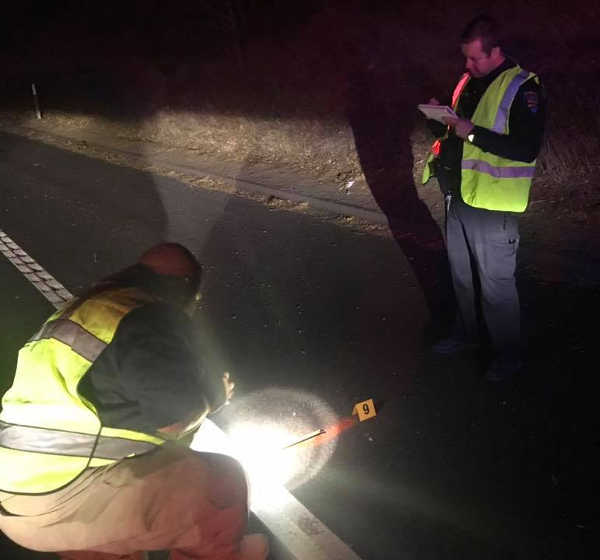
Clearlake Police officers gather evidence at the scene of a crash that killed a pedestrian in Clearlake, California, on Friday, November 15, 2019. Photo courtesy of the Clearlake Police Department. LAKE COUNTY, Calif. – A man was killed Friday evening after being struck by a vehicle while walking along Highway 53 in Clearlake.
Firefighters and police were dispatched to the incident, which occurred on Highway 53 south of Lakeshore Drive, at 5:49 p.m., according to radio reports.
The California Highway Patrol was asked to assist with closing down the area around the crash scene, from 18th Avenue to Lakeshore Drive on Highway 53, while medical personnel were arriving at the scene, scanner reports indicated.
An air ambulance had initially been requested to respond but it was canceled shortly afterward, as police confirmed the pedestrian had died shortly before 6 p.m.
Police on Friday night did not release the name of the man, reported to be in his 60s, pending notification of his next of kin.
The Clearlake Police Department said that preliminary indications are that the pedestrian entered the travel lane and was struck by a vehicle.
The driver of the vehicle remained at the scene and was cooperative with the investigation, police said.
Traffic Officer Michael Perreault is the investigating officer. If you have information regarding the case, please call him at 707-994-8251, Extension 519.
Email Elizabeth Larson at This email address is being protected from spambots. You need JavaScript enabled to view it.. Follow her on Twitter, @ERLarson, or Lake County News, @LakeCoNews.
LAKEPORT, Calif. – The Lakeport Unified School Board voted unanimously at its regular meeting Wednesday night to establish its priorities for the $1.86 million in remaining unspent Measure T bond proceeds, passed by Lakeport voters in 2014.
Measure T, passed by voters in 2014, authorized the bond issuance of $17 million for a long list of capital projects, including student technology equipment, health and safety upgrades, a new central food services facility, the renovation of Westshore Pool, construction of a new library/media center and more.
With the demand on contractors and tradesmen after all of the wild fires, district officials said there was a large increase in materials and construction costs for the food services facility and the Learning Resource Center.
“These remaining projects, I believe, maximize the impact and value of remaining bond proceeds from Measure T, focusing on student safety, technology enhancements, and enrollment growth” Board President Dan Buffalo said. “This priority list honors the will of the voters for the use of bond money given to the District in 2014.”
The eight projects approved on Wednesday are listed below in order of priority:
Audio/video security monitoring and communication system: $300,000.
To monitor and protect school facilities and mitigate acts for vandalism and theft. Also important to address disruptive student behavior such as fighting.
Complete upgrades to wireless access, districtwide: $155,000.
Necessary to support new audio/video monitoring and communication system as well as significantly enhance and stabilize access to internet and cloud-based learning.
Equipment replacement and acquisition for future public safety power shutoff events: $88,450.
A new necessity given the effects to district infrastructure resulting from Pacific Gas and Electric power shutoffs. Specifically, this affects power generators and fire alarms systems.
Complete technology upgrades: $383,000.
This will provide a chromebook for every student in every classroom throughout the district as well as an upgrade to 15-year-old computers in the recording technology classroom.
Asbestos removal and replacement of flooring: $60,000.
This work will take place in five remaining classrooms at Clear Lake High for the safety of staff and students and to comply with current regulations.
Create an alternative education campus near the district office: $600,000
This project includes moving portables and obtaining Division of the State Architect-required upgrades to existing building. This improves the climate and culture for the alternative education students and removes them from their proximity to the Lakeport Elementary School campus.
Landscaping: $29,000.
Complete landscaping in front of the new Learning Resource Center at Terrace Middle School.
Project reserve of 15 percent: $242,684.
The total approximate cost of all projects is $1,858,134.
Although none of the remaining projects that were prioritized by the board during Wednesday’s meeting address the items on the original bond list that support athletics, the board reaffirmed its commitment to identifying alternatives to address the athletic facilities including renovation/construction of a pool, rebuilding the tennis courts, constructing a fitness center for classes at CLHS and air conditioning for the high school gym.
“Though I am disappointed the remaining bond money was not enough to support the construction of the pool, I support this priority list because of the strong focus on student safety and academic support through technology enhancements,” said Board member Jen Hanson.
The board expressed its optimism that the district can work with its community partners to provide access to athletic facilities for our students.
The current board considered applying a portion of the unspent bond money toward the Westshore Pool, as well as other the other athletic needs.
“It was clear to me there wasn’t enough money left to do a whole pool renovation, reconstruction project, or any other athletic facility enhancements; however, I still wanted to retain a portion that could be applied to a future project,” said Buffalo.
In the initial planning stages of the bond, it was believed that the existing Westshore Pool could be renovated to bring it up to current standards.
Once it was determined that it was no longer possible to renovate the pool, the cost estimates to construct a new pool made it not feasible to complete, the district reported.
“An opportunity has since presented itself that I believe will address the community’s concern and desire for a pool, and potentially solve several other district athletic issues without the use of available bond proceeds,” Buffalo said. “Because of this opportunity, and my strong belief in its viability, I voted to prioritize remaining bond proceeds for other much-needed projects.”
During the discussion, the board thanked the work of the Bond Prioritization Committee formed earlier in 2019, which consisted of district staff, parents and community members.
The board also recognized the efforts of Superintendent Jill Falconer and her team to research information from 2014 to provide context and narrative of the intended use of bond proceeds when originally considered by the district and community.
“This has been a long and challenging process to determine the best use of the remaining bond funds,” said Falconer. “I appreciate the patience of the board and the community to see it through. At the outset of the process, the list of items to be funded was more than could be accomplished; however, we have managed to build some amazing facilities for our students that will be a benefit for years to come. With this new list of priorities, my hope is that we continue to support the success of our students.”
NORTH COAST, Calif. – A moderate earthquake that occurred Friday afternoon was felt in parts of Lake County and as far south as the Bay Area.
The 3.3-magnitude earthquake occurred at 2:29 p.m. Friday in northern Sonoma County, about 3.7 miles west of Cobb, according to the US Geological Survey.
It was recorded at a depth of 2.2 miles, the survey said.
The US Geological Survey received 20 shake reports on the quake, including from Lakeport and Kelseyville, as well as from areas in Napa and Sonoma counties, and into the Bay Area.
Email Elizabeth Larson at This email address is being protected from spambots. You need JavaScript enabled to view it.. Follow her on Twitter, @ERLarson, or Lake County News, @LakeCoNews.
 How to resolve AdBlock issue?