 How to resolve AdBlock issue?
News
- Details
- Written by: Elizabeth Larson
The forecast across Northern California calls for light precipitation from a storm system that’s moving east on Monday night and into Tuesday.
The agency said a couple of storms through Tuesday will move into the Pacific Northwest, with the first of the storms bringing rain to the extreme northern part of California into early Monday.
The second system will move through Monday night and Tuesday and bring precipitation chances further to the south. The National Weather Service said precipitation amounts are expected to be small for both systems.
The forecast predicts that high pressure will build over the region Tuesday night and Wednesday to dry the entire interior out, with temperatures around 10 degrees above seasonal normals expected for the second half of the week.
On Thursday and Friday, there will be a possibility of cloud cover due to some storm systems passing through, but otherwise sunny conditions are forecast through the weekend, the National Weather Service said.
In Lake County, showers are forecast from Monday night through Tuesday, to be followed by sunny conditions during the days from Wednesday through Saturday, and partly cloudy conditions overnight those nights.
Temperatures are expected to range from the high 30s to mid-40s at night and from the mid-50s to low 60s during the day.
There also are chances of light winds through Tuesday, the forecast said.
Email Elizabeth Larson at
- Details
- Written by: Lake County News reports
CDPH said the information was confirmed by the Los Angeles County Department of Public Health, the Orange County Health Care Agency and the U. S. Centers for Disease Control and Prevention.
“The California Department of Public Health has been preparing for this situation by working closely with local health departments and health care providers,” said Dr. Sonia Angell, CDPH director and state health officer. “We are supporting ongoing efforts by the Los Angeles County Department of Public Health and the Orange County Health Care Agency to respond to these cases, and will continue working with our partners to monitor for any additional cases that may occur in California, to ensure that persons can be safely and effectively evaluated for this novel virus, and to protect the health of the people of California.”
At this time, no other persons infected with nCoV-2019 have been identified in California. Currently, the immediate health risk from nCoV 2019 to the general public is low.
It is very important for persons who have recently traveled and who become ill to notify their health care provider of their travel history.
Persons who have recently traveled to Wuhan, China, or who have had contact with a person with possible novel coronavirus infection should contact their local health department or health care provider.
CDPH has been prepared and is continuing with the following actions:
· Providing information about the outbreak and how to report suspect cases to local health departments and health care providers in California.
· Coordinating with CDC personnel who are doing screening of travelers from Wuhan, China at SFO and LAX airports.
· Assuring that health care providers know how to safely manage persons with possible nCoV-2019 infection.
· Supporting hospitals and local public health laboratories for collection and shipment of specimens for testing at CDC for nCoV-2019.
· Activating CDPH’s Emergency Operations Center to coordinate response efforts across the state.
The nCoV-2019 outbreak in China continues to evolve and California is prepared for more cases that may arise.
CDPH considers this a very important public health event; the agency said it is closely monitoring the situation and providing updates to partners across the state to support their preparedness efforts.
As with any virus, especially during the flu season, CDPH reminds you there are a number of steps you can take to protect your health and those around you:
· Washing hands with soap and water.
· Avoiding touching eyes, nose or mouth with unwashed hands.
· Avoiding close contact with people who are sick are all ways to reduce the risk of infection with a number of different viruses.
· If someone does become sick with respiratory symptoms like fever and cough, they should stay away from work, school or other people to avoid spreading illness.
CDPH will not be providing additional information about the patients beyond what is being shared by the Los Angeles County Department of Public Health and Orange County Health Care Agency.
For more information about nCov-2019, please visit the CDPH website.
- Details
- Written by: Kathleen Scavone
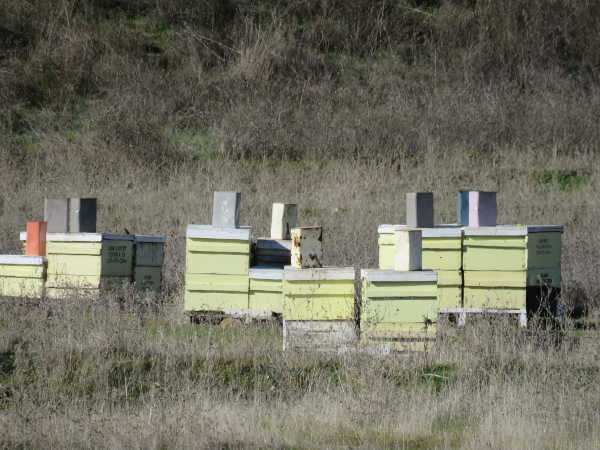
LAKE COUNTY, Calif. – During the cold winter months when many birds fly south and bears “den” – they do not strictly hibernate here in Lake County, but attain a “seasonal lethargy” – honeybees, like many of us, cope with cold temperatures by gathering reserves and slowing down.
Beekeepers tell us that when the temperatures drop down to the 50s and below, honeybees assemble in a special area of the hive into a cluster.
Using their amazing bee-wisdom, honeybees know that it is imperative that they keep their queen bee warm and safe, so the queen is kept inside the cluster. Then, the worker bees quiver their little wings while shivering.
These wise little critters also know to keep the cluster rotating to allow for those on the outside of the huddle to warm up on the inside. All of this unremitting motion generates enough heat in the hive to keep the temperature warm enough for survival.
But this incessant motion requires much in the way of sustenance, which means honey for energy.
Some sources state that depending on the size of the honeybees hive, they can devour up to 30 pounds of honey over the winter season.
I contacted a local hobbyist beekeeper, Arnaud Hubert and asked him some questions about beekeeping.
Here they are:
Q: What do bees in Lake County feed on in the winter months?
A: They slow down, but if a day is nice and sunny and warm enough, some bees will venture out for water, pollen or even nectar. There are some blooms right now – rosemary, silver dollar eucalyptus, manzanita and others.
Q: When bees swarm locally, who collects the swarm, and what is the procedure?
A: I do, as well as the other beekeepers mentioned on the following Facebook page (post is currently unpinned since we’re not in swarm season yet): https://www.facebook.com/BeekeepersGuildofLCC/.
A lot of people sometimes refer to a swarm as a hive, and vice-versa, which makes our job (or hobby, in my case) a bit tricky. When they call, we have to ask them to describe what they’re seeing. If it’s a cluster of bees on a branch or in another location, we can collect it as long as it can be reached. If it’s already settled inside a structure (between walls, empty wine barrel, or some other cavity approximately the size of the inside of an oven), then it’s no longer a swarm, it’s a hive.
If a swarm lands on someone’s property, they can choose to ignore it – the swarm will eventually move away after a few minutes or a couple of days. But they could also decide to settle in a cavity they find on that property - and then it becomes a potential problem.
Beekeepers will usually collect swarms for free, or a very modest fee. If, however, they need to extract it from a structure, it’s called a cut-out, or an extraction. That won’t be free, as it’s a lot of work. Often the extracted colony won’t survive.
Q: What kind of landscape do you recommend to encourage bees and other pollinators?
A: Native flowers! Also: rosemary, lavender, borage, clover, buckwheat, thyme … UC Davis, which also has created a wonderful bee garden which is worth visiting in the spring – has published this guide:
https://arboretum.ucdavis.edu/blog/support-california-native-bees-these-10-plants.
UC Berkeley has a “Bee Lab” and produced this much longer but excellent list: http://www.helpabee.org/best-bee-plants-for-california.html .
Q: Where we may purchase local honey?
A: I don’t produce enough to sell it these days. It’s mostly gifted to friends. But some local beekeepers sell their honey at local tasting rooms, feed stores, or specialty stores like Lakeport’s health food store, or A+H in Kelseyville.
Q: How have bees endured after all of the recent fires? I am imagining they have not fared well at all.
A: I’m not sure, and it might not necessarily be the case. The hives in the path of the fire, that’s for sure. Back in ’15, Dan Tyrell of Middletown lost his hives in the Valley fire and nothing was left of them. But honeybees can also be quite resilient, and it’s possible some feral hives that were in burned areas survived, even those inside a tree that partially burned.
As for the resulting ecology, a few years ago I saw some research done by a UC Davis student on the aftermath of the Rocky fire. He found that the bumblebee population – and the wildflower flora – was actually recovering remarkably well in that area.
Now bumblebees aren’t honeybees, but in some ways they are more important since those are native species. Honeybees are after all technically invasive since they were introduced in our area in the 19th century.
Personally I think it’s very important that people shift their concerns towards wild bee species, some of which are endangered or threatened.
Honeybees will not go away (even if they are being threatened by the varroa mite, their No. 1 enemy), as they are crucial to California’s agriculture economy. Hope this helps!
Thanks very much to Arnaud Hubert for sharing his insights and knowledge.
Kathleen Scavone, M.A., is a retired educator, potter, freelance writer and author of “Anderson Marsh State Historic Park: A Walking History, Prehistory, Flora, and Fauna Tour of a California State Park” and “Native Americans of Lake County.”
- Details
- Written by: Lake County News reports
The event will take place from noon to 4 p.m.
Nineteen notable local wineries and breweries are teaming up with 10-plus local restaurants, bakeries and eateries to offer a delectable experience you won’t soon forget.
Enjoy Mt. Konocti Winery and Event Center and fabulous views of Clear Lake and Mt. Konocti as you treat yourself to an array of chocolates, pastries and delectable savory bites while sampling a variety of wines, sparkling wines, dessert wines and even beer.
Take home a souvenir wine glass; have a chance to win the door prize – a giant wine glass terrarium; participate in an expansive silent auction; purchase your favorite wines to take home; and try your luck in a raffle with the lucky winners receiving a ginormous selection of wine that includes one or more bottles of wine from every single winery present.
All proceeds will benefit the programs and services of Lake Family Resource Center, which since 1995 has been strengthening the Lake County community one family at a time.
Tickets are $60 in advance and $70 at the door.
To purchase tickets visit http://lakefrc.org/wine-chocolate-more2020.