 How to resolve AdBlock issue?
News
- Details
- Written by: NATIONAL AERONAUTICS AND SPACE ADMINISTRATION
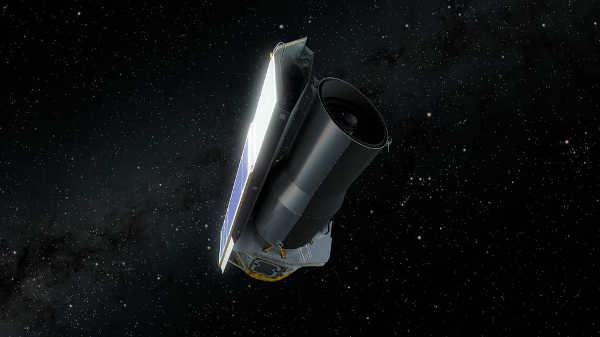
After more than 16 years studying the universe in infrared light, revealing new wonders in our solar system, our galaxy, and beyond, NASA's Spitzer Space Telescope's mission has come to an end.
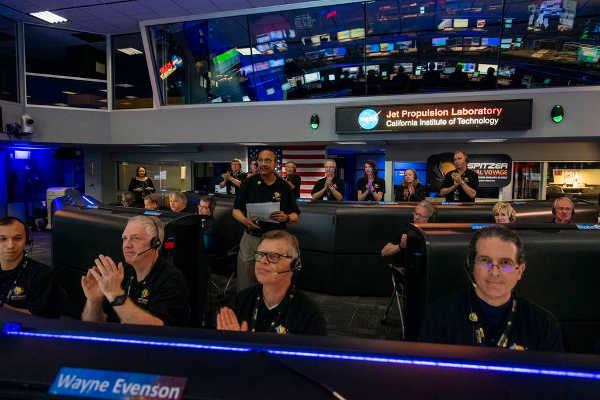
Mission engineers confirmed at 2:30 p.m. PST (5:30 p.m. EST) Thursday the spacecraft was placed in safe mode, ceasing all science operations. After the decommissioning was confirmed, Spitzer Project Manager Joseph Hunt declared the mission had officially ended.
Launched in 2003, Spitzer was one of NASA's four Great Observatories, along with the Hubble Space Telescope, the Chandra X-ray Observatory and the Compton Gamma Ray Observatory.
The Great Observatories program demonstrated the power of using different wavelengths of light to create a fuller picture of the universe.
"Spitzer has taught us about entirely new aspects of the cosmos and taken us many steps further in understanding how the universe works, addressing questions about our origins, and whether or not are we alone," said Thomas Zurbuchen, associate administrator of NASA's Science Mission Directorate in Washington. "This Great Observatory has also identified some important and new questions and tantalizing objects for further study, mapping a path for future investigations to follow. Its immense impact on science certainly will last well beyond the end of its mission."
Among its many scientific contributions, Spitzer studied comets and asteroids in our own solar system and found a previously unidentified ring around Saturn.
It studied star and planet formation, the evolution of galaxies from the ancient universe to today, and the composition of interstellar dust.
It also proved to be a powerful tool for detecting exoplanets and characterizing their atmospheres.
Spitzer's best-known work may be detecting the seven Earth-size planets in the TRAPPIST-1 system – the largest number of terrestrial planets ever found orbiting a single star – and determining their masses and densities.
In 2016, following a review of operating astrophysics missions, NASA made a decision to close out the Spitzer mission in 2018 in anticipation of the launch of the James Webb Space Telescope, which also will observe the universe in infrared light. When Webb's launch was postponed, Spitzer was granted an extension to continue operations until this year.
This gave Spitzer additional time to continue producing transformative science, including insights that will pave the way for Webb, which is scheduled to launch in 2021.
"Everyone who has worked on this mission should be extremely proud today," Hunt said. "There are literally hundreds of people who contributed directly to Spitzer's success, and thousands who used its scientific capabilities to explore the universe. We leave behind a powerful scientific and technological legacy."
Though it was not NASA's first space-based infrared telescope, Spitzer was the most sensitive infrared telescope in history when it launched, and it delivered a deeper and more far-reaching view of the infrared cosmos than its predecessors.
Above Earth's atmosphere, Spitzer could detect some wavelengths that cannot be observed from the ground. The spacecraft's Earth-trailing orbit placed it far away from our planet's infrared emissions, which also gave Spitzer better sensitivity than was possible for larger telescopes on Earth.
Spitzer's prime mission came to an end in 2009, when the telescope exhausted its supply of the liquid helium coolant necessary for operating two of its three instruments – the Infrared Spectrograph, or IRS, and Multiband Imaging Photometer for Spitzer, or MIPS.
The mission was deemed a success, having achieved all of its primary science objectives and more.
But Spitzer's story wasn't over. Engineers and scientists were able to keep the mission going using only two out of four wavelength channels on the third instrument, the Infrared Array Camera, or IRAC.
Despite increasing engineering and operations challenges, Spitzer continued to produce transformational science for another 10 1/2 years – far longer than mission planners anticipated.
During its extended mission, Spitzer continued to make significant scientific discoveries. In 2014, it detected evidence of asteroid collisions in a newly formed planetary system, providing evidence that such smash-ups might be common in early solar systems and crucial to the formation of some planets.
In 2016, Spitzer worked with Hubble to image the most distant galaxy ever detected. From 2016 onward, Spitzer studied the TRAPPIST-1 system for more than 1,000 hours.
All of Spitzer's data are free and available to the public in the Spitzer data archive. Mission scientists say they expect researchers to continue making discoveries with Spitzer long after the spacecraft’s decommissioning.
"I think that Spitzer is an example of the very best that people can achieve," said Spitzer Project Scientist Michael Werner. "I feel very fortunate to have worked on this mission, and to have seen the ingenuity, doggedness and brilliance that people on the team showed. When you tap into those things and empower people to use them, then truly incredible things will happen."
NASA's Jet Propulsion Laboratory (JPL) in Pasadena, California, conducts mission operations and manages the Spitzer Space Telescope mission for the agency's Science Mission Directorate in Washington. Science operations are conducted at the Spitzer Science Center at Caltech in Pasadena.
Spacecraft operations are based at Lockheed Martin Space in Littleton, Colorado. Data are archived at the Infrared Science Archive housed at IPAC at Caltech. Caltech manages JPL for NASA.
Lockheed Martin in Sunnyvale, California, built the Spitzer spacecraft, and during development served as lead for systems and engineering, and integration and testing. Ball Aerospace and Technologies Corporation in Boulder, Colorado provided the optics, cryogenics and thermal shells and shields for Spitzer.
Ball developed the IRS instrument, with science leadership based at Cornell University, and the MIPS instrument, with science leadership based at the University of Arizona in Tucson. NASA's Goddard Space Flight Center in Greenbelt, Maryland, developed the IRAC instrument, with science leadership based at the Harvard Smithsonian Astrophysics Observatory in Cambridge, Massachusetts.
View some of the amazing images showcasing some of Spitzer's greatest discoveries at https://www.jpl.nasa.gov/news/news.php?feature=7221 .
- Details
- Written by: Lake County News reports
On Wednesday, Jody Buck Hickey, 39, was sentenced to 90 days in jail and three years of probation for the Oak fire, according to Cal Fire.
The Oak fire burned 53 acres and an outbuilding, and forced the evacuation of 300 residents along with the closure of Highway 29 for several hours near Kelseyville on Sept. 7, as Lake County News has reported. It was fully contained the following day.
Authorities arrested Hickey on the day of the fire on suspicion of causing a wildland fire while using equipment. They said he was welding and grinding in dry grass.
Cal Fire reported that Hickey pleaded guilty to a misdemeanor, California Health and Safety Code 13001.
That code section states: “Every person is guilty of a misdemeanor who, through careless or negligent action, throws or places any lighted cigarette, cigar, ashes, or other flaming or glowing substance, or any substance or thing which may cause a fire, in any place where it may directly or indirectly start a fire, or who uses or operates a welding torch, tar pot or any other device which may cause a fire, who does not clear the inflammable material surrounding the operation or take such other reasonable precautions necessary to insure against the starting and spreading of fire.”
Cal Fire Sonoma-Lake-Napa Unit Chief Shana Jones reminded county residents to use caution when using equipment.
“Whether working to create defensible space around your home, mowing the lawn or pulling your dirt bike over to the side of the road, if you live in a wildland area you need to use all equipment responsibly,” Jones said. “Lawn mowers, weed-eaters, chain saws, grinders, welders, tractors and trimmers can all spark a wildland fire. Do your part the right way to keep your community fire safe.”
For more information on how you can help prevent wildfire visit www.readyforwildfire.org.
- Details
- Written by: Elizabeth Larson
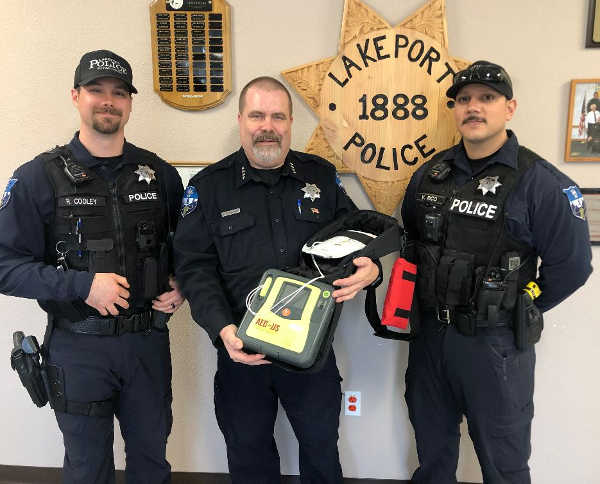
LAKEPORT, Calif. – The Lakeport Police Department has a new piece of life-saving equipment to use in service to the community.
On Thursday, Chief Brad Rasmussen said his department won an automated external defibrillator, more commonly known as an AED, from the company AED.us.
The company sells the defibrillators and also gives one away a week as part of its commitment to reduce the number of preventable sudden cardiac arrest deaths by placing as many of the AEDs in communities as possible.
“This is our mission, passion and duty,” the company said on its website.
Rasmussen said he applied to the company online for one of its AEDs in the fall. The new unit arrived on Wednesday.
“We are planning on getting more to have in the field and around city facilities,” Rasmussen said.
He said winning the new piece of equipment is particularly timely since all of the department’s officers just completed their annual first responder certification update, which included the use of AEDs.
For the past two years, the training has included certifying officers in the use of AED units, Rasmussen said.
During a daylong training on Jan. 22, all of the officers updated their first responder, AED and CPR certifications and skills, among other training topics, he said.
That was the same day that the Clearlake Police Department sent over some units to patrol the streets for a shift while the training took place, as Lake County News has reported.
Rasmussen said the new unit is valued at $1,200, but such units can cost anywhere from $500 to more than $2,000.
“We will get started with carrying this one I won but will need more,” he said.
The AED.us website cites statistics from the American Heart Association that show that out-of-hospital cardiac arrest survival rates have risen steadily alongside increased use – and knowledge of – CPR by bystanders.
To enter to win an AED, visit the AED.us website.
To find CPR, AED and other life-saving classes, visit the Red Cross website.
Email Elizabeth Larson at
- Details
- Written by: Lake County News reports
Whether people are attending parties or hanging out in a bar, planning for a safe ride home will be their best defensive move.
Option plays include calling a cab or ride-sharing service, using public transportation, or lining up a designated driver in advance.
Those who host parties should take care of the most valuable player, the designated driver, with plenty of non-alcoholic beverages.
“Driving impaired is completely preventable,” CHP Commissioner Warren Stanley said. “Lives are on the line. Not only are innocent people at risk, impaired drivers stand to lose money, their freedom, their license, and their vehicle.”
Alcohol is not the only substance that can lead to an arrest for driving under the influence. Cannabis, prescription drugs, and illegal drugs all can impair driving. Driving is a complex task, and any drug can slow reaction time.
The CHP will have a full team of officers ready to intercept dangerous drivers. In addition to stopping impaired drivers, they will be watching for seat belt usage, speeding and distracted driving.
Three people died in alcohol-involved collisions in California on Super Bowl Sunday in 2019. Another 140 people were injured, preliminary CHP data shows. The CHP made 187 DUI arrests that day.
The public can help keep California roadways safe by calling 9-1-1 if they suspect an impaired driver.
Callers should be prepared to give the vehicle’s description, location, license plate number, and direction of travel.