 How to resolve AdBlock issue?
News
- Details
- Written by: Elizabeth Larson
Dogs available for adoption this week include mixes of Chihuahua, German Shepherd, husky and pit bull.
Dogs that are adopted from Lake County Animal Care and Control are either neutered or spayed, microchipped and, if old enough, given a rabies shot and county license before being released to their new owner. License fees do not apply to residents of the cities of Lakeport or Clearlake.
The following dogs at the Lake County Animal Care and Control shelter have been cleared for adoption (additional dogs on the animal control Web site not listed are still “on hold”).
Because the shelter in place order remains in effect, call Lake County Animal Care and Control at 707-263-0278 or visit the shelter online at http://www.co.lake.ca.us/Government/Directory/Animal_Care_And_Control.htm for information on visiting or adopting.

Female Chihuahua
This female Chihuahua has a short tan coat.
She has been spayed.
She’s in kennel No. Q1, ID No. 13659.

‘Lady’
“Lady” is a female pit bull mix with a short tan coat.
She has been spayed.
She is in kennel No. 22, ID No. 13703.

Female Chihuahua
This female Chihuahua has a short black coat with white markings.
She is in kennel No. 25, ID No. 13686.

Female husky
This young female husky has a medium-length black and cream coat and blue eyes.
She is in kennel No. 27, ID No. 13707.

‘Luna’
“Luna” is a young female husky with a medium-length gray and white coat.
She has been spayed.
She is in kennel No. 29, ID No. 13540.

Male German Shepherd
This young male German Shepherd has a fully brown and black coat.
He is in kennel No. 31, ID No. 13706.
Email Elizabeth Larson at
- Details
- Written by: Kara Manke
The results suggest that hospitals in the U.S. may be harder hit by the coronavirus pandemic than initially thought, as many forecasts of disease burden — particularly the number of hospital beds and ICU units needed at the peak of infection — are based on data out of China.
“The hospital resources needed to meet the needs of severely ill patients are substantial,” said Joseph Lewnard, an assistant professor of epidemiology at UC Berkeley and lead author of the paper. “We found that observations from China may not provide a sufficient basis for anticipating the U.S. health care demand.”
The team analyzed the anonymized medical records of the nearly 9.6 million Kaiser Permanente members in Southern California, Northern California and Washington state.
The study focused on 1,277 Kaiser Permanente members who were hospitalized with clinically- or laboratory-confirmed cases of COVID-19 between the start of the year and early April.
“Because Kaiser Permanente members receive comprehensive health care from a single provider network, we overcome many of the difficulties that arise in studies of diseases within the fragmented U.S. health care delivery system,” said Lewnard.
Despite the grim forecast for hospitals, the report does offer a glimmer of hope: Estimates of transmission intensity, based on extrapolations of infection rates from hospitalization data, indicate that the social distancing measures in the region are succeeding at “flattening the curve” of contagion.
“When people engaged in protecting themselves and their communities through social distancing, their efforts translated into a substantial reduction in the transmissibility of the disease,” said Vincent Liu, a research scientist at the Kaiser Permanente Division of Research in Northern California and co-author of the paper. “Those efforts are going to be critical for this next phase, in which social distancing measures are gradually relaxed. We need our communities to stay really engaged, because these data show that even the actions of individuals and small groups can really impact the spread of the virus.”
The results appeared online May 22 in the The BMJ.
Longer hospital stays, lower transmission rates
Of the 1,277 Kaiser Permanente members who were hospitalized with COVID-19, 42 percent required care in the ICU, and 18 percent died from the disease. Modeling estimates based on observations in China usually assume that only about 30 percent of hospitalized patients will require ICU care.
Similarly, the data showed that hospital stays lasted an average of 10.7 days for survivors and 13.7 days for non-survivors, compared to an average of 7.5 days among non-survivors in China.
Troublingly, 25 percent of patients were hospitalized for 16 days or more. In comparison, a widely-used modeling study from Imperial College London projecting health care needs assumes an average stay of eight days.
While the underlying reasons for these discrepancies remain unclear, the authors stress the need to collect data in different regions and under different health care settings and caution against heavy reliance on models based on data from other countries.
“The spread of COVID-19 and its impact on local health care systems show differences across the world,” Liu said. “Health care systems differ, and their capabilities and structure have an effect on the local response and the impact of the surge. So, it's really important to understand how our own data agree with, or in some cases differ, from the experience we've seen in other countries.”
Not surprisingly, the analysis also revealed that the virus tends to hit older people the hardest. Approximately 50 percent of hospitalizations were among adults aged 60 and older, and 25 percent were among adults aged 73 and older.
Similarly, hospitalized men seemed to be hit harder than women: Hospitalized males over the age of 80 faced a 58 percent risk of death, and hospitalized females of the same age faced only a 32 percent risk of death.
Estimates of transmission intensity over time yielded promising results. The team found that the transmission rate of the virus has decreased significantly, and the drop began slightly before statewide shelter-in-place orders went into effect in late March.
This effect is likely due to the implementation of smaller-scale social distancing measures, such as local restrictions on gatherings and individuals’ compliance with safety recommendations, in the weeks prior to the statewide orders, the authors said.
However, while the data indicate that social distancing is succeeding, the authors warn that we shouldn’t expect to return to normal anytime soon.
“These data suggest that if we were to release all of our mitigation measures at one time, the disease would start rapidly spreading again,” Liu said. “We have to be really strategic and vigilant about how and when we roll back our social distancing measures. It’s going to require coordination between health care systems, community partners, government and public health agencies, academic institutions and industry.”
“We also need to be mindful of just how severe the disease is,” Lewnard added. “We see an 18 percent overall fatality rate among all people who are getting hospitalized, and 42 percent end up in the ICU, so the impact of transmission in terms of severe disease and hospital burden is quite high.”
Co-authors of the paper include Michael L. Jackson, Mark A. Schmidt, Jean P. Flores, Chris Jentz, Scott Young and Jim Bellows of Kaiser Permanente; Britta L. Jewell of Imperial College London; and Graham R. Northrup, Ayesha Mahmud, Arthur L. Reingold, Maya Petersen and Nicholas P. Jewell of UC Berkeley.
The study was funded by Kaiser Permanente.
Kara Manke writes for the UC Berkeley News Center.
- Details
- Written by: Robert Sanders
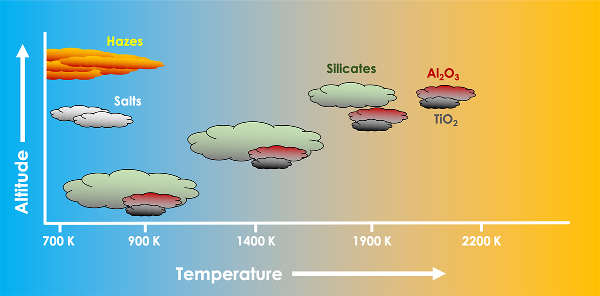
Giant planets in our solar system and circling other stars have exotic clouds unlike anything on Earth, and the gas giants orbiting close to their stars — so-called hot Jupiters — boast the most extreme.
A team of astronomers from the United States, Canada and the United Kingdom have now come up with a model that predicts which of the many types of proposed clouds, from sapphire to smoggy methane haze, to expect on hot Jupiters of different temperatures, up to thousands of degrees Kelvin.
Surprisingly, the most common type of cloud, expected over a large range of temperatures, should consist of liquid or solid droplets of silicon and oxygen, like melted quartz or molten sand. On cooler hot Jupiters, below about 950 Kelvin (1,250 degrees Fahrenheit), skies are dominated by a hydrocarbon haze, essentially smog.
The model will help astronomers studying the gases in the atmospheres of these strange and distant worlds, since clouds interfere with measurements of the atmospheric composition. It could also help planetary scientists understand the atmospheres of cooler giant planets and their moons, such as Jupiter and Saturn’s moon Titan in our own solar system.
“The kinds of clouds that can exist in these hot atmospheres are things that we don’t really think of as clouds in the solar system,” said Peter Gao, a postdoctoral fellow at the University of California, Berkeley, who is first author of a paper describing the model that appeared May 25 in the journal Nature Astronomy. “There have been models that predict various compositions, but the point of this study was to assess which of these compositions actually matter and compare the model to the available data that we have.”
The study takes advantage of a boom over the past decade in the study of exoplanet atmospheres.
Though exoplanets are too distant and dim to be visible, many telescopes — in particular, the Hubble Space Telescope — are able to focus on stars and capture starlight passing through the atmospheres of planets as they pass in front of their stars.
The wavelengths of light that are absorbed, revealed by spectroscopic measurements, tell astronomers which elements make up the atmosphere.
To date, this technique and others have found or inferred the presence of water, methane, carbon monoxide and carbon dioxide, potassium and sodium gases and, in the hottest of the planets, vaporized aluminum oxide, iron and titanium.
But while some planets seem to have clear atmospheres and clear spectroscopic features, many have clouds that completely block the starlight filtering through, preventing the study of gases below the upper cloud layers. The compositions of the gases can tell astronomers how exoplanets form and whether the building blocks of life are present around other stars.
“We have found a lot of clouds: some kinds of particles — not molecules, but small droplets — that are hanging out in these atmospheres,” Gao said. “We don't really know what they are made of, but they are contaminating our observations, essentially making it more difficult for us to assess the composition and abundances of important molecules, like water and methane.”
Ruby clouds
To explain these observations, astronomers have proposed many strange types of clouds, composed of aluminum oxides, such as corundum, the stuff of rubies and sapphires; molten salt, such as potassium chloride; silicon oxides, or silicates, like quartz, the main component of sand; sulfides of manganese or zinc that exist as rocks on Earth; and organic hydrocarbon compounds. The clouds could be liquid or solid aerosols, Gao said.
Gao adapted computer models initially created for Earth’s water clouds and subsequently extended to the cloudy atmospheres of planets like Jupiter, which has ammonia and methane clouds.
He expanded the model even further to the much higher temperatures seen on hot gas giant planets — up to 2,800 Kelvin, or 4,600 degrees Fahrenheit (2,500 degrees Celsius) — and the elements likely to condense into clouds at these temperatures.
The model takes into account how gases of various atoms or molecules condense into droplets, how these droplets grow or evaporate and whether they are likely to be transported in the atmosphere by winds or updrafts, or sink because of gravity.
“The idea is that the same physical principles guide the formation of all types of clouds,” said Gao, who has also modeled sulfuric acid clouds on Venus. “What I have done is to take this model and bring it out to the rest of the galaxy, making it able to simulate silicate clouds and iron clouds and salt clouds.”
He then compared his predictions to available data on 30 exoplanets out of a total of about 70 transiting exoplanets with recorded transmission spectra to date.
The model revealed that many of the exotic clouds proposed over the years are difficult to form because the energy required to condense the gases is too high. Silicate clouds condense easily, however, and dominate over a 1,200-degree Kelvin range of temperatures: from about 900 to 2,000 Kelvin. That’s a range of about 2,000 degrees Fahrenheit.
According to the model, in the hottest atmospheres, aluminum oxides and titanium oxides condense into high-level clouds. In exoplanets with cooler atmospheres, those clouds form deeper in the planet and are obscured by higher silicate clouds. On even cooler exoplanets, these silicate clouds also form deeper in the atmosphere, leaving clear upper atmospheres.
At even cooler temperatures, ultraviolet light from the exoplanet’s star converts organic molecules like methane into extremely long hydrocarbon chains that form a high-level haze akin to smog. This smog can obscure lower-lying salt clouds of potassium or sodium chloride.
For those astronomers seeking a cloudless planet to more easily study the gases in the atmosphere, Gao suggested focusing on planets between about 900 and 1,400 Kelvin, or those hotter than about 2,200 Kelvin.
“The presence of clouds has been measured in a number of exoplanet atmospheres before, but it is when we look collectively at a large sample that we can pick apart the physics and chemistry in the atmospheres of these worlds,” said co-author Hannah Wakeford, an astrophysicist at the University of Bristol in the U.K. “The dominant cloud species is as common as sand — it is essentially sand — and it will be really exciting to be able to measure the spectral signatures of the clouds themselves for the first time with the upcoming James Webb Space Telescope.”
Future observations, such as those by NASA’s JWST, scheduled for launch within a few years, should be able to confirm these predictions and perhaps shed light on the hidden cloud layers of planets closer to home. Gao said that similar exotic clouds may exist at depths within Jupiter or Saturn where the temperatures are close to those found on hot Jupiters.
“Because there are thousands of exoplanets versus just one Jupiter, we can study a bunch of them and see what the average is and how that compares to Jupiter,” Gao said.
He and his colleagues plan to test the model against observational data from other exoplanets and also from brown dwarfs, which are basically gas giant planets so massive they’re almost stars. They, too, have clouds.
“In studying planetary atmospheres in the solar system, we typically have the context of images. We have no such luck with exoplanets. They are just dots or shadows,” said Jonathan Fortney of UC Santa Cruz. “That's a huge loss in information. But what we do have to make up for that is a much larger sample size. And that allows us to look for trends — here, a trend in cloudiness — with planetary temperature, something that we just don't have the luxury of in our solar system.”
Other co-authors of the paper are Daniel Thorngren of the University of Montreal in Canada, Graham Lee of Oxford University in the U.K., Diana Powell and Xi Zhang of UC Santa Cruz, Caroline Morley of the University of Texas at Austin and Kevin Stevenson of the Applied Physics Laboratory at Johns Hopkins University in Maryland.
Gao was supported by NASA’s postdoctoral program and a 51 Pegasi b Fellowship from the Heising-Simons Foundation.
Robert Sanders writes for the UC Berkeley News Center.
- Details
- Written by: Elizabeth Larson
The Friday update explained that the court will begin conducting in-person trials or contested hearings the week of June 15. The number of cases set on a given date and time have been limited to allow for appropriate social distancing.
The court said it will begin conducting jury trials sometime after June 22.
The court clerk’s offices will reopen to the public on June 8. The public is encouraged to continue to make use of the dropbox whenever possible to avoid person-to-person interaction.
Court officials said numerous types of other hearings will continue to be done via videoconference.
The court severely curtailed operations beginning in mid-March when separate shelter in place orders were issued by Lake County Public Health Officer Dr. Gary Pace and Gov. Gavin Newsom, as Lake County News has reported.
Both of those shelter in place orders remain active as aspects of reopening are underway.
“Even as reopening begins, the COVID-19 pandemic continues and it is apparent that social distancing, limits on gatherings, and mandatory face coverings will remain in place for weeks and, in some form, potentially months to come,” court officials said in a Friday statement.
Officials said the court provides an essential government service and that it has taken “significant steps” in an effort to comply with the Public Health officer’s order and to protect court users and staff from the spread of COVID-19.
As the court prepares to reopen and begin providing in-person services to the public, court officials have limited the number of cases on the calendar, will require social distancing in court facilities, and continue to handle matters via remote means whenever possible.
In accordance with the Public Health officer’s May 21 order, the court will require face coverings for anyone entering a court facility.
Remote court hearings
The court will continue to hold the following hearings by remote appearance only. All attorneys and parties must appear by phone/video as directed by the court. The court will provide
instructions for the remote appearance.
Hearing dates for the following calendars will remain as presently set:
– Daily in-custody criminal arraignments.
– Juvenile detention hearings.
– Felony law and motion, Department 3, Tuesdays at 8:15 a.m.
– Sentencings, Department 3, Mondays at 1:30 p.m.
– Misdemeanor disposition/setting and motions, Department 1, Mondays at 8:15 a.m. and 1:30 p.m.
– Misdemeanor settlement conferences, Department 1, Tuesdays at 1:30 p.m.
– Civil law and motion, Department 2, Mondays at 9 a.m.
– Civil case management, Department 2, Mondays at 10:30 a.m.
– Conservatorships, Department 2, Mondays at 1:30 p.m.
– Probate, Department 2, Mondays at 2 p.m.
– Department of Child Support Services Family Support, Clearlake Branch, Tuesdays at 9 a.m.
– Domestic violence restraining orders, Department 2, Tuesdays at 8:15 a.m.
– Family law and motion, Department 2, Tuesdays at 10 a.m.
– Juvenile delinquency and dependency calendars, Mondays, 8:18 a.m./1:30 p.m., Department 4.
– Civil harassment restraining order calendar, Tuesdays, 8:15 a.m., Department 4.
– Trials and contested hearings.
Felony law and motion, preliminary hearings
The felony law and motion calendar will be held by remote appearance. However, out-of-custody defendants ordered to appear will be required to attend in person. Preliminary hearings will continue to be held in person.
Misdemeanor arraignment calendar
The misdemeanor arraignment calendar will begin the week of June 8. This calendar will be held in person. The number of cases set on a given date/time have been limited to allow for appropriate social distancing.
Jury trials
The court will begin conducting jury trials sometime after June 22, when necessary. If you receive a jury summons for a date after June 22, you are required to appear.
Steps have been taken to minimize the risk to jurors, including reducing the number of jurors who are summoned to appear at one time. Additional details are provided with the jury summons.
Clearlake Branch operations: Small claims/traffic/unlawful detainer
The Clearlake Branch will begin holding court calendars beginning June 22. Unlawful detainer cases will be set in compliance with Statewide Emergency Rules 1 and 2.
Self-Help Center
The Self-Help Center will continue to provide service by remote means only.
Litigants can contact the Self-Help Center by phone 707-994-4612, or email
All Judicial Council forms may be found here.
As the situation is quickly evolving, the court said it will keep the public up to date on its website.
Email Elizabeth Larson at