 How to resolve AdBlock issue?
News
- Details
- Written by: Elizabeth Larson
The meeting will take place via webinar beginning at 6 p.m. Tuesday, June 2.
To speak on an agenda item, access the meeting remotely here or join by phone by calling 213-929-4221 or toll-free, 866-952-8437. The access code is 706-076-643; the audio pin will be shown after joining the webinar. Those phoning in without using the web link will be in “listen mode” only and will not be able to participate or comment.
Comments can be submitted by email to
Please indicate in the email subject line "for public comment" and list the item number of the agenda item that is the topic of the comment. Comments that read to the council will be subject to the three minute time limitation (approximately 350 words). Written comments that are only to be provided to the council and not read at the meeting will be distributed to the council prior to the meeting.
The main item on Tuesday’s agenda is the consideration of the recommended 2020-21 budget, which will be presented by Finance Director Nick Walker.
The document, which can be seen here, shows revenue projections of $5.2 million for 2020-21, down by $1 million from the revenue actuals for 2019-20.
It also shows projected expenditures in the coming fiscal year of just over $6 million, up from the $5.5 million reported for the current fiscal year.
The city has had several years of fiscal surpluses. The current fiscal year also has a projected surplus of $718,000, while a $851,630 deficit is anticipated in the 2020-21 fiscal year.
On the consent agenda – items considered noncontroversial and usually accepted as a slate on one vote – are ordinances; minutes of the special meetings on May 18, 19, 26 and 27, and the regular meeting of May 19; confirmation of the continuing existence of a local emergency for the Mendocino Complex fire; confirmation of the continuing existence of a local emergency for the February 2019 storms; confirmation of the continuing existence of a local emergency for the October 2019 public safety power shutoff; confirmation of the continuing existence of a local emergency for the COVID-19 public health emergency; approve application 2020-013 for the Tuesday Farmer’s Market in Library Park, contingent on Health Department approval and staff recommendations; authorize the city manager to sign purchase order with Arrow Fence for the purchase and installation of the chain link security fence at the new police department, and to authorize the purchase and installation of the electrical work, IPROX reader and Honeysuckle vines; approve and authorize the city manager to execute a professional services agreement with Miskis Services for installation of a sewer liner as proposed; approve the side letter agreement with Unrepresented Employees Compensation and Benefits Program adopted March 6, 2018; receive and file the Illegal Fireworks Police Operation Plan; approve and authorize the city manager to execute a service agreement with the Local Government Commission for CivicSpark Fellow for project year 2020-21; approve Amendment No. 4 to the agreement for services between the city of Lakeport and Margaret Silveira, dated Oct. 18, 2016; adopt a resolution accepting acquisition of the property located at 800 N. Main St. in Lakeport and authorizing the city manager to execute documents related thereto.
Email Elizabeth Larson at
- Details
- Written by: Jeb Barnes, University of Southern California – Dornsife College of Letters, Arts and Sciences and Thomas F. Burke, Wellesley College
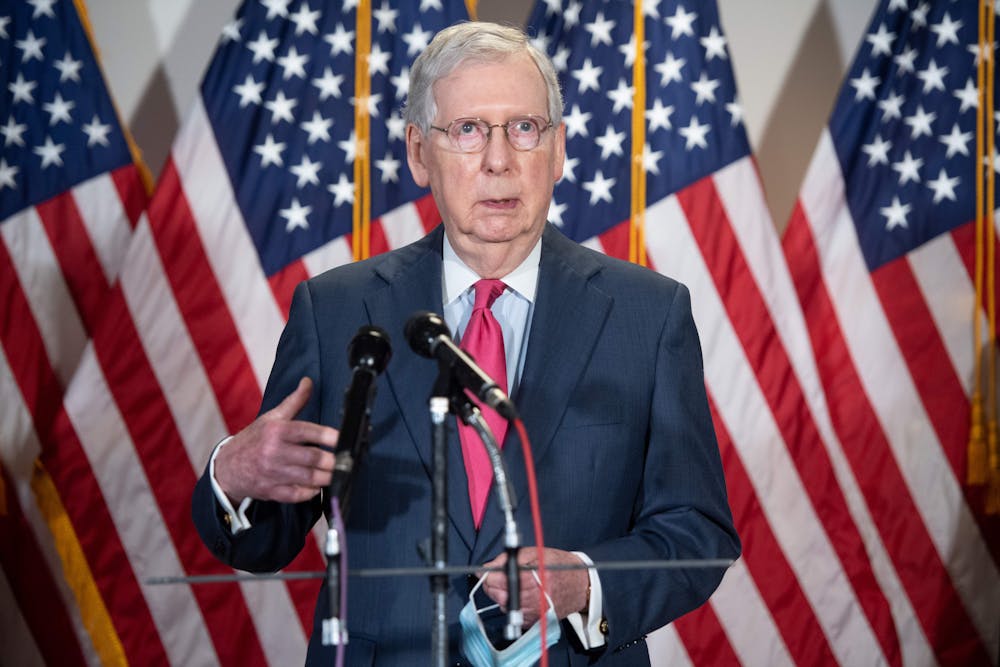
Republican Senate Majority Leader Mitch McConnell has issued a demand: Any further coronavirus aid legislation must protect businesses from coronavirus-related lawsuits.
Democrats have balked, with House Speaker Nancy Pelosi saying they “have no interest in diminishing protections for employees and customers.”
Superficially, this standoff seems like another example of Washington’s toxic politics, where hope for any legislation rests on crass political trades among bickering partisan factions.
Our research, though, indicates there’s more to this struggle than just partisan politics. American ambivalence about government has left litigation to play an outsized role in responding to crises like this one. Including protections for businesses against lawsuits alongside a new aid package might make sense.

Disasters lead to court
Health disasters in the United States – the opioid epidemic, the diseases caused by tobacco use, lead paint, asbestos, Agent Orange and many others – often generate a surge of court cases.
But research shows that litigation is an expensive, haphazard way to handle injury claims. Legal action can drive some businesses into bankruptcy while leaving many victims without the money and damages they sought. Studies of the personal injury system suggest that for every dollar the injured recover, another dollar is spent on lawyers and lawyering.
Although only a small number of cases have been filed so far, the coronavirus pandemic seems likely to replicate this pattern.
At this early stage, class action lawsuits are pending against cruise ships on the grounds that they negligently exposed passengers to the virus and, in some cases, prevented them from seeking treatment. Prisons and nursing homes, where many have died as a result of COVID-19, face similar suits.
And personal injury lawsuits are only one type of litigation related to COVID-19. Employers are concerned about potential liability for bringing workers back too soon, while others are already facing suits over wages, worker safety protections, pensions, privacy, and disability accommodations and discrimination claims.
Consumers are suing airlines, colleges and universities, ticketing agencies and others for refunds. Bankruptcies – another kind of litigation – are reportedly on the rise, and many more will surely follow, as businesses collapse under the weight of stay-at-home orders and people with no or limited insurance face crushing medical bills.
While conservatives like McConnell and his fellow party members have legitimate concerns about the potential costs of litigation, they’re wrong about why litigation happens in the first place. They tend to attribute surges of litigation to a kind of character defect: Americans, they contend, have become whiny victims who, urged on by greedy lawyers, sue at every opportunity.
Scholars, however, question whether Americans are more innately litigious than citizens of other affluent countries. They point instead to a fundamental tension in American politics that gives courts an unusually prominent role in public policy.
On one hand, Americans want protections against pervasive social problems, such as environmental harms, unsafe products and sudden economic downturns.
On the other hand, many Americans are skeptical of the typical response of most nations to such problems: a larger welfare and regulatory state.
And even when a majority of Americans favor expanding government, our fragmented lawmaking process, in which bills must pass through multiple committees and two chambers of Congress and be signed by the president, provide repeated opportunities for special interest groups to block sweeping reforms.
This leaves those in distress to pursue help where they can find it, in the legal system.
Asbestos cases: 730,000 claims in US, only 10 in Netherlands
Consider the asbestos crisis. Asbestos is a “magic mineral,” which is flexible enough to be woven into cloth yet stronger than steel. After World War II, manufacturers used it in everything from hair driers to automobile brakes to ship boilers.
The problem is that exposure to asbestos can be deadly, causing fatal diseases such as asbestosis, a progressive scarring of the lungs that slowly strangulates its victims, and mesothelioma, a fast-acting cancer of the linings of the lungs.
Contrary to the myth of litigiousness, American workers exposed to asbestos did not immediately sue when they starting falling ill in growing numbers in the late 1960s.
Instead, they filed claims with state workers’ compensation programs for lost wages and help with their medical bills. When these programs provided very limited relief, they turned to lawyers, who found new ways to hold companies liable for the failure to warn their workers about the dangers of their products.
Over the next few decades, asbestos litigation skyrocketed. By the early 2000s, Americans had filed an estimated 730,000 claims for damages associated with their illnesses and to punish companies for their reckless conduct. Those claims have bankrupted scores of businesses while providing victims slow and erratic payments. The final price tag could reach an estimated US$325 billion in today’s dollars.
The Netherlands offers an instructive contrast. Dutch workers suffered from asbestos-related diseases at five to 10 times the rate of American workers.
Yet Dutch workers had filed a total of 10 – 10! – lawsuits against businesses by the early 1990s.
Dutch workers had little incentive to sue, because they were guaranteed relatively generous health and unemployment benefits from the government that would be deducted from any recovery in the courts.
Less government; more litigation
The asbestos example underscores an implicit trade in the American approach to social problems that leaves both Republicans and Democrats unsatisfied: less “government” but more litigation.
It is the same trade that leaves Republicans railing against medical malpractice lawsuits while Democrats decry the lack of universal health insurance.
The coronavirus pandemic, like other health disasters, has revealed the downsides of this trade for both businesses and households. Businesses, already under financial strain from the pandemic, worry that the trickle of lawsuits that has already begun will turn into a torrent. Displaced workers lack adequate health care insurance and have no guarantee they will be protected from poverty when their unemployment benefits run out.
This brings us back to the congressional standoff. Congress could clarify the responsibilities of businesses, creating a safe harbor from lawsuits: If businesses adopt model sanitation and social distancing measures and provide workers with protective equipment, they could not be sued on the grounds that these procedures were inadequate. In exchange, the aid package should ensure that workers’ lost wages and medical costs associated with the pandemic are fully covered.
This would not be a cynical partisan deal. It would be an exchange of remedies, replacing some forms of litigation, which have often proved expensive and unreliable mechanisms for protecting workers and consumers, with direct support for those whose health and livelihoods have been devastated.
If properly structured, such a deal would offer more aid for victims of the coronavirus and more legal certainty for businesses seeking to reopen. That would be a win for both sides – and a step away from depending so much on courts to respond to disasters like this pandemic.
[Insight, in your inbox each day. You can get it with The Conversation’s email newsletter.]
Jeb Barnes, Professor of Political Science, University of Southern California – Dornsife College of Letters, Arts and Sciences and Thomas F. Burke, Ralph Emerson and Alice Freeman Palmer Professor of Political Science, Wellesley College
This article is republished from The Conversation under a Creative Commons license. Read the original article.
- Details
- Written by: Elizabeth Larson
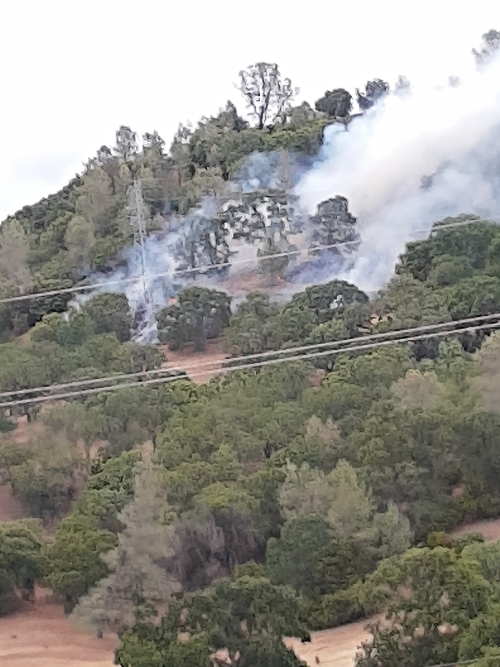
LAKE COUNTY, Calif. – Firefighters contained a small wildland fire that burned in the hills near Clearlake Oaks on Saturday.
The fire originally was dispatched at about 2 p.m. Saturday near Catholic Church Road and Highway 20 in Clearlake Oaks.
However, firefighters from Cal Fire, Northshore Fire and other local agencies responding to the area said it actually was located in the hills behind the Moose Lodge.
Firefighters responding to the scene also were urged to be on the lookout for fallen power lines due to a brief power outage on the Northshore before the fire was dispatched.
A Cal Fire helicopter arriving at the scene at around 2:15 p.m. said the fire was between two to four acres, with a slow rate of spread and approaching the crest of the hill. More resources were requested, including airplanes and dozers.
Responding ground units were challenged in accessing the fire, finally finding a road that led to it. They also reported that all power lines in the area were still up, based on radio traffic.
Firefighters and equipment remained on scene into Saturday night.
Incident command reported that shortly before 8 p.m. that the fire’s final size was approximately 4.3 acres.
A cause for the fire has so far not been reported.
Email Elizabeth Larson at
- Details
- Written by: Lake County News reports
Given the uncertainty of holding large social events due to the coronavirus pandemic, the board made the decision to cancel.
Grillin’ on the Green is the sole fundraising activity for the Westside Community Park Committee, said Committee Chair Dennis Rollins, making the decision especially difficult.
In addition to developing the park, the committee is also responsible for the maintenance and operation of the portion of the park known as the Jane Barnes Field.
Rollins reports that in spite of the current challenges, two projects are scheduled to begin in June with donations received from the Rotary Club of Lakeport and the Russell McIntire Trust.
Rotary is funding the purchase and installation of an ADA-compliant portable toilet that will be anchored on a concrete foundation located between the concession stand and the storage building on the east side of the Jane Barnes Field.
The Russell McIntire Trust’s generous donation will fund the installation of curb, gutter and sidewalk along the east side of the parking lot at the Jane Barnes Field.
This work will start at the entrance to the parking lot from Westside Park Road and extend south the length of the playing field, increasing pedestrian safety and helping to ensure that vehicles cannot accidentally enter the field.
The Westshore Little League softball program and Early Lake Lions Club Horseshoe League did not take place this year due to the Shelter-In-Place orders.
However, the Konocti Youth Soccer League is planning to start practice sessions in August and play its season with modifications. The park is also home to the Ukiah Men’s Soccer League.
Westside Community Park at 1401 Westside Park Road is currently open for walking and use of the outdoor exercise equipment. Users are reminded to maintain social distancing.
The Westside Community Park Committee is a nonprofit organization which is developing the park in conjunction with the city of Lakeport, volunteers and contributions from individuals, organizations and businesses dedicated to creating a recreational facility for use by youth and adults from throughout Lake County.
For more information about supporting the development of the park, contact Rollins at 707-349-0969.