 How to resolve AdBlock issue?
News
- Details
- Written by: NATIONAL AERONAUTICS AND SPACE ADMINISTRATION

New results from the NASA/ESA Hubble Space Telescope suggest the formation of the first stars and galaxies in the early universe took place sooner than previously thought.
A European team of astronomers have found no evidence of the first generation of stars, known as Population III stars, as far back as when the universe was just 500 million years old.
The exploration of the very first galaxies remains a significant challenge in modern astronomy.
We do not know when or how the first stars and galaxies in the universe formed. These questions can be addressed with the Hubble Space Telescope through deep imaging observations. Hubble allows astronomers to view the universe back to within 500 million years of the big bang.
A team of European researchers, led by Rachana Bhatawdekar of the European Space Agency, or ESA, set out to study the first generation of stars in the early universe.
Known as Population III stars, these stars were forged from the primordial material that emerged from the big bang.
Population III stars must have been made solely out of hydrogen, helium and lithium, the only elements that existed before processes in the cores of these stars could create heavier elements, such as oxygen, nitrogen, carbon and iron.
Bhatawdekar and her team probed the early universe from about 500 million to 1 billion years after the big bang by studying the cluster MACS J0416 and its parallel field with the Hubble Space Telescope (with supporting data from NASA's Spitzer Space Telescope and the ground-based Very Large Telescope of the European Southern Observatory).
"We found no evidence of these first-generation Population III stars in this cosmic time interval," said Bhatawdekar of the new results.
The result was achieved using the Hubble Space Telescope's Wide Field Camera 3 and Advanced Camera for Surveys, as part of the Hubble Frontier Fields program.
This program (which observed six distant galaxy clusters from 2012 to 2017) produced the deepest observations ever made of galaxy clusters and the galaxies located behind them which were magnified by the gravitational lensing effect, thereby revealing galaxies 10 to 100 times fainter than any previously observed.
The masses of foreground galaxy clusters are large enough to bend and magnify the light from the more distant objects behind them. This allows Hubble to use these cosmic magnifying glasses to study objects that are beyond its nominal operational capabilities.
Bhatawdekar and her team developed a new technique that removes the light from the bright foreground galaxies that constitute these gravitational lenses.
This allowed them to discover galaxies with lower masses than ever previously observed with Hubble, at a distance corresponding to when the universe was less than a billion years old.
At this point in cosmic time, the lack of evidence for exotic stellar populations and the identification of many low-mass galaxies supports the suggestion that these galaxies are the most likely candidates for the reionization of the universe.
This period of reionization in the early universe is when the neutral intergalactic medium was ionized by the first stars and galaxies.
"These results have profound astrophysical consequences as they show that galaxies must have formed much earlier than we thought," said Bhatawdekar. "This also strongly supports the idea that low-mass/faint galaxies in the early universe are responsible for reionization."
These results also suggest that the earliest formation of stars and galaxies occurred much earlier than can be probed with the Hubble Space Telescope. This leaves an exciting area of further research for the upcoming NASA/ESA/CSA James Webb Space Telescope – to study the universe's earliest galaxies.
These results are based on a previous 2019 paper by Bhatawdekar et al., and a paper that will appear in an upcoming issue of the Monthly Notices of the Royal Astronomical Society. These results are also being presented at a press conference during the 236th meeting of American Astronomical Society.
The European team of astronomers in this study consists of R. Bhatawdekar and C.J. Conselice.
The Hubble Space Telescope is a project of international cooperation between NASA and ESA. NASA’s Goddard Space Flight Center in Greenbelt, Maryland, manages the telescope. The Space Telescope Science Institute in Baltimore conducts Hubble science operations. STScI is operated for NASA by the Association of Universities for Research in Astronomy in Washington, D.C.

- Details
- Written by: Elizabeth Larson
LAKE COUNTY, Calif. – The Clearlake City Council on Thursday night approved a resolution to call for the municipal election this fall, when three council seats will be decided.
The discussion begins at the 32:10 mark in the video above.
City Clerk Melissa Swanson said the seats up for election in November currently are held by Phil Harris, Joyce Overton and Russell Perdock.
She said the filing period for nomination papers and candidates’ statements is July 13 through Aug. 7. If any incumbent chooses not to file nomination papers, the filing period for candidates is
then automatically extended through Aug. 12.
Swanson reported to the council that the Secretary of State’s Office published a guidance memo for all election officials in regard to COVID-19 safety precautions.
Over the next month, Swanson said staff will develop information for candidates and filing procedures based on the Secretary of State’s guidance and work in cooperation with the Lake County Registrar of Voters to provide the most accessible and safe candidate filing possible.
Swanson said the council needed to adopt a resolution calling the election and authorizing the consolidation with the statewide election on Nov. 3.
Next, the resolution will need to be approved by the Board of Supervisors and the county elections office will conduct the election on the behalf of the city and prepare the official canvass, she said.
Swanson said the cost of the election for the council seats will be $10,000 to $15,000 and will be budgeted for the 2020-21 fiscal year.
Overton asked about procedures for necessary actions like gathering signatures. Swanson said they will be working on those guidelines.
Harris said he wanted potential candidates to be able to come to council meetings, which aren’t currently open to the public. Swanson said that can be worked on once meetings can be reopened.
City Manager Alan Flora said that staff is looking at trying to accommodate at least some members of the public back in City Hall at the first council meeting in July. He said he expects some direction from the governor on trying to encourage further reopening.
He also told the council that while he was at the courthouse in Lakeport on Wednesday he spoke with the registrar of voters, who has received some initial direction from the Secretary of State’s Office on the upcoming election.
While there will be a focus on mail-in voting, Flora said there will be accommodation for in-person voting.
There may not be all of the customary precincts available for in-person voting but there will be some, and the registrar asked that the city be flexible at City Hall in allowing people the opportunity to vote. He said they would make sure to make it available.
Vice Mayor Dirk Slooten moved to adopt the resolution calling the municipal election on Nov. 3, with Overton seconding and the council approving it 5-0.
Email Elizabeth Larson at
- Details
- Written by: Elizabeth Larson
The council approved the budget following a presentation by Finance Director Nick Walker.
Due to the COVID-19 pandemic, Walker explained that the city’s budgeting process was “disrupted slightly.”
As a result, he said staff has been challenged to figure out the new fiscal year budget.
Normally staff has planning meetings with the council in March, but they were delayed. Meetings with department heads also were crammed into the end of May after staff had conducted planning and research.
In her budget message, which introduces the document, City Manager Margaret Silveira had noted, “The fiscal year 2019-20 started out very promising. Goals were set, projects were moving, new events were being scheduled, more public art was developing, plans were being made for a new park, and then COVID-19 hit. The community did its part by sheltering in place. Due to the swift action of our community, sheltering in place has lessened the health crisis, but negatively affected our economy. The extent of the losses are unknown at the time of this budget adoption.”
Walker said the budget process is a collaborative one and also is research-driven.
In the 2020-21 budget year, budget revenues are projected to be $15.4 million while expenditures will be $18.3 million. Walker said the difference will be covered by funds that already have been collected – such as state funds for road repairs – from previous years to complete projects.
The city’s projected expenditures for the 2020-21 fiscal year include $5.7 million for personnel, $6 million for operations, $1.9 million for debt service and $4.7 million in capital improvement projects, Walker said.
Walker said the capital improvement projects include $1.25 million for repairs necessitated by the 2017 storms.
Walker said 84 percent of the total city revenues this year are coming from taxes, including sales and property tax.
The general fund is being impacted by a 15 percent increase in health insurance premiums. Other types of insurance have increased by nearly 50 percent over last year for a total cost of $250,000, of which $140,000 is coming out of the general fund, Walker said.
Walker said the main reason for the $718,000 surplus that is projected for the 2019-20 budget is because of some projects that are being carried over.
He said adding those projects into the 2020-21 budget actually reduces the estimated budget deficit from $851,630 to $113,630, which means the budget is almost balanced.
For the new year, Walker said staff is recommending halting discretionary funding and projects, and some road improvement and maintenance.
Regarding important city revenue sources, he said sales tax is down 11 percent over 2019, and that drop in sales tax accounts for 40 percent of the projected $1 million decrease in city revenues, Walker said.
The remaining 60 percent of the drop in city revenue comes from decreases in transient occupancy tax, business licenses, and permits and franchises, according to Walker’s report.
Walker said the economy had been ticking up by about 2 percent annually over the last several years before the pandemic hit.
He said there are several capital improvement projects still to go forward, including the new lakefront park, which is being funded through a state grant, as well as the outstanding 2017 flood repairs, the Hartley Street Safe Routes to Schools project, a water well study, water main replacements, pump replacements and other needed equipment and paving work.
The city’s total number of full-time positions so far hasn’t changed but positions are being adjusted, he said.
The city’s budgeting projections offer several scenarios for potential deficits over the coming year.
If the city’s current plans are able to go forward, the budget anticipates a deficit of $362,000. However, it also includes the possibility of a COVID-19-related shelter in place order in the fall which, if it were to be a prolonged event, could see the city’s deficit swell to $1.7 million.
On top of that, the city has increased retirement liabilities through the CalPERS system, not just for past losses during the Great Recession but for the impacts of the pandemic, which could see the city’s projected retirement costs climb until 2025. Those costs wouldn’t begin to taper off until 2035. Walker said that’s without knowing fully how the pandemic will ultimately affect CalPERS.
One of the slides in Walker’s presentation showed that the city’s fund balance could drop by millions of dollars through 2031 if total expenditures outpace revenues.
“It has required us to really look at this long term future, long term being 10 years,” he said.
The city will have to either find revenue or cut expenses. “I have no doubt that this management team will be able to do that,” Walker said.
Silveira noted that insurance costs in California “went crazy this year” because of the state’s many disasters.
Mayor George Spurr asked Walker if he expects to see a loss in property tax revenue. Walker said he didn’t.
That revenue source is based on prior-year assessments and usually is two years behind, Walker explained. He said they’re not seeing an impact so far on the housing market, which appears steady.
Councilwoman Stacey Mattina thanked the management team for detailed and thoughtful work in goal setting. “We got so much done in the last year.”
Councilwoman Mireya Turner moved to approve the budget, with Councilman Kenny Parlet seconding and the council approving the document 5-0.
Email Elizabeth Larson at
- Details
- Written by: Elizabeth Larson
While the shelter has moved most of its dogs into foster, potential adopters can make appointments to meet and adopt available dogs.
The following dogs are ready for adoption or foster.

“Lady” is a female German Shepherd mix.
She has been spayed.
She is dog No. 3683.
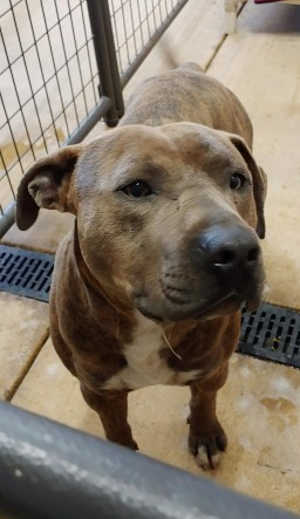
“Spud” is a male American Staffordshire Terrier with a short brindle and white coat.
He has been neutered.
He is dog No. 3733.
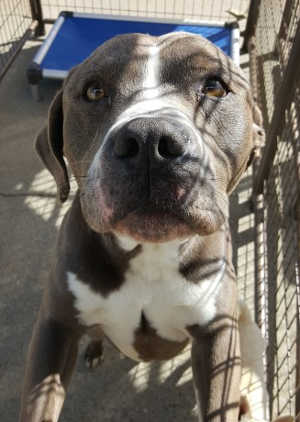
“Tyson” is a male American Staffordshire Terrier with a short gray and white coat.
He has been neutered.
He is dog No. 1863.
Clearlake Animal Control’s shelter is located at 6820 Old Highway 53, off Airport Road.
Hours of operation are noon to 4 p.m. Tuesday through Saturday. The shelter is closed Sundays, Mondays and major holidays; the shelter offers appointments on the days it’s closed to accommodate people.
Call the Clearlake Animal Control shelter at 707-273-9440, or email
Visit Clearlake Animal Control on Facebook or at the city’s website.
Email Elizabeth Larson at