How to resolve AdBlock issue?
Refresh this page
How to resolve AdBlock issue?
Refresh this page
Lake County News,California
  • Home
    • Registration Form
  • News
    • Education
    • Veterans
    • Community
      • Obituaries
      • Letters
      • Commentary
    • Police Logs
    • Business
    • Recreation
    • Health
    • Religion
    • Legals
    • Arts & Life
    • Regional
  • Calendar
  • Contact us
    • FAQs
    • Phones, E-Mail
    • Subscribe
  • Advertise Here
  • Login
How to resolve AdBlock issue?
Refresh this page

News

Senators sound alarm on potential purging of eligible voters through DHS database

Details
Written by: LAKE COUNTY NEWS REPORTS
Published: 16 July 2025

Several U.S. senators are raising concerns about eligible individuals being removed from the voter rolls.

On Tuesday, U.S. Senators Alex Padilla (D-Calif.), Ranking Member of the Senate Rules and Administration Committee, Gary Peters (D-Mich.), Ranking Member of the Senate Homeland Security and Government Affairs Committee (HSGAC), and Jeff Merkley (D-Ore.) expressed serious concerns that recent changes to and the expanded use of the insufficiently tested Department of Homeland Security’s (DHS) Systematic Alien Verification for Entitlements (SAVE) program could purge eligible citizens from state voter rolls.

In addition to President Trump’s attempts to create obstacles to the ballot box through his anti-voter “election integrity” executive order earlier this year, DHS overhauled the program to verify the citizenship of voters on state voter rolls over false concerns of noncitizen voting. 

However, the senators said the administration’s political agenda and data quality issues could lead to the erroneous disenfranchisement of eligible voters. 

The senators warned that U.S. Citizenship and Immigration Services, or USCIS, has not conducted sufficient testing to root out errors and false positives that could make the SAVE program ready for widespread use by states to determine voter eligibility, independent of other databases.

They also criticized DHS’ lack of transparency surrounding the program’s operations and safeguards. 

More than nine million records have already been run through the new SAVE program with little to no transparency.

“States and nonpartisan voter advocacy organizations have expressed concerns with using the SAVE program as a standalone tool to determine voter eligibility without adequate safeguards,” wrote the senators. “In particular, there are concerns that data quality issues may cause state and local officials who rely on the program to receive false positives or incomplete results. This means state and local officials must take on additional burdens to verify SAVE’s results and to ensure that eligible Americans are not denied their right to cast a ballot.”

“Public transparency and assurances that the Department is appropriately protecting citizens’ rights, including privacy, is extremely important,” continued the Senators. “Unfortunately, DHS has not issued any of the routine and required documentation about the program’s operations and safeguards or issued any public notice or notice to Congress. … It has been reported that the Department is apparently preparing to urge all state election officials to use this program but has not provided these officials with any briefings about its capabilities or safeguards.”

The Senators expressed particular concern with the fact that DHS briefed the Election Integrity Network — an organization founded by Cleta Mitchell, a lawyer who worked to overturn the results of the 2020 election — on the changes to the SAVE program before providing information to lawmakers or the public. 

They requested that the Senate Rules and Administration Committee and HSGAC receive any materials shared with external organizations as well as a briefing on these changes to the SAVE program.

Additionally, the Senators reiterated a series of questions for the record that Padilla previously asked USCIS Director nominee Joseph Edlow about the SAVE program. After receiving no substantive response from Edlow, the senators asked Secretary Noem to respond to the same questions by July 29. 

Senator Padilla led 11 Senators in introducing the Defending America’s Future Elections Act to repeal Trump’s illegal anti-voter executive order and prevent the Department of Government Efficiency, or DOGE, from accessing sensitive voter registration data and state records. 

Padilla previously led 14 Democratic senators in calling on Trump to revoke his illegal anti-voter executive order and issued a statement slamming the order when it was announced.

Full text of the letter is below:

We are seeking information regarding the recent overhaul of the Systematic Alien Verification for Entitlements (SAVE) program, which the Department has apparently undertaken with the goal of expanding the program to verify citizenship of voters on state voter rolls. 

States and nonpartisan voter advocacy organizations have expressed concerns with using the SAVE program as a standalone tool to determine voter eligibility without adequate safeguards. In particular, there are concerns that data quality issues may cause state and local officials who rely on the program to receive false positives or incomplete results. This means state and local officials must take on additional burdens to verify SAVE’s results and to ensure that eligible Americans are not denied their right to cast a ballot. 

Public transparency and assurances that the Department is appropriately protecting citizens’ rights, including privacy, is extremely important. Unfortunately, DHS has not issued any of the routine and required documentation about the program’s operations and safeguards or issued any public notice or notice to Congress. Recent reports indicate that the Department of Homeland Security has run more than 9 million voter records through the new SAVE system. It has been reported that the Department is apparently preparing to urge all state election officials to use this program but has not provided these officials with any briefings about its capabilities or safeguards.

We are also gravely concerned that the Department has not shared information with lawmakers and the public, but did reportedly provide a private advance briefing about the changes to the database to the Election Integrity Network, an organization founded by Cleta Mitchell, a lawyer who worked to overturn the results of the 2020 election. 

We request that USCIS brief the staff of the Senate Committees on Rules and Administration and Homeland Security and Governmental Affairs and provide any other materials that have been shared with external organizations like EIN about the updates to the SAVE program.

Further, Ranking Member Padilla previously posed a series of nomination hearing questions for the record to Joseph Edlow, the nominee to be Director of USCIS about the SAVE program but received no substantive responses in his reply. Given Mr. Edlow’s lack of response and the impact the use of this program will have on the American people, we are once again seeking complete and substantive answers to similar questions from you. As the program continues to be in use, we respectfully seek responses no later than July 29, 2025.

1) What level of access to the SAVE program and the underlying data that feeds into it was provided to staff of the Department of Government Efficiency?

a) What precautions, if any, were taken to ensure the integrity of the SAVE program and the data it accesses were not compromised?

b) In initiating your changes, what if any notice did you provide to the public on data privacy?

c) Will you commit that going forward USCIS will review and monitor all the user access, usage, and other relevant data related by all personnel to the SAVE program to ensure that individuals’ data is not compromised and compliance with the Privacy Act? 

2) USCIS has announced that users can search the program using an individual’s Social Security Number, name, and date of birth. What categories of information are being shared by USCIS with the Social Security Administration, and vice versa?

a) Does USCIS plan to segregate that data from searches that are conducted using a Department-issued identification number?

b) Can you describe the testing USCIS has done to confirm accuracy of this expanded program? What is your accuracy rate? Is it possible to determine what percentage of US citizens could be falsely identified as non-citizens in the SAVE program?

c) How will USCIS work to educate state and local election officials on the potential for falsely identifying individuals as noncitizens or providing inconclusive findings that can occur when using the system in the context of verifying voter eligibility?

3) How does the Department plan to fund the SAVE program now that it is free to government agencies at the federal, state, and local level?

a) What steps will be taken to ensure the program has the infrastructure to support this level of use, including hiring additional staff that may be needed for manual verifications to reconcile contradictory information? 

4) Does the Department have memoranda of agreement (MOA) with each state or local agency that uses the SAVE program?

a) If not, which agencies are using SAVE without an MOA? 

b) Existing MOAs between USCIS and states on voting require remediation steps before a state may remove a voter from their rolls following a SAVE program’s non-confirmation of citizenship. How is USCIS actively seeking to ensure that states are in compliance with this provision of the MOA? 

c) Will you make the MOAs public?

5) Is the expansion of this program covered by the SAVE System of Records Notice published in 2020?

a) If so, please provide a copy of the SAVE MOA or Computer Matching Agreement.

b) If not, please provide any relevant interagency data-sharing or data-matching agreements between the Department and the Social Security Administration.

6) Have you completed an updated Privacy Impact Assessment (PIA) for the SAVE program. If so, please provide a copy. If not, please address:

a) Data quality requirements and procedures

b) Data retention and information sharing policies

7) Does SAVE retain data from voter rolls? If so:

a) What data elements are saved?

b) Who within the Department has access to any saved data?

c) How long is this data retained?

As Secretary, you have a responsibility to assure the public that the Department is acting appropriately to protect citizens’ rights and personally identifiable data. We look forward to your prompt attention to these important questions.

How 17M Americans enrolled in Medicaid and ACA plans could lose their health insurance by 2034

Details
Written by: Simon F. Haeder, Texas A&M University
Published: 16 July 2025
The millions of people losing insurance include many who get coverage through the ACA marketplace. sesame/DigitalVision Vectors via Getty Images

The big tax and spending package President Donald Trump signed into law on July 4, 2025, will cut government spending on health care by more than US$1 trillion over the next decade.

Because the final version of the legislation moved swiftly through the Senate and the House, estimates regarding the number of people likely to lose their health insurance coverage were incomplete when Congress approved it by razor-thin margins. Nearly 12 million Americans could lose their health insurance coverage by 2034 due to this legislation, according to the nonpartisan Congressional Budget Office.

However, the number of people losing their insurance by 2034 could be even higher, totaling more than 17 million. That’s largely because it’s likely that at least 5 million Americans who currently have Affordable Care Act marketplace health insurance will lose their coverage once subsidies that help fund those policies expire at the end of 2025. And very few Republicans have said they support renewing the subsidies.

In addition, regulations the Trump administration introduced earlier in the year will further increase the number of people losing their ACA marketplace coverage.

As a public health professor, I see these changes, which will be phased in over several years, as the first step in a reversal of the expansion of access to health care that began with the ACA’s passage in 2010. About 25.3 million Americans lacked insurance in 2023, down sharply from 46.5 million when President Barack Obama signed the ACA into law. All told, the changes in the works could eliminate three-quarters of the progress the U.S. has made in reducing the number of uninsured Americans following the Affordable Care Act.

Millions will lose their Medicaid coverage

The biggest number of people becoming uninsured will be Americans enrolled in Medicaid, which currently covers more than 78 million people.

An estimated 5 million will eventually lose Medicaid coverage due to new work requirements that will go into effect nationally by 2027.

Work requirements target people eligible for Medicaid through the Affordable Care Act’s expansion. They tend to have slightly higher incomes than other people enrolled in the program.

Medicaid applicants who are between 19 and 64 years old will need to certify they are working at least 80 hours a month or spending that much time engaged in comparable activities, such as community service.

When these rules have been introduced to other safety net programs, most people lost their benefits due to administrative hassles, not because they weren’t logging enough hours on the job. Experts like me expect to see that occur with Medicaid too.

Other increases in the paperwork required to enroll in and remain enrolled in Medicaid will render more than 2 million more people uninsured, the CBO estimates.

And an additional 1.4 million would lose coverage because they may not meet new citizenship or immigration requirements.

In total, these changes to Medicaid would lead to more than 8 million people becoming uninsured by 2034.

Many of those who aren’t kicked out of Medicaid would also face new copayments of up to US$35 for appointments and procedures – making them less likely to seek care, even if they still have health insurance.

The new policies also make it harder for states to pay for Medicaid, which is run by the federal government and the states. They do so by limiting the taxes states charge medical providers, which are used to fund the states’ share of Medicaid funding. With less funding, some states may try to reduce enrollment or cut benefits, such as home-based health care, in the future.

Losing Medicaid coverage may leave millions of low-income Americans without insurance coverage, with no affordable alternatives for health care. Historically, the people who are most likely to lose their benefits are low-income people of color or immigrants who do not speak English well.

Protester holds sign that says 'My friend had cancer. ACA saved his life.'
A supporter of the Affordable Care Act stands in front of the Supreme Court building on Nov. 10, 2020. Samuel Corum/Getty Images

ACA marketplace policies may cost far more

The new law will also make it harder for the more than 24 million Americans who currently get health insurance through Affordable Care Act marketplace plans to remain insured.

For one, it will be much harder for Americans to purchase insurance coverage and qualify for subsidies for 2026.

These changes come on the heels of regulations from the Trump administration that the Congressional Budget Office estimates will lead to almost 1 million people losing their coverage through the ACA marketplace. This includes reducing spending on outreach and enrollment.

What’s more, increased subsidies in place since 2021 are set to expire at the end of the year. Given Republican opposition, it seems unlikely that those subsidies will be extended.

Not extending the subsidies alone could mean premiums will increase by more than 75% in 2026. Once premiums get that unaffordable, an additional 4.2 million Americans could lose coverage, the Congressional Budget Office estimates.

With more political uncertainty and reduced enrollment, more private insurers may also withdraw from the ACA market. Large insurance companies such as Aetna, Cigna and UnitedHealth have already raised concerns about the ACA market’s viability.

Should they exit, there would be fewer choices and higher premiums for people getting their insurance this way. It could also mean that some counties could have no ACA plans offered at all.

Ramifications for the uninsured and rural hospitals

When people lose their health insurance, they inevitably end up in worse health and their medical debts can mount. Because medical treatments usually work better when diagnoses are made early, people who end up uninsured may die sooner than if they’d still had coverage.

Having to struggle to pay the kinds of high medical bills people without insurance face takes a physical, mental and financial toll, not just on people who become uninsured but also their families and friends. It also harms medical providers that don’t get reimbursed for their care.

Public health scholars like me have no doubt that many hospitals and other health care providers will have to make tough choices. Some will close. Others will offer fewer services and fire health care workers. Emergency room wait times will increase for everyone, not just people who lose their health insurance due to changes in Trump’s tax and spending package.

Rural hospitals play a crucial role in health care access.

Rural hospitals, which were already facing a funding crisis, will experience some of the most acute financial pressure. By one estimate, more than 300 hospitals are at risk of closing.

Children’s hospitals and hospitals located in low-income urban areas also disproportionately rely on Medicaid and will struggle to keep their doors open.

Republicans tried to protect rural hospitals by designating $50 billion in the legislative package for them over 10 years. But this funding comes nowhere near the $155 billion in losses KFF expects those health care providers to incur due to Medicaid cuts. Also, the funding comes with a number of restrictions that could further limit its effectiveness.

What’s next

Some Republicans, including Sens. Mike Crapo and Ron Johnson, have already indicated that more health care policy changes could be coming in another large legislative package.

They could include some of the harsher provisions that were left out of the final version of the legislation Congress approved. Republicans may, for example, try to roll back the ACA’s Medicaid expansion.

Moving forward, spending on Medicare, the insurance program that primarily covers Americans 65 and older, could decline too. Without any further action, the CBO says that the law could trigger an estimated $500 billion in mandatory Medicare cuts from 2026 to 2034 because of the trillions of dollars in new federal debt the law creates.

Trump has repeatedly promised not to cut Medicare or Medicaid. And yet, it’s possible that the Trump administration will issue executive orders that further reduce what the federal government spends on health care – and roll back the coverage gains the Affordable Care Act brought about.

Portions of this article first appeared in a related piece published on June 13, 2025.The Conversation

Simon F. Haeder, Associate Professor of Public Health, Texas A&M University

This article is republished from The Conversation under a Creative Commons license. Read the original article.

Lakeport’s 10th Street corridor made safer for pedestrian and bicycle access

Details
Written by: LAKE COUNTY NEWS REPORTS
Published: 15 July 2025

The 10th Street corridor in Lakeport, California, before and after recent work to improve pedestrian and bicycle access. Photos courtesy of the city of Lakeport.


LAKEPORT, Calif. — The city of Lakeport has made significant progress in transforming 10th Street into a safer and more accessible east-west route for pedestrians and cyclists. 

As a low-traffic residential street that parallels the heavily traveled 11th Street corridor, 10th Street offers a safer alternative for residents traveling between neighborhoods and key destinations, including Safeway, CVS, the post office, banks and local restaurants.

Recent upgrades include the installation of a 215-foot Class I path that connects 10th Street to the shopping center via Manzanita Drive. 

Class I paths are fully separated from vehicle traffic and provide a designated, paved route for walking, biking, and using mobility devices, offering a safe and user-friendly connection away from busy roads.

This new link eliminates a longstanding dead end and improves access to commercial services.

Additional improvements include ADA-compliant curb ramps and new sidewalks at the 10th Street and North Street intersection, supported by a voluntary sidewalk extension from a nearby homeowner. 

To promote safer crossings, a rectangular rapid flashing beacon has been installed at the intersection of 11th and High Street. This feature enhances pedestrian visibility and encourages use of the 10th Street route.

Upcoming project phases will focus on:
 
• Completing sidewalk gaps on the north side of 10th Street.
• Installing a mid-block RRFB at Main Street for safer downtown crossings.
• Repairing roadway surfaces and applying edge-line striping to establish advisory bike lanes while preserving on-street parking.

“These improvements reflect the city’s phased, cost-effective strategy for enhancing pedestrian safety and connectivity,” the city said in an announcement. “The project supports Lakeport’s long-term vision for a more walkable, bike-friendly community while maximizing available resources.”

For more information, contact the Lakeport Public Works Department at 707-263-3578 or visit www.cityoflakeport.com. 

District 3 residents invited to take survey on community issues

Details
Written by: LAKE COUNTY NEWS REPORTS
Published: 15 July 2025

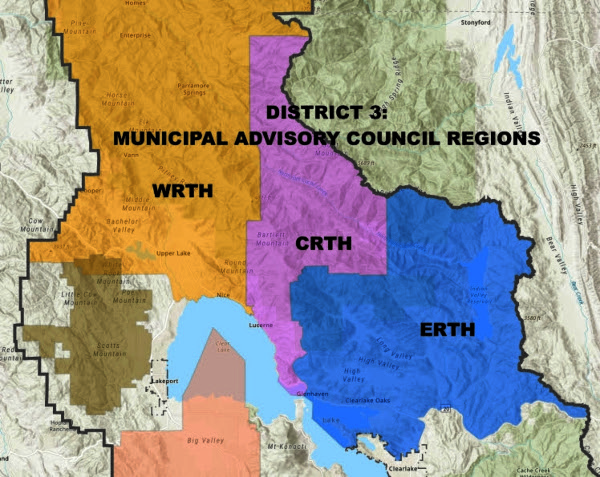
LAKE COUNTY, Calif. — Residents of Lake County’s District 3 are being invited to take a survey about community issues that are most important to them.

The three Municipal Advisory Councils, or MACs, of District 3 — East Region Town Hall, Central Region Town Hall and Western Region Town Hall — wish to jointly tackle issues shared along Lake County’s Northshore area.

The MACs need the community’s help in prioritizing which projects are most important to the communities. 

From code enforcement to public safety issues, local economy to the environment, they want to hear from Northshore residents.

“By working together, we can have a greater impact in helping our communities thrive,” the groups said in an announcement.

The survey can be found online here.

It can also be accessed via the ERTH website.

  1. California becomes largest economy in the world to achieve clean energy milestone
  2. FEMA’s flood maps often miss dangerous flash flood risks, leaving homeowners unprepared
  3. Supervisors to discuss state grant applications, pause on cannabis permits 
  • 225
  • 226
  • 227
  • 228
  • 229
  • 230
  • 231
  • 232
  • 233
  • 234
How to resolve AdBlock issue?
Refresh this page
