How to resolve AdBlock issue?
Refresh this page
How to resolve AdBlock issue?
Refresh this page
Lake County News,California
  • Home
    • Registration Form
  • News
    • Education
    • Veterans
    • Community
      • Obituaries
      • Letters
      • Commentary
    • Police Logs
    • Business
    • Recreation
    • Health
    • Religion
    • Legals
    • Arts & Life
    • Regional
  • Calendar
  • Contact us
    • FAQs
    • Phones, E-Mail
    • Subscribe
  • Advertise Here
  • Login
How to resolve AdBlock issue?
Refresh this page

News

California steps up to improve LGBTQ youth suicide hotline in wake of Trump administration cuts

Details
Written by: Lake County News reports
Published: 17 July 2025

Just weeks after the Trump administration announced that IT would eliminate specialized suicide prevention support for LGBTQ youth callers through the 988 Suicide & Crisis Lifeline, California is taking action to improve behavioral health services and provide even more affirming and inclusive care. 

Through a new partnership with The Trevor Project, Gov. Gavin Newsom and the California Health and Human Services Agency, or CalHHS, will provide the state’s 988 crisis counselors enhanced competency training from experts, ensuring better attunement to the needs of LGBTQ youth, on top of the specific training they already receive.

This partnership builds on existing collaborations, like those under California’s Master Plan for Kids’ Mental Health, and reflects a shared commitment to evidence-based, LGBTQ+ affirming crisis care. 

Callers to 988 will continue to be met with the highest level of understanding, respect and affirmation when they reach out for help.

“While the Trump administration continues its attacks on LGBTQ kids, California has a message to the gay community: we see you and we’re here for you. We’re proud to work with the Trevor Project to ensure that every person in our state can get the support they need to live a happy, healthy life,” said Gov. Newsom.

“To every young person who identifies as LGBTQ+: You matter. You are not alone. California will continue to show up for you with care, with compassion, and with action,” said Kim Johnson, secretary of CalHHS. “Through this partnership, California will continue to lead, providing enhanced support for these young people.”

“There could not be a more stark reminder of the moral bankruptcy of this administration than cutting off suicide prevention resources for LGQBT youth. These are young people reaching out in their time of deepest crisis — and I’m proud of California’s work to partner with the Trevor Project to creatively address this need. No matter what this administration throws at us, I know this state will always meet cruelty with kindness and stand up for what’s right," said First Partner Jennifer Siebel Newsom.
 
California’s crisis call centers

Across California, 12 988 call centers remain staffed around the clock by trained crisis counselors, ready to support anyone in behavioral health crises, including LGBTQ youth.

If you, a friend, or a loved one are in crisis or thinking about suicide, you can call, chat, or text 988 and be immediately connected to skilled counselors at all times. Specialized services for LGBTQ youth are also available via The Trevor Project hotline at 1‑866‑488‑7386, which continues as a state-endorsed access point.
 
State supports

California’s Children and Youth Behavioral Health Initiative, or CYBHI, a key component of Governor’ Newsom’s Master Plan for Kids’ Mental Health, offers behavioral health services and supports for children, youth, and families.  

In addition to focused messaging for LGBTQ youth within three ongoing statewide youth mental health campaigns, CYBHI has funded more than a dozen community organizations to provide targeted services for LGBTQ youth by establishing or expanding LGBTQ community spaces, increasing workforce supports, reducing behavioral health stigma, and raising awareness about suicide prevention. 

Additional free continuum-of-care services are available to help address concerns before they become crises, including peer support through CalHOPE and virtual behavioral health services platforms BrightLife Kids and Soluna. These resources are available for all California youth, young adults, and families, regardless of insurance or immigration status.

Why this matters

LGBTQ youth are four times more likely to attempt suicide than their peers, and without affirming services, their risk increases dramatically. Since its launch in 2022, the 988 LGBTQ+ “Press 3” line connected more than 1.5 million in crisis.
 
How to get help 

Call, text or chat 988 at any time to be connected with trained crisis counselors.

Text PRIDE, or dial 1‑866‑488‑7386, to reach Trevor Project specialists.

Visit CalHOPE for non-crisis peer and family support.

‘Big Beautiful Bill’ will have Americans paying higher prices for dirtier energy

Details
Written by: Daniel Cohan, Rice University
Published: 17 July 2025

Congress passed Donald Trump’s tax and spending bill on July 3, 2025. Kevin Carter/Getty Images

When congressional Republicans decided to cut some Biden-era energy subsidies to help fund their One Big Beautiful Bill Act, they could have pruned wasteful subsidies while sparing the rest. Instead, they did the reverse. Americans will pay the price with higher costs for dirtier energy.

The nearly 900-page bill that President Donald Trump signed on July 4, 2025, slashes incentives for wind and solar energy, batteries, electric cars and home efficiency while expanding subsidies for fossil fuels and biofuels. That will leave Americans burning more fossil fuels despite strong public and scientific support for shifting to renewable energy.

As an environmental engineering professor who studies ways to confront climate change, I think it is important to distinguish which energy technologies could rapidly cut emissions or need a financial boost to become viable from those that are already profitable but harm the environment. Unfortunately, the Republican bill favors the latter while stifling the former.

A large piece of mechanical equipment picks up coal from the ground.
The Spring Creek Mine in Decker, Mont., is just one mine in the Powder River Basin, the most productive coal-producing region in the U.S. AP Photo/Matthew Brown

Cuts to renewable electricity

Wind and solar power, often paired with batteries, provide over 90% of the new electricity added nationally and around the world in recent years. Natural gas turbines are in short supply, and there are long lead times to build nuclear power plants. Wind and solar energy projects – with batteries to store excess power until it’s needed – offer the fastest way to satisfy growing demand for power. Recent technological breakthroughs put geothermal power on the verge of rapid growth.

However, the One Big Beautiful Bill Act rescinds billions of dollars that the Inflation Reduction Act, enacted in 2022, devoted to boosting domestic manufacturing and deployments of renewable energy and batteries.

It accelerates the phaseout of tax credits for factories that manufacture equipment needed for renewable energy and electric vehicles. That would disrupt the boom in domestic manufacturing projects that had been stimulated by the Inflation Reduction Act.

Efforts to build new wind and solar farms will be hit even harder. To receive any tax credits, those projects will need to commence construction by mid-2026 or come online by the end of 2027. The act preserves a slower timeline for phasing out subsidies for nuclear, geothermal and hydrogen projects, which take far longer to build than wind and solar farms.

However, even projects that could be built soon enough will struggle to comply with the bill’s restrictions on using Chinese-made components. Tax law experts have called those provisions “unworkable,” since some Chinese materials may be necessary even for projects built with as much domestic content as possible. For example, even American-made solar panels may rely on components sourced from China or Chinese-owned companies.

Princeton University professor Jesse Jenkins estimates that the bill will mean wind and solar power generate 820 fewer terawatt-hours in 2035 than under previous policies. That’s more power than all U.S. coal-fired power plants generated in 2023.

That’s why BloombergNEF, an energy research firm, called the bill a “nightmare scenario” for clean energy proponents.

However, one person’s nightmare may be another man’s dream. “We’re constraining the hell out of wind and solar, which is good,” said U.S. Rep. Chip Roy, a Texas Republican who is backed by the oil and gas industry.

Workers install solar panels on a roof.
Federal tax credits for homeowners who install solar panels will now expire at the end of 2025. AP Photo/Michael Conroy

Electric cars and efficiency

Cuts fall even harder on Americans who are trying to reduce their carbon footprints and energy costs. The quickest phaseout comes for tax credits for electric vehicles, which will end on Sept. 30, 2025. And since the bill eliminates fines on car companies that fail to meet fuel economy standards, other new cars are likely to guzzle more gas.

Tax credits for home efficiency improvements such as heat pumps, efficient windows and energy audits will end at the end of 2025. Homeowners will also lose tax credits for installing solar panels at the end of the year, seven years earlier than under the previous law.

The bill also rescinds funding that would have helped cut diesel emissions and finance clean energy projects in underserved communities.

A car connects to a large metal box with a thick cable.
Federal tax credits for buying electric vehicles will end on Sept. 30, 2025. AP Photo/Jae C. Hong

Support for biofuels and fossil fuels

Biofuels and fossil fuels fared far better under the bill. Tens of billions of dollars will be spent to extend tax credits for biofuels such as ethanol and biodiesel.

Food-based biofuels do little good for the climate because growing, harvesting and processing crops requires fertilizers, pesticides and fuel. The bill would allow forests to be cut to make room for crops because it directs agencies to ignore the effects of biofuels on land use.

Meanwhile, the bill opens more federal lands and waters to leasing for oil and gas drilling and coal mining. It also slashes the royalties that companies pay to the federal government for fuels extracted from publicly owned land. And a new tax credit will subsidize metallurgical coal, which is mainly exported to steelmakers overseas.

The bill also increases subsidies for using captured carbon dioxide to extract more oil and gas from the ground. That makes it less likely that captured emissions will only be sequestered to combat climate change.

Summing it up

With fewer efficiency improvements, fewer electric vehicles and less clean power on the grid, Princeton’s Jenkins projects that the law will increase household energy costs by over $280 per year by 2035 above what they would have been without the bill. The extra fossil fuel-burning will negate 470 million tons of anticipated emissions reductions that year, a 7% bump.

The bill will also leave America’s clean energy transition further behind China, which is deploying more solar and wind power and electric vehicles than the rest of the world combined.

No one expected President Joe Biden’s Inflation Reduction Act to escape unscathed with Republicans in the White House and dominating both houses of Congress, even though many of its projects were in Republican-voting districts. Still, pairing cuts to clean energy with support for fossil fuels makes Trump’s bill uniquely harmful to the world’s climate and to Americans’ wallets.

This article includes some material previously published on June 10, 2025.The Conversation

Daniel Cohan, Professor of Civil and Environmental Engineering, Rice University

This article is republished from The Conversation under a Creative Commons license. Read the original article.
Clearlake City Council to discuss new power study, management salary increase

Details
Written by: LINGZI CHEN
Published: 16 July 2025

CLEARLAKE, Calif. — The Clearlake City Council this week will review a new feasibility study by Sonoma Clean Power on alternative power options, and discuss salary adjustment for management employees. 

The council will meet at 6 p.m. Thursday, July 17, in the council chambers at Clearlake City Hall, 14050 Olympic Drive.

The agenda can be found here.

The meeting will be broadcast live on the city's YouTube channel or the Lake County PEGTV YouTube Channel. 

Community members also can participate via Zoom. The webinar ID is 819 8866 1218, the  pass code is 899422. One tap mobile is available at +16694449171,,82771053751#, or join by phone at 669-444-9171 or 646-931-3860.

Under business, the council will consider a presentation of a feasibility report from Sonoma Clean Power to provide service within the city. 

Sonoma Clean Power is “a non-profit that purchases electricity generation for customers in Sonoma and Mendocino counties, while PG&E continues to maintain and operate all the poles, wires and substations of the grid,” the staff report explained. 

The company conducted a study in 2019 which found that “it would be unable to offer competitive service to Lake County residents at the time,” according to the staff report.

However, market and regulatory conditions have improved and the new feasibility study conducted this year suggests a total bill saving of 4.2% to 12.9%.

The study also outlined a service start date to be the second quarter of 2027.

In other business, the council is being asked to consider a 2.4% cost-of-living adjustment, or COLA, for the city’s management employees under the Management Classification and Benefits Plan. 

The proposed adjustment is based on the March-to-March Consumer Price Index, or the CPI, which rose 2.4% over the past year. Previous increases were 1.9% in 2019, 1.5% in 2020, 2.6% in 2021, 8.5% in 2022, 5% in 2023, and 3.5% in March 2024.

The staff report also noted that, over the five years prior to Fiscal Year 2022-23, COLA adjustments for management lagged behind those given to all other employment groups, resulting in a narrowing pay gap between management and other employees — a situation referred to in the report as salary compaction. 

In 2022-23, the council voted to approve a 6% COLA to management to bring their cumulative increases in line with the other city bargaining units.

As of July 1, all other bargaining groups received a 3% COLA, the report said. Staff recommends a 2.4% COLA for management employees. 

The council will also hold a public hearing on converting a portion of Acacia Street, from Arrowhead Road to Sonoma Avenue, to a one-way street. The proposal aims to improve traffic flow and safety, according to the staff report. Parking will also be redesigned. 

“The area has high traffic and safety concerns around Pomo School,” the staff report said. “There have been numerous near misses with both vehicles and pedestrians.”

On the meeting’s consent agenda — items that are considered routine in nature and usually adopted on a single vote — are warrants and council minutes; continuation of emergency declarations for winter storms and the Boyles Fire; approval of Resolution 2025-29 supporting an application for Land and Water Conservation Fund grants for the Austin Skatepark Rehabilitation Project; approval of an agreement with Government Finance Services to provide finance and administrative services for fiscal year 2025–26; notification of expiring committee appointments; and approval of a five-year extension to the PEG TV Agreement.
The council also will hold a closed session to discuss anticipated litigation; conduct a performance evaluation of the city attorney; and discuss ongoing litigation in Case No. CV-424401, Koi Nation of Northern California v. City of Clearlake, in Lake County Superior Court.

Email Lingzi Chen at This email address is being protected from spambots. You need JavaScript enabled to view it.. 

Cal Fire launches online viewer to monitor vegetation burn severity from California wildfires

Details
Written by: LAKE COUNTY NEWS REPORTS
Published: 16 July 2025
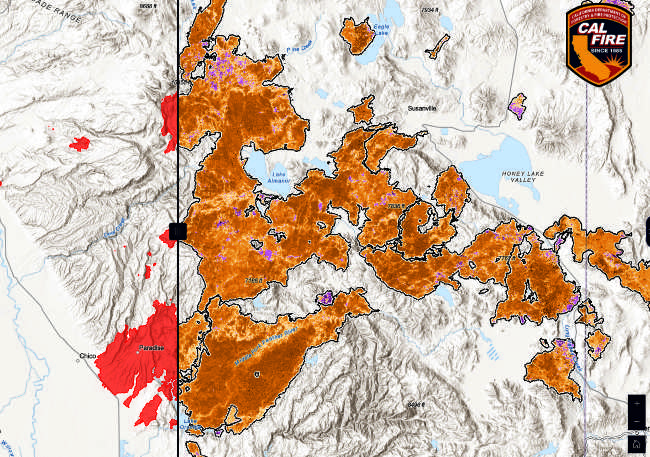
The new California Vegetation Burn Severity Online Viewer. Courtesy image.

Cal Fire’s Fire and Resource Assessment Program, or FRAP, has launched the new California Vegetation Burn Severity Online Viewer, an interactive public mapping tool that shows how wildfires have impacted vegetation across the state. 

This resource supports California’s commitment to transparency and wildfire resilience under Senate Bill 1101.

The Burn Severity Viewer displays burn severity data for all wildfires over 1,000 acres in California from 2015 to 2023.

With this information easily accessible, landowners, planners, scientists, and the public are empowered to better understand postfire conditions, support ecological recovery and plan for future fire resilience.

“This tool helps Californians see and understand how fire affects our landscapes,” said Chris Keithley, assistant deputy director for FRAP. “It gives communities data to support efforts to plan prescribed burns, guide restoration work, and reduce future wildfire risk.”

The Burn Severity Viewer has several benefits to post fire recovery planning: 1) helps identify areas in need of reforestation or active restoration; 2) improves fire preparedness by assisting prescribed fire practitioners in planning treatments based on past burn severity and fuel changes; 3) enhances safety by offering insights for fire suppression planning and understanding how previous burns might influence future fire behavior; 4) informs habitat management by identifying changes to wildlife habitat and supporting conservation work.

This new tool features interactive maps showing burn severity across all land ownerships. Users can search fires by name, year, cause, or size; view multiple data layers, including fire perimeters and severity classifications; add custom data layers; and generate downloadable, georeferenced maps for field use. 

The viewer will be updated annually to include new qualifying fires.

Burn severity is measured using advanced remote sensing techniques and translated into both the Composite Burn Index, or CBI, for forested areas and a continuous severity scale for all vegetation types. 

Data are derived from satellite imagery processed one year after each fire to account for vegetation recovery and delayed tree mortality.

The tool’s development is guided by a Technical Advisory Committee with experts from the California Wildfire & Forest Resilience Task Force – Science Advisory Panel, California Air Resources Board, NASA , U.S. Geological Survey, and U.S.D.A. Forest Service.

This marks Phase 1 of the project, focused on the online viewer with planned annual updates. Phase 2 will deliver downloadable datasets as Cal Fire continues to refine methods, especially for non-forested landscapes.

The viewer is now live and available to the public here.

For more information about Cal Fire’s Fire and Resource Assessment Program visit the webpage.

  1. Senators sound alarm on potential purging of eligible voters through DHS database
  2. How 17M Americans enrolled in Medicaid and ACA plans could lose their health insurance by 2034
  3. Lakeport’s 10th Street corridor made safer for pedestrian and bicycle access
  • 224
  • 225
  • 226
  • 227
  • 228
  • 229
  • 230
  • 231
  • 232
  • 233
How to resolve AdBlock issue?
Refresh this page
