How to resolve AdBlock issue?
Refresh this page
How to resolve AdBlock issue?
Refresh this page
Lake County News,California
  • Home
    • Registration Form
  • News
    • Education
    • Veterans
    • Community
      • Obituaries
      • Letters
      • Commentary
    • Police Logs
    • Business
    • Recreation
    • Health
    • Religion
    • Legals
    • Arts & Life
    • Regional
  • Calendar
  • Contact us
    • FAQs
    • Phones, E-Mail
    • Subscribe
  • Advertise Here
  • Login
How to resolve AdBlock issue?
Refresh this page

News

Regional search and rescue teams take part in helicopter training at Lake Mendocino

Details
Written by: LAKE COUNTY NEWS REPORTS
Published: 19 July 2025
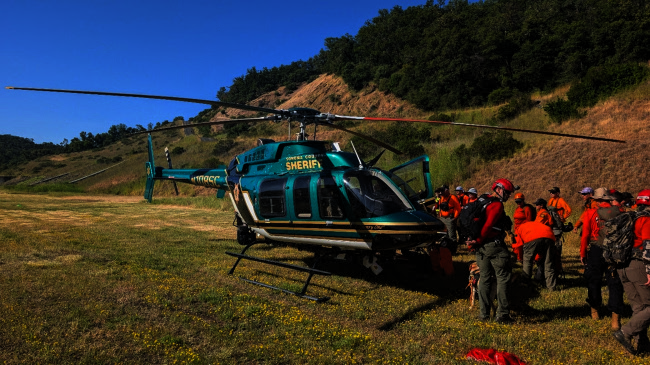
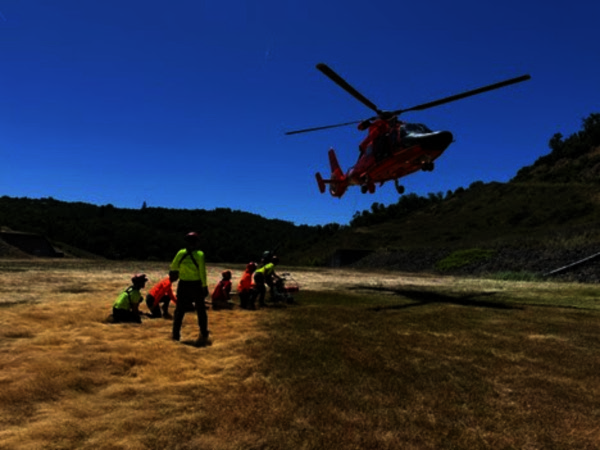
Participants at the helicopter training at Lake Mendocino. Courtesy photo.


NORTH COAST, Calif. — Search and rescue teams from around Northern California participated in a multi-day helicopter training earlier this summer at Lake Mendocino.

The Mendocino County Sheriff’s Office Search and Rescue Team reported that it led the advanced helicopter awareness training May 30 to June 1.

Officials said Mendocino’s team completed the specialized helicopter awareness training exercise with the assistance of search and rescue teams in Napa and Marin, and California Search and Rescue.

The exercise was designed to enhance emergency response capabilities in challenging terrain.

The joint training operation, conducted in collaboration with regional aviation partners, focused on loading / unloading operations, hoist procedures, and rapid deployment of SAR personnel into remote and rugged areas. 

The exercise took place at the Lake Mendocino Emergency Spillway, allowing for multiple training areas, simulating real-world scenarios that often require helicopter support during critical rescue missions.

A helicopter used for the training at Lake Mendocino. Courtesy photo.


The training included both seasoned volunteers and new recruits, all of whom trained under the guidance of certified flight crews and search and rescue coordinators. Emphasis was placed on communication, safety protocols, and coordination between ground and air units.

The Mendocino County Sheriff’s Office Search and Rescue Team thanked the search and rescue teams from Alameda, Contra Costa, Glenn, Humboldt, Lake, Marin, Napa, Nevada, Placer, San Mateo, Santa Clara, Solano and Sonoma counties, and Bay Area Mountain Rescue Unit, California Rescue Dog Association and California Search and Rescue Team for their participation and assistance in making the training possible.

Mendocino County’s team extended its sincere gratitude to the U.S. Army Corps of Engineers for providing access to the training location, and to Silva Septic, The Party Pros, Taqueria Michoacan, My California Food Truck, Ocean Fresh LLC, Slam Dunk Pizza, Starbucks Coffee and the Ukiah Natural Foods Co-Op for their generous logistical support. 

“These community partnerships were instrumental in the success of the training weekend,” the team said.

The team also thanked CalFire, REACH Air Medical Services, Sonoma County Sheriff’s Office Henry-1 and the United States Coast Guard for providing their helicopters and helicopter crews for this training event.

Cal Fire brought its helicopter to the training. Courtesy photo.

Space News: A strange bright burst in space baffled astronomers for more than a year. Now, they’ve solved the mystery

Details
Written by: Clancy William James, Curtin University
Published: 19 July 2025

CSIRO’s ASKAP radio telescope on Wajarri Country. © Alex Cherney/CSIRO

Around midday on June 13 last year, my colleagues and I were scanning the skies when we thought we had discovered a strange and exciting new object in space. Using a huge radio telescope, we spotted a blindingly fast flash of radio waves that appeared to be coming from somewhere inside our galaxy.

After a year of research and analysis, we have finally pinned down the source of the signal – and it was even closer to home than we had ever expected.

A surprise in the desert

Our instrument was located at Inyarrimanha Ilgari Bundara, the CSIRO Murchison Radio-astronomy Observatory in remote Western Australia, where the sky above the red desert plains is vast and sublime.

We were using a new detector at the radio telescope known as the Australian Square Kilometre Array Pathfinder – or ASKAP – to search for rare flickering signals from distant galaxies called fast radio bursts.

We detected a burst. Surprisingly, it showed no evidence of a time delay between high and low frequencies – a phenomenon known as “dispersion”.

This meant it must have originated within a few hundred light years of Earth. In other words, it must have come from inside our galaxy – unlike other fast radio bursts which have come from billions of light years away.

A problem emerges

Fast radio bursts are the brightest radio flashes in the Universe, emitting 30 years’ worth of the Sun’s energy in less than a millisecond – and we only have hints of how they are produced.

Some theories suggest they are produced by “magnetars” – the highly magnetised cores of massive, dead stars – or arise from cosmic collisions between these dead stellar remnants. Regardless of how they occur, fast radio bursts are also a precise instrument for mapping out the so-called “missing matter” in our Universe.

When we went back over our recordings to take a closer a look at the radio burst, we had a surprise: the signal seemed to have disappeared. Two months of trial and error went by, until the problem was found.

ASKAP is composed of 36 antennas, which can be combined to act like one gigantic zoom lens six kilometres across. Just like a zoom lens on a camera, if you try to take a picture of something too close, it comes out blurry. Only by removing some of the antennas from the analysis – artificially reducing the size of our “lens” – did we finally make an image of the burst.

We weren’t excited by this – in fact, we were disappointed. No astronomical signal could be close enough to cause this blurring.

This meant it was probably just radio-frequency “interference” – an astronomer’s term for human-made signals that corrupt our data.

It’s the kind of junk data we’d normally throw away.

Yet the burst had us intrigued. For one thing, this burst was fast. The fastest known fast radio burst lasted about 10 millionths of a second. This burst consisted of an extremely bright pulse lasting a few billionths of a second, and two dimmer after-pulses, for a total duration of 30 nanoseconds.

So where did this amazingly short, bright burst come from?

A white graph with a blue line that spikes suddenly.
The radio burst we detected, lasting merely 30 nanoseconds. Clancy W. James

A zombie in space?

We already knew the direction it came from, and we were able to use the blurriness in the image to estimate a distance of 4,500 km. And there was only one thing in that direction, at that distance, at that time – a derelict 60-year-old satellite called Relay 2.

Relay 2 was one of the first ever telecommunications satellites. Launched by the United States in 1964, it was operated until 1965, and its onboard systems had failed by 1967.

But how could Relay 2 have produced this burst?

Some satellites, presumed dead, have been observed to reawaken. They are known as “zombie satellites”.

But this was no zombie. No system on board Relay 2 had ever been able to produce a nanosecond burst of radio waves, even when it was alive.

We think the most likely cause was an “electrostatic discharge”. As satellites are exposed to electrically charged gases in space known as plasmas, they can become charged – just like when your feet rub on carpet. And that accumulated charge can suddenly discharge, with the resulting spark causing a flash of radio waves.

Electrostatic discharges are common, and are known to cause damage to spacecraft. Yet all known electrostatic discharges last thousands of times longer than our signal, and occur most commonly when the Earth’s magnetosphere is highly active. And our magnetosphere was unusually quiet at the time of the signal.

Another possibility is a strike by a micrometeoroid – a tiny piece of space debris – similar to that experienced by the James Webb Space Telescope in June 2022.

According to our calculations, a 22 micro-gram micrometeoroid travelling at 20km per second or more and hitting Relay 2 would have been able to produce such a strong flash of radio waves. But we estimate the chance the nanosecond burst we detected was caused by such an event to be about 1%.

Plenty more sparks in the sky

Ultimately, we can’t be certain why we saw this signal from Relay 2. What we do know, however, is how to see more of them. When looking at 13.8 millisecond timescales – the equivalent of keeping the camera shutter open for longer – this signal was washed out, and barely detectable even to a powerful radio telescope such as ASKAP.

But if we had searched at 13.8 nanoseconds, any old radio antenna would have easily seen it. It shows us that monitoring satellites for electrostatic discharges with ground-based radio antennas is possible. And with the number of satellites in orbit growing rapidly, finding new ways to monitor them is more important than ever.

But did our team eventually find new astronomical signals? You bet we did. And there are no doubt plenty more to be found.The Conversation

Clancy William James, Senior Lecturer (astronomy and astroparticle physics), Curtin University

This article is republished from The Conversation under a Creative Commons license. Read the original article.

Supervisors push back on proposed air quality district fee increase

Details
Written by: LINGZI CHEN
Published: 18 July 2025

LAKE COUNTY, Calif. — In an ongoing discussion over raising permit fees issued by the Lake County Air Quality Management District, the Board of Supervisors this week pushed back on a proposed three-year rollout. 

The Lake County Air Quality Management District is “one of 35 local regulatory agencies in California responsible for ambient (outdoor) air quality in our geographic region,” the agency’s website states. “It’s our duty to ensure the fair and consistent implementation of local, state and federal air quality regulations.”

For nearly 30 years, the district has kept its fees flat — a move district officials say has strained staffing and operation. Now the agency is proposing a significant fee increase, phased in over three years, with a 35% increment for the first year. But the Board of Supervisors was hesitant to move forward. 

At the end of Tuesday’s discussion, the board asked the district to consider a five-year implementation plan instead with a 20% first-year increase. The matter will return for further discussion at a follow-up meeting. 

If approved, this would be the district’s first major fee increase since 1996, aside from the introduction of a burn permit fee in 2003 and yearly adjustments tied to the Consumer Price Index, or CPI.

While supervisors were concerned that such a huge extent of increase may bring undesirable impact to local economic development, Air Pollution Control Officer Douglas Gearhart maintained that the fee changes — after three decades —  are both urgent and necessary. 

For the district, CPI adjustments alone no longer suffice, Gearhart said.

“We're probably at 50 to 60% cost recovery on the permit programs,” said Gearhart at the board’s June 10 meeting when the matter was first brought forward to the supervisors. That means only about half to 60% of the true cost of running the permit programs is being covered by the fees they charge. 

Gearhart mentioned that the district has to carry “lots of state and federal mandates, all of which are unfunded.” 

“And they are unfunded because the state Legislature passes laws and says districts have fee authority, therefore adopt a fee to pay for it, and so we haven't had to do that. We've been able to avoid that for, well, since I've been here over 25 years,” said Gearhart. “We've gotten to the point where we're just, we're not able to sustain that.”

The board agreed to proceed with the rule changes such as lifting the annual burn ban but raised concerns for the impact of fee increases and requested a side-by-side analysis of the new fees at the June meeting. 

Supervisors ask for five-year rollout, annual review

About a month following the first hearing, Gearhart this week came back with a fee study summary based on staff time to perform tasks and a side-by-side comparison of the current fees against the proposed new fees. 

A three-year rollout plan was proposed for existing permitted facilities, with 35% increments each year. 

At the Tuesday meeting, supervisors pointed toward the magnitude of these increases. 

“It’s not just a 100% increase; it’s a very large increase,” Supervisor Bruno Sabatier said, citing examples of  fees jumping from $300 to $3000. “This impacts agriculture; this impacts economic development, any kind of development.”

Gearhard reminded the board that the increase will be incremental over three years. 

Sabatier later said that he would like the board to have a year-by-year review to approve it annually and also suggested lengthening the rollout time from three years to four years. 

In the fee comparison table, the less significant changes proposed include an increase from $335.38 to $950 for a type of authority to construct or from $20,122.98 to $21,095 for a type of permit to operate. 

The more significant changes include a type of permit to operate fee that currently costs $670.78 and is proposed to increase to $23,438 for a power plant modification permit. 

Later, when Supervisor Helen Owen questioned this change, Gearhart explained that this resulted from a changed fee structure. The over $20,000 fees were just issued in a different way in the past, he said. 

Gearhart also explained that some increases are more significant because the task is much tougher than the standard ones while paying the same, lower fee. 

The permit for “aggregate extraction and process for over 100,000 tons per year” has been charged $670.78 as a standard generator, for example. 

“Aggregate extraction is a much bigger, much more complicated facility with a lot more emissions, a lot more equipment; the time required for inspections, the time required for reporting that goes into that is much more significant. So that's why the change is so much more significant for that,” Gearhart responded when Owen inquired on this item. “It was an unfair system for the people with smaller equipment and people with larger facilities ended up getting a lot more for their money.”

Later, Supervisor Brad Rasmussen proposed a five-year implementation period with the first-year increase around 20% rather than 35% to mitigate economic impact. 

“I understand you have limitations and whatnot. I just know that this is going to limit a lot of the agencies and businesses that are trying to, you know, put forth anything,” said Supervisor Eddie Crandell. “So for me, I’d like to see six phases.”

Gearheart said that the district has been working on a replacement fee schedule for the last five to 10 years. The process was initially planned to start in 2020, he said. “Then we had COVID, then we had fires … So we've been putting this off to prevent the economic impacts and the impacts to the community because we had the salary savings, because we didn't have staff, we couldn't keep staff here.”

“We're not an economic development agency. We are here to protect the community from air pollution,” he continued. “We're not trying to balance what's the potential growth of the county versus impacts from smoke and the community health impacts related to equipment and emissions.”

At the end of the discussion, the Board of Supervisors came to a consensus to offer a five-year period to implement the fee raises, with the requirement to come back to the board for review and approval every year.

“I’m good with that,” said Rasmussen. “So we’re not locking ourselves in for five years.”

The discussion is ongoing and no final action has been taken at this point. A follow-up meeting will be scheduled for this agenda. 

Email Lingzi Chen at This email address is being protected from spambots. You need JavaScript enabled to view it.. 

Thompson calls bill to rip funding from public media and foreign aid ‘an attack on public safety’

Details
Written by: Elizabeth Larson
Published: 18 July 2025

Lake County’s member of Congress on Thursday criticized a bill passed by Congressional Republicans to take back federal funding from public media stations and foreign aid programs that was already approved by Congress and signed into law.

“Make no mistake: These clawbacks are an attack on public safety,” said Congressman Mike Thompson. “Our public radio and TV stations, especially those in rural communities, are often the only trusted local news source. Publicly funded media stations are the ones covering our kids’ high school sports games, providing high-quality educational programming to our kids, and distributing essential public safety information during natural disasters. To slash this funding is to attack these important services.

“At the same time, Congressional Republicans are pulling funding from Ukraine and other allies. When our allies are unsafe, we are all unsafe. Cuts to foreign aid undermine our national security,” Thompson said.

“Congressional Republicans’ claims that this is about saving money are laughable considering they just passed a bill that will add nearly $5 trillion to our national debt in order to give tax breaks to their billionaire donors who don’t need the help. They are pulling the rug out from under our allies and our local news stations. The American people will pay the price,” Thompson added. 
 
Congressman Mike Thompson represents California’s Fourth Congressional District, which includes all or part of Lake, Napa, Solano, Sonoma and Yolo Counties. He is a senior member of the House Committee on Ways and Means. Rep. Thompson is Chairman of the House Gun Violence Prevention Task Force. He is also Co-Chair of the bipartisan, bicameral Congressional Wine Caucus and a member of the fiscally-responsible Blue Dog Coalition.

  1. U.S. foreclosure starts increase 7 percent in first six months of 2025
  2. Clearlake Animal Control: ‘Zero’ and the dogs
  3. Lake County governments adopt state’s new fire hazard map; ‘very high’ severity zones expanded by 14,000 acres
  • 222
  • 223
  • 224
  • 225
  • 226
  • 227
  • 228
  • 229
  • 230
  • 231
How to resolve AdBlock issue?
Refresh this page