 How to resolve AdBlock issue?
News
- Details
- Written by: Kathleen Scavone

LAKEPORT, Calif. – I've been a fan of vegetable gardening since I was a kid when I marveled at the plump, red juiciness of my mom's homegrown tomatoes grown under the kitchen window.
When I was invited into my childhood friend's family garden, it just seemed magical that you could get something for nothing, as it appeared to my young eyes.
There in that little plot of rich soil was something for all of the senses. The scent of mint drifted in the air as I wandered their garden's rows, as did the spicy fragrance of carnation, lavender and penstemon.
When I was asked to help pick their golden lemon cucumbers I was surprised at the prickly skin of that strange vegetable!
Her garden also acquainted me with other novel-to-me veggies such as squash in all of their strange and delightful forms, white radishes and potatoes that were purple!
In my house, we usually ate green beans and spinach from a can, and when artichokes or corn were in season we had farm-fresh versions of those staples.
As any gardener or farmer, for that matter, can tell you, there is always something that needs to be done whether it is hoeing, weeding, thinning, transplanting or watering.
Gardening becomes a fine balancing act where you want to attract the right critters, and discourage the damaging or destructive ones.
I enjoy planting sunflowers, salvia and other pollinator-attractors, and companion plantings using marigolds to discourage bean beetles.
My motto is “something for everyone,” so that if a gopher outmaneuvers me by snaking under my raised beds somehow, or the goldfinches snack on my tender greens, my M.O. is to plant enough for all of us.
A critter-proof fence is always a necessity in order to keep out the deer, raccoons, rabbits and other hungry neighbors. Done and done.
Just when I thought I had covered all bases I began to notice the mulch had been pushed aside in several of the raised beds and holes dug into the damp soil.
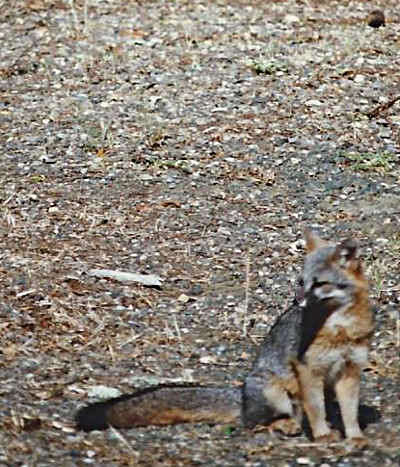
Hmmm, I thought. Squirrels? But they never bothered my garden in the past, usually sticking to acorns and other typical squirrel food. Whatever it was that was digging in the garden was not disturbing the plants, but merely the mulch and soil surrounding the plants.
As I patted down the mini-excavations and replaced the mulch I decided to position a critter-cam in the garden to solve the mystery.
Then, mystery solved – it was a fox! A gray fox! Maybe he'd been looking for the little tree frogs I'd seen in the more damp areas of the garden.
I'd seen foxes around the area throughout the years and even witnessed them pouncing on a plethora of frogs one year, but had forgotten they were so adept at climbing as well as squeezing through such small openings.
These beautiful creatures, speckled gray on top with reddish colors underneath, usually dine on small birds, animals and insects along with the occasional nibble of fruit.
Gray foxes are not often seen during the daylight hours, as they are snug in their burrows or hollow trees.
Gray foxes are members of the Canidae family and are one of only two members with the ability to climb trees and, I'm surmising, my garden fence.
The other member with climbing ability is the Asian raccoon dog which, of course, we do not have here in California.
A gray fox has specially adapted claws to help him hook onto a tree's bark in the wild.
Fossil evidence found in Arizona supplies proof that foxes have been around for millions of years.
The male fox is called a tod, or dog and a group of foxes is known as an earth, leash or skulk.
There are native red foxes that populate the Sierra Nevada and the Cascade Mountains and they are a threatened species.
The non-native red fox is an introduced species that poses a threat to certain ecosystems since they are highly adaptable. The red foxes were brought here for fur farming and hunting in the past.
The gray fox gestation phase is close to 53 days, and a litter may range from one to seven kits or pups.
If you happen to hear a “yipping, barking” sound, you just may have heard a fox.
Kathleen Scavone, M.A., is a retired educator, potter, freelance writer and author of “Anderson Marsh State Historic Park: A Walking History, Prehistory, Flora, and Fauna Tour of a California State Park” and “Native Americans of Lake County.”
- Details
- Written by: Lake County News reports
“Seniors comprise almost 25 percent of Lake County’s overall population,” said Executive Director Lisa Morrow. “While undertaking such an expansion of services in the midst of a pandemic certainly presents its challenges, we are excited to now be serving this important section of our community – especially during these challenging times.”
During pandemic restrictions, the Senior Center Wellness program continues with classes such as Tai Chi offered via Zoom.
Meals on Wheels is still serving the Northshore and has expanded its services to also include those who previously joined the senior center for onsite dining.
Seniors interested in Wellness Zoom classes or those wanting to sign up for meal delivery should call the senior center at 707-263-4218 or Lake Family Resource Center at 707-279-0563.
The Meals on Wheels Thrift Store located in Lakeport is open. New thrift store hours will be Monday through Friday from 9 a.m. to 4 p.m.
Once it’s safe to do so, Lake Family Resource Center looks forward to reopening the Activities Center for group meals, a variety of wellness classes and workshops and other gatherings.
Lake Family Resource Center officials said they also look forward to adding robust programming and services to reach out to and engage seniors in a variety of ways.
“We not only look forward to continuing current programming, we’re excited about exploring additional programming. We envision support groups, more wellness activities as well as home visits for the seniors of Lake County,” said Morrow.
She also wants to engage seniors as volunteers to rock infants and provide comfort to the youngest of the clients served by Lake Family Resource Center.
“With the addition of the senior population to our clients, we are now extremely well-rounded, serving every facet of our community from Pre-K through gray,” Morrow said. “This gives us an outstanding opportunity to enrich the lives of many community members of every age group.”
The Lakeport Senior Center will remain its own separate nonprofit organization with Lake Family Resource Center managing its operations and administration through a contract.
Denise Johnson, a lifetime resident of Lake County, will be the senior center’s director of operations. Johnson has been with Lake Family Resource Center for almost four years, functioning as the housing services coordinator, a program she herself developed.
Prior to joining the Lake Family Resource Center, Johnson was employed by the District Attorney’s Office as a victim services advocate for elders experiencing abuse.
Lake Family Resource Center has been serving Lake County families since 1995 to achieve safe, sustainable, healthy families and community. A 501c3 nonprofit organization, most services are provided at no cost and are funded through government grants and community donations.
Before this expansion with the Lakeport Senior Center, Lake Family Resource Center served approximately 1,400 families and 4,500 individuals each year.
For more information about the center and its services, call 707-279-0563 or visit its website.
- Details
- Written by: Gerard Buckley, Rochester Institute of Technology

The Americans with Disabilities Act is 30 years old.
For young people who have grown up with the ADA, the results of this landmark legislation are part of everyday life – sometimes in ways they may not even realize.
I was there at the beginning. As a young deaf man in 1990, I attended the Rose Garden ADA signing ceremony. I clearly recall the sun was shining brilliantly and the joy among leaders in the disability community who had long worked to bring about this civil rights legislation.
In the decades since, I have witnessed the ADA’s profound impact as an educator of deaf and hard-of-hearing students for this population and the U.S. as a whole.
A decades-long journey
Four senators who were major supporters of the ADA in the 1980s had personal connections to the issue. Edward Kennedy of Massachusetts had an intellectually disabled sister. Iowa’s Tom Harkin had a brother who was deaf. Bob Dole of Kansas had been disabled in World War II. Connecticut’s Lowell Weicker had a son with Down syndrome. A seminal moment at the passage of the ADA was Harkin’s address to Congress in sign language – the first time the body had been addressed this way.
The ADA prohibits discrimination against persons with disabilities in employment, state and local government services, businesses that are public accommodations or commercial facilities and in transportation.
In many ways, I feel the most important changes brought about by the legislation relate to making it easier for deaf people to communicate. In his book “A Phone of Our Own: The Deaf Insurrection Against Ma Bell,” historian Harry Lang described the long struggle in the deaf community to gain access to the telephone. The ADA provided a huge leap forward by requiring the establishment of nationwide telecommunications relay services. This system provided telephone access 24/7 to deaf citizens who previously had relied on volunteer services with limited hours. No longer would deaf individuals be excluded from employment opportunities requiring the use of the phone. And it enabled deaf people to participate in the mainstream of the American life by being free to call for pizza or to wish a loved one happy birthday.
A more entertaining life
Title III of the ADA required that public facilities, such as hospitals, bars, shopping centers and museums – but, importantly, not movie theaters – provide access to verbal information on televisions, films or slide shows.
Stiff opposition from the motion picture and cable industry prevented the ADA from including a requirement for closed captioning in films and on cable television. However, as a concession, Congress did include a requirement for all federally funded public service announcements to be captioned.

The historian Lang examines the history of access to films and television through captioning. He describes how the ADA was a milestone greatly affecting efforts to make educational and entertainment films accessible to deaf persons.
Creating a ‘deaf middle class’
ADA and Section 504, which guarantees accessibility and accommodations in public schools, provided educational opportunities for many deaf and hard-of-hearing students to attend college. This helped create, as educators and authors Carol Padden and Tom Humphries referred to it, a deaf middle class of community leaders and an ever-increasing number of deaf lawyers, doctors and PhDs.
While great strides have been made, people with disabilities still are twice as likely to be unemployed as those without disabilities. The employment gap between deaf and hearing people in the United States is significant. Only 53.3% of deaf people ages 25-64 were employed in 2017, compared to 75.8% of hearing people an employment gap of 22.5 percent. In round numbers, nearly 10 million Americans are hard of hearing and close to 1 million are functionally deaf.
Deaf college graduates fare much better. The college I lead, Rochester Institute of Technology’s National Technical Institute for the Deaf, puts a high emphasis on building relationships with employers. Historically, 95% of our graduates find employment.
New pandemic challenges
As the world navigates the COVID-19 pandemic, new challenges are arising. Masks make communication difficult for those who rely on speechreading, endless Zoom meetings bring more fatigue for those who rely on visual communication, and access to health care and emergency information can be spotty.
But there are bright spots when one considers progress since passage of the ADA. Recognition of American Sign Language and the importance of ASL interpreters for access has grown tremendously over the past 30 years as deaf and hard-of-hearing citizens have sought greater inclusion in the mainsteam of American society. Captioning is used by more than 60% of students with disabilities, and 50% of those with no reported disabilities. Prior to the current employment crisis, the Bureau of Labor Statistics predicted increased demand for sign language interpreters. Automatic speech recognition apps allow for increased interaction between deaf and hearing colleagues, classmates and friends. These advancements benefit not only the students on my campus, but at other campuses with deaf populations such as Gallaudet University and California State University, Northridge.
[Deep knowledge, daily. Sign up for The Conversation’s newsletter.]
The ADA proclaimed accessibility as a civil right. Just as ADA-sanctioned accommodations such as sidewalk ramps originally designed to benefit those with mobility issues was a positive for families with strollers and bicycles, closed captioning designed as a service for deaf and hard-of-hearing individuals now is ubiquitous on televisions, computers and smart phones in hearing households as well.
The deaf community has historically been able to work around challenges and find solutions to communication barriers. This time in our history is no different. Innovative thinkers continually find ways to advocate, modify and make current and emerging technologies work for everyone.
Gerard Buckley, President of the National Technical Institute for the Deaf, Rochester Institute of Technology
This article is republished from The Conversation under a Creative Commons license. Read the original article.
- Details
- Written by: Elizabeth Larson
Dogs available for adoption this week include mixes of Anatolian Shepherd, Belgian Malinois, chow chow, pit bull and shepherd.
Dogs that are adopted from Lake County Animal Care and Control are either neutered or spayed, microchipped and, if old enough, given a rabies shot and county license before being released to their new owner. License fees do not apply to residents of the cities of Lakeport or Clearlake.
The following dogs at the Lake County Animal Care and Control shelter have been cleared for adoption (additional dogs on the animal control Web site not listed are still “on hold”).
Call Lake County Animal Care and Control at 707-263-0278 or visit the shelter online at http://www.co.lake.ca.us/Government/Directory/Animal_Care_And_Control.htm for information on visiting or adopting.
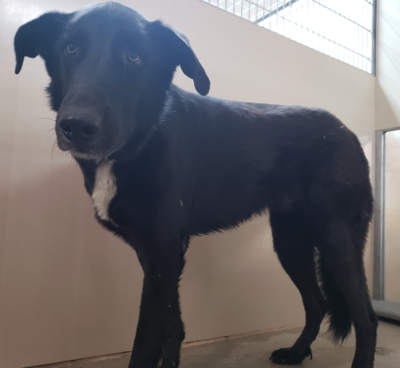
Male Anatolian Shepherd
This male Anatolian Shepherd has a medium-length black coat with white markings.
He has been neutered.
He is in kennel No. 13, ID No. 13803.
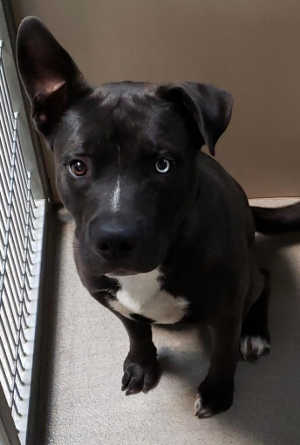
Male pit bull terrier
This male pit bull terrier has a black coat.
He is in kennel No. 18, ID No. 13772.
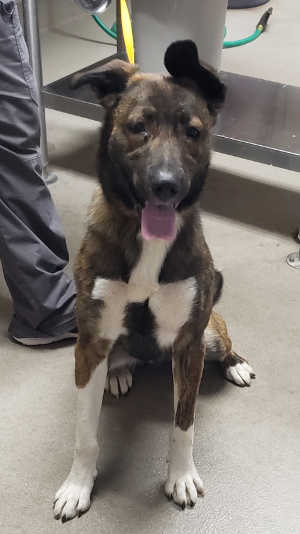
Shepherd mix
This female shepherd mix has a brindle and white coat.
She is in kennel No. 22, ID No. 13776.
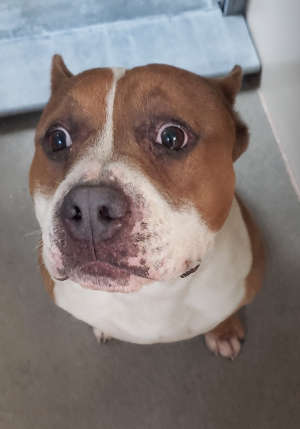
‘Mugsy’
“Mugsy” is a male pit bull terrier with a short tan and white coat.
He is in kennel No. 26, ID No. 13797.

Female Belgian Malinois
This female Belgian Malinois Shepherd has a short black and tan coat.
She is in kennel No. 31, ID No. 13793.
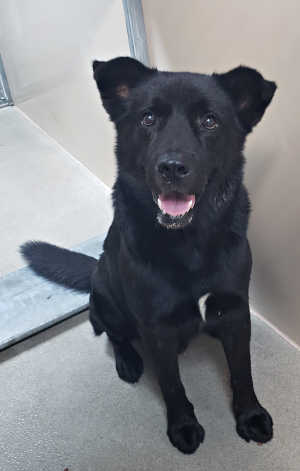
Male chow chow
This male chow chow has a medium-length black coat.
He is in kennel No. 33, ID No. 13795.
Email Elizabeth Larson at