 How to resolve AdBlock issue?
News
- Details
- Written by: Elizabeth Larson
Dogs available for adoption this week include mixes of chow chow, husky, Labrador Retriever and pit bull.
Dogs that are adopted from Lake County Animal Care and Control are either neutered or spayed, microchipped and, if old enough, given a rabies shot and county license before being released to their new owner. License fees do not apply to residents of the cities of Lakeport or Clearlake.
The following dogs at the Lake County Animal Care and Control shelter have been cleared for adoption (additional dogs on the animal control Web site not listed are still “on hold”).
Call Lake County Animal Care and Control at 707-263-0278 or visit the shelter online at http://www.co.lake.ca.us/Government/Directory/Animal_Care_And_Control.htm for information on visiting or adopting.

Female Labrador Retriever
This female Labrador Retriever mix has a short black coat with white markings.
She is in kennel No. 9, ID No. 13989.

Female pit bull terrier
This female pit bull terrier has a short gray and white coat.
She is in kennel No. 18, ID No. 13990.

‘Lilly’
“Lilly” is a female pit bull-husky mix with a short brown and white coat.
She is in kennel No. 21, ID No. 13991.

‘Shiloh’
“Shiloh” is a male pit bull-chow chow mix with a short tan coat.
He is in kennel No. 24, ID No. 13992.

‘Hunter’
“Hunter” is a male yellow Labrador Retriever.
He has been neutered.
He’s in kennel No. 30, ID No. 13896.
Email Elizabeth Larson at
- Details
- Written by: Miles Hatfield

NASA is preparing for the first launch of a sounding rocket since the coronavirus pandemic began in the United States.
The DUST-2 mission, which is short for the Determining Unknown yet Significant Traits-2, will carry a miniature laboratory into space, simulating how tiny grains of space dust – the raw materials of stars, planets and solar systems – form and grow.
The launch window opens at the White Sands Missile Range in New Mexico on Sept. 8.
DUST-2, a collaboration between NASA and the Japan Aerospace Exploration Agency, follows up on the DUST mission launched in October 2019.
Like its predecessor, DUST-2 will fly on a sounding rocket, a suborbital rocket that makes a brief trip into space before falling back to Earth. Sounding rockets provide cost-effective access to space and remain one of the most efficient ways to achieve near-zero gravity, a critical requirement for the mission.
DUST-2’s goal is to study how individual atoms, shed by dying stars and supernovae, stick together. When they do, they form dust grains – some of the basic building blocks of our universe.
“What we're trying to do is duplicate what happens in at least two astrophysical environments,” said principal investigator Joe Nuth, a planetary scientist at NASA’s Goddard Space Flight Center in Greenbelt, Maryland. “One is when [dust] grains form when stars die, as they blow off their outer atmospheres. The other is during the formation of solar systems, where you're actually forming planets from the vaporized dust of star-forming clouds.”
Both environments involve atoms colliding, sticking together, and forming dust grains. But exactly how dust grains form and grow depends on many different factors. Nuth and his collaborator, Yuki Kimura of Hokkaido University in Japan, designed DUST-2 to study which factors are most important.
The refrigerator-sized mini-laboratory will launch aboard a Black Brant IX sounding rocket, reaching an altitude of about 210 miles high before beginning to fall back down to Earth.
A lot happens in the next six and a half minutes.
Thirty seconds into freefall, the first of its six experiments – all slight modifications of one another – kicks on. Inside a sealed chamber, a tiny filament begins to heat up. The thin coating of iron, silicon, magnesium and other particles sprayed onto the filament diffuse into the surrounding chamber.
Some of these atoms will collide and stick – the beginnings of a dust grain – while others ricochet away. Each minute, another chamber turns on until the payload parachutes back to Earth for recovery.

Back in the lab, Nuth, Kimura and their teams will study the grains that formed in each of the six chambers. Hotter particles collide more often, so they will measure how grains formed differently farther or closer to the hot filament.
Some elements may block one another from growing dust grains, so they will study which elements ended up in each grain.
They’ll also explore a surprise finding from the DUST-1 mission: In that experiment, dust grains that formed in argon gas with a small fraction (5%) of oxygen tended to smush together more than those formed in pure argon, a non-reactive noble gas.
“Without the oxygen, the atoms were like little billiard balls that touched and stuck,” said Nuth. “But with oxygen, when the billiard balls touched, they partially merged together. That was something we didn't suspect.”
Their hunch is that oxygen lowered the melting point of the dust grain, so that incoming particles mashed into partly molten material. To test this idea, DUST-2 removed all oxygen and replaced it with a small quantity (about 5%) of hydrogen.
“If that’s the case, we should get none of that merging with hydrogen,” Nuth said. “So we’ll see if it pans out.”
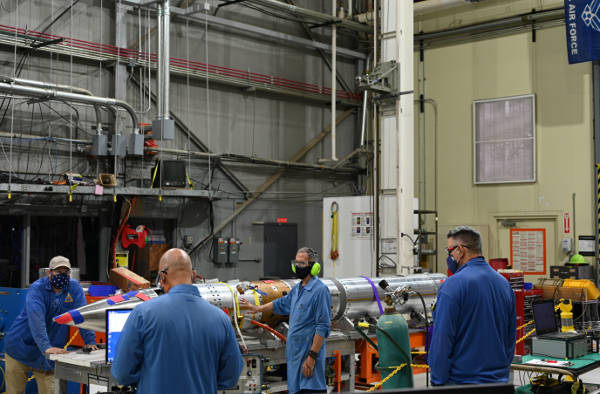
The experiment also includes a new carbon fiber heating filament for more precise control of the temperature. But the biggest difference between DUST-1 and DUST-2 is in mission operations – it’s the first sounding rocket to launch during the COVID-19 pandemic. The team has implemented many new processes in the background to ensure the launch can happen while protecting the health of the workforce.
“As we carefully evaluated each task, we developed new ways to accomplish some of our hands-on work to minimize the risk of exposure,” said John Hickman, deputy program manager for NASA’s Sounding Rockets Program.
Every four hours, the team sanitizes all surfaces and equipment. “In addition to masks we have eye protection – face shields and safety glasses,” said Eric Roper, NSROC mission manager who oversaw operations at White Sands. “We’ve worked pretty hard to develop a culture of doing these things as second nature.”
It seems to be working – even with the new precautions, launch preparations have proceeded on schedule.
“Honestly it’s going about the same pace as usual,” said Roper. “The team’s done a phenomenal job adapting to the situation.”
NASA's Sounding Rockets Program is managed at the agency's Wallops Flight Facility, which is managed by NASA's Goddard Space Flight Center in Greenbelt, Maryland. NASA's Heliophysics Division funds the Sounding Rockets Program for the agency.
Miles Hatfield works for NASA’s Goddard Space Flight Center in Greenbelt, Maryland.
- Details
- Written by: Lake County News reports
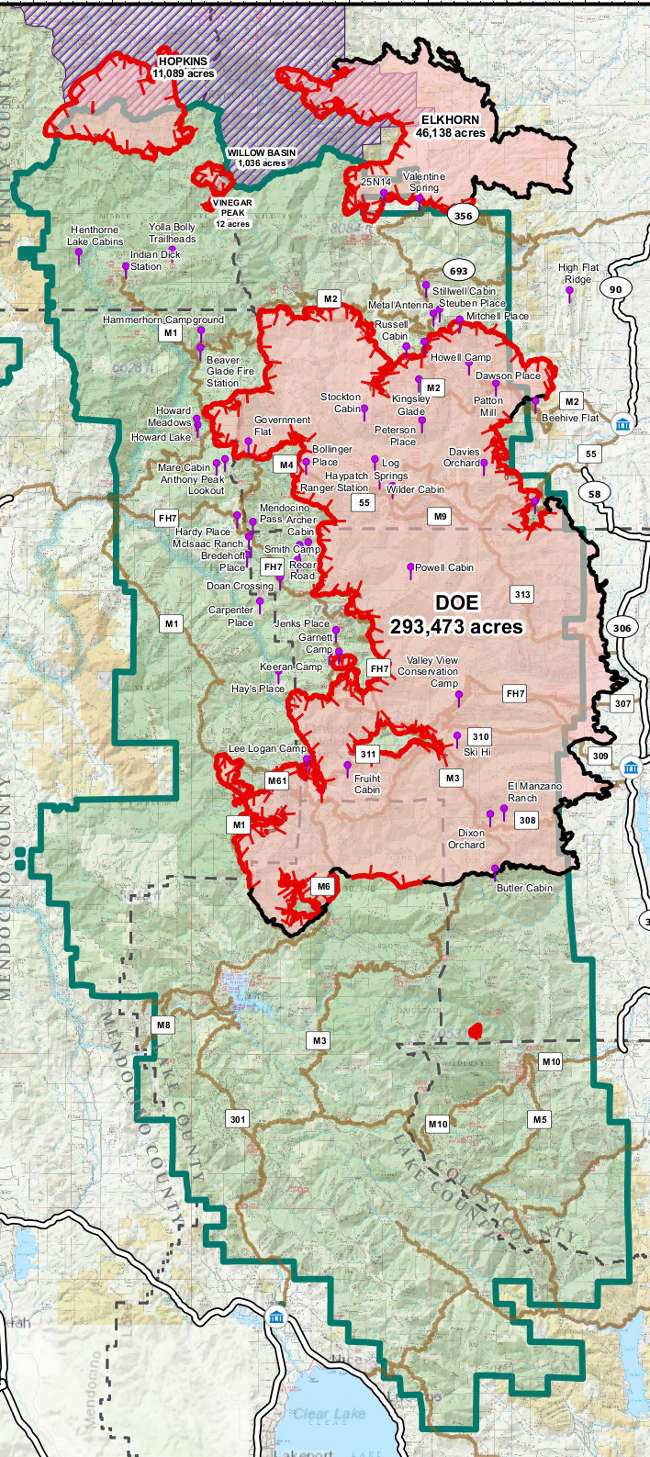
The August Complex rose to 305,673 acres on Saturday, with containment remaining at 23 percent, according to the US Forest Service report.
There will be a virtual community meeting at 7 p.m., Saturday, Sept. 5. Residents, particularly from the Covelo area, are encouraged to participate.
The meeting and fire updates can be found on the Mendocino National Forest Facebook page.
The complex originally was 37 fires that merged into several larger incidents. Those fires – the Hull, Doe, Tatham and Glade – have since merged to form one large fire.
The Doe fire is 297,377 acres and 23 percent contained, the Tatham fire is 15,594 acres and 9 percent contained, the Hull fire is 13,177 acres and 10 percent contained, and the Hopkins fire is 11,089 acres and zero percent contained.
The Forest Service said 1,048 resources are committed to the complex, including 22 crews, four camp crews, seven helicopters, 46 engines, 20 dozers, 31 water tenders and three masticators.
The National Weather Service has issued a fire weather warning beginning 10 p.m. Monday and continuing through 8 a.m. Wednesday.
Weather predictions call for extreme heat ranging from the mid-90s on the ridges to 110 degrees in the valleys. Relative humidity is expected to drop to the single digits.
Winds will shift from southeast to northwest, with sustained wind speeds of up to 25 miles per hour. This could result in the potential for rapid fire spread throughout the complex and dense smoke in the surrounding area.
Officials said there was a slopover across the M1 Road in the Riley Ridge area of the Doe fire.
Helicopters and dozers are performing containment operations. Crews are making good progress containing a spot fire north of Anthony Peak and South of Buck Rock. Small aircraft will assist in this area, as smoke conditions permit, the Forest Service reported.
The Hopkins fire is moving toward areas of old burn scars and road systems surrounding the perimeter of the fire. Burnout operations and air operations will proceed Saturday. There are presently five engines and three bulldozers committed to the Hopkins fire, officials said.
Mendocino National Forest officials updated the area closure for the August Complex on Sept. 5. The Forest Order 08-20-12 and map are posted on the forest website.
The most up to date information on the August Complex can be found on InciWeb.
- Details
- Written by: Elizabeth Larson
Lake County’s COVID-19 cases totaled 360 on Friday, said Dr. Gary Pace. That’s an increase of 36 over the previous Friday.
Of those, 38 are under active Public Health monitoring and 317 are recovered. None currently are hospitalized and five have died.
On Friday night, more than 731,000 cases and approximately 13,643 deaths were reported statewide by Public Health departments across California.
Lake County Public Health said 10,040 tests have been conducted locally.
On Friday, the California Department of Public Health said 11,796,970 tests have been conducted in the state, an increase of 133,046 over the prior 24-hour reporting period.
The state said local health departments have reported 33,307 confirmed positive cases in health care workers and 157 deaths statewide.
In Lake County, Pace said Public Health is continuing to track an outbreak at a local skilled nursing facility.
Pace said he would not comment when asked to identify the specific facility.
He said Friday that the outbreak has resulted in four of the facility’s staff members testing positive. Five residents have contracted the virus, and two have died; those deaths were Lake County’s fourth and fifth COVID-19 deaths.
“Similar concerning situations have arisen in other counties around the state,” said Pace.
“The facility is working with local Public Health and state regulators to ensure everything is being done to protect staff and residents,” Pace said.
Pace told Lake County News that the facility has been working with Public Health and “reportedly following the protocols.”
He said the state has visited the facility with the outbreak and reviewed infection prevention issues.
“Of course this is a very concerning scenario in our community. And there has been a great deal of controversy about mask-wearing and general adoption of protective measures,” Pace said.
He said skilled nursing facilities are extremely vulnerable and have been successful in keeping the virus out until this point.
Pace said the virus is generally entering into workplaces through contacts outside of work – such as family and social gatherings.
Email Elizabeth Larson at