 How to resolve AdBlock issue?
News
- Details
- Written by: Stephen McCord
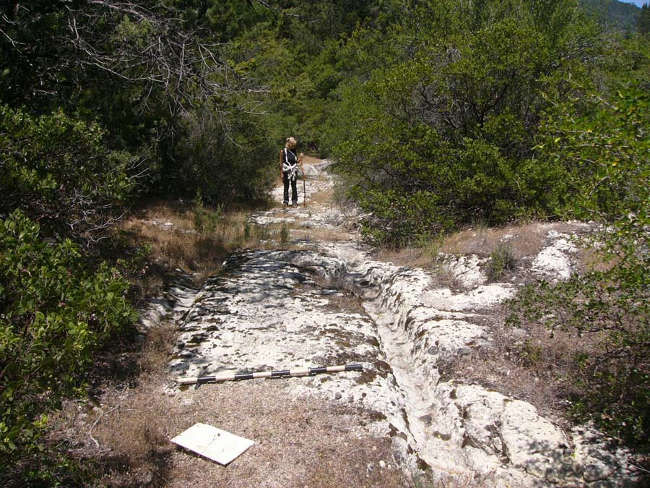
NORTHERN CALIFORNIA – Mercury, which occurs naturally in many parts of California’s Coast Range, was mined during three eras in our region: the Gold Rush for recovering gold flakes (late 1800s), the two world wars for munitions (early- to mid-1900s), and most recently for products such as hearing aids, batteries and fluorescent light bulbs (up to the early 1970s).
We are now left with the legacy of about 80 abandoned mercury mines in the upper Cache Creek and Putah Creek watersheds.
This mining largely pre-dated two important developments: major water projects damming and diverting runoff from the two watersheds, and modern environmental laws. Enterprising miners simply dumped their contaminated waste downhill to be swept away in the next storm. That contaminated material still blankets our landscape.
Today’s mercury problem
Mercury is an odd element: it is liquid at room temperature, yet 13 times denser than water. In nature, mercury is a concern because one form, methylmercury, is extremely toxic to humans and wildlife – one droplet is enough to pollute several Olympic-size swimming pools worth of water.
Today, mercury is a common cause of contaminated waters statewide, including in our local watersheds.
Exposure to methylmercury comes largely from eating fish that have accumulated it through their diets to levels about one million times more concentrated than their water.
The state’s Office of Environmental Health Hazard Assessment has issued several warnings for people to limit their consumption of local fish.
But wait … there’s more! The LNU Lightning Complex Fires are burning around many mine sites. Fire impacts on mercury can vary depending on factors such as the fire’s temperature and the forms of mercury, but much more than usual can be released into the air (vaporized and adsorbed to smoke and ash) and downstream (adsorbed to eroded ash and soil).
A silver lining of fires is that they clear the vegetation, making it easier to identify, access and clean up mine sites.
Tuleyome to the rescue
Tuleyome, a nonprofit organization based in Woodland, is a regional leader in cleaning up abandoned mercury mine sites.
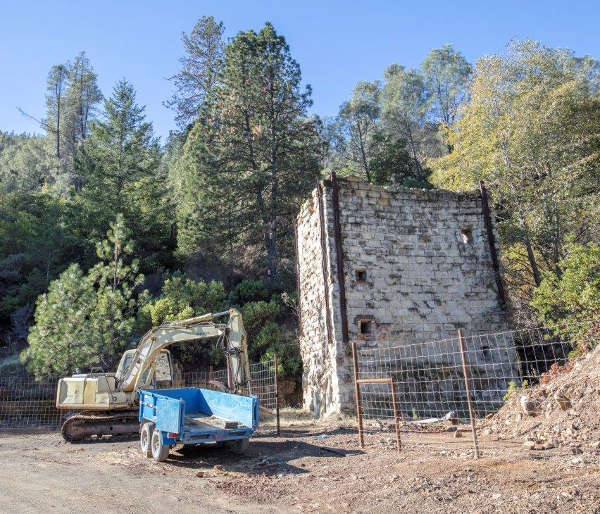
Tuleyome led projects from 2012 to 2019 funded by the California Department of Fish and Wildlife's Ecosystem Restoration Program to clean up the Corona and Twin Peaks mercury mines in northwest Napa County. The site is in the Lake Berryessa watershed, and contributed to high mercury concentrations in fish and fish-eating birds in the streams and lake.
The core project team assembled under Tuleyome’s leadership included many regional experts: soil scientist Vic Claassen from UC Davis, mining geologist Greg Reller of Burleson Consulting in Folsom, general contractor Justin Smith from Middletown, attorney Michael Lozeau of Lozeau & Drury in Alameda, environmental engineer Peter Green from UC Davis, and chemist Tim Tsukamoto of TKT Consulting in Reno, Nevada.
As a “Good Samaritan,” Tuleyome worked with regulators to address the many environmental laws governing abandoned mine sites. The project team spent many hours studying the site’s cultural history, plants and animals.
Those efforts allowed the team to most effectively make the site safer, revegetate barren hillsides, and treat acidic drainage water. Researchers continue to study the bacteria found in the mine drainage water for their ability to thrive in such harsh conditions.
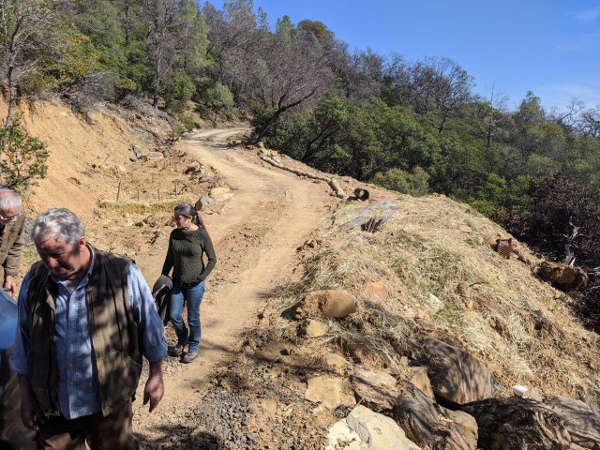
Tuleyome also recently completed a project funded by Napa County’s Lake Berryessa Watershed Improvement Program to improve nearly three miles of Oat Hill Mine Road, which passes by several mercury mines (including Corona and Twin Peaks).
The road, first constructed in 1867 for stagecoaches, ran into disrepair when the alternative toll road became a free public highway in 1924 and large-scale mining operations along the roadway ceased.
Most culverts were undersized and improperly installed, frequently failing during heavy rains. After culverts plugged, runoff flowed down the dirt road, scouring channels and washing away berms.
Tuleyome’s project team designed and constructed durable road improvements to reduce erosion (of mercury-rich sediment) and localized flooding, leading to better water quality downstream and access to the mine sites and road network.
This project also supported the planned Napa County Open Space Trail System and public primitive campground, potentially connecting to the popular Oat Hill Mine Trail.
What’s next?
Regional water managers recently completed a project to identify and prioritize all of our region’s mercury mine sites, and then to conduct detailed site assessments and produce cleanup plans for a select few. Several stakeholders are now considering how to address those sites.
Tuleyome is also proposing to improve roads in a designated off-highway vehicle use area near Knoxville (in the Lake Berryessa watershed and beside a UC Davis reserve).
As for the recent road improvement project, these planned efforts will reduce mercury-laden soil erosion from contaminating local waterways and the lake.
For more information, visit www.tuleyome.org/projects/mercury-mine-remediation-program.
Stephen McCord is president of McCord Environmental, based in Davis, California. As a registered professional engineer, he has more than 25 years of consulting, research and teaching experience in the environmental engineering field throughout the US and internationally. Dr. McCord has managed Tuleyome’s mercury cleanup projects since 2011. Tuleyome is a nonprofit, nonpartisan organization that engages in advocacy and active stewardship with diverse communities to conserve, enhance, restore and enjoy the lands in the region.
- Details
- Written by: Lake County News reports
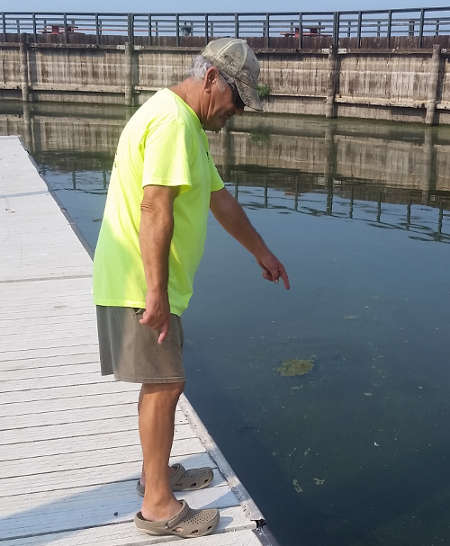
LAKE COUNTY, Calif. – Users of Clear Lake are advised to use extra caution when operating motorboats around shallow waters and near the shores of Clear Lake during the fall and winter months due to submerged debris near the lake’s surface.
Due to low water levels, submerged debris such as rocks, trees, sediments and other objects can cause significant damage if hit or come in contact with boats operating at normal to significant speed.
Lake County Water Resources Department advises boaters to maintain a safe speed and keep a clear line of vision ahead of their vessel, especially in the shallow areas and shoreline of the lake.
The Water Resources Department, in coordination with Lake County Marine Patrol, actively monitors and identifies submerged hazardous debris as lake levels drop.
However, this is an ongoing process and boaters should remain aware of their surroundings and maintain a safe speed when in and around Clear Lake’s shallow waters and shoreline.
For questions regarding this topic, or to report in-lake hazards such as debris or missing or found hazard buoys, please contact the Water Resources Department at 707-263-2344.
- Details
- Written by: Lake County News reports
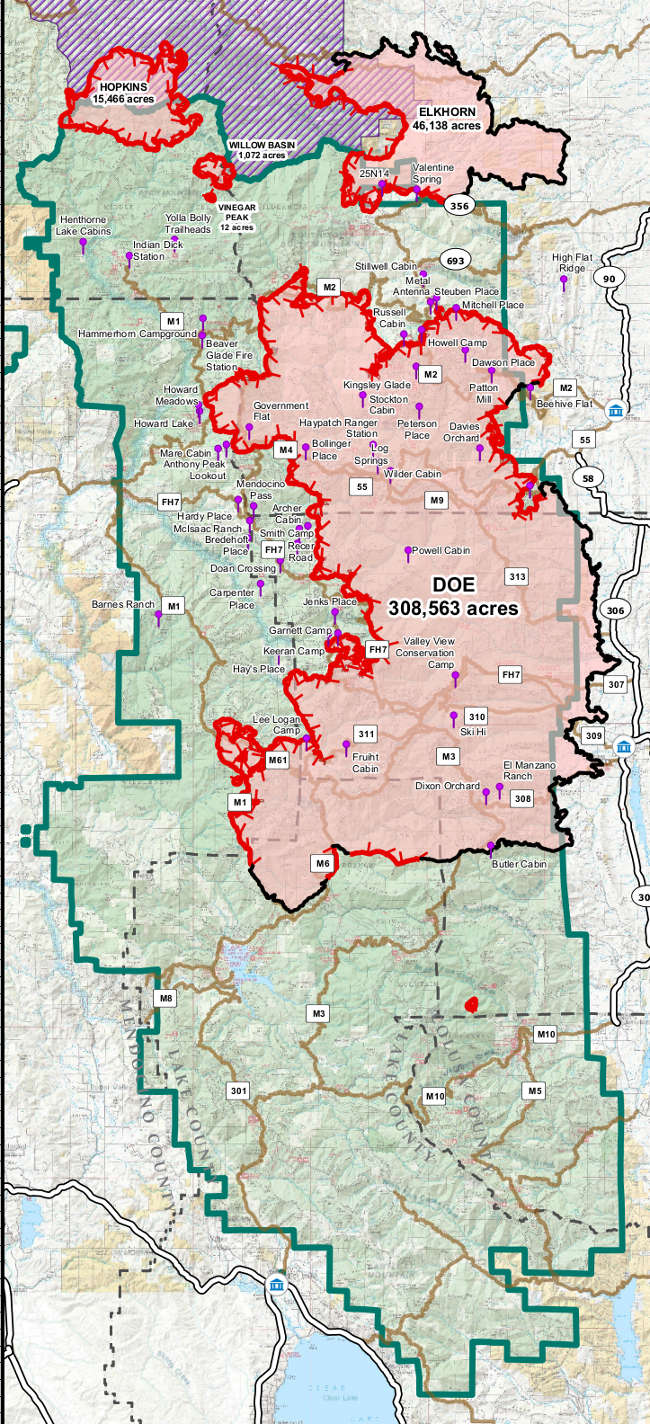
The US Forest Service said the August Complex in the Mendocino National Forest reached 325,172 acres and 24 percent containment on Sunday.
The Hull, Doe, Tatham, and Glade fires have merged to form one large fire, officials said.
There are 1,070 resources committed to the complex, including 22 crews, four camp crews, seven helicopters, 53 engines, 20 dozers, 32 water tenders, and two masticators.
Due to high temperatures and gusty winds, the potential for rapid fire spread throughout the complex will continue today through Tuesday, officials said. Temperatures could range from the mid-90s on the ridges to 110 degrees in the valleys.
A spot fire moved beyond the containment line in the Buck Rock area moving west towards an old burn scar. The Forest Service said crews will continue to contain and mop up the spot.
Firefighters were assisted with air operations dropping water from C-130 tankers and helicopters Saturday on the Hopkins fire, which is 15,466 acres and 10-percent contained, officials said.
The Forest Service said firefighters continue to use old burn scars and road systems in burnout operations, working along Rainbow Ridge with crews and heavy equipment, and air support.
Air operations also supported work in the areas around the M1 Road near the northwest corner of the Hull fire. Officials said a spot crossed the line during a burnout operation on Saturday. Fire retardant was used to cool down the area and hand crews worked to mop up the spot fire. That work continued on Sunday.
The burnout operations near Mendocino Pass to the west side of the Doe fire were successful and stayed within containment lines, officials said. Crews are also conducting burnout operations around the Mitchell Place on the north end of the Complex.
The Forest Service said crews are performing these operations in anticipation of potential rapid fire spread in the coming days. The burnout operations are aimed at slowing or stopping the fire as it reaches predetermined areas.
Mendocino National Forest officials updated the area closure for the August Complex on Sept. 5. The Forest Order 08-20-12 and map are posted on the forest website.
Daily updates and the virtual community meeting can be found on the Mendocino National Forest Facebook page.
The most up to date information on the August Complex can be found on InciWeb.
- Details
- Written by: Elizabeth Larson
The National Weather Service issued the fire weather watch, which is in effect from 10 p.m. Monday through 8 a.m. Wednesday.
A fire weather watch means that critical fire weather conditions are forecast to occur, the National Weather Service said.
The forecast calls for a prolonged period of hot and dry conditions that began this weekend and will continue into early next week.
The National Weather Service said that period will be followed by the potential for strong north to northeast winds on area ridges from Monday evening through Wednesday morning, with wind speeds estimated to be between 20 and 30 miles per hour, and gusts as high as 40 miles per hour.
These winds would primarily impact Lake County and extreme eastern portions of Mendocino and Trinity counties, based on the forecast.
Strong winds combined with low relative humidity values of between 10 and 15 percent on Tuesday afternoon with poor overnight recoveries in the 25- to 40-percent range could result in critical fire weather conditions, the National Weather Service said.
Forecasters said those conditions meant that any new fires that develop will likely spread rapidly.
At the same time, an excessive heat warning is in effect in Lake County and across the state through Tuesday at 6 p.m. due to temperatures topping the century mark.
Compounding the situation for Lake County is a continuing air quality alert that’s in effect through 10 p.m. Monday.
The Lake County Air Quality Management District issued the alert due to smoky and hazy conditions from the LNU Lightning Complex, which is nearly full containment, and the August Complex, which continues to grow in the Mendocino National Forest.
Local air quality conditions can be tracked here.
A fire and smoke map can be found here.
Email Elizabeth Larson at