 How to resolve AdBlock issue?
News
- Details
- Written by: Lake County News reports
The grid operator declared a Stage 2 Emergency just before 6 p.m. Sunday when a transmission line from Oregon reduced capacity by 900 megawatts due to the heat. At the same time, generation totaling 260 megawatts tripped offline.
Conservation helped grid operators overcome those challenges and avoid rotating power outages.
“Consumer action to conserve energy tonight was key to helping us keep power flowing throughout the state,” said Eric Schmitt, ISO’s vice president of operations. “We recognize the sacrifice that consumers make in conserving energy during these very hot conditions, and appreciate their contribution.”
The ISO issued a Flex Alert to urge consumers to conserve energy during this statewide heatwave that’s driving up energy consumption.
The Flex Alert will be reissued on Monday, with conservation needed again from 3 p.m. to 9 p.m., the ISO said.
Consumers are urged to conserve electricity when the grid is most stressed in the afternoons and evenings, when temperatures remain high and solar production is falling due to the sun setting.
Between 3 p.m. and 9 p.m., the ISO is urging consumers to:
– Set air conditioning thermostats to 78 degrees, if health permits.
– Defer use of major appliances.
– Turn off unnecessary lights.
– Unplug unused electrical devices.
– Close blinds and drapes.
– Use fans when possible.
– Limit time the refrigerator door is open.
Consumers can also take steps to prepare for the Flex Alert by doing the following before 3 p.m.:
– “Pre-cool” their homes, or lower air conditioning thermostats.
– Charge electric vehicles.
– Charge mobile devices and laptops.
– Run dishwashers, washing machines and other major appliances.
– Set pool pumps to run in the early morning or late at night.
Temperatures on Monday will continue to be hot throughout the western US. The ISO is also monitoring numerous wildfires that may impact electrical lines.
For information on Flex Alerts, and to get more electricity conservation tips, visit the ISO’s Flex Alert website.
- Details
- Written by: ESTHER OERTEL
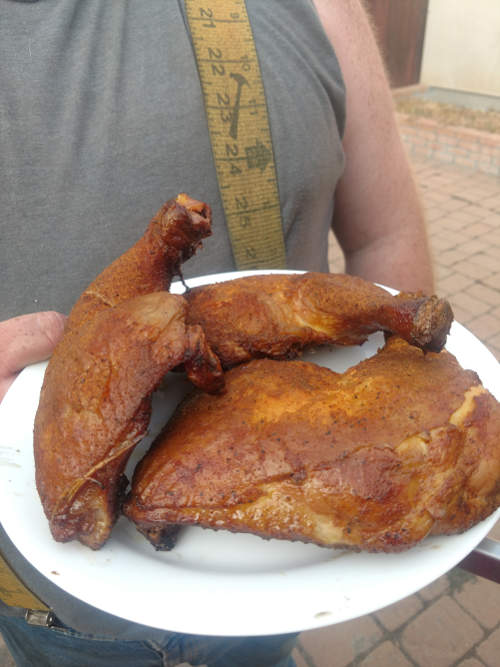
LAKE COUNTY, Calif. – Many an American will be firing up the grill this Labor Day weekend. While today’s methods of cooking over fire can be quite sophisticated, the act of grilling is almost as old as humankind itself.
Before we go any further, it should be noted that there is a difference between grilling and barbecuing. The words are sometimes used interchangeably, but technically grilling is cooking at a high temperature directly over flame or another heat source (hot coals, for example).
Barbecue, on the other hand, is a low and slow method of cooking that utilizes indirect heat and smoke. The longer cooking time at a lower temperature allows the smoke to permeate and flavor what’s being cooked.
To take it a step further, smoking is a method similar to barbecue, but the temperature is even lower, typically under 225 degrees Fahrenheit, and the cook time is longer.
Now on to the history of grilling.
When our ancestors were able to tame fire, it changed the course of human evolution. Fire provided light on dark nights and a means to cook food, it warded off predators, and its warmth allowed humans to migrate to colder climates.
Up until recently, the oldest hard evidence of man using fire was found at Qesem Cave in Israel and dates to more than 300,000 years ago.
In April 2012, however, archaeologists found evidence of campfires that could have burned a million years ago. Charred bones and the ashy remains of plants were found at Wonderwerk Cave in South Africa, a dwelling place for humans and our ancestors for more than two million years.
The sharp edges on the bones and the excellent preserved state of the plant ash indicated that they would have been burned in the cave, rather than in a wildfire, as being blown into the cave by the wind would have blunted the bones and damaged the plant matter.
The discovery rekindled a controversy that’s been smoldering for decades. Could cooking over fire have allowed our ancestors to take in more calories, contributing to an increase in brain size? This theory of human origins is called the “cooking hypothesis.” Not all archaeologists agree, and other factors are cited as contributors to brain growth.
Either way, one thing is certain: cooking with fire and smoke make for some great tasting fare!
Let’s fast forward from a million years ago to a more familiar era: the 1940s.
During World War II, the U.S. government asked the Coleman Co. of Wichita, Kansas to develop a compact stove for military use.
The parameters were that the stove had to be lightweight for easy carrying, no bigger than a quart-sized bottle, able to operate in extreme temperatures (from -60 to +125 degrees Fahrenheit), and able to burn any type of fuel.
The result was the G.I. Pocket Stove, which was developed in only 60 days.
The stove was a hit among the soldiers and served the military well during the war. A side benefit was that it reintroduced the idea of outdoor cooking to the troops, perhaps contributing to the enthusiasm for backyard grilling in the post war era.
In the midst of post-war affluence and the resulting baby boom, people flocked to the suburbs from cities and rural areas. The same G.I.s who had used the Pocket Stove during wartime now had growing families and backyards, and a national obsession with backyard grilling was born.
The grills in most backyards at that time were not particularly sophisticated. They consisted of a place for charcoal with a raised grill grate above it, and the process was vulnerable to the elements, such as wind, which could affect the flame and therefore cooking temperature.
Enter George Stephen, a salesman for the Weber Brothers Metal Works in Chicago, who in 1952 decided he was going to make a better grill. Inspired by the shape of the round metal buoys made by the company at that time, he tweaked one and transformed it into a simple version of what we now know as a kettle grill.
A few well-placed holes and a removable top transformed the way a nation grilled.
Gas grills weren’t far behind, with the Chicago Combustion Co. producing a portable gas grill in 1954.
Now a word about fuel. The fuel of choice for barbecuing is wood, which is also used in smoking, though some smokers are designed to use pellets.
With grilling, it’s typically gas or charcoal. While wood charcoal has been around since ancient times, it was a man named Ellsworth B. A. Zwoyer who in 1897 invented and patented the charcoal briquet, a form of fuel designed for easier use in grills.
In 1919, Henry Ford of car assembly line fame further popularized Zwoyer’s invention by using wood and sawdust byproducts from automobile manufacturing to mass produce briquets. His colleague Edward Kingsford assisted him in this process and an industry was born.
These days there are a plethora of ways to grill, barbecue or smoke food, with ever advancing technology to make things easier, or at least fancier. Even so, we must give a nod of thanks to our human ancestors for blazing a trail by igniting the grilling fire a million years ago.
Today’s recipe is for barbecue beans made on the grill a la Bob Oertel, my oldest son. I thank him for sharing his methods with us!
Bob’s Barbecued Beans (they’re delicious!)
Use a pot that can withstand the heat of a grill, such as one that’s oven safe. Bob uses an aluminum Dutch oven.
Ingredients:
Olive oil for the pot
1 diced onion, any color
1 diced bell pepper, any color
A couple of Mexican peppers of your choice, such as jalapeno, Anaheim, or poblano, diced (use a jalapeno pepper or two if heat is desired)
A couple of garlic cloves, minced, or a spoonful of jarred minced garlic
4 cans of assorted beans, drained (Bob likes to use one can each of kidney and black beans, plus two cans of pinto beans)
1 regular sized bottle of barbecue sauce
1 can beer, any type
Seasonings to your liking, such as Italian seasoning, garlic salt, dehydrated onion, black pepper, smoked paprika, or pre-made barbecue rub (Bob likes to use them all)
½ cup brown sugar
¼ cup molasses if you’ve got it
4 strips bacon, cooked and chopped
Procedure:
Place the pot with olive oil on the grill over indirect heat (meaning hot coals on the opposite side of the grill).
Heat olive oil, then add onions and peppers and cook until soft, stirring occasionally.
Add garlic and stir, cooking until soft (be careful not to burn).
Add beans, barbecue sauce, beer, seasonings, brown sugar, molasses, and bacon; stir to combine.
Cook for 2 to 3 hours until liquid is mostly reduced and the flavors permeate beans.
Stir occasionally to prevent burning.
This makes about eight hearty side dish servings.
Notes:
Be sure not to use a pot that’s Teflon coated or has plastic handles.
Beer may be replaced with a juice, such as apple or orange.
Bacon may be cooked on the grill before chopping and adding (see below).
Leftover grilled or barbecued meat may be added. (For example, if Bob makes these beans on a Sunday, he might add leftover pulled pork, tri tip, sausage or chicken that he barbecued or grilled on Friday or Saturday.)
If you want lots of heat, keep the seeds in the jalapenos.
How Bob cooks bacon on the grill:
There’s no need to grease the grill if it’s seasoned. (If not, spray a little grilling oil, such as Pam, on it.)
Lay bacon strips on the grill over indirect heat.
Depending on the temperature, the bacon may take 20 to 30 minutes to cook on a kettle grill. (If using a low temperature smoker, it can take up to an hour and a half.)
Flip bacon three to four times during the process.
Note: Do not cook over direct heat as dripping grease can cause flare-ups.
Esther Oertel is a writer and passionate home cook from a family of chefs. She grew up in a restaurant, where she began creating recipes from a young age. She’s taught culinary classes in a variety of venues in Lake County and previously wrote “The Veggie Girl” column for Lake County News. Most recently she’s taught culinary classes at Sur La Table in Santa Rosa, Calif. She lives in Middletown, Calif.
- Details
- Written by: Lake County News reports
California Biodiversity Day, held Sept. 7 of each year, is an opportunity to celebrate the unique diversity of living things found in our state and encourage actions to protect them. This year’s celebration coincides with Labor Day.
Although physical distancing restrictions and other COVID-19 precautions have prevented California Department of Fish and Wildlife ecological reserves and wildlife areas from planning the "open house" style celebrations that were hosted last year, where large groups of people could gather, CDFW staff across the state have created a roster of ways – both virtual and outdoors – for Californians to explore and learn about the biodiversity found on state lands.
A master list of California Biodiversity Day events can be found here.
This year's virtual events, self-guided tours and outdoor opportunities lend themselves to physical distancing. The events will be held over the course of a week, through Sept. 13.
A sampling of California Biodiversity Day 2020 events, many of which feature the use of the free iNaturalist app, include the following:
– Take one of the many self-guided tours available at CDFW properties throughout the state. Use the iNaturalist app to learn and document any plants, animals or other organisms you encounter while exploring CDFW ecological reserves and wildlife areas.
– Challenge yourself with a self-guided bioblitz at Old Town San Diego State Historic Park. Contribute observations of organisms spotted while exploring the park through Sept. 13.
– Play along in the bioblitz competition between Prairie Creek Redwoods State Park and Humboldt Redwoods State Park. Support your favorite park in their quest to log the highest number of bioblitz participants.
– Play California Biodiversity Bingo. Download the California Academy of Science's bingo card and see if you can find enough common species in your backyard or neighborhood to make a bingo.
– Challenge your family to with a bioblitz at the greater Mono Lake area, including Lee Vining Canyon and Lundy Canyon. Share what you see, from bird nests to scat samples.
– Get ideas for kid-friendly activities on the Santa Cruz Museum of Natural History's website. Learn about ways to engage kids at home in exploring and learning about biodiversity.
– Venture out on a virtual scavenger hunt at the Nimbus Fish Hatchery. Walk along the Discovery Trail and try to find as many of the species on the list as you can.
Visit the website for a full list of events and details.
All proposed in-personal activities will take place outdoors and involve minimal contact between participants and any staff present, with an observed minimum physical distance of 6 feet from individuals from different households observed by all.
- Details
- Written by: Elizabeth Larson
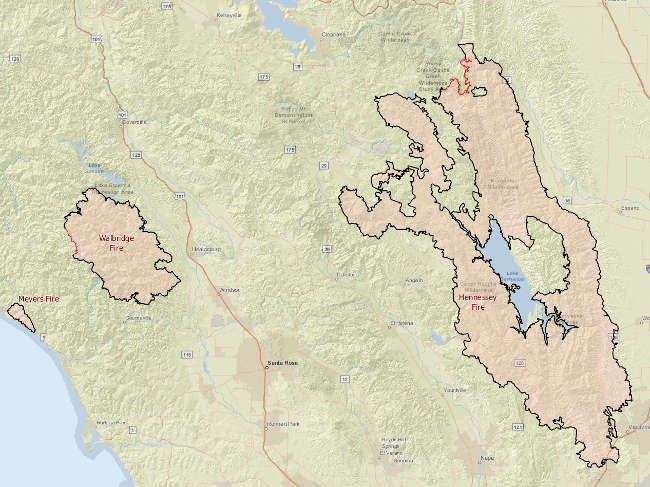
LAKE COUNTY, Calif. – Containment continues to edge upward on the LNU Lightning Complex as more than 1,600 firefighters remain assigned to the incident.
For nearly a week, the complex has remained at 375,209 acres, with firefighters strengthening lines and increasing containment daily. On Saturday evening, the containment had risen to 89 percent.
On the east side of the complex in Colusa, Lake, Napa, Solano and Yolo counties, containment on the 317,909-acre Hennessey fire was up to 89 percent, Cal Fire said.
To the west in Sonoma County, Cal Fire said the Walbridge fire west of Healdsburg is at 54,940 acres and 95 percent containment. The 2,360-acre Meyers fire north of Jenner was fully contained last week.
Cal Fire said resources assigned on Saturday night included 1,674 firefighters, 125 engines, 40 water tenders, six helicopters, 39 hand crews and 36 dozers.
Approximately 1,350 structures remain threatened, Cal Fire said. The number of structures destroyed and damaged, 1,491 and 232, respectively, has not changed.
Numerous evacuation warnings remain in effect in repopulated areas throughout the fire area, including in southern Lake County, in and around Lower Lake and Middletown, according to Cal Fire.
Officials said they are monitoring the hot and dry weather conditions forecast for the weekend.
Email Elizabeth Larson at