 How to resolve AdBlock issue?
News
- Details
- Written by: Elizabeth Larson
Dogs available for adoption this week include mixes of border collie, Chihuahua, German Shepherd, Great Pyrenees, husky, Labrador Retriever, Papillon and pit bull.
Dogs that are adopted from Lake County Animal Care and Control are either neutered or spayed, microchipped and, if old enough, given a rabies shot and county license before being released to their new owner. License fees do not apply to residents of the cities of Lakeport or Clearlake.
The following dogs at the Lake County Animal Care and Control shelter have been cleared for adoption (additional dogs on the animal control Web site not listed are still “on hold”).
Call Lake County Animal Care and Control at 707-263-0278 or visit the shelter online at http://www.co.lake.ca.us/Government/Directory/Animal_Care_And_Control.htm for information on visiting or adopting.

Female Labrador Retriever
This female Labrador Retriever has a short black coat with white markings.
She is in kennel No. 8, ID No. 14073.

Male Chihuahua
This male Chihuahua has a short tan coat.
He is in kennel No. 11, ID No. 14094.

Male Papillon-Chihuahua
This male Papillon-Chihuahua mix has a medium-length tan and white coat.
He is in kennel No. 19, ID No. 14084.

German Shepherd Dog-Labrador Retriever mix
This young male German Shepherd Dog-Labrador Retriever mix has a short tan coat.
He is in kennel No. 21, ID No. 14085.

Male pit bull
This male pit bull has a short brown coat.
He is in kennel No. 22, ID No. 14066.

Male Great Pyrenees
This male Great Pyrenees has a long white coat.
He is in kennel No. 24, ID No. 14077.

Male border collie
This young male border collie has a short black and white coat.
He is in kennel No. 27, ID No. 14052.

Male husky-German Shepherd Dog
This young male husky-German Shepherd Dog has a medium-length cream and black coat.
He is in kennel No. 29, ID No. 14097.

‘Layla’
“Layla” is a female Labrador Retriever-pit bull mix.
She has a short black and white coat and has been spayed.
She’s in kennel No. 30, ID No. 14079.

‘Max’
“Max” is a male pit bull terrier mix with a short tan coat.
He has been neutered.
He’s in kennel No. 31, ID No. 14078.
Email Elizabeth Larson at
- Details
- Written by: Francis Reddy
Familiar stars shine, nebulae glow, and nearby galaxies tantalize in a new panorama of the northern sky assembled from 208 pictures captured by NASA’s Transiting Exoplanet Survey Satellite, or TESS.
The planet hunter imaged about 75 percent of the sky in a two-year-long survey and is still going strong.
TESS has discovered 74 exoplanets, or worlds beyond our solar system. Astronomers are sifting through some 1,200 additional exoplanet candidates, where potential new worlds await confirmation. More than 600 of these candidates lie in the northern sky.
TESS locates planets by simultaneously monitoring many stars over large regions of the sky and watching for tiny changes in their brightness.
When a planet passes in front of its host star from our perspective, it blocks some of the star’s light, causing it to temporarily dim. This event is called a transit, and it repeats with every orbit of the planet around the star. This technique has proven to be the most successful planet-finding strategy so far, accounting for about three-quarters of the nearly 4,300 exoplanets now known.
The data collected also allow for the study of other phenomena such as stellar variations and supernova explosions in unprecedented detail.
The northern mosaic covers less of the sky than its southern counterpart, which was imaged during the mission’s first year of operations.
For about half of the northern sectors, the team decided to angle the cameras further north to minimize the impact of scattered light from Earth and the Moon. This results in a prominent gap in coverage.
TESS map of the northern sky
The northern panorama represents only a glimpse of the data TESS has returned. The mission splits each celestial hemisphere into 13 sectors. TESS imaged each sector for nearly a month using four cameras, which carry a total of 16 sensors called charge-coupled devices, or CCDs.
During its primary mission, the cameras captured a full sector of the sky every 30 minutes. This means each CCD acquired nearly 30,800 full science images.
Adding in other measurements, TESS has beamed back more than 40 terabytes so far – equivalent to streaming some 12,000 high-definition movies.
Remarkably, these numbers will rise sharply over the next year. TESS has now begun its extended mission, during which it will spend another year imaging the southern sky. The satellite will revisit planets discovered in its first year, find new ones, and fill in coverage gaps from its initial survey.
Improvements to the satellite’s data collection and processing now allow TESS to return full sector images every 10 minutes and measure the brightness of thousands of stars every 20 seconds – all while continuing its previous strategy of measuring the brightness of tens of thousands of stars every two minutes.
“These changes promise to make TESS’s extended mission even more fruitful,” said Padi Boyd, the mission’s project scientist at NASA’s Goddard Space Flight Center in Greenbelt, Maryland. “Making high-precision measurements of stellar brightness at these frequencies makes TESS an extraordinary new resource for studying flaring and pulsating stars and other transient phenomena, as well as for exploring the science of transiting exoplanets.”
TESS is a NASA Astrophysics Explorer mission led and operated by MIT in Cambridge, Massachusetts, and managed by NASA's Goddard Space Flight Center. Additional partners include Northrop Grumman, based in Falls Church, Virginia; NASA’s Ames Research Center in California’s Silicon Valley; the Harvard-Smithsonian Center for Astrophysics in Cambridge, Massachusetts; MIT’s Lincoln Laboratory; and the Space Telescope Science Institute in Baltimore. More than a dozen universities, research institutes, and observatories worldwide are participants in the mission.
Francis Reddy works for NASA’s Goddard Space Flight Center in Greenbelt, Maryland.
- Details
- Written by: Elizabeth Larson
On Friday, Lake County Public Health Officer Dr. Gary Pace reported that 28 new cases of COVID-19 had been reported countywide, bringing the total to 628.
That’s the second-largest single-day increase in cases reported in Lake County since cases began to be confirmed locally in April, based on a review of data publicly reported by Lake County Public Health.
Pace said late this week Public Health also received word of the county’s 13th COVID-19-related death.
“The individual was over 65 years old and had longstanding health issues,” he said.
This most recent death is connected to an outbreak at a second skilled nursing facility where there are 27 residents who have been infected along with nine staff, Pace said.
Pace did not name the facility, but the California Department of Public Health’s COVID-19 dashboard for skilled nursing facilities indicated the second facility is Rocky Point Care Center in Lakeport.
A previous outbreak at Lakeport Post Acute resulted in 37 residents getting the virus and 22 staff, with seven residents dying, according to state and local reports.
That initial outbreak, along with community spread, coincided with – and contributed to – a surge in new cases in Lake County, peaking at 78 during the week of Sept. 13 to 19. Pace said evacuations from the LNU Complex fires and Labor Day weekend activities were additional complicating factors.
Pace said the outbreak at Lakeport Post Acute is now under control, with no new cases in 10 days.
Meadowood Nursing Center in Clearlake has no reported cases in residents, and less than 11 in health care workers, the state reported.
On Friday, CDPH said 26,456 residents of California’s 1,223 skilled nursing facilities had tested positive for COVID-19 and 4,557 had died, while 19,989 health care workers in those facilities had contracted the virus, with 152 of them dying.
Statewide, county Public Health departments reported more than 849,000 total cases and just over 16,500 deaths due to COVID-19 as of Friday night.
The state said local health departments have reported 40,758 positive cases in health care workers and 191 deaths statewide.
As of Friday, 15,736,497 tests have been conducted in California, an increase of 112,874 over the prior 24-hour reporting period, the state said.
Pace said it’s predicted that COVID-19 infections will increase in the coming months, due to flu season, colder weather and indoor activities. He is urging community members to get flu shots.
As for when a COVID-19 vaccine would realistically be available, Pace said, “Likely after the first of the year.”
He added, “Initial supplies will be limited, and probably directed to hospital workers and others at highest risk.”
Once supplies increase – possibly in early spring – the vaccine will start to reach the general public, Pace said.
“There is great hope for some sort of normalcy by summertime 2021; the promise of a vaccine is driving those hopes,” he said.
Email Elizabeth Larson at
- Details
- Written by: Elizabeth Larson
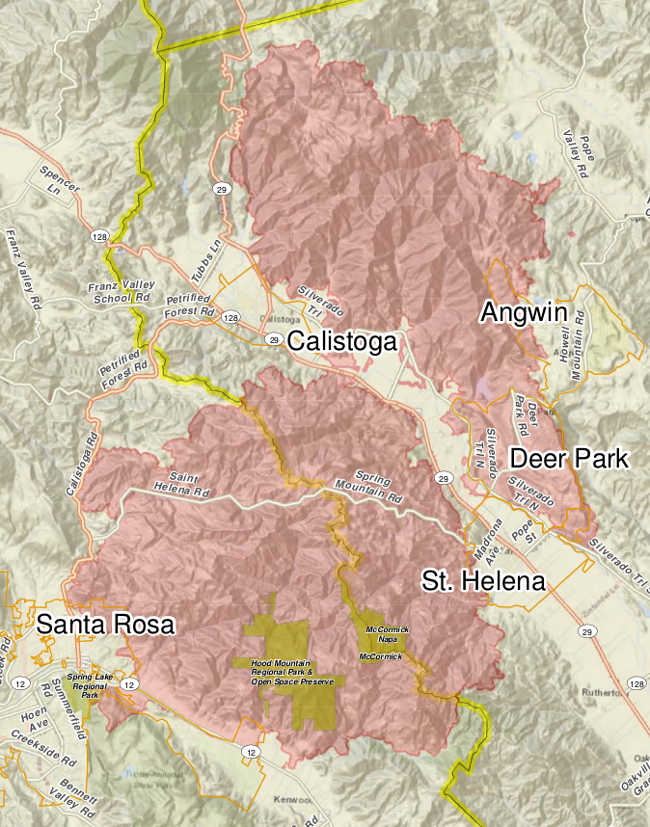
NORTHERN CALIFORNIA – The growth of the Glass fire has stopped while cooler conditions are helping firefighters on the massive August Complex to continue to increase containment.
Cal Fire said the Glass fire remained at 67,484 acres on Friday night, marking the first day of no growth on the incident since it began on Sept. 27 in Napa and Sonoma counties.
Containment also grew several percentage points to 78 percent, Cal Fire said.
Officials said activity on the fire line on Friday was limited to scattered heat signatures and isolated smoldering heavy fuels across the fire area.
With conditions improving, on Friday the evacuation warnings for two areas south of Middletown in Lake County were lifted and a portion of Highway 29 from Middletown to Tubbs Lane was reopened.
Resources continue to be reduced on the fire. On Friday evening, 1,437 personnel remained assigned to the fire, along with 162 engines, 20 water tenders, 10 helicopters, 23 hand crews, 11 dozers and two masticators, Cal Fire reported.
On Friday night, Cal Fire said 2,560 structures remained threatened by the fire.
Cal Fire said the damage inspection has been completed. The final assessment showed that 638 structures have been destroyed in Sonoma County, including 334 single-family homes, while 917 buildings have been destroyed in Napa County, with 308 of them being homes. In addition, 132 structures were damaged in Sonoma County and 150 in Napa County.
Cal Fire continues to anticipate the fire will be fully contained on Oct. 20.
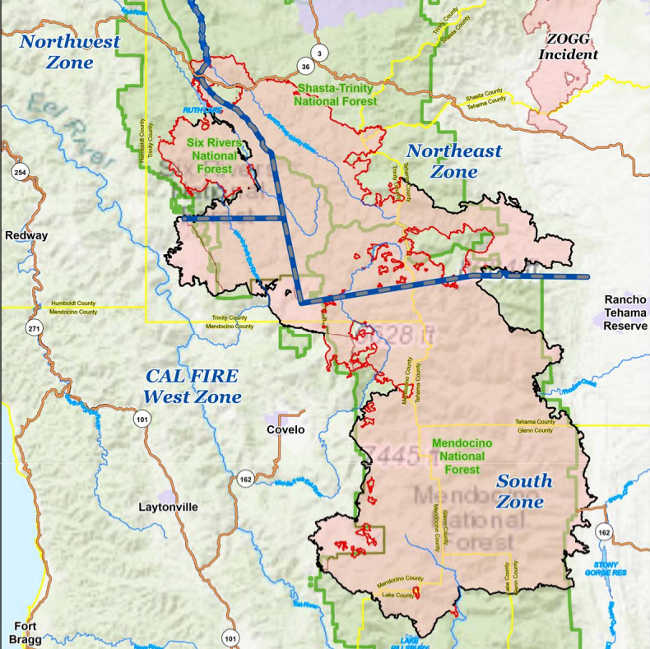
New team takes over August Complex South Zone
On Friday, the Southwest Area Type 1 Incident Management Team No. 1 assumed command of the August Complex South Zone, one of four zones on the complex. The other zones are the Northwest, Northeast and West.
The complex was up to 1,023,629 acres and 67-percent containment on Friday night, Cal Fire said. Approximately 4,524 personnel are assigned.
The US Forest Service said that on Thursday, a helicopter dropped water to support dozers and ground crews as they continued to secure the perimeter and mop-up around a 300-acre slop-over northeast of Lake Pillsbury, over the M6 Road near Bloody Rock.
Cooler temperatures and increased humidity are helping reduce fire activity, officials said. Pockets of heat within the fire’s perimeter are expected to continue to smolder. Firefighters will continue to mop up, monitor and patrol along the firelines.
The Forest Service said firefighters are currently assessing suppression repair needs. Suppression repair is a series of immediate post-fire actions taken to repair damages and minimize potential soil erosion and impacts resulting from fire suppression activities.
This work repairs the hand and dozer fire lines, roads, trails, staging areas, safety zones, and drop points used during fire suppression efforts.
For more information on the three phases of wildfire recovery visit this page.
Officials said the No. 1 priority remains firefighter and public safety. They asked that weekend travelers please be cautious while traveling on roads and highways as firefighters and equipment are working in the area.
The August Complex is expected to be fully contained Nov. 15, the Forest Service reported.
Email Elizabeth Larson at