 How to resolve AdBlock issue?
News
- Details
- Written by: Elizabeth Larson
The council honored Richard Bean, who stepped down effective Sept. 30, at its meeting on Oct. 1.
Bean joined the commission in March 2017. He’s the retired pastor of Clearlake Church of the Nazarene and a longtime Lake County resident.
Mayor Russ Cremer commended Bean for his efforts. “You’ve always given your all.”
Bean thanked the council for recognizing him, noting he was very humbled by it as all as by the confidence they placed in him.
He said he tried his best to make the city a better place in which to live and commended the council for its efforts to do the same.
While he said he hated to leave the commission, it was necessary for him to do.
Vice Mayor Dirk Slooten, who along with Cremer served with Bean on the planning commission before his election to the city council, said it was always a pleasure working with Bean.
The rest of the council also offered their thanks, as did City Manager Alan Flora, who said Bean was great to work with and that, even when he disagreed on a topic, he shared his opinions honestly and tactfully.
Bean said he loves the city of Clearlake and raised his family there. He’s lived there going back to the time the city was incorporated in 1980.
“My heart is here,” he said, adding that he is so thankful to see the progress that’s been made over the last five to six years.
Later in the meeting, the council interviewed via Zoom two candidates to succeed Bean on the council, Michael McKeown and Fawn Williams.
After interviewing both at length, with each sharing their ideas and backgrounds, the council voted to select Williams as the city’s next planning commissioner.
Williams, a 31-year Clearlake resident, previously worked in the finance and mortgage industry, and since January 2003 has owned and operated Show Dressed Up, making custom women’s and girl’s clothing for wearing in competitions for Western pleasure, horsemanship and showmanship.
She’s also a member of Soroptimist International of Clear Lake and is a volunteer and past board member of SPCA of Lake County.
After the vote, McKeown offered Williams his congratulations. “You did fantastic.”
Cremer congratulated Williams, who had applied for the commission once previously.
“The work is going to start now,” said Cremer. “We’ve got a lot of things ahead of us, a lot of important projects coming up, so you are going to be busy.”
“I’m just really excited to get started and to be a part of some of the decisions that are going to help make Clearlake a better place,” Williams said.
Email Elizabeth Larson at
- Details
- Written by: Malinda Maynor Lowery, University of North Carolina at Chapel Hill
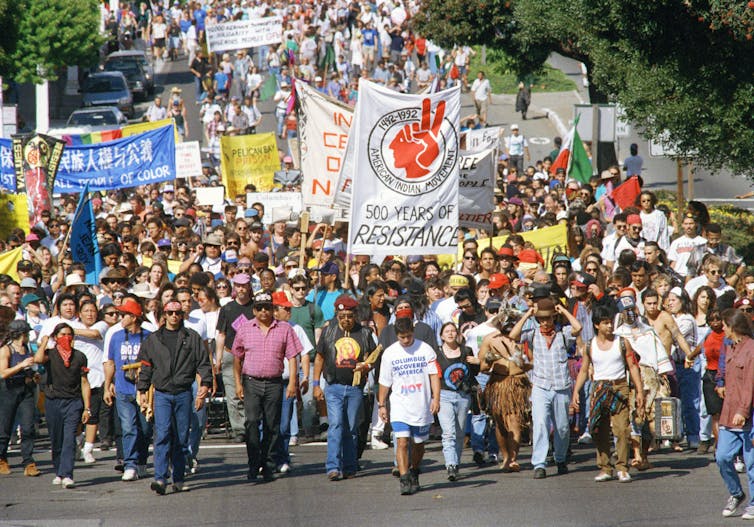
Increasingly, Columbus Day is giving people pause.
More and more towns and cities across the country are electing to celebrate Indigenous Peoples Day as an alternative to – or in addition to – the day intended to honor Columbus’ voyages.
Critics of the change see it as just another example of political correctness run amok – another flash point of the culture wars.
As a scholar of Native American history – and a member of the Lumbee Tribe of North Carolina – I know the story is more complex than that.
The growing recognition and celebration of Indigenous Peoples Day actually represents the fruits of a concerted, decades-long effort to recognize the role of indigenous people in the nation’s history.
Why Columbus?
Columbus Day is a relatively new federal holiday.
In 1892, a joint congressional resolution prompted President Benjamin Harrison to mark the “discovery of America by Columbus,” in part because of “the devout faith of the discoverer and for the divine care and guidance which has directed our history and so abundantly blessed our people.”
Europeans invoked God’s will to impose their will on indigenous people. So it seemed logical to call on God when establishing a holiday celebrating that conquest, too.
Of course, not all Americans considered themselves blessed in 1892. That same year, a lynching forced black journalist Ida B. Wells to flee her home town of Memphis. And while Ellis Island had opened in January of that year, welcoming European immigrants, Congress had already banned Chinese immigration a decade prior, subjecting Chinese people living in the U.S. to widespread persecution.
And then there was the government’s philosophy towards the country’s Native Americans, which Army Colonel Richard Henry Pratt so unforgettably articulated in 1892: “All the Indian there is in the race should be dead. Kill the Indian in him, and save the man.”
It took another 42 years for Columbus Day to formally become a federal holiday, thanks to a 1934 decree by President Franklin D. Roosevelt.
He was responding, in part, to a campaign by the Knights of Columbus, a national Catholic charity founded to provide services to Catholic immigrants. Over time, its agenda expanded to include advocacy for Catholic social values and education.
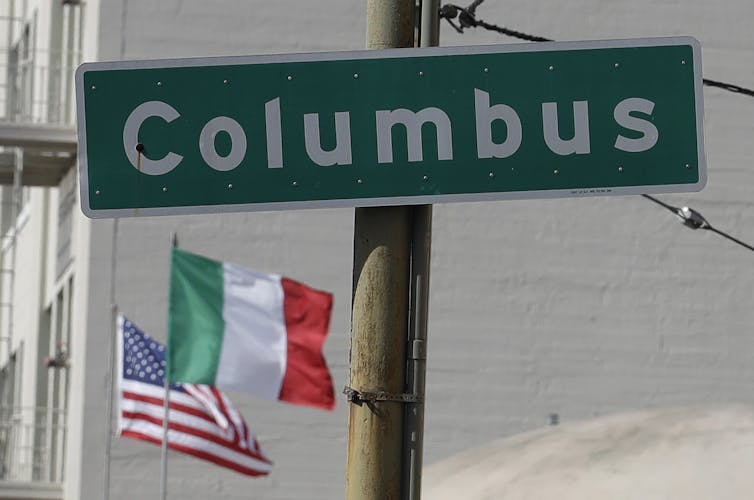
When Italians first arrived in the United States, they were targets of marginalization and discrimination. Officially celebrating Christopher Columbus – an Italian Catholic – became one way to affirm the new racial order that would emerge in the U.S. in the 20th century, one in which the descendants of diverse ethnic European immigrants became “white” Americans.
Indigenous people power
But some Americans started to question why Indigenous people – who’d been in the country all along – didn’t have their own holiday.
In the 1980s, Colorado’s American Indian Movement chapter began protesting the celebration of Columbus Day. In 1989, activists in South Dakota persuaded the state to replace Columbus Day with Native American Day. Both states have large Native populations that played active roles in the Red Power Movement in the 1960s and 1970s, which sought to make American Indian people more politically visible.
Then, in 1992, at the 500th anniversary of Columbus’ first voyage, American Indians in Berkeley, California, organized the first “Indigenous Peoples’ Day,” a holiday the city council soon formally adopted. Berkeley has since replaced its commemoration of Columbus with a celebration of indigenous people.
The holiday can also trace its origins to the United Nations. In 1977, indigenous leaders from around the world organized a United Nations conference in Geneva to promote indigenous sovereignty and self-determination. Their first recommendation was “to observe October 12, the day of so-called ‘discovery’ of America, as an International Day of Solidarity with the Indigenous Peoples of the Americas.” It took another 30 years for their work to be formally recognized in the United Nations Declaration on the Rights of Indigenous Peoples, which was adopted in September 2007.
Unexpected allies
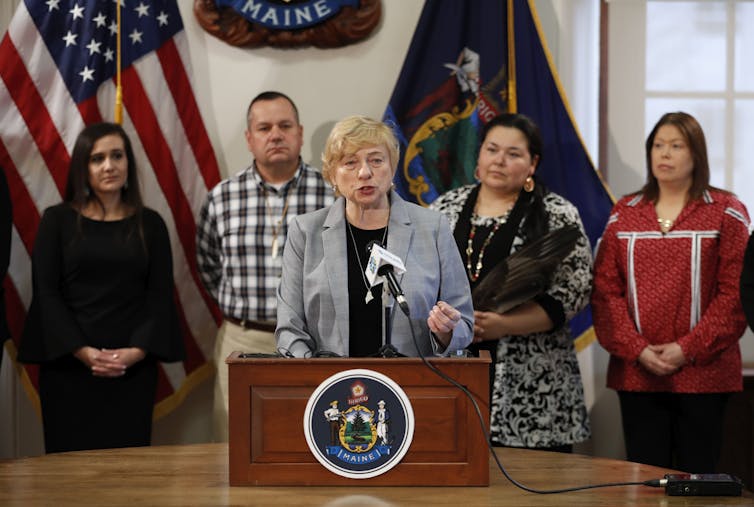
Today, cities with significant native populations, like Seattle, Portland and Los Angeles, now celebrate either Native American Day or Indigenous Peoples Day. And states like Hawaii, Nevada, Minnesota, Alaska and Maine have also formally recognized their Native populations with similar holidays. Many Native governments, like the Cherokee and Osage in Oklahoma, either don’t observe Columbus Day or have replaced it with their own holiday.
But you’ll also find commemorations in less likely places. Alabama celebrates Native American Day alongside Columbus Day, as does North Carolina, which, with a population of over 120,000 Native Americans, has the largest number of Native Americans of any state east of the Mississippi River.
In 2018, the town of Carrboro, North Carolina, issued a resolution to celebrate Indigenous Peoples Day. The resolution noted the fact that the town of 21,000 had been built on indigenous land and that it was committed to “protect, respect and fulfill the full range of inherent human rights,” including those of indigenous people.
While Columbus Day affirms the story of a nation created by Europeans for Europeans, Indigenous Peoples Day emphasizes Native histories and Native people – an important addition to the country’s ever-evolving understanding of what it means to be American.
[ Like what you’ve read? Want more? Sign up for The Conversation’s daily newsletter. ]
Malinda Maynor Lowery, Professor of History and Director, Center for the Study of the American South, University of North Carolina at Chapel Hill
This article is republished from The Conversation under a Creative Commons license. Read the original article.
- Details
- Written by: Lake County News reports
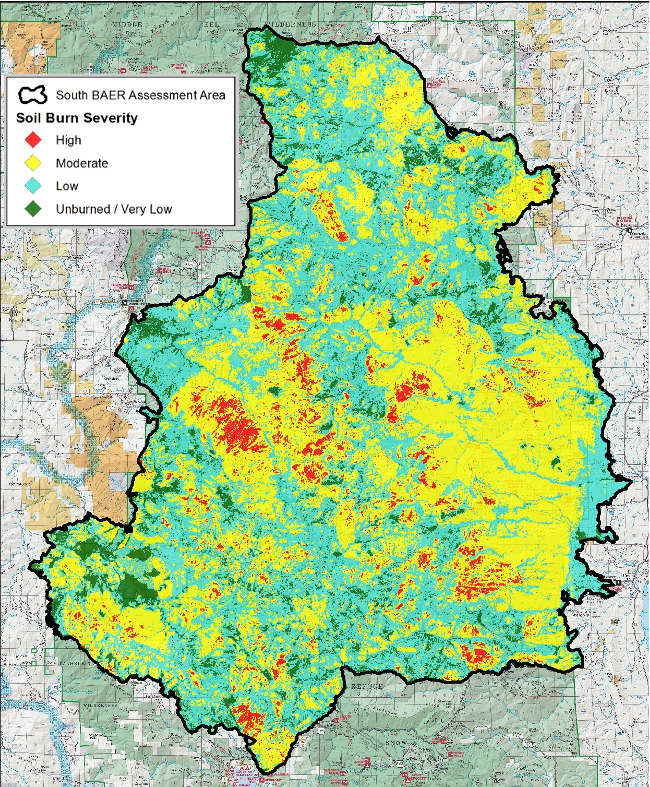
NORTHERN CALIFORNIA – Burned Area Emergency Response, or BAER, specialists recently completed their data gathering and verification fieldwork of the August Complex-South burn area.
Across all of its zones, the August Complex was up to 1,028,601 acres burned and 75 percent contained as of Sunday night, according to the US Forest Service.
Officials said the soil burn severity map has been finalized. Soil burn severity levels are unburned/very low, low, moderate and high.
The map shows that in the August Complex-South fire area, approximately 52 percent of the 521,256 acres analyzed by the BAER team is either unburned/very low (9%) or low (43%) soil burn severity, while 44 percent sustained a moderate soil burn severity, and only 4 percent burned at high soil burn severity.
Of the land assessed, 416,301 acres, or 79.9 percent, is owned by the Forest Service, 90,288 acres or 17.3 percent is held by other owners, 14,660 acres or 2.8 percent is owned by the Bureau of Land Management and 7 acres, less than 1 percent, covers other federal lands.
The BAER post-fire assessment team uses soil burn severity data to identify if there are areas of concern where increased soil erosion, accelerated surface water run-off, and debris flows have the potential to impact human life/safety, property, and critical natural and cultural resources from storm events.
The team consists of Forest Service scientists and specialists who are considering emergency stabilization options for those critical resources on National Forest System lands.
The BAER team shares it analysis and findings with interagency cooperators who work
with private land and business owners to help them prepare for upcoming rain events.
BAER Team Leaders Luke Rutten and Kendal Young said, “The BAER team expects erosion and run-off within the August Complex-South fire area to moderately increase as a result of the fire because 48 percent of the burned area experienced moderate or high soil burn severity.”
In specific areas that experienced moderate to high soil burn severity, there is concern for increased post-fire run-off from steep hillslopes and resultant increases in post-fire soil erosion and debris flows.
The August Complex-South soil burn severity BAER map, shown above, can be downloaded at the interagency August Complex Post-Fire BAER InciWeb site as a JPEG or PDF version under the “maps” tab.
- Details
- Written by: Lake County News reports
The data cover 164,981 positions and a total of nearly $9.86 billion in 2019 wages and just under $2.83 billion in health and retirement costs for 3,093 special districts.
Special districts are governmental entities created by a local community to meet a specific need. Data for 2019 show the top 10 districts by total wages are in health care, transit, utility, water, and fire districts. Nine of the top 10 individual salaries reported are in health care districts.
The state controller also maintains and publishes state and California State University salary data.
California law requires cities, counties and special districts to annually report compensation data to the state controller.
In Lake County, the site reported there are 28 special districts with 413 employees, wages totaling $10,481,433 and $3,402,464 in retirement and health contributions.
The top 10 largest special districts in Lake County are as follows:
– Lake County Fire Protection District: 48 employees; wages, $1,828,737; retirement and health contributions, $842,697.
– Kelseyville Fire Protection District: 42 employees; wages, $1,581,252; retirement and health contributions, $434,497;
– Northshore Fire Protection District: 37 employees; wages, $1,319,098; retirement and health contributions, $431,851.
– Hidden Valley Lake Community Services District: 18 employees; wages, $1,045,225; retirement and health contributions, $426,752.
– Clearlake Oaks Water District: 27 employees; wages, $938,687; retirement and health contributions, $269,991.
– Lakeport Fire Protection District: 30 employees; wages, $853,883; retirement and health contributions, $366,648.
– Lake County Vector Control District: 16 employees; wages, $613,495; retirement and health contributions, $245,225.
– Konocti County Water District: 17 employees; wages, $539,485; retirement and health contributions, $157,757.
– Cobb Area County Water District: 18 employees; wages, $336,431; retirement and health contributions, $50,094.
– Lower Lake County Waterworks District No. 1: 14 employees; wages, $303,632; retirement and health contributions, $61,421.
An additional special district in Lake County, the Anderson Springs Community Services District, didn’t file information for 2019, according to the site.
A list of districts that did not file or filed incomplete reports is available here.
Since the GCC website launched in 2010, it has registered more than 12 million pageviews. The site contains pay and benefit information on more than two million government jobs in California, as reported annually by each entity.
Users of the site can view compensation levels on maps and search by region, narrow results by name of the district or by job title, and export raw data or custom reports.
As the chief fiscal officer of California, Controller Yee is responsible for accountability and disbursement of the state’s financial resources. The controller has independent auditing authority over government agencies that spend state funds.