 How to resolve AdBlock issue?
News
- Details
- Written by: Elizabeth Larson
The company said the shutoff, which could take place on Wednesday, would impact about 50,000 customers, including about 30 – two of them medical baseline customers – in Lake County.
Based on an outage map, the customers in Lake County would be in the south county, near Cobb and Middletown, and power would be shut off on Wednesday evening between 6 and 8 p.m.
In addition to Lake, other counties were power could be shutoff are portions of Alameda, Amador, Butte, Calaveras, Contra Costa, El Dorado, Monterey, Napa, Nevada, Placer, Plumas, San Mateo, Santa Clara, Santa Cruz, Shasta, Sierra, Solano, Sonoma, Tehama and Yuba.
PG&E said 9,230 customers in Napa County and 1,781 customers in Sonoma County are estimated to be impacted.
Based on the forecast, high fire-risk conditions are expected to arrive Wednesday evening, with high winds continuing to through Thursday morning in some locations and Friday morning in other locations. PG&E said it would then inspect the lines for damage and work to have power restored to customers within 12 daylight hours.
PG&E said the highest probability areas for this public safety power shutoff, or PSPS, are the Northern Sierra Nevada foothills; the mid and higher elevations in the Sierra generally north of Yosemite; the North Bay mountains near Mt. St. Helena; small pockets in the East Bay near Mt. Diablo; the Oakland Hills east of Piedmont; the elevated terrain east of Milpitas around the Calaveras Reservoir; and portions of the Santa Cruz and Big Sur mountains.
PG&E's in-house meteorologists, as well as staff in its Wildfire Safety Operation Center and Emergency Operation Center, will continue to monitor conditions closely, and additional customer notifications will be issued as they move closer to the potential event.
The company said it began to send out notifications to customers via text, email and automated phone calls late Monday afternoon about the potential for a shutoff.
PG&E has launched a new tool at its online Safety Action Center to help customers prepare for PSPS events.
Last month, PG&E conducted two PSPS events that both impacted small numbers of customers.
A year ago, when PG&E first rolled out the PSPS events, most of Lake County’s residents were out of power for a week due to two overlapping planned outages.
Due to better weather technology and mitigation efforts such as sectionalizing devices and temporary generation, PG&E said the PSPS event that occurred from Sept. 7 to 10 affected 54 percent fewer customers than a comparable event would have in 2019.
Email Elizabeth Larson at
- Details
- Written by: Liz Essley Whyte, Center for Public Integrity
https://publicintegrity.org/ .
Twenty-four states are in the “red zone” for new coronavirus cases, according to documents the White House Coronavirus Task Force distributes to governors every week but does not publish. States in the middle of the country — North Dakota, South Dakota, Wisconsin, Montana and Utah — topped the list.
The Center for Public Integrity obtained the weekly reports, the existence of which it first revealed in July. The Trump administration has been withholding them from the public. In July, 18 states were in the red zone, with more than 100 new cases per 100,000 residents.
The task force in its most recent reports emphasized the need for masks and testing. “Masks must be worn indoors in all public settings and group gathering sizes should be limited,” the task force told red-zone Kansas, where most counties have opted out of a statewide mask mandate.
The Oct. 4 report to Idaho appears to be the first time the task force has explicitly recommended closing schools: "Recommend change to online K-12 classes in counties and metro areas with elevated test positivity and incidence among schoolage children and increasing hospital utilization," the White House advised, noting that outbreaks in 10 Idaho counties may be related to school openings. The Trump administration championed opening schools this summer, and the task force reports previously generally avoided the topic of K-12 education.
But the task force didn’t recommend the steps it advised for red zone states earlier in the pandemic, such as closing bars and limiting gatherings to 10 people or fewer. The Democrat-led House Select Subcommittee on the Coronavirus Crisis last month criticized the task force for watering down its recommendations over time.
Only one state, Vermont, was in the green zone for cases in the most recent report, with just six new cases per 100,000 residents in the last week.
The White House earlier told Public Integrity that it was not releasing the reports because the pandemic response should be state-led and federally supported. “The United States will not be shut down again,” White House spokesman Judd Deere said in August.
Since then, Public Integrity has contacted officials in all 50 states weekly to obtain the reports. Governors and health officials in 13 states — Alabama, Alaska, Arizona, Florida, Indiana, Massachusetts, Mississippi, New Hampshire, New York, South Dakota, Tennessee, Texas and West Virginia — have refused to share any so far or have not responded to repeated inquiries to multiple officials. The White House has said that states are free to share the reports if they want to do so.
The 24 states in the red zone are:
1. North Dakota
2. South Dakota
3. Wisconsin
4. Montana
5. Utah
6. Iowa
7. Nebraska
8. Idaho
9. Arkansas
10. Oklahoma
11. Missouri
12. Kansas
13. Wyoming
14. Tennessee
15. Minnesota
16. Kentucky
17. Alabama
18. Mississippi
19. Alaska
20. Nevada
21. Illinois
22. Indiana
23. Texas
24. South Carolina
Note: This story has been updated to reflect information contained in the Oct. 4 Idaho report.
This article first appeared on Center for Public Integrity and is republished here under a Creative Commons license.
- Details
- Written by: Elizabeth Larson
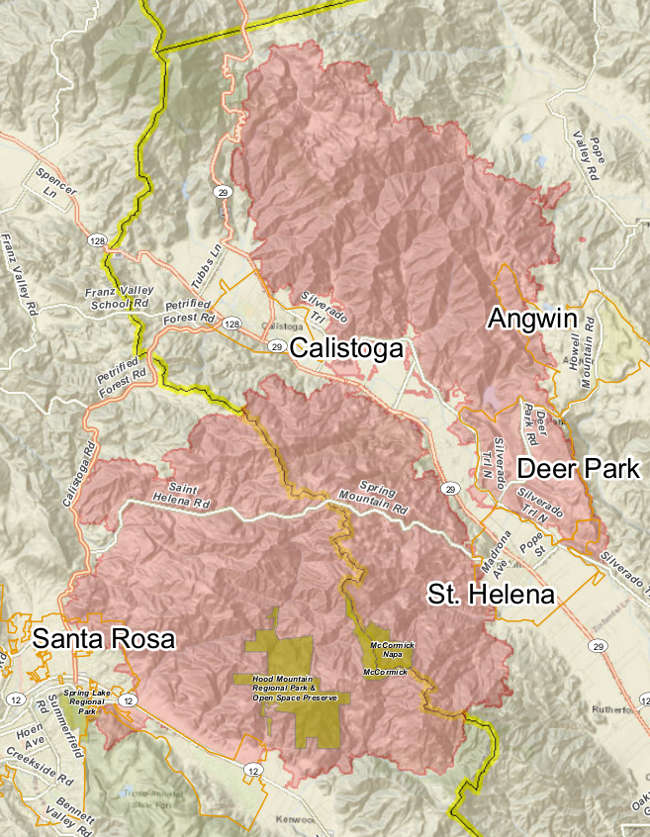
LAKE COUNTY, Calif. – Fire crews are within striking distance of having the Glass fire fully contained, while thousands of firefighters continue their work to control the August Complex.
On Monday night, the Glass fire remained at 67,484 acres, with containment at 96 percent, Cal Fire reported.
The incident, expected to be fully contained on Oct. 20, has been burning in Napa and Sonoma counties since Sept. 27, coming less than a mile from Lake County’s southern border.
Total structures that continued to be threatened by the incident were reduced again on Monday to 1,217, Cal Fire said.
Cal Fire’s final damage assessment, released late last week, said the Glass fire has destroyed 1555 structures and damaged 282 others.
On Monday night, resources that Cal Fire said remained assigned to the incident included 219 firefighters, 10 engines, seven water tenders, one helicopter, two hand crews and 10 dozers.
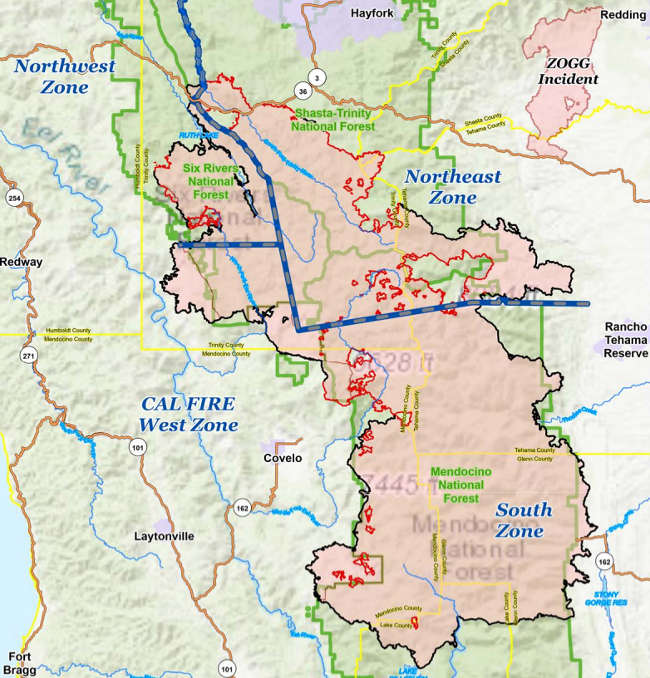
Changes in weather could bring more fire activity in August Complex area
On California’s largest fire, the August Complex, by Monday night it had burned 1,029,029 acres on the Mendocino, Shasta-Trinity and Six Rivers National Forests, with containment up to 76 percent, the US Forest Service reported.
Officials said 4,610 personnel are assigned on all four zones of the complex, which has been burning since Aug. 17.
The Forest Service said firefighters continue to coordinate with Cal Fire on control measures in the Hellhole Canyon area, northeast of Covelo.
On the west and south sides of the South Zone, which includes portions of the Mendocino National Forest in northern Lake County, fire crews are felling hazard trees along roadways as needed for firefighters and public safety. Crews continue to patrol firelines by ground and air, officials said.
The Forest Service said smoke may be visible in areas where pockets of vegetation within the fire’s perimeter continue to burn and temperatures warm up over the next few days.
On the west side of the South Zone, the Forest Service said firefighters are repairing handline constructed on the southwestern portion of the fire during suppression operations. Firefighters continue to scout for additional opportunities for suppression repair.
Changes in the weather this week could lead to challenges for firefighters.
The Forest Service said relative humidity is expected to drop after the moist weekend with an increase in afternoon winds that have the potential to dry out fuels and increase fire activity along ridges and slopes. The dry weather is expected to continue through the week, with generally northerly breezes.
Email Elizabeth Larson at
- Details
- Written by: Lake County News reports
Pedestrian deaths have increased nationwide over the last decade.
In California, pedestrians are 37 times more likely to be injured in a collision than any other roadway user.
Between 2008 and 2017, pedestrian-related incidents accounted for 19 percent of all collisions resulting in death or serious injury.
“At least two pedestrians or cyclists lose their lives on California’s transportation system each day – a number we refuse to accept or normalize,” said Caltrans Director Toks Omishakin. “Safety remains our top priority and the department will work diligently until the trend is reversed. Data-driven augmentations to safety features and a recent $100 million investment dedicated to pedestrian-focused infrastructure improvements will help enhance safety for those who walk and bike on California roadways.”
Caltrans is enhancing pedestrian safety measures at high-risk locations based on traffic collision data. The department uses a first-of-its-kind pedestrian safety toolbox that includes 47 countermeasures to enhance pedestrian safety on the state highway system.
Caltrans investigates high-risk locations to determine the best safety improvement in the toolkit. Specific toolbox improvements include:
– Signal timing enhancement and extended pedestrian crossing times.
– Intersection and roadway design changes, such as sidewalks, curb extensions, and roundabouts or raised intersections that provide enhanced pedestrian safety in high traffic locations.
– New pedestrian signs and markings, including high-visibility crosswalks, advanced stop and yield markings, or “yield to pedestrian” signs.
Caltrans is already implementing these safety measures (click here to view locations) and expects to identify further safety improvements by September 2021.
In addition, the California Transportation Commission recently approved $100 million for projects that promote active transportation options, such as:
– 310 miles of new and repaired bike lanes;
– Installation and repair of nearly 50 miles of sidewalk;
– Nearly 3,000 new crosswalks; and
– 178 transit stop improvements, such as bus shelters.
The California Office of Traffic Safety, or OTS, is also providing more than $8 million in funding for programs dedicated to the safe and equal access of roads for pedestrians, including:
– Complete Streets Safety Assessments to assist local agencies statewide in identifying and implementing infrastructure improvements to pedestrian safety and accessibility.
–Community Pedestrian and Bicycle Safety Training programs that encourage local residents in underserved communities to develop a community action plan to improve walking and biking safety.
–Coordinate Walking Tours and education outreach with health care providers and senior centers. Focus on high-collision areas for older adult pedestrians and measures to improve safe travel for older adults.
–Develop “walking school busses” with groups that walk with students to school and educate students on traffic rules and best safety practices.
National Pedestrian Safety Month is an important reminder that we are all pedestrians at one time or another and that we all play a role in protecting those who walk on California’s transportation system.
“Behavior change goes hand in hand with infrastructure improvements,” OTS Director Barbara Rooney said. “Safe habits by drivers and pedestrians complement a transportation system that is designed with pedestrian travel in mind.”
Motorists and pedestrians can follow these tips to alter their habits for the sake of pedestrian safety.
Tips for drivers:
– Slow down on busy streets and intersections.
–Avoid distractions like cell phones, eating, using in-dash touch screens, or deep conversations with passengers.
–Be extra careful when approaching crosswalks.
–Be prepared to stop for pedestrians.
– Avoid blocking crosswalks when making a right-hand turn.
– Turn headlights on and slow down at night when pedestrians are more difficult to see.
Tips for pedestrians:
– Stay off the phone, especially when crossing the street.
– Always try to use marked crosswalks, preferably at stop signs or signals.
– Make eye contact and nod or wave at drivers. A quick nod or wave is an easy way to let a driver know you see them, and they see you.
– Be careful crossing streets or entering crosswalks at night when you’re more difficult to see.
– Walk with a flashlight and wear a reflective vest at night to make it easier for drivers to see you.
– Remember to look both ways for cars if you need to briefly walk into the street to maintain social distancing on sidewalks.
For more information about Caltrans pedestrian programs click here and visit the Office of Traffic Safety website to access pedestrian safety tips by clicking here.