 How to resolve AdBlock issue?
News
State’s COVID-19 blueprint places most counties in restrictive purple tier; Lake remains in red tier
- Details
- Written by: Elizabeth Larson
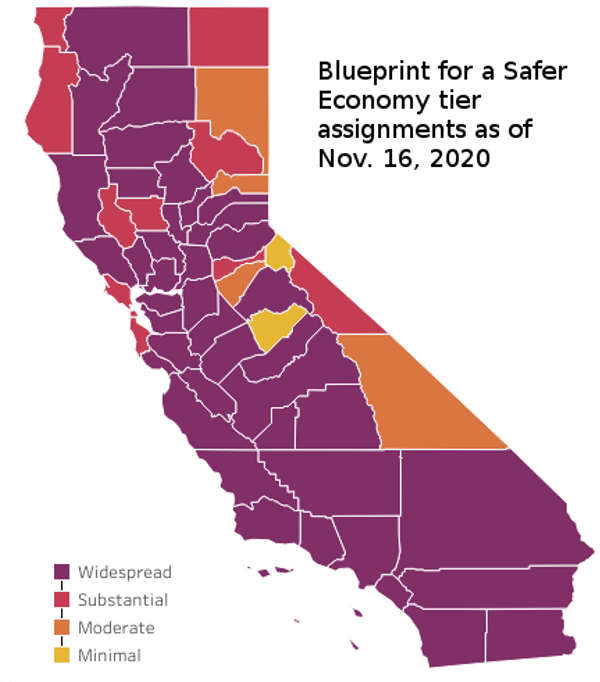
LAKE COUNTY, Calif. – Lake was among a handful of counties on Monday that avoided being placed by the state under tighter restrictions related to COVID-19.
The state on Monday reported its new rankings of the 58 counties in the Blueprint for a Safer Economy in response to spiking caseloads across the state.
The blueprint has four tiers:
– Yellow, or minimal; most indoor business operations are open with modifications.
– Orange, or moderate; some indoor business operations are open with modifications.
– Red, or substantial; some nonessential indoor business operations are closed.
– Purple, or widespread; many nonessential indoor business operations are closed.
Monday’s update of the rankings shows that 41 counties are now in the purple tier, the most restrictive.
Of those 41 counties, 29 were just moved into the purple tier from a lower tier. Twelves others – Imperial, Los Angeles, Madera, Monterey, Riverside, Sacramento, San Bernardino, San Diego, Shasta, Sonoma, Tehama and Tulare – had been in the purple tier last week and remain so this week.
Lake County has been in the red tier for some time and in the latest rankings on Monday remained there, allowing businesses and activities to continue without more restrictions.
Other counties whose rankings remained unchanged in the lower tiers as of Monday are Alpine, yellow; Inyo, orange; Lassen, orange; and Mariposa, yellow.
Lake’s neighboring counties of Glenn, Mendocino, Napa, Sonoma and Yolo are all in the purple tier now, while Colusa is in the red tier.
Lake County’s total cases reached 788 on Monday, with three currently hospitalized and 726 recovered. There are now 18 deaths reported, an increase of one since last week, Lake County Public Health reported.
The county’s adjusted case rate is 5.7, the fifth-lowest case rate statewide, based on California Department of Public Health numbers.
Statewide, 1,043,950 cases and 18,305 deaths had been reported by county Public Health departments as of Monday night.
The California Department of Public Health said Monday that the seven-day positivity rate is 5 percent and the 14-day positivity rate is 4.6 percent.
As of Monday, 21,068,894 tests had been conducted in California, which the California Department of Public Health said represented an increase of 202,109 over the prior 24-hour reporting period.
To date, 17,213 tests have been conducted in Lake County, according to the Public Health Department.
For more information about the tiers and restrictions, visit www.covid19.ca.gov.
Email Elizabeth Larson at
- Details
- Written by: Elizabeth Larson
City Manager Alan Flora presented, and received approval for, his plan to facilitate development of the former Pearce Field Airport property on Highway 53 from the council at its Oct. 1 meeting.
The site has been slated for a shopping center in several different iterations, but so far no project has been completed.
Flora said it was “a little depressing” to research the property’s history, as he didn’t realize how far back efforts and discussions to develop it went.
Based on Flora’s report to the council, the Clearlake Redevelopment Agency purchased the 38.5-acre property for $840,000 from the county in 1994, after the county closed it. Four years later, the redevelopment agency sold 10 acres that were used to develop Outrageous Waters water park, now closed.
After the shutdown of redevelopment, the property was transferred in 2013 from the agency to the city for public use, he said.
Flora proposed to the council that the city offer a compensation agreement to the taxing entities that are entitled to proceeds – such as the Konocti Unified School District, Woodland Community College, the Lake County Office of Education and the county of Lake – should the city sell the property.
In order to actually make the project happen, Flora said the city needs to get creative. That includes installing infrastructure – water, sewer and roads – at the site.
If the city has full control of the property, Flora said it could move forward with a low- or no-cost ground lease to a development firm, that would then develop the property and rent it out.
Eliminating the cost of infrastructure and land would make the site more attractive to developers, Flora said.
Flora said there are a couple of successful local businesses that are potentially interested in this proposed development model.
He said the city would need to take the plan to the Lake County Redevelopment Oversight Board for final approval.
The proposal includes having the city maintain 1.72 acres for uses including animal control’s shelter, the city’s Public Works yard – until a new location is found – and the Lake County Fire Protection District.
Flora proposed paying $10,000 per acre to the taxing entities – or a total of $241,800. He said the taxing entities have been agreeable to a proposal to reduce the cost for private developers.
“This is a little different model than what we had proposed before,” he said.
The city could then take on the commitment of installing infrastructure. Flora said if the city can get those first two steps moving forward, it can start on design work and negotiations.
Councilman Phil Harris moved to approve the plan, which the council approved 5-0.
The council unanimously approved a second motion for the city to work with RAM Development Partners, a sister company to Retail Strategies, the company that has been working with the city to attract development interest and investment into Clearlake, on the project.
Flora took the proposal to the county’s redevelopment oversight board late last month.
At the meeting, which Flora took place on Oct. 28, the board unanimously approved the compensation agreement.
He said he has a good amount of interest in the project.
RAM Development’s current role is marketing and planning for the build-out, Flora said.
“We will be developing plans and designing the roadway and infrastructure. If all goes well we will actually use RAM as the developer for the property. We would do a ground lease to RAM, they would then build the space and then lease to tenants,” he said.
“Everything is looking great for this project to move forward,” Flora said.
Email Elizabeth Larson at
- Details
- Written by: Janine Smith Citron
LAKE COUNTY, Calif. – November is National Hospice and Palliative Care Month, and it also marks the 41st year of serving Lake County residents.
Hospice Services of Lake County formed in 1979 by a group of concerned volunteers.
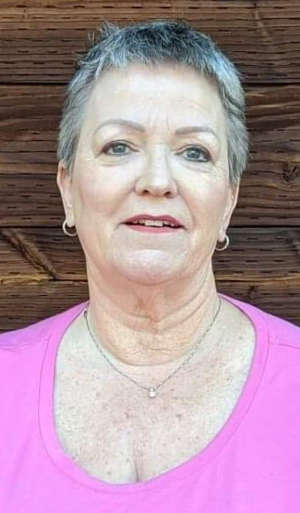
This year the group also is welcoming Cindy Sobel, RN, MS, as the new executive director. She succeeds Ruth Lincoln, who retired Oct. 30.
The Board of Directors of Hospice Services of Lake County selected Sobel from a highly competitive field on Oct. 29.
“The board was most impressed by her knowledge of Lake County with 30 years of clinical leadership experience in home care management and six years serving Hospice Services of Lake County,” said Board President Don Hubbard.
Held in high regard by her peers and staff, Sobel has an outstanding record of accomplishment in performance improvement, strategic planning, business planning and operations management.
She is no stranger to hospice and palliative care in Lake County. During her leadership role as director of Patient Care Services, she grew the Palliative Care program, adding and training new staff to expand services for Lake County residents.
Sobel holds a Master of Science degree in healthcare management, a Bachelor of Science in management and a registered nursing degree.
Having a lifelong passion for education, she is also a “Train the Trainer” for the End-of-Life Nursing Education Consortium for more than four years.
“Hospice Services of Lake County encourages you to explore your options for comfort care and to share your wishes with family, loved ones and your professional healthcare providers. We have many services to assist you,” said Sobel.
There are many myths about eligibility and the best time to start hospice care. Often, starting sooner provides the most benefits.
Hospice Services of Lake County will mark the month with community outreach to help bring about awareness of options to enhance quality of life for individuals experiencing a life-threatening disease.
In addition, the organization will present the second annual Festival of Trees Nov. 20 to 30. The annual “Light Up a Life” ceremonies are scheduled for Dec. 3 in Lakeport and Dec. 12 in Middletown.
Hospice Services of Lake County started as a small organization assisting only a few patients in 1980.
In the last 12 months, the team of trained staff provided hospice care to 262 individuals including 58 military veterans.
In the same period of time, 86 individuals including adults and children have received grief counseling in response to the loss of family members or loved ones through support groups, the Wings of Hope family camps and school-based counseling programs.
All services are provided following protocols established by the CDC and Lake County Department of Health Services.
Trained volunteers providing patient/family support, bereavement services, assistance with the thrift store, fund development and administrative duties are an integral part of the organization. Eighty-six volunteers provided 2, 912 hours of service in the past 12 months.
The core of hospice service is to provide patient- and family-centered care, ensuring the highest quality of life at the end-of-life wherever the individual calls home. Specially trained staff ensure that families receive the necessary support to allow that to happen. Services include nursing care, symptom management, and emotional and spiritual support tailored to a patient’s needs and wishes.
Services are paid for 100 percent by Medicare, Medi-Cal and the Veteran’s Administration. Many private health insurances also cover hospice care.
Financial support from the community through individual and corporate donations allows Hospice Services to cover special needs of patients and provide community bereavement services. No patients are turned away if they do not have the means to pay for hospice care.
“We encourage you to see how our compassionate team can assist you and your loved ones. We are happy to talk with you about the services that we provide and how we can help,” said Sobel.
Call us at 707-263-6222 or visit Hospice Services at 1862 Parallel Drive, Lakeport.
Additional information is also available on Hospice Services of Lake County’s website, www.lakecountyhospice.org.
Janine Smith Citron is director of development for Hospice Services of Lake County.
- Details
- Written by: Jennifer Balch, University of Colorado Boulder
As of late fall, wildfires are still smoldering under snowfall in Colorado. I am hoping that the cold and snowy weather over the last few days will finally put to bed the 2020 fire season in my state. Through much of October, great pillars of smoke rose in the sky and ash rained down from at least four major fall wildfires, affecting millions in the urban corridors east of the Rocky Mountains.
October wildfires are rare in Colorado, especially large ones that burn more than 1,000 acres. Only about a dozen that size have burned since 1984, out of 335 in the state over that period.
This fall’s major blazes are a signal of climate change in the here and now. And they’re not the only such evidence in a record hot and dry 2020 fire season, where states across the West are still putting out hot spots and mopping up the blazes.
Wildfires have shaped the Earth for hundreds of millions of years and play key roles in many of its ecosystems. And humans have used fire for landscape management for millennia. But we are just starting to understand our modern relationship with fire. As a fire scientist based in the West, I see reason for hope. By making changes now, I believe that we can help shape the types of fire we live with in the future.

Pathways to living with more fire
More than 8.7 million acres – an area larger than the state of Maryland – have burned across the U.S. just in 2020. Tens of millions of people have suffered from the resulting toxic smoke. Hundreds of thousands have been forced to evacuate in the midst of the COVID-19 pandemic. Thousands of homes have burned to the ground, and dozens of people have lost their lives.
The science is clear: Earth’s warming climate has doubled the area in western U.S. forests that has burned since the 1980s. And this increase comes at a high price. The most devastating wildfires have caused US$76 billion in damage since 1980, with most of those losses occurring in the past 20 years. And the 2020 fire season isn’t over yet.
Fire is responding quickly to climate change, so humans need to respond faster. Based on my own research and work by others, here are six pathways that I believe will help the U.S. get ahead of its wildfire crisis.
- Build better. Across the U.S., tens of millions of homes have been built in the wildland-urban interface, where development runs up against forests, shrublands and grasslands. These communities need to retrofit flammable homes and build new ones that are fire-resistant.
Mapping zones where fire is likely in a changing climate is critical. Just as the Federal Emergency Management Agency produces maps of flood-prone areas, the U.S. needs national firescape maps, coupled with national policies to guide development and insurance decisions.
Congress passed an omnibus bill in 2018 that mandated wildfire hazard potential mapping, but this effort will require concerted scientific support and funding. The maps should incorporate how warming temperatures affect the likelihood of wildfires, and should tie into a national program that directs development out of harm’s way.
- Emphasize backyard management. Local communities and federal and state land management agencies should focus on reducing flammable trees and brush near where people live. Mechanical removal, raking and logging in the middle of the woods to reduce fire risk is way too expensive and ineffective. It would cost billions of dollars to clean up 150 million dead trees in California.
There’s also a need for more research on how homes ignite and how fire progresses through neighborhoods. The U.S. has had mandatory fire codes for over a century to limit fires indoors and protect occupants. Today we need similar measures for outdoor areas around homes.
- Bring Smokey Bear to the suburbs. Many human activities bring fire. Virtually all of the wildfires that threaten homes anywhere in the lower 48 states are started by human actions, either deliberate or accidental.
For decades the U.S. Forest Service’s Smokey Bear public education campaign taught Americans that “Only you can prevent forest fires.” Today there’s a need to raise awareness of how daily activities, from camping to setting off fireworks or operating yard equipment, can generate sparks. Power lines, which can blow over during extreme weather conditions and start deadly wildfires, should be a major focus.
- Use fire to fight fire. Studies show that the U.S. is not setting enough prescribed fires to reduce flammable materials on the ground, especially in western states.
The only federal agency that has been able to increase prescribed burning in the past two decades is the Bureau of Indian Affairs. This may reflect growing recognition that Native American burning practices offer a model for fire-prone communities. Science-informed policies to delineate when and where to implement prescribed burning could help agencies manage smoke more effectively and support ecosystem restoration.
- Understand whom wildfires harm most. A 2018 study estimated that 12 million socially vulnerable Americans who are poorly equipped to respond to fire due to low incomes, language barriers or other factors live in areas where there is substantial wildfire potential.
Further, people of color, based on majority Black, Hispanic or Native American census tracts, may be more vulnerable than others. This disparity makes it urgent to better pinpoint whose lungs and homes are in harm’s way, who receives and acts on evacuation notices, and how well fuel treatments and firefighting protect the most vulnerable communities. Answering these questions would help to reduce disproportionate wildfire risks borne by vulnerable communities.
- Stop fixating on “megafires” and “gigafires.” Big fires matter for smoke, small fires matter for homes and fast-moving fires matter for lives. There are better ways to delineate why wildfires matter to society.
New sources ranging from satellites to government records to social media are providing a wealth of opportunities to learn more about wildfire behavior and how it threatens people and affects ecosystems. These data could be linked with information on why fires are becoming so costly, damaging and deadly, leading to astronomical fire suppression budgets.
[Deep knowledge, daily. Sign up for The Conversation’s newsletter.]
The U.S. spends over $2 billion on average fighting wildfires every year. I believe it’s time to abandon our emergency response mindset and start investing in proactive measures to reduce risks. In my view, we will never get ahead of the threat without a better understanding of how to manage flammable landscapes and adapt to increasing wildfire threats.
Jennifer Balch, Associate Professor of Geography and Director, Earth Lab, University of Colorado Boulder
This article is republished from The Conversation under a Creative Commons license. Read the original article.