 How to resolve AdBlock issue?
News
- Details
- Written by: Elizabeth Larson
CLEARLAKE, Calif. – The Clearlake City Council is moving forward with a potential land sale and a land purchase, two actions that are intertwined as part of a larger plan to bring more amenities to the city.
At its Nov. 5 meeting, the council unanimously approved a letter of intent for a six-month exclusive negotiation period with King Management LLC, which wants to purchase a 2.5-acre portion of Redbud Park at 14800 Ballpark Ave.
It followed up by approving a purchase agreement with One Shot Mining Co. LLC for parcels located at 14885 Burns Valley Road, 14795 Burns Valley Road, 14760 Olympic Drive, 3334 Washington St., 3359 Washington St. and 3367 Washington St. The purchase price is $870,000.
The discussion of the Redbud Park negotiations begins at the 52-minute mark in the video above. It is immediately followed by the property purchase item.
City Manager Alan Flora explained that in July the city entered into a letter of intent with King Management for development of a hotel at the former Pearce Field airport property on Highway 53.
“They are still interested in moving forward with that project,” said Flora.
However, the company also has become interested in doing another hotel development at the Redbud Park location, he said.
Altogether, Flora said there is a 6.5-acre area at the Redbud Park site, which encompasses the city’s three Little League fields, for the potential hotel development by King Management, retail and a second hotel. Those plans wouldn’t impact the nearby Youth Center.
The park, overall, is reported to have 15 acres, so even with the sale the boat launch, pier, restrooms and parking would remain.
Having a new hotel and other amenities in place there, Flora said, would let the city take advantage of opportunities such as more fishing tournaments at the park’s Thompson Harbor.
However, Flora said the city doesn’t want to move forward with the hotel project until it has new ballfields in place for the Little League teams, which the city would like to relocate to the new property it is seeking to purchase on Burns Valley Road.
Flora said King Management is proposing a 60- to 80-room national brand hotel, with a small conference center, pool and other amenities, on the 2.5 acres on the far eastern portion of the property.
One of the benefits of moving the ballfields to another location, said Flora, is that it would allow for the city to improve the ballfields and have larger crowds without impacting the nearly residential areas as much. It also would allow for night games.
He recommended moving forward with the letter of intent, which is the prelude to a purchase agreement. The city would then begin seeking parties to purchase and develop the remaining four acres of the available park property.
Council members supported the idea but added that they also wanted new ballfields in place before the old ones are redeveloped for the hotel project.
In response to questions from a community member, Flora emphasized that any hotel development wouldn’t happen until new ballfields are built at a new location. “The city is not interested in disrupting any of the seasons.”
“I have a longtime emotional attachment to that ballfield,” said Mayor Russ Cremer.
The existing fields at Redbud Park have been in place for 60 years, and during the discussion Cremer said he was on the first Little League team for the Clearlake Highlands that played there beginning in 1959.
Helen Mitcham of the Southshore Little League said they are trying to get a season going for early 2021 and was concerned about the timing of the negotiations.
Flora repeated that the city isn’t interested in causing impacts on the Little League season and that removal of the old ballfields wouldn’t be allowed to move forward without new ballfields being constructed.
“I love the vision that you have,” said Supervisor Bruno Sabatier.
He wanted to know if the city could stipulate that proceeds from the park property sale go to developing the ballfields at the new location.
Flora said it’s their intent to use the funds from the sale of the ballfields for construction of the new fields, adding that the money they get won’t be enough to build new fields with adequate lighting, irrigation and parking, and that they’ll be looking for other funds as well.
Mitcham told the council that the Little League has grants they plan on applying for to pay for lights at the new location.
Councilman Phil Harris said he had discussed the concept with the Little League board.
If a sales agreement is negotiated, timelines would be pivotal, with Harris noting that the city’s ultimate goal is to provide adequate playing fields for children and have opportunities to host tournaments.
Councilman Russ Perdock said he liked the idea of creating a sports complex, not just ballfields, and having the opportunity to offer tournament play for both adults and children.
Councilwoman Joyce Overton moved to authorize Flora signing the letter of intent with King Management, which Perdock seconded and the council approved 4-0. Vice Mayor Dirk Slooten recused himself from the discussion.
Council approves purchase of 31-acre property
The council then turned to the proposed purchase of the land from One Shot Mining Co.
Flora said the city has been talking for years about developing a new Public Works yard and relocating from the existing location at the former airport property.
Now, with a new animal shelter at the airport property, it’s even more important to get a new location because there’s not enough room for Public Works and animal control at the site, he said.
Flora said staff had been looking at various opportunities and found some adequate sites. Due to the need to develop a new location for the ballfields, they started zeroing in on this site on Burns Valley Road.
“We think that this particular site also includes an opportunity to have a housing development on it,” along with a recreational center, additional retail and commercial development on the eastern portion, said Flora.
The property’s owners have so far removed one building on the land and a second will be removed prior to escrow closing, Flora said.
The purchase agreement calls for the city to make three annual payments, $300,000 per year for each of the first two years and then a final payment of $270,000, with no interest accruing, he said.
Slooten said he thought it was an excellent opportunity, and a good place to locate the corporation yard and ballfields. The location is flat and will be easier to develop, he added.
Harris agreed with Slooten. “I think this is a premier property for the city to own.”
Harris asked if the city had already started looking for grant opportunities for the ballfield and other aspects of the plan.
Flora said yes, reporting that they think it’s an excellent fit for a grant for infill development.
“There may be some other opportunities out there that we haven’t pursued as well,” said Flora, explaining that the city is working with a contractor on funding for the Highlands Park project, and that they can have the contractor look at other funding opportunities for this new development.
Harris asked if there are any potential issues with developing ballfields on the land due to the nearby Orchard Park Senior Living facility. Flora said they will need to design the project in such a way as to mitigate any issues.
“I just think this is a fantastic opportunity,” said Perdock.
Flora said that if the council approved the purchase, city staff would move forward as soon as possible with planning, explaining there are a lot of pieces between this and the Redbud Park property development that all work together.
During public comment, Sheryl Almon asked them to include a swimming pool in the recreation complex.
Miles Cooley pointed out that there are numerous large and beautiful oak trees on the property and he wanted to make sure they are taken into account in designing a project there.
Vicki Crystal thanked the staff and council for looking for alternative locations for the corporation yard – they previously had considered a location at a county-owned property on Pond Road – and lauded them for their work and efforts to approve the city.
Mitcham asked to establish a committee that includes the Little League to work on plans for the property. “We want to be in the discussion and are ready and willing to help.”
Staff and council members agreed that there should be such an ad hoc committee that includes the Little League to work on the project.
Cremer said he wanted to hold off on development of housing at the site until the sports complex is completed. Harris agreed, unless the housing portion is key to getting grants.
Slooten moved to approve the purchase agreement, which Harris seconded and the council approved 5-0.
Email Elizabeth Larson at
- Details
- Written by: Elizabeth Larson
The meeting will begin at 9 a.m. Tuesday, Nov. 17.
The supervisors will meet in the board chambers on the first floor of the Lake County Courthouse, 255 N. Forbes St., Lakeport, for a hybrid meeting format which also will include the opportunity for community members to continue to participate virtually.
The meeting can be watched live on Channel 8, online at https://countyoflake.legistar.com/Calendar.aspx and on the county’s Facebook page. Accompanying board documents, the agenda and archived board meeting videos also are available at that link.
To participate in real-time, join the Zoom meeting by clicking this link at 9 a.m. The meeting ID is 939 8046 7939, password 667935.
To submit a written comment on any agenda item please visit https://countyoflake.legistar.com/Calendar.aspx and click on the eComment feature linked to the meeting date. If a comment is submitted after the meeting begins, it may not be read during the meeting but will become a part of the record.
In an untimed item, the board will continue a discussion regarding staff’s proposal to consider extending Friday office closures to the public through March 31, 2021, in light of COVID-19 and expected effects of the 2020-21 flu season.
The Friday closures began in August 2018 on a six-month basis in response to county job vacancy rates and have since been extended for other reasons, most recently COVID-19.
At the Nov. 3 meeting, Supervisor Rob Brown said there is nothing more permanent than a temporary program. “This is playing out that way.”
Supervisors expressed their desire to see the closures end and Friday office hours to resume by April. Supervisor Bruno Sabatier suggested that the closures should begin to be rolled back in January, when departments could assign one staffer each to basic customer service duties.
The board on Tuesday is expected to finalize its direction to staff on the matter.
In other business on Tuesday, at 9:05 a.m. the board will get an update from Public Health Officer Dr. Gary Pace.
At 10:45 a.m., the board will consider an ordinance allowing microenterprise home kitchen operations with a pilot program.
A memo to the board from Supervisor Sabatier and Supervisor EJ Crandell explained, “AB626 allows for a home kitchen to be utilized for a limited number of meals per week, and a limited amount of income to individuals wishing to start a home based food facility. In order to allow this to occur in Lake County, we must opt in and allow the permitting of such facilities.”
The memo noted that on July 21 the board approved moving forward with producing an ordinance opting in for AB626 and offering a Microenterprise Home Kitchen Operations permit to the public.
Since county staffers have raised issues about the impact on workload, Crandell and Sabatier are proposing a pilot program allowing for a maximum of two applications per month for a maximum of 10 total applications during the pilot program period.
“The applications will also be separated at 2 per district to ensure that the program will be accessible around the county and not concentrated in one area,” the memo said.
The permit process will require approval by the landlord if the home is not owned by the tenant and also will require a zoning permit or minor use permit depending on whether or not food is being delivered, according to the memo.
“A minor use permit would be necessary to ensure that parking and traffic issues would be mitigated prior to approving a permit,” Crandell and Sabatier wrote.
The full agenda follows.
CONSENT AGENDA
5.1: Approve the early release of one member of the Lucerne Area Town Hall.
5.2: Ratify second side letter agreement with county of Lake Deputy Sheriff’s Association regarding amendment to the 2019 MOU.
5.3: Approve amendment to the County of Lake COVID-19 Public Health Emergency Return to Work – Worksite Protection Protocol.
5.4: (a) Waive the formal bidding process, pursuant to Lake County Code Section 38.2, as it is not in the public interest due to the unique nature of goods or services; and (b) approve the agreement between the county of Lake and Redwood Community Services Inc. Tule House for substance abuse block grant eligible substance use disorder perinatal residential services for Fiscal Year 2020-21, for an amount not to exceed $50,000 and authorize the board chair to sign the agreement.
5.5: (a) Waive the formal bidding process, pursuant to Lake County Code Section 38.2, as it is not in the public interest due to the unique nature of goods or services; and (b) approve the agreement between the county of Lake and Redwood Community Services Inc. Tule House for drug Medi-Cal eligible substance use disorder perinatal residential services for Fiscal Year 2020-21, for an amount not to exceed $150,000.00 and authorize the board chair to sign the Agreement.
5.6: (a) Waive the formal bidding process, pursuant to Lake County Code Section 38.2, as it is not in the public interest due to the unique nature of goods or services; and (b) approve the agreement between the county of Lake and Willow Glen Care Center for adult residential support services and specialty mental health services for Fiscal Year 2020-21 for a contract maximum of $100,000 and authorize the board chair to sign the agreement.
5.7: (a) Waive the formal bidding process pursuant to Lake County Code Section 38.2, as it is not in the public interest due to the unique nature of goods or services; and (b) approve agreement between the county of Lake and Social Service Data Solutions Inc. DBA Decipher HMIS and Impact Homelessness Project for the coordination of activities involved in the compliance with the Lake County Continuum of Care Homeless Management Integration Software for Fiscal Year 2020-21 for a contract maximum of $54,300 and authorize the board chair to sign the agreement.
5.8: Adopt resolution approving the standard agreement between county of Lake and the Department of Housing and Community Development in the amount of $560,227 and authorize the board chair to sign the agreement.
5.9: Approve Addendum No. 3 to the commercial lease agreement between the county of Lake and Bruno’s Property Management to allow for the additional lease of attached property at the 6302 13th Ave., Lucerne, California and authorize the board chair to sign.
5.10: Adopt resolution to amend the budget for FY 2020-2021 by appropriating unanticipated revenue for Public Health services and authorize the Health Services director to sign necessary documents to secure these funds.
5.11: Adopt resolution amending Resolution 2020-134 establishing position allocations for Fiscal Year 2020-21, Budget Unit No.4011, Public Health.
5.12: Approve the continuation of a local health emergency and order prohibiting the endangerment of the community through the unsafe removal, transportation, and disposal of fire debris for the Mendocino Complex fire.
5.13: Approve the continuation of a local health emergency related to the 2019 Coronavirus (COVID-19) as proclaimed by the Lake County Public Health officer.
5.14: A) Authorize the Public Services director / assistant purchasing agent to issue a purchase order not to exceed $65,000 to Leete Generators for a portable diesel generator, including installation; and B) approve Budget Transfer in Budget Unit 4011, Health Services Department, Public Health Division to Object Code 62-74, to purchase and install a backup generator in the amount of $65,000.
5.15: Approve the continuation of resolution ratifying the declaration of local health emergency and order prohibiting the endangerment of the community through the unsafe removal, transport, and disposal of fire debris for the LNU Complex wildfire.
5.16: Approve the continuation of a local emergency due to the Mendocino Complex fire incident (River and Ranch fires).
5.17: Approve the continuation of a local emergency due to the Pawnee fire incident.
5.18: Approve the Continuation of a local emergency due to COVID-19.
5.19: Approve the continuation of a local emergency in Lake County in response to the LNU Lightning Complex wildfire event.
5.20: Sitting as the Board of Directors, Lake County Watershed Protection District, consideration and approval of joint funding agreement with the U.S. Geological Survey, U.S. Dept. of the Interior for annual maintenance of the Kelsey Creek flow gauge station in the amount of $14,430 and authorize the chair to sign.
5.21: Sitting as the Board of Directors for the Lake County Watershed Protection District, (a) waive the formal bidding process, pursuant to Lake County Code Section 38.2 (2) & (3), as it is not in the public interest due to the unique nature of the goods or services and its determined that competitive bidding would produce no economic benefit to the county; (B) approve the agreement between the county of Lake and EOA Inc. environmental consulting firm in the amount of $104,000 to provide assistance to meet NPDES storm water permit and TMDL compliance and to authorize the chair of the board of directors to sign the agreement.
5.22: Sitting as the Board of Directors for the Lake County Watershed Protection District, approve the reimbursement agreements between the district and (a) the city of Lakeport and the (b) city of Clearlake to provide reimbursement for TMDL and storm water program services and to authorize the chair of the board of directors to sign the agreements.
5.23: Approve amendment one to agreement between the county of Lake and Quincy Engineering Inc. for engineering services for Hill Road MP 7.75 Landslide Repair Project in Lake County.
5.24: Approve amendment two to the agreement between the county of Lake and Quincy Engineering Inc. for engineering services for replacement of Cooper Creek Bridge at Witter Springs Road (14C-0119) in Lake County.
5.25: Approve additional leave of absence that extends beyond Department Leave and County Administrative Officer approved leave for Shirah Ruiz from Nov. 12, 2020, through Jan. 4, 2021, and authorize the Board of Supervisors chair.
TIMED ITEMS
6.1, 9:01 a.m.: Public input.
6.2, 9:05 a.m.: Consideration of update on COVID-19.
6.3, 10 a.m.: Public hearing, discussion/consideration to name an existing unnamed road located off Jerusalem Grand in Middletown Area, Psi Keep Ranch Road.
6.4, 10:30 a.m.: Discussion of Proposition 64 Draft Cannabis Equity Assessment and Funding For Equity Program.
6.5, 10:45 a.m.: Consideration of ordinance allowing microenterprise home kitchen operations with a pilot program.
6.6, 11:15 a.m.: Continuance of hearing on account and proposed assessment for the property 12942 Second St., Clearlake Oaks.
UNTIMED ITEMS
7.2: (a) Discussion and possible direction to staff regarding Friday closures; (b) consideration of a resolution extending Friday closures through March 31, 2021, in light of COVID-19 and expected effects of the 2020-21 flu season.
7.3: Consideration of proposed 2021 Board of Supervisors regular meeting calendar.
7.4: Consideration of amendment two to the agreement between the county of Lake and the Kelseyville Motel for COVID-19 emergency isolation housing and authorize the chair to sign.
CLOSED SESSION
8.1: Public employee appointment pursuant to Gov. Code Section 54957(b) (1): Appointment of Special Districts administrator.
8.2: Public employee evaluations: County Administrative Officer Carol Huchingson, Public Health Officer Dr. Gary Pace.
8.3: Conference with legal counsel: Existing litigation pursuant to Government Code section 54956.9 (d)(1): City of Clearlake v. County of Lake, et al.
8.4: Conference with legal counsel: Significant exposure to litigation pursuant to Government Code section 54956.9(d)(2)(e)(3), claim of Lillie.
8.5: Conference with legal counsel: Existing litigation pursuant to Government Code section 54956.9 (d)(1): Sabalone v. County of Lake.
Email Elizabeth Larson at
- Details
- Written by: Elizabeth Larson
The council will meet at 6 p.m. Tuesday, Nov. 17.
The meeting will be by teleconference only. The city council chambers will not be open to the public.
The agenda can be found here.
To speak on an agenda item, access the meeting remotely here or join by phone by calling toll-free 669-900-9128 or 346-248-7799. The webinar ID is 973 6820 1787, access code is 477973; the audio pin will be shown after joining the webinar. Those phoning in without using the web link will be in “listen mode” only and will not be able to participate or comment.
Comments can be submitted by email to
Indicate in the email subject line "for public comment" and list the item number of the agenda item that is the topic of the comment. Comments that read to the council will be subject to the three minute time limitation (approximately 350 words). Written comments that are only to be provided to the council and not read at the meeting will be distributed to the council prior to the meeting.
In a public hearing during the Tuesday meeting, the council will consider approving a resolution that would change the name of Westside Park Road to Charlie Jolin Way.
The proposal, which was brought to the council over the summer by the Westside Community Park Committee, received initial approval from the council before it went to the Lakeport Planning Commission. The commission followed up by approving the proposal in October.
Jolin died in June at age 96. He is credited with being the prime mover in the creation and promotion of the park.
Also on Tuesday, Public Health Officer Dr. Gary Pace will give the council an update on COVID-19 in Lake County.
In other business, the council will receive a presentation on the Redwood Empire Municipal Insurance Fund and the merger with Public Agency Risk Sharing Authority of California to create the California Intergovernmental Risk Authority, or CIRA, and direct staff to work with CIRA on steps necessary to complete the merger and place joint powers agreements and bylaws as a consent item on a future agenda.
On the consent agenda – items considered noncontroversial and usually accepted as a slate on one vote – are ordinances; minutes of the council’s regular Nov. 3 meeting; and the Oct. 29 warrant register.
Email Elizabeth Larson at
- Details
- Written by: Luna Lu, Purdue University and Vishal Saravade, Purdue University

Every day, Americans travel on roads, bridges and highways without considering the safety or reliability of these structures. Yet much of the transportation infrastructure in the U.S. is outdated, deteriorating and badly in need of repair.
Of the 614,387 bridges in the U.S., for example, 39% are older than their designed lifetimes, while nearly 10% are structurally deficient, meaning they could begin to break down faster or, worse, be vulnerable to catastrophic failure.
The cost to repair and improve nationwide transportation infrastructure ranges from nearly US$190 billion to almost $1 trillion. Repairing U.S. infrastructure costs individual households, on average, about $3,400 every year. Traffic congestion alone is estimated to cost the average driver $1,400 in fuel and time spent commuting, a nationwide tally of more than $160 billion per year.
I am a professor in the Lyles School of Civil Engineering and the director of the Center for Intelligent Infrastructures at Purdue University. My co-author, Vishal Saravade, is part of my team at the Sustainable Materials and Renewable Technology (SMART) Lab. The SMART Lab researches and develops new technologies to make American infrastructure “intelligent,” safer and more cost-effective. These new systems self-monitor the condition of roads and bridges quickly and accurately and can, sometimes, even repair themselves.
Smart, self-healing concrete
Infrastructure – bridges, highways, pavement – deteriorates over time with continuous use. The life of structures could be extended, however, if damages were monitored in real time and fixed early on. In the northern U.S., for example, freeze-thaw cycles in winter cause water to seep into the pavement where it freezes, expands and enlarges cracks, which can cause significant damage. If left unrepaired, this damage may propagate and break down pavements and bridges.

Such damage can be identified and repaired autonomously. At an early stage of a crack, for example, self-healing pavement would activate super absorbent polymers to absorb water and produce concrete-like material that fills in the crack. Cracks as small as a few microns could be healed to prevent significant damage by preventing or delaying the later stages of the freeze-thaw cycle.
Roadway technology
Many researchers in the world are working on improving construction infrastructure. Technologies recently being explored include solar and energy-harvesting roads, charging lanes for electric vehicles, smart streetlights and reducing carbon-related emissions from construction materials.
At the Purdue SMART Lab, our team is also testing novel sensors that monitor transportation infrastructure by embedding them in several Indiana interstate highways. We plan to expand to other state highway systems in the next few years with a goal to better accommodate increased traffic and provide accurate estimates of road conditions during construction and its life.
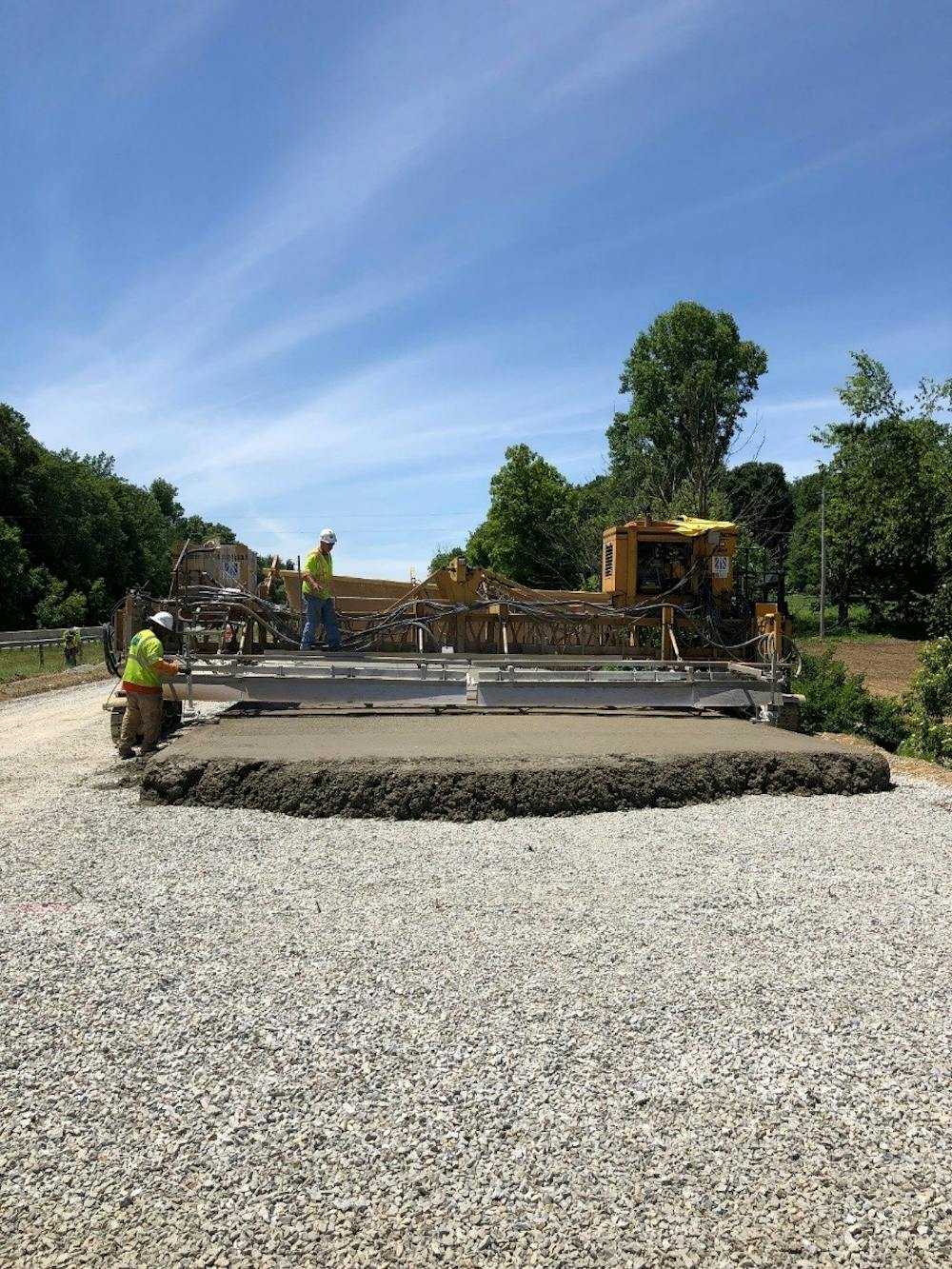
Sensors embedded in concrete pavement acquire information about the infrastructure’s health condition in real time and communicate the data to computers. Electrical signals are applied through the sensors. Concrete’s vibrations are converted into electrical signals that are read and analyzed by lab-built customized software. This enables transportation engineers to make effective and data-driven decisions from opening roads to traffic and to proactively identifying issues that cause damage or deterioration.
After concrete is poured for highway pavement, for example, it takes hours to cure and become strong enough to open for traffic. The timing of when to open a highway depends on when the concrete mix is cured. If a roadway opens too early and the concrete is undercured, it can reduce the life expectancy of the pavement and increase maintenance costs. Waiting too long to open a road can result in traffic delays, congestion and increased safety risks for construction workers and commuters. Curing concrete for massive highway projects requires close attention by engineers in conjunction with the weather specific to that region.
Smart sensors embedded in concrete enable engineers to monitor the infrastructure and make data-driven decisions about when a road can open while retaining maximum life expectancy. Sensors can also help monitor the quality of concrete and whether it is robust enough to withstand traffic flow and corrosion after a roadway is opened. Smart, efficient infrastructure can significantly reduce structural failures, both catastrophic and through normal wear, as well as lead to reduced costs and provide new ways for structural engineers to assess real-time information about the pavement.
[Get our best science, health and technology stories. Sign up for The Conversation’s science newsletter.]
Saving time and money
Congress recognizes the need to invest in American transportation systems. A $494 billion legislation package, the INVEST In America Act, was recently introduced to address America’s deteriorating highways and bridges while diminishing carbon pollution.
Smart sensors and intelligent infrastructure system can enable significant savings of time and money with improved construction safety. Sensors can provide engineers with real-time data of the quality of our infrastructure to make the best decisions for building and maintaining roads, bridges and pavements while improving safety for drivers and construction workers. The addition of self-repairing properties can help build sustainable and long-lasting infrastructure to reduce maintenance and costs.
Luna Lu, ACPA Scholar & Professor Of Civil Engineering, Purdue University and Vishal Saravade, Post-doctoral Scientist, Purdue University
This article is republished from The Conversation under a Creative Commons license. Read the original article.