 How to resolve AdBlock issue?
News
- Details
- Written by: Elizabeth Larson
In a unanimous vote at the end of the nearly two-hour meeting, the board decided to declare the district in the hybrid learning phase, the second step in the Lake County Return to School Continuum, which includes in-person schooling. That transition will be complete by Jan. 4.
As part of that phase two, Lakeport Unified students will be able to return to athletic competitions as soon as the state gives the go-ahead. Under the continuum, athletics can only resume in stages two and above, not in the first phase, distance learning.
On Nov. 9, the board had voted 3-2 during a special meeting to move into the hybrid model on Jan. 4, at the start of the next semester.
However, during its regular Wednesday night meeting, the board was confronted during a discussion on sports events by parents, students and coaches who wanted them to move up the start date to Nov. 30, with the board ultimately agreeing to hold a special meeting Friday to hear information from Public Health Officer Dr. Gary Pace on reopening.
Last week, Superintendent Jill Falconer told the board that Nov. 30 was the earliest staff could be prepared to move to in-person instruction after giving parents at least 10 days' notice.
With the Thanksgiving break now underway, Falconer told the board on Friday night that Nov. 30 is actually the district’s next school day.
That date, Falconer said, is “not an option because we haven’t told parents anything.”
Instead, the board approved a motion offered by Board Chair Dan Buffalo that he said offered an “elegant solution.”
It recognized that the district already is practicing stage two because of having 200 special education and English as a second language students on campus daily; that the board’s Nov. 9 decision declared the district’s movement into the second phase; and gives Jan. 4 as the time by which the transition from distance learning to the phase two hybrid model will be completed.
The board’s nuanced action on Friday night is an attempt to get ahead of what Dr. Pace said during the meeting is a high likelihood of Lake County seeing increased restrictions from the state under its revamped Blueprint for a Safer Economy.
Pace said that within the next week or so Lake could move from the red, or second-most restrictive tier on the blueprint, to purple, the most restrictive.
If that were the case when the district was still in phase one of the back to school plan, it would be unable to open for in-person instruction until the county returned to a lower tier, which Pace said could be well after the Christmas holiday.
Lucerne Elementary and Upper Lake Unified, the county’s two smallest school districts, began the school year with in-person instruction and so far have had no issues with outbreaks, Pace reported.
Separately, some Lake County Office of Education schools have had in-person instruction. The county’s private and Christian schools also have teachers and students together in the classrooms and are capacity for enrollment, Lake County Superintendent of Schools Brock Falkenberg told Lake County News on Friday.
Kelseyville Unified has announced plans to transition to phase two on Nov. 30, and during a special Friday afternoon meeting of the Konocti Unified School Board, Superintendent Dr. Becky Salato said that district is on target to open in the hybrid model on Jan. 5 – so long as the situation doesn’t change.
Middletown Unified this week sent out a survey to parents in which the administration reported that it is projecting January as the time for potentially moving into a stage two or three model.
However, on Friday Middletown Unified followed up with a report that three of its staffers at Coyote Valley Elementary School and Middletown Middle School have tested positive for COVID-19 and are now in quarantine.
20JULY Return2School EngSpan FINALFinal by LakeCoNews on Scribd
Pace updates board on COVID-19 and schools
The Lakeport Unified board met in the Marge Alakszay Center, this time sitting farther apart than at the last meeting, a measure Buffalo said was taken at the direction of Public Health and the district attorney.
They were joined by an in-person audience as well as more than 100 people including parents, and teachers participating via Zoom.
Dr. Pace, who also attended via Zoom, went through a PowerPoint that he has recently presented to other school district boards. The 19-page presentation is published below.
“Things are changing really fast right now, in the state and in the county,” said Pace, but at the same time there is evidence to support the safe opening of schools.
Pace said the United States has tended to prioritize opening restaurants more than supporting on-site learning at schools, while Europe has taken the opposite approach.
He said there is starting to be a marked increase in new cases “and there's no end in sight,” making it a very concerning time.
While he said he believes the state’s tier system is probably one of the best in the country for allowing local control and differentiation between areas, it’s not perfect.
“We are on the verge of going into the purple tier,” said Pace. “Things have really changed in the last two weeks.”
That’s because the majority of the state’s 58 counties are moving into the most restricted tier. “Our numbers are quickly moving that way, he said, adding that there is a very good chance by this time next week the county will be in the purple tier.
As of Friday, Lake’s caseload was at 823, with total deaths remaining at 18.
“I don’t think there’s anything we can do to stop that at this point,” he said of the potential tier change.
Once Lake County is in the purple tier, schools that already are open can remain so, but those that haven’t yet opened won’t be able to, although Pace said elementary schools can pursue waivers to open.
He said the science indicates that children – particularly those age 10 and under – are less susceptible to contracting and spreading COVID-19. As children get older, the chances of contracting the virus increase.
Pace explained during the meeting that of Lake County’s total cases, 100 – or 13-percent – involve children age 18 and under. Of those 100 cases, 22 percent were in children from birth to age 4, 35 percent were in the 5 to 12 age group, and 44 percent were in those ages 13 to 18. One local child has been hospitalized.
However, he said there are risks for teachers. “To ignore that, I think is a mistake.”
Pace said the evidence from Australia and Europe shows that adults are much more likely to introduce the virus into schools than children. “This data has been very reassuring about the risk” from kids transmitting it to adults. There also haven’t been many cases traced to children passing it to each other.
In New York’s schools, they did random testing of 16,000 children three weeks into school reopening and only 28 tested positive. Among 37,000 staff, there were 180 positives. Pace said that in California, only two outbreaks have been registered in schools.
Pace said there is a greater downside to not having students back in class, pointing to declining grades, challenges from poor wifi and disparities for economically disadvantaged children. There also are the impacts on mental health, increases of trauma and domestic violence, substance abuse, lack of sports and loss of socialization.
Keeping schools safe will involve social distancing, limiting congregate activities, using masks, screening for temperatures, conducting testing and having an active response when cases are identified, Pace said.
He said he’s working with the local districts to work out arrangements for testing staff. Currently, the county’s testing site doesn’t test children, although beginning on Dec. 1 it will offer testing for children age 12 and older. Pace said it’s best to go through one’s pediatrician, adding that Tribal Health also has done a good job testing children.
Buffalo asking about long-term impacts of COVID-19. Pace said there’s a lot that’s not known.
He referred to Multisystem Inflammatory Syndrome in Children, or MIS-C, a rare inflammatory condition in children that’s associated with COVID-19. The California Department of Public Health said it can damage multiple organ systems, require hospitalization and be life-threatening.
Signs and symptoms of MIS-C include a fever that does not go away, abdominal pain, vomiting, diarrhea, neck pain, rash, bloodshot eyes or feeling tired. Early diagnosis and treatment of patients is critical to preventing long-term complications, the state reported.
On Friday, the California Department of Public Health said 129 cases of MIS-C have been reported statewide.
While those children get really sick, the vast majority don’t, Pace said.
Board member Carly Alvord asked Pace about the comparisons between COVID-19 and the flu.
He explained that the flu season has a beginning, middle and an end, and tends to be more seasonal. It hasn’t been the same with COVID-19.
The last really bad flu season had a death toll of 100,000, with COVID-19 now having registered 250,000 deaths in eight months, Pace said. “The worst is still ahead of us.”
He pointed out that the 1918 flu pandemic – which he said lasted about a year and a half – had 650,000 deaths.
Pace said COVID-19 is in a “whole other league” from the flu, which he added doesn’t keep students out of school.
Board member Jeannie Markham asked about sports, which Pace acknowledged are important. He said Public Health is following the state guidelines, which were due to be updated with a more elaborate version but stopped by this week’s developments, a reference to the governor’s actions to put more counties in the restricted tier.
“At this point it’s very vague what they're allowing,” he said, which is mainly conditioning.
While “fomite” transmission – through contaminated surfaces and objects – no longer seems to be as much of a concern for contracting COVID-19, Pace said being in indoor spaces, running, breathing deeply from exertion and bumping into each other is.
Alvord asked Pace if he agreed with the statement this week by Centers for Disease Control and Prevention Director Robert Redfield, who said the data suggests children are safest in school.
Pace indicated he agreed, noting that with more evidence the medical community is getting behind that conclusion.
Board agrees on next actions
Following Pace’s presentation, the board then turned to its only agendized action item, the consideration of its scheduled start date.
Falconer said the district had agreed to abide by the return to school continuum, and based on that document, with some students already on campus since the beginning of the school year, she believed the district already was partially in stage two. By declaring it’s in stage two, she said they could begin sports.
Buffalo then offered the motion to make that declaration and abide by its Nov. 9 decision, making Jan. 4 the date for the transition’s completion. He said that compromise also gives staff the necessary time to complete implementing protocols and notify parents.
Markham, herself a retired teacher, said she knows that the district’s teachers will rise to the occasion. “They will be ready for this and rise to that challenge when it’s time.”
She also encouraged students and parents to take advantage of the opportunity to meet with teachers on campus. “Your struggles don’t have to be academic,” she said.
Markham added, “We care about you. We want to see you.”
During public comment, Sheriff Brian Martin, who has a son attending the high school, said he liked what he was hearing from the board and it was a good compromise. Martin had been among those on Wednesday encouraging board members to move up the school start date.
Referring to a COVID-19 outbreak that’s continuing at the jail, “We’ve dealt with this,” Martin said, noting Dr. Pace’s help and guidance, and his willingness to leave decisionmaking up to the individual agencies.
District teacher and parent Tanya Wynacht thanked the board for finding a compromise. She said she wants her students to come to school and also wants her son to be able to enjoy a school year.
The board then took the 5-0 vote to approve the motion, gaining a round of applause before the meeting ended.
Email Elizabeth Larson at
Lake County Public Health officer COVID-19 presentation by LakeCoNews on Scribd
- Details
- Written by: Lake County News reports
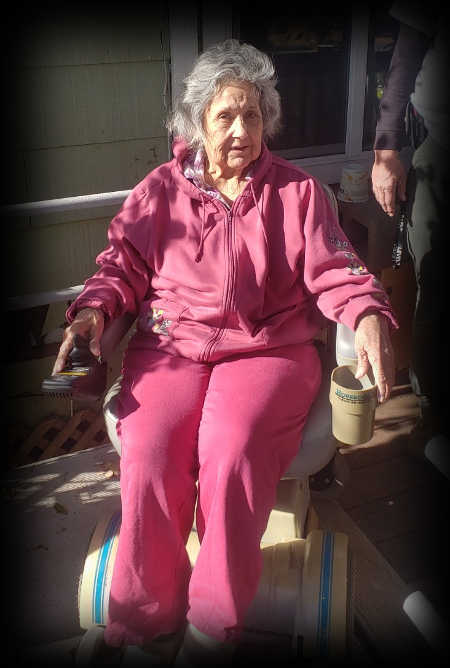
LAKE COUNTY, Calif. – Habitat for Humanity is continuing to offer a variety of services to make homes safer and more comfortable for Lake County residents who need the help.
Referred to Habitat for Humanity by a friend, Margaret and Margie Bartlemus were in desperate need of a ramp for their home.
It has been difficult for Margaret Bartlemus to get her daughter in and out of their home by herself and Margie Bartlemus was unable to easily use a manual wheelchair.
When they reached out to Habitat to request assistance with a ramp, they were fortunate to discover that Habitat also had a motorized scooter available for their use.
Habitat’s repair team discovered the family was also in need of a new stove, a working heating and cooling system, and repairs to a plumbing leak under their sink, all of which they addressed as part of the Brush of Kindness Critical Home Repair Program.
“Everything they have done has been wondrous,” Margie Bartlemus said. “This ramp was a miracle for me because I only had four steps to climb but they were so difficult. I want to thank them for all of the things that they did. If they can help someone else, I say trust them. They are good people.
To date, Habitat for Humanity Lake County has assisted approximately 300 homeowners with repairs to their homes. They expect to complete as many additional families as possible for 2021 and are accepting applications now.
Brush of Kindness recipients are typically seniors and military veterans who may be disabled and unable to effect repairs on their own.
In addition to Habitat’s homeownership program, critical health and safety-related repair work has become one of Habitat Lake County’s primary goals.
Donations to the Critical Home Repair Fund, especially for wheelchair ramps and lifts are critical to the program’s success.
To donate, or if you or someone you know are low-income homeowners who could benefit from critical health and safety-related repairs, please contact Habitat for Humanity Lake County at 707-994-1100 for an application or visit the office at 15312 Lakeshore Drive in Clearlake.
- Details
- Written by: Pamela M. Aaltonen, Purdue University

As Americans prepare for the first Thanksgiving in the time of the coronavirus, the Centers for Disease Control and Prevention issued a stark warning a week before the big day: Don’t travel.
No over the river and through the woods to grandmother’s condo. No flying to a beach gathering with the family you choose.
And if it sounds like the CDC is trying to be like the Grinch who stole Thanksgiving, it is important to remember the grim statistic of more than a quarter of a million people dead from COVID-19. There is no mistaking: The coronavirus is out of control.
Ultimately, lowering the staggering numbers of COVID-19 cases and deaths lies squarely with us. Yes, governments can mandate actions; but we’re the ones responsible for adhering to them. Our failure is clear when you look at the latest numbers: Deaths from the virus are projected to soon approach 2,000 Americans a day, and cases continue to climb in the vast majority of states.
If national numbers don’t spur action, will it help to localize the problem? You can find out what’s happening closer to home here at the Johns Hopkins Coronavirus Resource Center. Drill down to see the data in your state and county, then take a moment to pause and consider the catastrophic consequences. It’s still within our power to reverse course and lower these numbers. But as a public health scholar and researcher, I can tell you that as infections increase, the more difficult that becomes.
Even the rural states of North Dakota, South Dakota, Iowa and Wyoming are experiencing tremendous surges. Exhausted hospitals and health care workers across the U.S. are becoming overwhelmed, if not already there. Overwhelmed systems place care at risk. Those with other health conditions need medical intervention and hospitalization. And those with a lax attitude about COVID-19 put themselves at increased risk for negative health outcomes.
Changing behavior is a must
Modifying our behavior minimizes the chances to spread infection. But this is a big task. Government actions are most effective when based on local data and the option to loosen or tighten restrictions based on solid information. We should not view these actions as an attempt to take away our civil liberties. Instead, we should think of them as liberating, a way to keep us away from the virus.
It is not too late to modify your behavior if you’ve been reluctant to accept the realities of the virus. With promising vaccines on the horizon, our challenge as individuals is to reduce current infection numbers. And to do that, everyone must commit to established public health strategies.
A dozen things you can do
-
Always mask up when indoors and around people who don’t live in your household.
-
Always mask up when outdoors and unable to maintain physical distancing.
-
Use either disposable masks or a multi-layer tightly woven cotton mask. Single-layer kerchiefs are insufficient.
-
When you mask up, make sure it fits your face and covers both nose and mouth. Wash or sanitize your hands after touching or removing the mask.
-
Remember that masks are not a substitute for physical distancing.
-
Maintain at least six feet of distance between you and others outside of your household.
-
Wash your hands frequently with soap and water for 20 seconds, or use a hand sanitizer with at least 60% alcohol.
-
Avoid motions that transfer organisms from your hands to your face. Your mouth, nose and eyes have mucous membranes that are potentially receptive to these organisms.
-
Clean frequently touched surfaces.
-
Do as much as possible outside and keep interactions with others short.
-
Fortify ventilation systems for more frequent air exchanges.
-
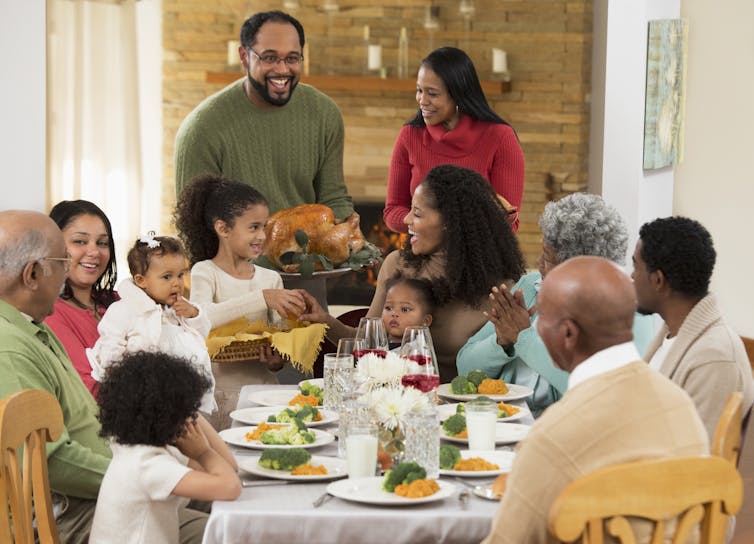
Curtail in-person holiday celebrations with those not in your household.
Celebrations are particularly challenging because it’s difficult for everyone to self-quarantine for the 14 days prior to the event. Also, events are typically inside rather than out; spacing of six feet may not be an option; ventilation systems in our energy-efficient homes are likely COVID-19-insufficient; and one cannot be masked while eating.
[Deep knowledge, daily. Sign up for The Conversation’s newsletter.]
So for Thanksgiving, do a virtual gathering instead. Cook the same menu in different houses to promote a sense of sharing. Send e-cards to each other with a personal note and wish for a good holiday. Or do a Zoom call where all can speak and express thankfulness for the ability to still be able to connect this year.
It is not unusual for COVID-19 patients to rage when they discover that those around them dismissed or downplayed the wisdom and experience of scientists and doctors about the realities of the pandemic. But there is no need to give up, even in the face of increasingly frightening statistics. Instead, now is the time we need to commit not just to ourselves, but to one another. What’s standing in the way of curtailing the numbers of COVID-19 cases, hospitalizations and deaths is us.
Pamela M. Aaltonen, Professor Emerita; Immediate Past President, APHA, Purdue University
This article is republished from The Conversation under a Creative Commons license. Read the original article.
- Details
- Written by: DENNIS FORDHAM
California’s Proposition 19 (passed in 2020) amends existing local property tax reassessment rules (i.e., California’s Proposition 13 and 58) in its Constitution.
Proposition 19 affects two categories of residents: first, seniors, severely disabled and victims of wildfire or natural disaster who relocate within California; second, families who transfer real properties between generations.
Effective April 1, 2021, “an owner of a primary residence who is over 55 years of age, severely disabled, or a victim of a wildfire or natural disaster may transfer the taxable value of their primary residence to a replacement primary residence located anywhere in this state, regardless of the location or value of the replacement primary residence, that is purchased or newly constructed as that person’s principal residence within two years of the sale of the original primary residence.” (https://vig.cdn.sos.ca.gov/2020/general/pdf/topl-prop19.pdf )
This is welcome news for seniors, disabled persons, and wildfire/disaster victims who are no longer restricted to relocating within their existing county.
“For any transfer of taxable value to a replacement primary residence of equal or lesser value than the original primary residence, the taxable value of the replacement primary residence shall be deemed to be the taxable value of the original primary residence.”
“For any transfer of taxable value to a replacement primary residence of greater value than the original primary residence, the taxable value of the replacement primary residence shall be calculated by adding the difference between the full cash value of the original primary residence and the full cash value of the replacement primary residence to the taxable value of the original primary residence.” Thus, the new residence’s additional value is added to the prior residence’s old tax base.
A person seeking to transfer their residence’s tax assessed value must file an application with the assessor in the county of the new residence. Seniors and severely disable property owners may transfer their old residence’s property tax basis up to three times in their lifetime. No such restriction applies to fire and disaster victims.
Next, under existing law (Proposition 58) a parent can transfer their family residence, family farm and up to $1 million in assessed value of other real properties to their children (either during the parent’s life or at death) without changing the property’s assessed value. Similarly a grandparent to grandchild exclusion applies when the grandchild’s parent (who is the child of the grandparent) is deceased.
Effective February 16, 2021, the parent-child and grandparent-grandchild exclusions from property tax reassessment only apply to transfers of a family home and only if the child or grandchild, as relevant, moves into the family home within 1 year of the transfer. Furthermore, for family homes where the current value at time of transfer exceeds its existing tax assessment (in the hands of the transferor) by more than $1 million (to be adjusted annually), then the excess value is added to the existing assessed value to compute the current assessed value.
Some residents may make wish to transfer real properties to their children (or grandchildren) prior to Feb. 16, 2021, in order to take advantage of existing law.
However, the children and grandchildren will not get a step-up in basis at the death of the transferor parent or grandparent. Rather, they will get the transferor’s adjusted basis in the property at time of transfer. When the children sell the property, they will pay capital gains tax on the difference between their basis and the sales price.
It is expected that the tax revenue lost by giving seniors, disabled persons and fire/disaster victims tax relief is more than made up with tax revenue gains on transfers to children and certain transfers to grandchildren. The revenue funds California’s fire-fighting and local schools.
Dennis A. Fordham, attorney, is a State Bar-Certified Specialist in estate planning, probate and trust law. His office is at 870 S. Main St., Lakeport, Calif. He can be reached at