 How to resolve AdBlock issue?
News
- Details
- Written by: Robert Sanders
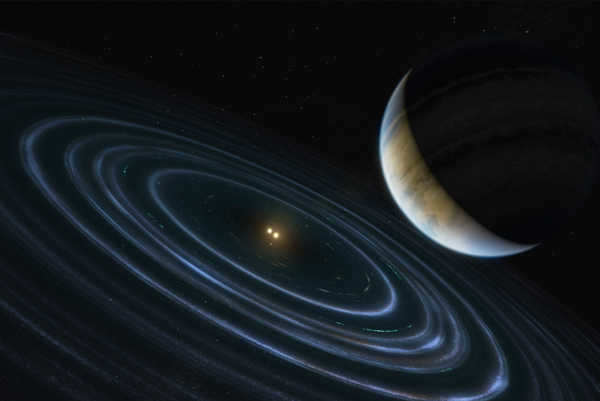
BERKELEY, Calif. – Astronomers are still searching for a hypothetical “Planet Nine” in the distant reaches of our solar system, but an exoplanet 336 light years from Earth is looking more and more like the Planet Nine of its star system.
Planet Nine, potentially 10 times the size of Earth and orbiting far beyond Neptune in a highly eccentric orbit about the sun, was proposed in 2012 to explain perturbations in the orbits of dwarf planets just beyond Neptune’s orbit, so-called detached Kuiper Belt objects. It has yet to be found, if it exists.
A similarly weird extrasolar planet was discovered far from the star HD 106906 in 2013, the only such wide-separation planet known. While much heavier than the predicted mass of Planet Nine — perhaps 11 times the mass of Jupiter, or 3,500 times the mass of Earth — it, too, was sitting in a very unexpected location, far above the dust plane of the planetary system and tilted at an angle of about 21 degrees.
The big question, until now, has been whether the planet, called HD 106906 b, is in an orbit perpetually bound to the binary star — which is a mere 15 million years old compared to the 4.5 billion-year age of our sun — or whether it’s on its way out of the planetary system, never to return.
In a paper appearing Dec. 10 in The Astronomical Journal, astronomers finally answer that question. By precisely tracking the planet’s position over 14 years, they determined that it is likely bound to the star in a 15,000-year, highly eccentric orbit, making it a distant cousin of Planet Nine.
If it is in a highly eccentric orbit around the binary, “This raises the question of how did these planets get out there to such large separations,” said Meiji Nguyen, a recent UC Berkeley graduate and first author of the paper. “Were they scattered from the inner solar system? Or, did they form out there?”
According to senior author Paul Kalas, University of California, Berkeley, adjunct professor of astronomy, the resemblance to the orbit of the proposed Planet Nine shows that such distant planets can really exist, and that they may form within the first tens of millions of years of a star’s life. And based on the team’s other recent discoveries about HD 106906, the planet seems to favor a scenario where passing stars also play a role.
“Something happens very early that starts kicking planets and comets outward, and then you have passing stars that stabilize their orbits,” he said. “We are slowly accumulating the evidence needed to understand the diversity of extrasolar planets and how that relates to the puzzling aspects of our own solar system.”
A young, dusty star with a weird planet
HD 106906 is a binary star system located in the direction of the constellation Crux. Astronomers have studied it extensively for the past 15 years because of its prominent disk of dust, which could be birthing planets. Our solar system may have looked like HD 106906 about 4.5 billion years ago as the planets formed in the swirling disk of debris left over from the formation of the sun.
Surprisingly, images of the star taken in 2013 by the Magellan Telescopes in Chile revealed a planet glowing from its own internal heat and sitting at an unusually large distance from the binary: 737 times farther from the binary than Earth is from the sun (737 astronomical units, or AU). That’s 25 times farther from the star than Neptune is from the sun.
Kalas, who searches for planets and dust disks around young stars, co-led a team that used the Gemini Planet Imager on the Gemini South Telescope to obtain the first images of the star’s debris disk. In 2015, these observations provided evidence that led theorists to propose that the planet formed close to the binary star and was kicked out because of gravitational interactions with the binary. The evidence: The stars’ outer dust disk and inner comet belt are lopsided, suggesting that something — the planet — perturbed their symmetry.
“The idea is that every time the planet comes to its closest approach to the binary star, it stirs up the material in the disk,” said team member Robert De Rosa of the European Southern Observatory in Santiago, Chile, who is a former UC Berkeley postdoctoral fellow. "So, every time the planet comes through, it truncates the disk and pushes it up on one side. This scenario has been tested with simulations of this system with the planet on a similar orbit — this was before we knew what the orbit of the planet was.”
The problem, as pointed out by those simulating such planet interactions, is that a planet would normally be kicked out of the system entirely, becoming a rogue planet. Some other interaction, perhaps with a passing star, would be necessary to stabilize the orbit of an eccentric planet like HD 106906 b.
A similar scenario has been proposed for the formation of Planet Nine: that its interaction with our giant planets early in our solar system’s history kicked it out of the inner solar system, after which passing stars in our local cluster stabilized its orbit.
Kalas went looking for such a fly-by star for HD 106906 b, and last year he and De Rosa, then at Stanford University, reported finding several nearby stars that would have zipped by the planetary system 3 million years earlier, perhaps providing the nudge needed to stabilize the planet’s orbit.
Now, with precise measurements of the planet’s orbit between 2004 and 2018, Nguyen, de Rosa and Kalas present evidence that the planet is most likely in a stable, but very elliptical, orbit around its binary star.
“Though it's only been 14 years of observations, we were still able to, surprisingly, get a constraint on the orbit for the first time, confirming our suspicion that it was very misaligned and also that the planet is on an approximately 15,000-year orbit.” Nguyen said. “The fact that our results are consistent with predictions is, I think, a strong piece of evidence that this planet is, indeed, bound. In the future, a radial velocity measurement is needed to confirm our findings.”
The science team’s orbital measurements came from comparing astrometric data from the European Space Agency’s Gaia observatory, which accurately maps the positions of billions of stars, and images from the Hubble Space Telescope. Because Hubble must obscure the glare from the binary star to see the dimmer debris disk, astronomers were unable to determine the exact position of the star relative to HD 106906 b. Gaia data allowed the team to determine the binary’s position more precisely, and thus chart the movement of the planet relative to the binary between 2004 and 2018, less than one-thousandth of its orbital period.
“We can harness the extremely precise astrometry from Gaia to infer where the primary star should be in our Hubble images, and then measuring the position of the companion is rather trivial,” Nguyen said.
In addition to confirming the planet’s 15,000-year orbit, the team found that the orbit is actually tilted much more severely to the plane of the disk: between 36 and 44 degrees. At its closest approach to the binary, its elliptical orbit would take it no closer than about 500 AU from the stars, implying that it has no effect on inner planets also suspected to be part of the system. That is also the case with Planet Nine, which has no observed effect on any of the sun’s eight planets.
“What I really think makes HD 106906 unique is that it is the only exoplanet that we know that is directly imaged, surrounded by a debris disk, misaligned relative to its system and is widely separated,” Nguyen said. “This is what makes it the sole candidate we have found thus far whose orbit is analogous to the hypothetical Planet Nine.”
The work was supported by the National Science Foundation (AST-1518332) and the National Aeronautics and Space Administration (NNX15AC89G, NNX15AD95G, HST-GO-14670/NAS5-26555). This work benefited from NASA’s Nexus for Exoplanet System Science (NExSS) research coordination network sponsored by NASA's Science Mission Directorate.
Robert Sanders writes for the UC Berkeley News Center.
- Details
- Written by: Lake County News reports
The transition is effective Monday, Dec. 28, at 8 a.m. in Sonoma, Lake, Napa, Colusa, Yolo, and Solano counties.
It’s the latest fire season transition over the past decade, which has seen the fire season extend further into the late fall and early winter months.
Sonoma-Lake-Napa Unit Chief Shana Jones reminded residents that safe residential pile burning of forest residue by landowners is a crucial tool in reducing fire hazards.
State, federal and local land management and fire agencies will also be utilizing this same window of opportunity to conduct prescribed burns aimed at improving forest health on private and public lands.
Cal Fire will continue to maintain staffing to meet any potential threat, as well as maintaining the ability to strategically move resources to areas that remain at a higher threat level.
Cal Fire also will continue to monitor weather conditions closely and still has the ability to increase staffing should weather conditions change or if there is a need to support wildfires or other emergencies in other areas of the state.
The 2020 fire season has been a very active year, even more so than in 2019. Statewide, Cal Fire and firefighters from many local agencies responded to over 8,000 wildfires within the State
Responsibility Area that burned over 1.4 million acres.
In the Sonoma-Lake-Napa Unit, Cal Fire responded to over 600 wildfires that charred over 434,000 acres.
During the cooler winter months, Cal Fire will continue to actively focus efforts on fire prevention and fuels treatment activities as guided by the state’s Strategic Fire Plan and localized unit fire plans.
These will be done through public education, prescribed burns and various types of fuel reduction projects. These activities are aimed at reducing the impacts of large, damaging wildfires, public safety and improving overall forest health.
Residents are urged to still take precautions outdoors in order to prevent sparking a wildfire. A leading cause of wildfires this time of year is from escaped landscape debris burning. Before you burn, ensure it is a permissive burn day by contacting the local air quality district and then make sure you have any and all required burn permits.
During burning, make sure that piles of landscape debris are no larger than 4 feet in diameter, provide a 10-foot clearance down to bare mineral soil around the burn pile and ensure that a responsible adult is in attendance at all times with a water source and a shovel.
For more ways to burn safely visit www.ReadyForWildfire.org.
- Details
- Written by: Elizabeth Larson
The following dogs are ready for adoption or foster.

“Bella” is a female Siberian Husky mix.
She has a long red and white coat.
She is dog No. 4428.

‘Ben’
“Ben” is a male American Pit Bull terrier mix.
He has a short brindle coat.
He is dog No. 4454.

‘Brownie’
“Brownie” is a male Chihuahua with a short black and tan coat.
He is dog No. 4431.

‘Bruce’
“Bruce” is a male American Staffordshire Terrier mix puppy.
He has a short smooth yellow coat.
He is dog No. 4383.

‘Bumble’
“Bumble” is a male Siberian Husky with a gray and black coat.
He is dog No. 4452.

‘Cindy Lou’
“Cindy Lou” is a female German Shepherd mix.
She has a medium-length tan and black coat.
She is dog No. 4448.

‘Jack’
“Jack” is a male Labrador Retriever mix with a short yellow coat.
He is dog No. 4155.

‘Jerry’
“Jerry” is a male American Pit Bull terrier with a short brindle coat.
He is dog No. 4455.

‘Rudolph’
“Rudolph” is a male shepherd mix.
He has a short tan and black coat.
He is dog No. 4436.

“Sadie” is a female American Pit Bull terrier mix with a short black and white coat.
She is dog No. 4460.

‘Sugarplum’
‘Sugarplum’ is a female German Shepherd mix.
She has a medium-length black coat.
She is dog No. 4447.

‘Tinsle’
“Tinsle” is a female American Pit Bull Terrier mix puppy.
She has a short brindle and brown coat.
She is dog No. 4433.

‘Toby’
“Toby” is a male boxer mix.
He has a short tan and white coat.
He is dog No. 4389.

‘Yule’
“Yule” is a husky of undetermined gender with a black and white coat.
Yule is dog No. 4432.
Call the Clearlake Animal Control shelter at 707-273-9440, or email
Visit Clearlake Animal Control on Facebook or on the city’s website.
Email Elizabeth Larson at
- Details
- Written by: NATIONAL AERONAUTICS AND SPACE ADMINISTRATION
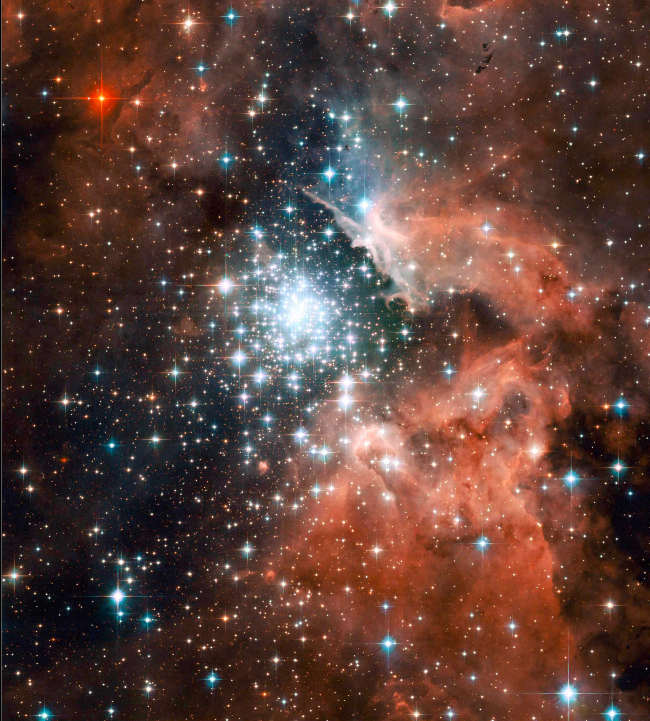
Thousands of sparkling young stars are nestled within the giant nebula NGC 3603, one of the most massive young star clusters in the Milky Way Galaxy.
NGC 3603, a prominent star-forming region in the Carina spiral arm of the Milky Way about 20,000 light-years away, reveals stages in the life cycle of stars.
Powerful ultraviolet radiation and fast winds from the bluest and hottest stars have blown a big bubble around the cluster.
Moving into the surrounding nebula, this torrent of radiation sculpted the tall, dark stalks of dense gas, which are embedded in the walls of the nebula.
These gaseous monoliths are a few light-years tall and point to the central cluster. The stalks may be incubators for new stars.
On a smaller scale, a cluster of dark clouds called "Bok" globules resides at the top, right corner. These clouds are composed of dense dust and gas and are about 10 to 50 times more massive than the sun.
Resembling an insect's cocoon, a Bok globule may be undergoing a gravitational collapse on its way to forming new stars.
The nebula was first discovered by Sir John Herschel in 1834.