 How to resolve AdBlock issue?
News
- Details
- Written by: Lake County News reports
One thing that will look familiar: The California Highway Patrol will be out removing impaired drivers from the road and assisting those in need.
“Heading into the new year, the mission of the CHP is unchanged to provide the highest level of Safety, Service, and Security,” CHP Commissioner Amanda Ray said. “Together, with the public’s commitment to safe and sober driving, our officers will continue to work to make California’s roadways safe for all who use them.”
This year more than ever, the safest New Year’s Eve is one spent at home.
To encourage safe travel for those who are on the road, the CHP will enact a maximum enforcement period, or MEP, starting at 6:01 p.m. on Thursday, Dec. 31, continuing through 11:59 p.m. on Sunday, Jan. 3.
To help bolster its holiday traffic safety effort, the CHP will partner with the National Highway Transportation Safety Administration and the Washington, Oregon, Idaho, Arizona, Nevada, Montana, Wyoming, North Dakota and South Dakota state patrols in a Western States Traffic Safety Coalition for the “Drive High, get a DUI,” campaign.
With the focus of the New Year’s operation to identify and remove impaired drivers from the road, the CHP will ensure a contingent of its 579 drug recognition evaluators are available to perform evaluations.
At least three people were killed in crashes in California during the previous New Year’s MEP. During that 30-hour traffic safety effort, the CHP made 491 arrests for driving under the influence.
For daily MEP updates and other valuable traffic safety-related information, follow @CHP_HQ on Twitter.
- Details
- Written by: LAKE COUNTY NEWS REPORTS
Informed by growing evidence of the decreased risks and increased benefits of in-person instruction – especially for our youngest students – Gov. Newsom is advancing a strategy that will help create safe learning environments for students and safe workplaces for educators and other school staff.
The plan was developed in partnership with the Legislature, and the governor will propose an early action package to ensure schools have the resources necessary to successfully implement key safety precautions and mitigation measures.
Components of the plan will be launched in the coming weeks.
“As a father of four, I know firsthand what parents, educators and pediatricians continue to say: in-person is the best setting to meet not only the learning needs, but the mental health and social-emotional needs of our kids,” said Newsom. “In the midst of this pandemic, my administration is focused on getting students back into the classroom in a way that leads with student and teacher health. By focusing on a phased approach with virus mitigation and prevention at the center, we can begin to return our kids to school to support learning needs and restore the benefits of in-person instruction. It’s especially important for our youngest kids, those with disabilities, those with limited access to technology at home and those who have struggled more than most with distance learning.”
The administration’s strategy focuses on ensuring implementation and building confidence by bringing back the youngest children (TK-2) and those who are most vulnerable first, then phasing in other grade levels through the spring. This phased-in return recognizes that younger children are at a lower risk of contracting and transmitting COVID-19.
At the same time, distance learning will remain an option for parents and students who choose it and for those whose health status does not allow them to return to school in the near term. Please find additional details about the rationale behind the plan here.
California’s Safe Schools for All framework to safe reopening of in-person instruction is built on four pillars:
Funding to support safe reopening: The budget will propose for immediate action in January, $2 billion to support safety measures – including testing, ventilation and PPE – for schools that have resumed in-person instruction or phasing in of in-person instruction by early spring.
Safety and mitigation measures for classrooms: To further ensure health and safety in the classroom, the Administration will support implementation of key health measures. This will include frequent testing for all students and staff, including weekly testing for communities with high rates of transmission; masks for all students and staff, including distribution of millions of surgical masks for school staff; improved coordination between school and health officials for contact tracing; and prioritization of school staff for vaccinations.
Hands-on oversight and assistance for schools: Dr. Naomi Bardach, a UCSF pediatrician and expert on school safety, will lead the Safe Schools for All Team, a cross-agency team composed of dedicated staff from CDPH, Cal/OSHA, and educational agencies. The team will provide hands-on support to help schools develop and implement their COVID-19 Safety Plans. These supports include school visits and walk-throughs as needed, webinars and training materials and ongoing technical assistance.
Transparency and accountability for families and staff: A state dashboard will enable all Californians to see their school’s reopening status, level of available funding and data on school outbreaks. Additionally, a web-based “hotline” will empower school staff and parents to report concerns to the Safe Schools for All Team, which will lead to escalating levels of intervention beginning with technical assistance and ending with legal enforcement.
Find additional details about the components of the plan here.
“These four pillars will serve as tools to safely guide our state’s return to in-person instruction and protect the health of students, educators and all school staff,” said CHHS Secretary Dr. Mark Ghaly. “As a pediatrician and father, I know schools are the best place our kids can be and the positive impact in-person learning has on their overall health and well-being.”
- Details
- Written by: Laurel Mellin, University of California, San Francisco

After a year of toxic stress ignited by so much fear and uncertainty, now is a good time to reset, pay attention to your mental health and develop some healthy ways to manage the pressures going forward.
Brain science has led to some drug-free techniques that you can put to use right now.
I am health psychologist who developed a method that harnesses our rip-roaring emotions to rapidly switch off stress and activate positive emotions instead. This technique from emotional brain training is not perfect for everyone, but it can help many people break free of stress when they get stuck on negative thoughts.
Why the stress response is so hard to turn off
Three key things make it hard to turn off stress-activated negative emotions:
-
First, our genes make us worrywarts. Our hunter-gatherer ancestors survived by assuming every rustle in the grasses was a lurking hungry lion, not harmless birds hunting for seeds. We’re essentially programmed to be hyperaware of threats, and our brains rapidly launch stress chemicals and negative emotions in response.
-
Second, the chemical cascade of stress hormones in the brain associated with negative emotions impairs cognitive flexibility, goal-directed behavior and self-control.
-
Third, our tendency to avoid dealing with negative emotions puts people in a perpetual cycle of ignoring unpleasant feelings, which amplifies stress and the risk of emotional health problems.
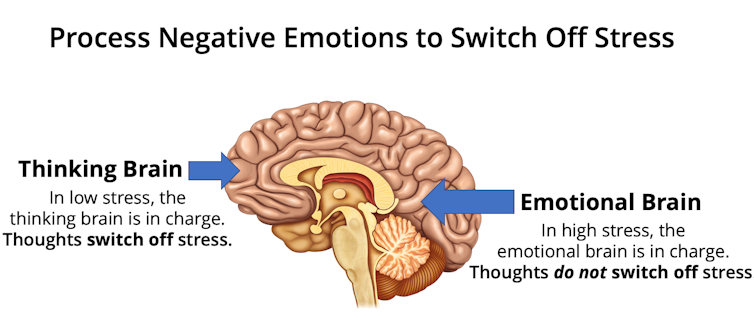
Traditional approaches for coping with stress were based on cognitive-behavioral therapy, which focuses on modifying patterns of thinking and behavior. It was developed before our modern understanding of stress overload.
Researchers at New York University discovered a paradox: Although cognitive methods were effective in low-stress situations, they were less effective when dealing with the high stress of modern life.
Emotional brain training works with these high-stress emotions in an effort to tame them, releasing negative emotions as the first of two steps in preventing stress overload.
Step 1: Release negative emotions
The only negative emotion in the brain that supports taking action rather than avoidance and passivity is anger.
Studies have shown that the suppression of anger is associated with depression and that suppressing anger doesn’t reduce the emotion. Healthy release of anger instead has been found to reduce other stress-related health risks.
Our technique is to switch off stress overload by using a controlled burst of anger to help the brain exert better emotional control and allow emotions to flow rather than become chronic and toxic. After that first short burst, other feelings can flow, starting with sadness to grieve the loss of safety, then fear and regret, or what we would do differently next time.
You can talk yourself through the stages. To experiment with the process, use these simple phrases to express the negative feelings and release your stress: “I feel angry that …”; “I feel sad that …”; “I feel afraid that …”; and “I feel guilty that …”
Step 2. Express positive emotions
After releasing negative emotions, positive emotions can naturally arise. Express these feelings using the same approach: “I feel grateful that …”; “I feel happy that …”; “I feel secure that …”; and “I feel proud that …”
Your mindset can quickly change, a phenomenon that has many potential explanations. One explanation is that in positive states, your brain’s neural circuits that store memories from when you were in the same positive state in the past can be spontaneously activated. Another is that the switch from negative to positive emotions quiets your sympathetic nervous system – which triggers the fight-or-flight response – and activates the parasympathetic system, which acts more like a brake on strong emotions.
Here’s what the whole stress relief process might look like like for me right now:
-
I feel angry that we’re all isolated and I can’t see my new grandson Henry.
-
I hate it that everything is so messed up! I HATE THAT!!!
-
I feel sad that I am alone right now.
-
I feel afraid that this will never end.
-
I feel guilty that I am complaining! I am lucky to be alive and have shelter and love in my life.
Then the positive:
-
I feel grateful that my daughter-in-law sends me photos of Henry.
-
I feel happy that my husband and I laughed together this morning.
-
I feel secure that this will eventually pass.
-
I feel proud that I am doing the best I can to cope.
After a daunting year, and with more challenges ahead in 2021, upgrading your approach to emotions can be a drug-free mood booster. Our COVID-19 fears need not consume us. We can outsmart the brain’s fear response and find moments that sparkle with promise.
[Get our best science, health and technology stories. Sign up for The Conversation’s science newsletter.]
Laurel Mellin, Associate Professor Emeritus of Family & Community Medicine and Pediatrics, University of California, San Francisco
This article is republished from The Conversation under a Creative Commons license. Read the original article.
- Details
- Written by: Elizabeth Larson
Chief Justice Tani Cantil-Sakauye signed the order in response to Presiding Judge Michael Lunas’ request for emergency relief under Government Code section 68115(a)(10), which addresses court operations during a state of emergency.
The order extends the time in section 1382 of the Penal Code for the holding of a criminal trial by not more than 30 days. In this case, it’s applicable only to cases in which the statutory deadline otherwise would expire from Dec. 30. The deadline is now extended to Jan. 28.
Court officials reported that they sought the order “as a result of the increasing COVID-19 cases both locally and statewide.”
This is the fifth emergency order the state has approved for the Lake County Superior Court to allow for the adjustment of court operations during the pandemic. Previous orders were issued on March 16 and March 27, April 28 and Aug. 14, according to the order the chief justice signed Tuesday.
Earlier this month, Lunas also ordered that trials would not resume before Dec. 30 and moved most of the court proceedings – with few exceptions – online in the wake of Lake County moving into the most restrictive tier on the state’s Blueprint for a Safer Economy.
In the weeks since, the court has confirmed that two employees have tested positive for COVID-19.
Court officials said Tuesday that no jury trial will take place before Jan. 27, so anyone who has received a jury summons for any date prior to that is not required to appear.
As for the impact on court operations, Court Executive Officer Krista LeVier told Lake County News, “While there are other jury trials that will be continued, the emergency order only impacts two in-custody defendants who have not waived their right to a trial within the statutory time frames.”
The court said all safety measures remain in place, including mandatory remote appearances in nearly all proceedings.
Details about court operations are updated at the court’s website, www.lake.courts.ca.gov.
Email Elizabeth Larson at