 How to resolve AdBlock issue?
News
- Details
- Written by: Elizabeth Larson
Dogs available for adoption this week include mixes of German Shepherd, heeler, husky, Labrador Retriever, mastiff, pit bull, shepherd and Yorkshire Terrier.
Dogs that are adopted from Lake County Animal Care and Control are either neutered or spayed, microchipped and, if old enough, given a rabies shot and county license before being released to their new owner. License fees do not apply to residents of the cities of Lakeport or Clearlake.
The following dogs at the Lake County Animal Care and Control shelter have been cleared for adoption (additional dogs on the animal control Web site not listed are still “on hold”).
Call Lake County Animal Care and Control at 707-263-0278 or visit the shelter online at http://www.co.lake.ca.us/Government/Directory/Animal_Care_And_Control.htm for information on visiting or adopting.

Male mastiff
This young male mastiff has a short tan coat.
He is in kennel No. 18, ID No. 14240.

Male pit bull
This male pit bull has a short brindle and brown coat.
He is in kennel No. 20, ID No. 14218.

Male husky
This male husky has a medium-length black and white blue eyes.
He has been spayed.
He’s in kennel No. 21, ID No. 14194.

Male husky
This male husky has a long gray and white coat and blue eyes.
He is in kennel No. 23, ID No. 14247.

Female pit bull terrier
This female pit bull terrier has a short gray coat.
She is in kennel No. 24, ID No. 14248.

Male German Shepherd
This young male German Shepherd has a long black and tan coat.
Shelter staff said he should not go to a home with livestock.
He is in kennel No. 25, ID No. 14253.

Male Yorkshire Terrier
This male Yorkshire Terrier has a medium-length brown and black coat.
He has been neutered.
He is in kennel No. 27, ID No. 14244.

Male shepherd mix
This male shepherd mix has a medium-length tricolor coat.
He has been altered.
He’s in kennel No. 28, ID No. 14241.

Male heeler-Labrador Retriever
This male heeler-Labrador Retriever mix has a short black and white coat.
He is in kennel No. 29, ID No. 14178.
Email Elizabeth Larson at
- Details
- Written by: Rebecca Dzombak
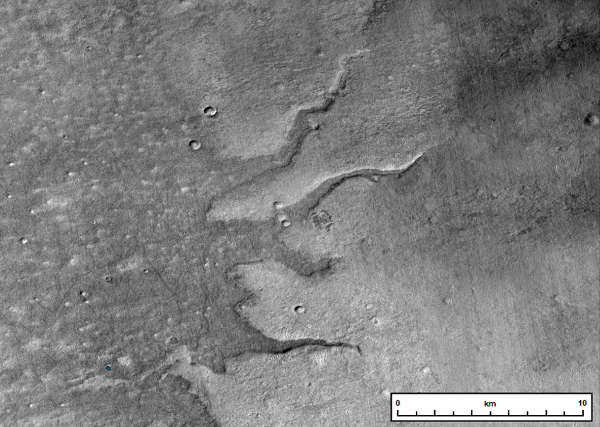
It took 15 years of imaging and nearly three years of stitching the pieces together to create the largest image ever made, the 8-trillion-pixel mosaic of Mars’ surface.
Now, the first study to utilize the image in its entirety provides unprecedented insight into the ancient river systems that once covered the expansive plains in the planet’s southern hemisphere. These three billion-year-old sedimentary rocks, like those in Earth’s geologic record, could prove valuable targets for future exploration of past climates and tectonics on Mars.
The work, published in December in Geology, complements existing research into Mars’ hydrologic history by mapping ancient fluvial (river) ridges, which are essentially the inverse of a riverbed.
“If you have a river channel, that’s the erosion part of a river. So, by definition, there aren't any deposits there for you to study,” Jay Dickson, lead author on the paper, explained. “You have rivers eroding rocks, so where did those rocks go? These ridges are the other half of the puzzle.”
Using the mosaic, as opposed to more localized imagery, let the researchers solve that puzzle on a global scale.
Mars used to be a wet world, as evidenced by rock records of lakes, rivers, and glaciers. The river ridges were formed between 4 and 3 billion years ago, when large, flat-lying rivers deposited sediments in their channels (rather than only having the water cut away at the surface).
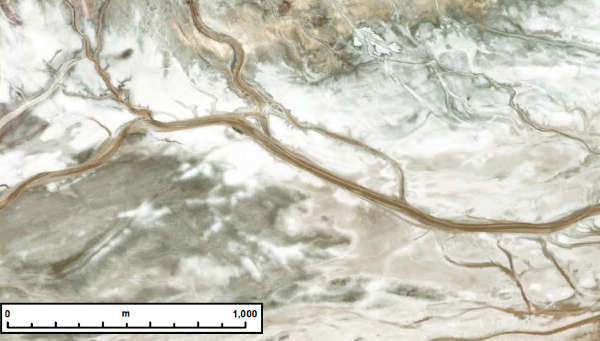
Similar systems today can be found in places like southern Utah and Death Valley in the U.S., and the Atacama Desert in Chile. Over time, sediment built up in the channels; once the water dried up, those ridges were all that was left of some rivers.
The ridges are present only in the southern hemisphere, where some of Mars’ oldest and most rugged terrain is, but this pattern is likely a preservation artifact.
“These ridges probably used to be all over the entire planet, but subsequent processes have buried them or eroded them away,” Dickson said. “The northern hemisphere is very smooth because it’s been resurfaced, primarily by lava flows.”
Additionally, the southern highlands are “some of the flattest surfaces in the solar system,” said Woodward Fischer, who was involved in this work. That exceptional flatness made for good sedimentary deposition, allowing the creation of the records being studied today.
Whether or not a region has fluvial ridges is a basic observation that wasn’t possible until this high-resolution image of the planet’s surface was assembled. Each of the 8 trillion pixels represents 5 to 6 square meters, and coverage is nearly 100 percent, thanks to the “spectacular engineering” of NASA’s context camera that has allowed it to operate continuously for well over a decade.
An earlier attempt to map these ridges was published in 2007 by Rebecca Williams, a co-author on the new study, but that work was limited by imagery coverage and quality.
“The first inventory of fluvial ridges using meter-scale images was conducted on data acquired between 1997 and 2006,” Williams said. “These image strips sampled the planet and provided tantalizing snapshots of the surface, but there was lingering uncertainty about missing fluvial ridges in the data gaps.”
The resolution and coverage of Mars’ surface in the mosaic has eliminated much of the team’s uncertainty, filling in gaps and providing context for the features. The mosaic allows researchers to explore questions at global scales, rather than being limited to patchier, localized studies and extrapolating results to the whole hemisphere.
Much previous research on Mars hydrology has been limited to craters or single systems, where both the sediment source and destination are known. That’s useful, but more context is better in order to really understand a planet’s environmental history and to be more certain in how an individual feature formed.
In addition to identifying 18 new fluvial ridges, using the mosaic image allowed the team to re-examine features that had previously been identified as fluvial ridges. Upon closer inspection, some weren’t formed by rivers after all, but rather lava flows or glaciers.
“If you only see a small part of [a ridge], you might have an idea of how it formed,” Dickson said. “But then you see it in a larger context—like, oh, it’s the flank of a volcano, it’s a lava flow. So now we can more confidently determine which are fluvial ridges, versus ridges formed by other processes.”
Now that we have a global understanding of the distribution of ancient rivers on Mars, future explorations—whether by rover or by astronauts—could use these rock records to investigate what past climates and tectonics were like.
“One of the biggest breakthroughs in the last twenty years is the recognition that Mars has a sedimentary record, which means we’re not limited to studying the planet today,” Fischer said. “We can ask questions about its history.”
And in doing so, he says, we learn not only about a single planet’s past, but also find “truths about how planets evolved … and why the Earth is habitable.”
As this study is only the first to use the full mosaic, Dickson looks forward to seeing how it gets put to use next. “We expect to see more and more studies, similar in scale to what we're doing here, by other researchers around the world,” he said. “We hope that this ‘maiden voyage’ scientific study sets an example for the scale of science that can be done with a product this big.”
“The global distribution of depositional rivers on early Mars,” by J.L. Dickson; M.P. Lamb; R.M.E. Williams; A.T. Hayden; W.W. Fischer, can be found online at https://pubs.geoscienceworld.org/gsa/geology/article-abstract/doi/10.1130/G48457.1/593435/The-global-distribution-of-depositional-rivers-on.
- Details
- Written by: Lake County News reports
Have you dreamed of starting your own food enterprise or restaurant, but always found the barriers to entry too great?
Beginning Jan. 4, the Lake County Health Services Department’s Environmental Health Division will be accepting applications and issuing up to 10 permits for Microenterprise Home Kitchen Operations.
MHKOs are small, home-based food service operations that can be the right fit for promising new chefs or people looking to try something different at a manageable level of risk:
· Maximums of 60 meals per week, 30 meals per day;
· No more than $50,000 worth of annual sales.
Lake is the second California county to implement this innovative program.
The pilot, which takes place from Jan. 4 to June 30, allows up to two permits per month, and a maximum of two per supervisorial district, so interested people should prepare now to participate.
“This is a very exciting chance for people in Lake County to fulfill a dream,” noted Eddie Crandell, District 3 supervisor and MHKO proponent. “Start up costs are an obstacle for many who have wonderful recipes they want to share with the world.”
“This program opens the door to a culinary gig economy, promoting business opportunity and resiliency in these turbulent times,” added District 2 Supervisor Bruno Sabatier, a key architect of Lake County’s local ordinance. “COVID-19 has greatly impacted traditional restaurants. I’m proud Lake County is at the forefront, and look forward to seeing this grow.”
Prior to obtaining an MHKO permit, approvals are needed. Food and environmental safety must be ensured, for example. Renters need permission from their landlord. Depending on the type of enterprise proposed, additional permits may be needed from the Lake County Community Development Department or relevant City Planning Department. In the cities, a business license is required.
More detail can be found in the county’s Ordinance No. 3999, passed Dec. 1.
Further resources will soon be available at http://www.lakecountyca.gov/Government/Directory/Environmental_Health.htm.
AB 626, the California Legislation enabling this program (effective Jan. 1, 2019), is viewable here.
If you review this information, and still have questions, call Environmental Health, at 707-263-1164.
- Details
- Written by: Lake County News reports
The webinar will take place at 9 a.m. Tuesday, Jan. 5, via Zoom and also will be streamed on Thompson’s Facebook page.
This new relief bill included more than $300 billion for small businesses, including for the Paycheck Protection Program and other resources.
Thompson will host the webinar with representatives from the Small Business Administration, who will provide updates and answer questions about these resources.
There are 500 slots available on the webinar to participants, which will be offered on a first-come, first-serve basis. These slots are non-transferable.
If you would like to participate, please email
An email will be sent containing information on how to join this webinar shortly before it begins.
“Know that I will continue working to bring relief back to our district to help us respond to and recover from the pandemic,” Thompson said.