 How to resolve AdBlock issue?
News
- Details
- Written by: Tom Corringham, University of California San Diego
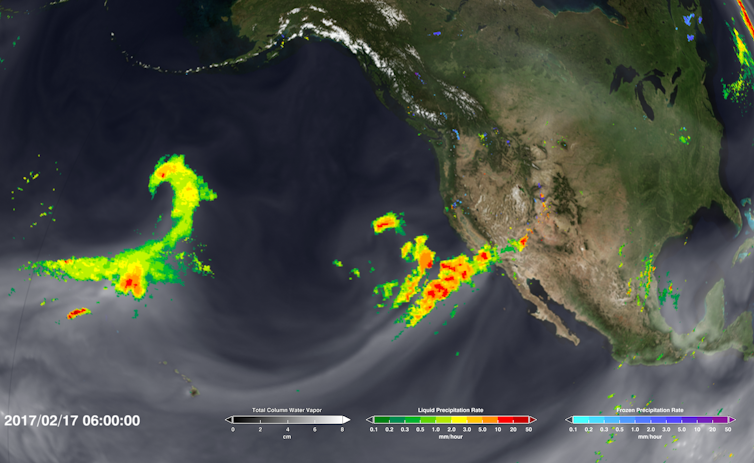
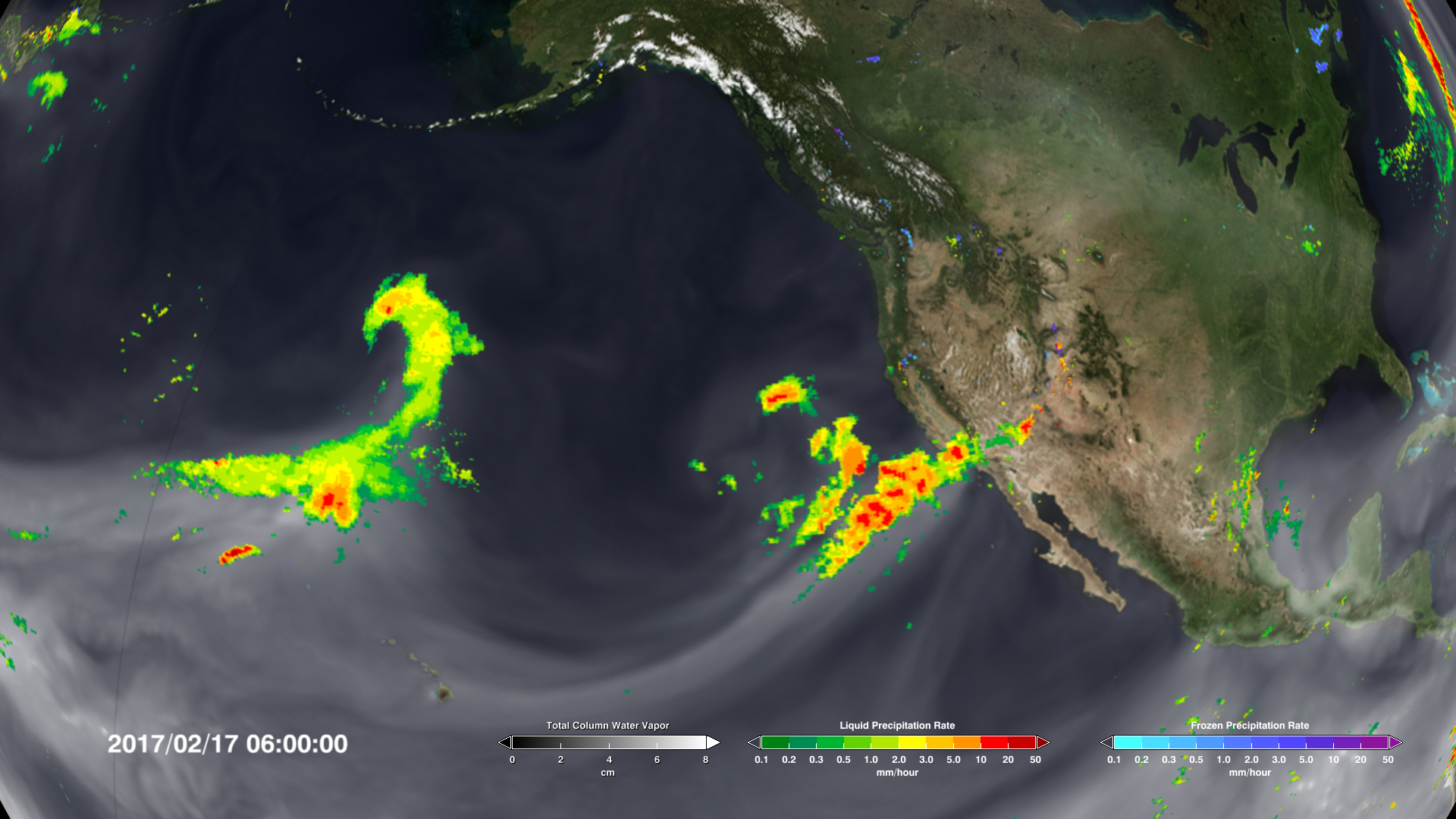
Ask people to name the world’s largest river, and most will probably guess that it’s the Amazon, the Nile or the Mississippi. In fact, some of Earth’s largest rivers are in the sky – and they can produce powerful storms, like the one now soaking California.
Atmospheric rivers are long, narrow bands of moisture in the atmosphere that extend from the tropics to higher latitudes. These rivers in the sky can transport 15 times the volume of the Mississippi River. When that moisture reaches the coast and moves inland, it rises over the mountains, generating rain and snowfall and sometimes causing extreme flooding.
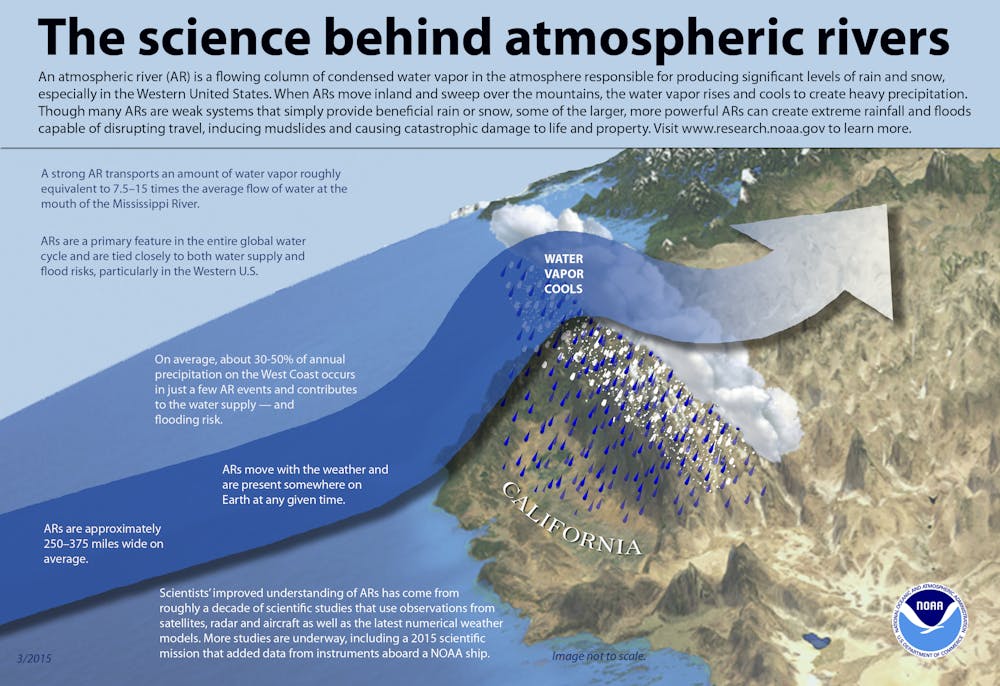

In the past 20 years, as observation networks have improved, scientists have learned more about these important weather phenomena. Atmospheric rivers occur globally, affecting the west coasts of the world’s major land masses, including Portugal, Western Europe, Chile and South Africa. So-called “Pineapple Express” storms that carry moisture from Hawaii to the U.S. West Coast are just one of their many flavors.
My research combines economics and atmospheric science to measure damage from severe weather events. Recently I led a team of researchers from Scripps Institution of Oceanography and the Army Corps of Engineers in the first systematic analysis of damages from atmospheric rivers due to extreme flooding. We found that while many of these events are benign, the largest of them cause most of the flooding damage in the western U.S. And atmospheric rivers are predicted to grow longer, wetter and wider in a warming climate.
Rivers in the sky
On Feb. 27, 2019, an atmospheric river propelled a plume of water vapor 350 miles wide and 1,600 miles long through the sky from the tropical North Pacific Ocean to the coast of Northern California.
Just north of San Francisco Bay, in Sonoma County’s famed wine country, the storm dumped over 21 inches of rain. The Russian River crested at 45.4 feet – 13.4 feet above flood stage.
For the fifth time in four decades, the town of Guerneville was submerged under the murky brown floodwaters of the lower Russian River. Damages in Sonoma County alone were estimated at over US$100 million.
Events like these have drawn attention in recent years, but atmospheric rivers are not new. They have meandered through the sky for millions of years, transporting water vapor from the equator toward the poles.
In the 1960s meteorologists coined the phrase “Pineapple Express” to describe storm tracks that originated near Hawaii and carried warm water vapor to the coast of North America. By the late 1990s atmospheric scientists had found that over 90% of the world’s moisture from the tropics and subtropics was transported to higher latitudes by similar systems, which they named “atmospheric rivers.”
In dry conditions, atmospheric rivers can replenish water supplies and quench dangerous wildfires. In wet conditions, they can cause damaging floods and debris flows, wreaking havoc on local economies.


Helpful and harmful
Researchers have known for some time that flooding due to atmospheric rivers could cost a lot of money, but until our study no one had quantified these damages. We used a catalog of atmospheric river events compiled by Scripps Institution of Oceanography’s Center for Western Weather and Water Extremes, and matched it to 40 years of flood insurance records and 20 years of National Weather Service damage estimates.
We found that atmospheric rivers caused an average of $1.1 billion in flood damages yearly in the western U.S. More than 80% of all flooding damages in the West in the years we studied were associated with atmospheric rivers. In some areas, such as coastal northern California, these systems caused over 99% of damages.
Our data showed that in an average year, about 40 atmospheric rivers made landfall along the Pacific coast somewhere between Baja California and British Columbia. Most of these events were benign: About half caused no insured losses, and these storms replenished the region’s water supply.
But there were a number of exceptions. We used a recently developed atmospheric river classification scale that ranks the storms from 1 to 5, similar to systems for categorizing hurricanes and tornadoes. There was a clear link between these categories and observed damages.
“
Atmospheric River category 1 (AR1) and AR2 storms caused estimated damages under $1 million. AR4 and AR5 storms caused median damages in the 10s and 100s of millions of dollars respectively. The most damaging AR4s and AR5s generated impacts of over $1 billion per storm. These billion-dollar storms occurred every three to four years.
A moister atmosphere means worse storms
Our most significant finding was an exponential relationship between the intensity of atmospheric rivers and the flood damages they caused. Each increase in the scale from 1 to 5 was associated with a 10-fold increase in damages.
Several recent studies have modeled how atmospheric rivers will change in the coming decades. The mechanism is simple: Greenhouse gases trap heat in the atmosphere, warming the planet. This causes more water to evaporate from oceans and lakes, and increased moisture in the air makes storm systems grow stronger.
Like hurricanes, atmospheric rivers are projected to grow longer, wider and wetter in a warming climate. Our finding that damages increase exponentially with intensity suggests that even modest increases in atmospheric river intensity could lead to significantly larger economic impacts.
Better forecasting is critical
I believe that improving atmospheric forecasting systems should be a priority for adapting to a changing climate. Better understanding of atmospheric rivers’ intensity, duration and landfall locations can provide valuable information to residents and emergency responders.
It also is important to discourage new construction in high-risk areas and help people move to safer locations after major disasters, rather than rebuilding in place.
Finally, our study underlines the need to reduce global greenhouse gas emissions. These storms will keep coming, and they’re getting stronger. In my view, stabilizing the global climate system is the only long-term way to minimize economic damage and risk to vulnerable communities.
[ Deep knowledge, daily. Sign up for The Conversation’s newsletter. ]
Tom Corringham, Postdoctoral Scholar in Climate, Atmospheric Science and Physical Oceanography, University of California San Diego
This article is republished from The Conversation under a Creative Commons license. Read the original article.
- Details
- Written by: Elizabeth Larson
Dogs available for adoption this week include mixes of Belgian Malinois, German Shepherd, hound, husky, Labrador Retriever, mastiff, pit bull and Rottweiler.
Dogs that are adopted from Lake County Animal Care and Control are either neutered or spayed, microchipped and, if old enough, given a rabies shot and county license before being released to their new owner. License fees do not apply to residents of the cities of Lakeport or Clearlake.
The following dogs at the Lake County Animal Care and Control shelter have been cleared for adoption (additional dogs on the animal control Web site not listed are still “on hold”).
Call Lake County Animal Care and Control at 707-263-0278 or visit the shelter online at http://www.co.lake.ca.us/Government/Directory/Animal_Care_And_Control.htm for information on visiting or adopting.

Husky-shepherd mix
This male husky-shepherd mix has a medium-length tan and white coat.
He is in kennel No. 14, ID No. 14318.

‘Sargent Chunk’
“Sargent Chunk” is a young male Rottweiler with a short red and black coat.
He is in kennel No. 15, ID No. 14303.

Pit bull puppy
This male pit bull puppy has a short brindle coat.
He is in kennel No. 18, ID No. 14311.

Male pit bull terrier-hound
This young male pit bull terrier-hound mix has a medium-length brown coat.
He is in kennel No. 19, ID No. 14276.

Male shepherd
This male shepherd has a long tan and white coat.
He has been neutered.
He’s in kennel No. 27, ID No. 14319.

Male German Shepherd-husky mix
This male German Shepherd-husky mix has a medium-length black and tan coat.
He has been neutered.
He’s in kennel No. 28, ID No. 14307.

Male Belgian Malinois
This young male Belgian Malinois has a medium-length red and black coat.
He is in kennel No. 29, ID No. 14269.

Male pit bull terrier
This male pit bull terrier has a short blue and white coat.
He is in kennel No. 30, ID No. 14314.

Male Rottweiler
This male Rottweiler has a short black and brown coat.
He has been neutered.
He is in kennel No. 31, ID No. 14315.

German Shepherd-husky mix
This young male German Shepherd-husky mix has a medium-length black and tan coat.
He is in kennel No. 33, ID No. 14309.
Email Elizabeth Larson at
- Details
- Written by: NATIONAL AERONAUTICS AND SPACE ADMINISTRATION
Seven minutes of harrowing descent to the Red Planet is in the not-so-distant future for the agency’s Mars 2020 mission.
NASA’s Mars 2020 Perseverance rover mission is just 22 days from landing on the surface of Mars. The spacecraft has about 25.6 million miles (41.2 million kilometers) remaining in its 292.5-million-mile (470.8-million-kilometer) journey and is currently closing that distance at 1.6 miles per second (2.5 kilometers per second).
Once at the top of the Red Planet’s atmosphere, an action-packed seven minutes of descent awaits – complete with temperatures equivalent to the surface of the Sun, a supersonic parachute inflation, and the first ever autonomous guided landing on Mars.
Only then can the rover – the biggest, heaviest, cleanest, and most sophisticated six-wheeled robotic geologist ever launched into space – search Jezero Crater for signs of ancient life and collect samples that will eventually be returned to Earth.
“NASA has been exploring Mars since Mariner 4 performed a flyby in July of 1965, with two more flybys, seven successful orbiters, and eight landers since then,” said Thomas Zurbuchen, associate administrator for NASA’s Science Mission Directorate at the agency’s headquarters in Washington. “Perseverance, which was built from the collective knowledge gleaned from such trailblazers, has the opportunity to not only expand our knowledge of the Red Planet, but to investigate one of the most important and exciting questions of humanity about the origin of life both on Earth and also on other planets.”
Jezero Crater is the perfect place to search for signs of ancient microbial life. Billions of years ago, the now-bone-dry 28-mile-wide (45-kilometer-wide) basin was home to an actively-forming river delta and lake filled with water.
The rock and regolith (broken rock and dust) that Perseverance’s Sample Caching System collects from Jezero could help answer fundamental questions about the existence of life beyond Earth.
Two future missions currently in the planning stages by NASA, in collaboration with ESA (European Space Agency), will work together to bring the samples back to Earth, where they will undergo in-depth analysis by scientists around the world using equipment far too large and complex to send to the Red Planet.
“Perseverance’s sophisticated science instruments will not only help in the hunt for fossilized microbial life, but also expand our knowledge of Martian geology and its past, present, and future,” said Ken Farley, project scientist for Mars 2020, from Caltech in Pasadena, California. “Our science team has been busy planning how best to work with what we anticipate will be a firehose of cutting-edge data. That’s the kind of ‘problem’ we are looking forward to.”

Testing future tech
While most of Perseverance’s seven science instruments are geared toward learning more about the planet’s geology and astrobiology, the mission also carries technologies more focused on future Mars exploration.
MOXIE (Mars Oxygen In-Situ Resource Utilization Experiment), a car-battery-size device in the rover’s chassis, is designed to demonstrate that converting Martian carbon dioxide into oxygen is possible.
Future applications of the technology could produce the vast quantities of oxygen that would be needed as a component of the rocket fuel astronauts would rely on to return to Earth, and, of course, the oxygen could be used for breathing as well.
The Terrain-Relative Navigation system helps the rover avoid hazards. MEDLI2 (the Mars Entry, Descent, and Landing Instrumentation 2) sensor suite gathers data during the journey through the Martian atmosphere. Together the systems will help engineers design future human missions that can land more safely and with larger payloads on other worlds.
Another technology demonstration, the Ingenuity Mars Helicopter, is attached to the belly of the rover. Between 30 and 90 days into the rover’s mission, Ingenuity will be deployed to attempt the first experimental flight test on another planet.
If that initial flight is successful, Ingenuity will fly up to four more times. The data acquired during these tests will help the next generation of Mars helicopters provide an aerial dimension to Mars exploration.
Getting ready for the red planet
Like people around the world, members of the Mars 2020 team have had to make significant modifications to their approach to work during the COVID-19 pandemic.
While a majority of the team members have performed their jobs via telework, some tasks have required an in-person presence at NASA’s Jet Propulsion Laboratory, which built the rover for the agency and is managing the mission.
Such was the case earlier this month when the team that will be on-console at JPL during landing went through a three-day-long COVID-adapted full-up simulation of the upcoming Feb. 18 Mars landing.
“Don’t let anybody tell you different – landing on Mars is hard to do,” said John McNamee, project manager for the Mars 2020 Perseverance rover mission at JPL. “But the women and men on this team are the best in the world at what they do. When our spacecraft hits the top of the Mars atmosphere at about three-and-a-half miles per second, we’ll be ready.”
Less than a month of dark, unforgiving interplanetary space remains before the landing. NASA Television and the agency’s website will carry live coverage of the event from JPL beginning at 11:15 a.m. PST (2:15 p.m. EST).
More about the mission
A key objective of Perseverance's mission on Mars is astrobiology, including the search for signs of ancient microbial life. The rover will characterize the planet's geology and past climate, pave the way for human exploration of the Red Planet, and be the first mission to collect and cache Martian rock and regolith.
Subsequent missions, currently under consideration by NASA in cooperation with ESA (European Space Agency), would send spacecraft to Mars to collect these sealed samples from the surface and return them to Earth for in-depth analysis.
The Mars 2020 mission is part of a larger program that includes missions to the Moon as a way to prepare for human exploration of the Red Planet. Charged with returning astronauts to the Moon by 2024, NASA will establish a sustained human presence on and around the Moon by 2028 through NASA's Artemis lunar exploration plans.
JPL, which is managed for NASA by Caltech in Pasadena, California, built and manages operations of the Perseverance rover.
For more about Perseverance visit www.mars.nasa.gov/mars2020/ and www.nasa.gov/perseverance.
For more information about NASA's Mars missions, go to https://www.nasa.gov/mars.

- Details
- Written by: Elizabeth Larson
“Fortunately, it appears Lake County’s rise in COVID-19 cases that started in November has begun to improve,” Pace said Friday.
Lake County was up to 2,748 total cases on Friday, with 32 deaths.
Statewide, California passed 40,000 COVID-19 deaths on Friday, with more than 3,273,600 cases, according to information posted by Public Health departments in all 58 counties.
Pace said Lake County’s daily case rate remains very high, at 61 out of 100,000, so there is still a strong likelihood of coming into contact with the virus when visiting out in the community and doing things like visiting busy stores.
He said test positivity is beginning to decrease and on Friday was at 12.2 percent.
“Hospitals are not nearly as full as they have been for the last several weeks,” he added.
Lake County remains in the state’s purple tier, the most restrictive on the Blueprint for a Safer Economy. In that tier, indoor dining remains prohibited; only outdoor dining is allowed.
Regarding the county’s vaccine distribution effort, Pace said that so far approximately 3,500 Lake County residents have been vaccinated over the past month and a half.
Pace said the Lake County Health Department received 800 doses of vaccine this week – up from 300 to 400 weekly in recent weeks – and will get another 800 next week.
“Given the continuing shortage, prioritization remains necessary. Vaccination of school staff will be complete by the end of next week. Vulnerable elders are a focus, as well,” Pace said.
According to 2019 estimates, Lake County has 5,300 residents aged 75 and above and 9,100 residents aged 65 to 74.
“We continue to move vaccine out into the community, sharing doses with clinical partners and vaccinating people at standup sites in Lakeport and Clearlake, with the aim of using up all vaccine we receive each week,” Pace said.
Pace said accelerating the rate of immunization remains a primary focus. “We are advocating to get significantly more doses, and making preparations to accommodate further vaccination clinics.”
He said Public Health is not making appointments for the general public at this point; those in eligible categories are being contacted to schedule.
“Please do not show up at our sites without an appointment. You will not get a vaccine,” he said.
Senior centers are reaching out to the most vulnerable people they regularly serve. Pace said not to call the senior centers as it’s not an effective way to get an appointment.
If you or a loved one are in an eligible group and you haven’t been contacted, Pace said to reach out to your medical provider.
For information on vaccines and clinics, visit http://health.co.lake.ca.us/Coronavirus/Vaccines.htm, call 211 or text covid19 to 211-211, or call the MHOAC line at 707-263-8174.
Email Elizabeth Larson at