How to resolve AdBlock issue?
News
- Details
- Written by: Elizabeth Larson
The council will meet at 6 p.m. Tuesday, Feb. 2.
The meeting will be by teleconference only. The city council chambers will not be open to the public.
The agenda can be found here.
To speak on an agenda item, access the meeting remotely here or join by phone by calling toll-free 669-900-9128 or 346-248-7799. The webinar ID is 973 6820 1787, access code is 477973; the audio pin will be shown after joining the webinar. Those phoning in without using the web link will be in “listen mode” only and will not be able to participate or comment.
Comments can be submitted by email to
Indicate in the email subject line "for public comment" and list the item number of the agenda item that is the topic of the comment. Comments that read to the council will be subject to the three minute time limitation (approximately 350 words). Written comments that are only to be provided to the council and not read at the meeting will be distributed to the council prior to the meeting.
On Tuesday, the council will receive an informational presentation from the Blue Ribbon Committee for the Rehabilitation of Clear Lake.
The council’s main item of business during the meeting will be to hold a public hearing as part of the process for seeking funds through the Community Development Block Grant Coronavirus Aid, Relief, and Economic Security Act – or CDBG-CV – program.
The council is expected to approve two new funding allocation and direct staff to proceed with the preparation of a CDBG-CV rounds 2 and 3 program application for the recommended purpose.
In her report to the council, Community Development Director Jenni Byers explained that the purpose of the public hearing is to solicit ideas from the public and provide direction to city staff on potential programs to include in the city’s CDBG-CV application.
She said activities allowed under the grant are a response to COVID-19 impacts, including short-term subsistence payments for households at risk of eviction and/or homelessness and housing costs for those exiting homelessness, homeless shelter operations, and health and education support services; public facility and infrastructure improvements; public facility acquisition, including health care facilities, emergency shelters and housing for persons experiencing homelessness in response to COVID-19 impacts; housing assistance; business assistance to help businesses retain employees or, for those businesses restarting after mandated COVID-19 related shutdowns, adding employees; and microenterprise assistance for businesses impacted by COVID-19 with five or fewer employees, including the business owner.
Byers said the city held an online community meeting on Jan. 21 and also released a survey to organizations, individuals and businesses requesting their input for the funding’s use.
She said 57 people responded and provided input. “The majority of responses indicated a positive response to using the funds for Economic Development activities such as business assistance and microenterprise assistance (5 or fewer employees), followed by Public Service (specifically rental assistance) and finally Public Facility and Infrastructure with a COVID nexus.
The survey will remain open here until Feb. 2 at 3 p.m. and staff will provide a discussion of those responses, she said.
Byers said city staff has met and discussed the potential of utilizing CDBG-CV monies to provide business assistance and to replace the HVAC system at the Silveira Community Center where ongoing COVID-19 testing is occurring three days a week under a memorandum of understanding with the Lake County Health Department. The center may also be used as a vaccination site for the residents of Lakeport.
She said city staff recently learned of a program that the state will be implementing to provide rental assistance for up to 12 months. “Therefore, rather than duplicate efforts, staff would recommend residents utilize the state program as individuals would not be able to receive CDBG funds and the State funding.”
Byers said staff recommends that $191,394 be allocated towards economic development activities and the remaining $50,000 be allocated under public facilities and infrastructure to replace the failing HVAC system so that residents may continue to have a local site for COVID-19 testing.
The California Department of Housing and Community Development, which oversees the state CDBG program, has noted that CDBG-CV monies should be expended quickly to address COVID-19-related needs.
“A program to provide business assistance and install the HVAC can be achieved quickly and would be made available to various community organizations involved in combating the effects of COVID-19 in our local area,” Byers said.
On the consent agenda – items considered noncontroversial and usually accepted as a slate on one vote – are ordinances; minutes of the regular council meeting on Jan. 19; warrants; and receipt and filing of the draft minutes of the Measure Z Advisory Committee meeting on Jan. 20.
Email Elizabeth Larson at
- Details
- Written by: Lake County News reports
The study surveyed American Indians and Alaska Natives across 46 states – representing 318 different tribal affiliations – to gather information ranging from individuals’ willingness to receive a COVID-19 vaccine to the hurdles they face in accessing healthcare and resources.
“This data will be important to all organizations conducting COVID-19 vaccine education efforts,” said Abigail Echo-Hawk, director of UIHI. “Native communities have unique challenges and needs that usually are not considered in public health campaigns.”
American Indian and Alaska Native people continue to be disproportionately impacted by the COVID-19 pandemic.
The COVID-19 incidence and mortality rates are 3.5 and 1.8 times that of non-Hispanic Whites, respectively.
While there has been worry about vaccine participation in native communities, 75 percent of study participants claimed they would be willing to receive a COVID-19 vaccine, higher than the national average according to an Ipsos survey from October 2020, which indicates that 64 percent of the U.S. general population was willing to receive a vaccine.
“Willingness to receive a vaccine and hesitancy are not mutually exclusive,” said Echo-Hawk. “Fear and distrust of government and medical systems still exists in our community, which are hurdles that we have to overcome.”
Echo-Hawk hopes the report can start to create a better understanding of the unique perspectives of native people.
“The data indicates that most native people willing to be vaccinated feel it is their responsibility for the health of their community,” Echo-Hawk said. “This shows what motivates our community when it comes to decision-making.”
The report’s key findings include:
• 75 percent of participants were willing to receive a COVID-19 vaccine.
• 74 percent of participants claimed that getting vaccinated is their responsibility to their community.
• 72 percent of participants wanted evidence that the vaccine is safe right now and in the long term.
• 39 percent of all participants reported difficulty traveling to their clinic for an appointment.
• Two-thirds of participants willing to get vaccinated were confident that COVID-19 vaccines were adequately tested for safety and effectiveness among Native people.
• 75 percent of participants willing to get vaccinated had concerns about potential side effects.
• 25 percent of participants were unwilling to receive a COVID-19 vaccine.
• 90 percent of participants unwilling to get vaccinated recognized COVID-19 as a serious disease.
• 89 percent of participants unwilling to get vaccinated had concerns about potential side effects.
Find the full report here.
The Urban Indian Health Institute is a public health authority and one of 12 tribal epidemiology centers in the country. It conducts research and evaluation, collects and analyzes data, and provides disease surveillance and resources to strengthen the health of American Indian and Alaska Native communities.
- Details
- Written by: Lake County News reports
The EDD has now resolved 99.9 percent of the 1.6 million backlogged claims identified by the EDD Strike Team in mid-September.
A backlogged claim is one that takes more than 21 days to issue first or further payment or disqualification, regardless if the claimant or EDD need to take some type of action.
The EDD said it will continue to provide weekly reports about the number of claims in process, including pending EDD action that delays payment beyond 21 days.
There will always be claims initiated by individuals who do not certify their eligibility for payment and abandon their claim. This agency said this happens for many reasons, including because the claimant returns to work or when the claim is fraudulent.
Additionally, there will always be more complex claims that take longer than 21 days to resolve, which is acknowledged by the U.S Department of Labor in their performance measures for states.
With that in mind, the EDD said it will adjust the data reflected on dashboards to better illustrate how many claims are in the queue awaiting EDD action beyond 21 days.
EDD is working on a new, more user-friendly dashboard and offers this clarification on the updates in the current two separate backlog dashboards.
Approximately 91 percent of the more than 900,000 unique claimants reflected on the two current dashboards come from these two categories: “Waiting for Claimant Certification” category on the current Initial Claims dashboard, and the “Potential Overpayment Non-Fault Queue” which is a subset of the “Resolving Other Eligibility Issues” category on the Continued Claims dashboard.
Changes on reporting this data in the new dashboard will include:
• In alignment with the recommendations from the state auditor, the EDD will remove the data that reflects “waiting for claimants to certify.” The EDD continues outreach to claimants about the requirement for completing a certification of eligibility before the first and any further payment every two weeks can be issued. Beyond that, this data does not constitute EDD work that is preventing payment.
• EDD will also remove the “potential overpayment” data. This work by EDD to assess if individuals may have received more in benefits than they qualify for does not prevent payments from being made.
Most of those remaining 9 percent of data reflected in the two backlog dashboards are associated with EDD’s efforts to implement the newly extended Pandemic
Unemployment Assistance and Pandemic Emergency Unemployment Compensation benefits, where new weeks of benefits are being added to older claims.
Status of suspended claims pending verification
The EDD recently suspended a total of 1.4 million claims that were deemed to be potentially fraudulent after applying additional screening. Emails and mailed notices started going out in early January to all individuals associated with these claims with instructions to either validate their identity, or that their eligibility must be determined before payments could resume. To date, only about half of the individuals two whom EDD sent emails have opened those emails.
The current breakdown includes:
• 1.1 million individuals were directed to ID.me for identity verification and have 30 days to respond from the date of their notice. So far, more than 300,000 have validated their identity through ID.me. Once EDD receives that information, if otherwise eligible, the payment barriers associated with the identity verification are lifted. It can take 7-10 days for the process to be completed and payment issued. Until then, claimants are encouraged to continue to certify for benefits in UI Online to prevent delays.
The EDD strongly encourages claimants to review the ID.me step-by-step guidance provided to fully utilize the fast and efficient self-service option for validating identity. This will help claimants avoid the wait times for an ID.me trusted referee via video chat.
Currently, 88 percent of claimants are able to utilize this self-service feature to quickly verify and protect their account.
• Another approximately 100,000 claimants without a UI Online account were mailed paper requests for identity verification. Once EDD receives and processes that information, if the claimant is otherwise eligible similar action is taken to lift the associated payment barriers and process the claim for payment.
The EDD strongly encourages claimants to register for an UI Online account to utilize the document upload feature to quickly verify and protect their account.
• The remaining 200,000 individuals are either receiving requests to validate their eligibility (other than identity), or are receiving a Notice of Determination explaining the reason for disqualification from benefits and their right to appeal.
Guidance for claimants who collected benefits from EDD in 2020
EDD is in the process of issuing a record 7.8 million Form 1099G federal tax forms to individuals who received benefits in 2020, such as unemployment, some types of Disability Insurance, or Paid Family Leave.
The fastest way to retrieve this form and related information is through a personal UI Online account, though forms are arriving by mail for those who did not opt for electronic form only. Information about opening an UI Online account is available on the File for Unemployment Overview Webpage.
Since the annual 1099G process for federal tax purposes may be new to many Californians, individuals are encouraged to visit EDD’s Tax Information webpage for more information, or access other tips and a helpful video through this one-page guide.
EDD staff will also assist by phone:
• Call 1-866-333-4606 if claimants don’t find their 1099G information in their UI Online account or to request a copy sent by mail. This is a self-serve line.
• Call 1-866-401-2849 if claimants don’t agree with the amount noted on their form or received it erroneously and need the issue corrected. This designated call center line is available Monday through Friday, 8 a.m. to 5 p.m., except on state holidays.
Individuals who suspect fraud can also visit EDD’s Help Fight Fraud webpage to learn how to report fraud and find information on protecting yourself from identity theft, and can also report fraud through AskEDD.
- Details
- Written by: Lake County News reports
LAKE COUNTY, Calif. – Although 2021 has just begun, the start of the new year brings to completion some of the projects the Lake County Land Trust put into motion in 2020, despite the pandemic.
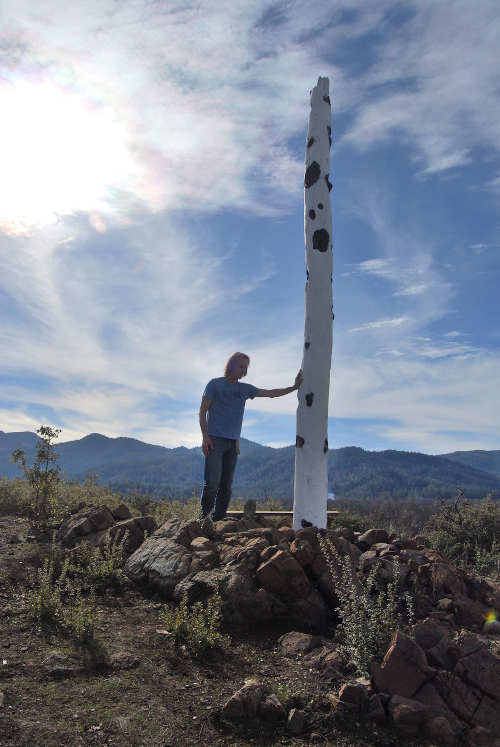
The first, a monolith installed at Rabbit Hill by Marcus Maria Jung in June, was the outcome of the LOCUS grant awarded to the Middletown Art Center from the National Endowment of the Arts, which supported community workshops to install public art.
The Middletown Art Center, or MAC, selected the Lake County Land Trust’s Rabbit Hill because of its location in central Middletown; its juxtaposition with Middletown Trailside Park, the site of the EcoArts trail; and the idea that a sculpture placed at Rabbit Hill could be symbolic of the resilience and rejuvenation of both nature and a community after a devastating wildfire.
Jung’s structure, tentatively entitled “Animate Earth - Gateway to the Sky - 2021,” is now complete with four pine benches placed in consideration of the four directions.
A beckoning entranceway consists of rock found on-site, placed in a cascading fashion along the sides of a set of railroad tie steps nestled into the hillside at the top of Rabbit Hill.
At different intervals, the artist worked alongside Stan Archacki, Denis Sullivan, Glenneth Lampert, Francis Hornback, Lorindra Moonstar and MAC’s LOCUS students and volunteers in placing and securing the structures.
“One of the Lake County Land Trust’s favorite aspects of Rabbit Hill is the community’s enjoyment of the spot, and their sense of ownership of it,” said Melissa Kinsel, development director for the Lake County Land Trust. “They treat it as if it were an extension of their own backyards, walking through it, relaxing, and taking care of it. Rabbit Hill matters to Middletown residents and they take good care of it.”
Jung’s work and his description of it add to the new narrative of Rabbit Hill: “This installation is an invitation to the local community and visitors to come together and gather in a timeless space in the heart and soul of the land around us. The sky opens up as we come to share our prayers and offerings with this site, the land and the greater world. In return we receive the bountiful blessings of nature and the wisdom of the earth in all her beauty.”
Lisa Kaplan, executive and artistic director at MAC added, “The LOCUS project as a whole commemorates place, the resilience of flora and fauna lost to fire, where we are now as a community, and the vision we have for our future.”
Rabbit Hill Preserve is located at 21281 Stewart Street in Middletown, and is open to visitors and their leashed dogs from dawn to dusk.
New boardwalk at Rodman Preserve
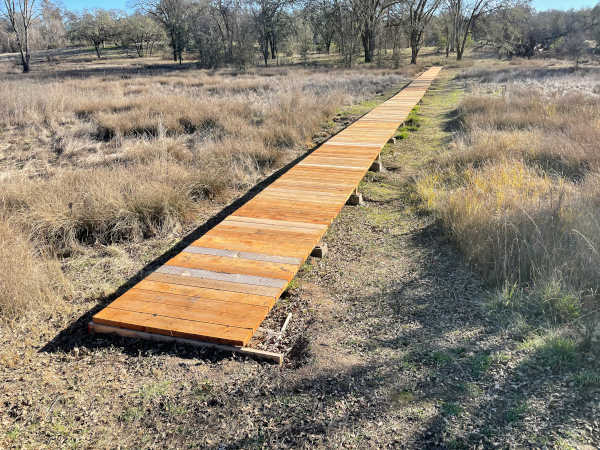
A 216-foot-long redwood boardwalk was completed at the Rodman Preserve that will enable the Land Trust to lead its popular guided nature walks at the preserve even during the rainy season.
A portion of the trail is below lake level and gets swamped most years when the rains are heavy. This new elevated walkway will prevent this section from being impassable.
Funds for the new boardwalk came from the Rose Foundation, through its Cal Wildlands grant program.
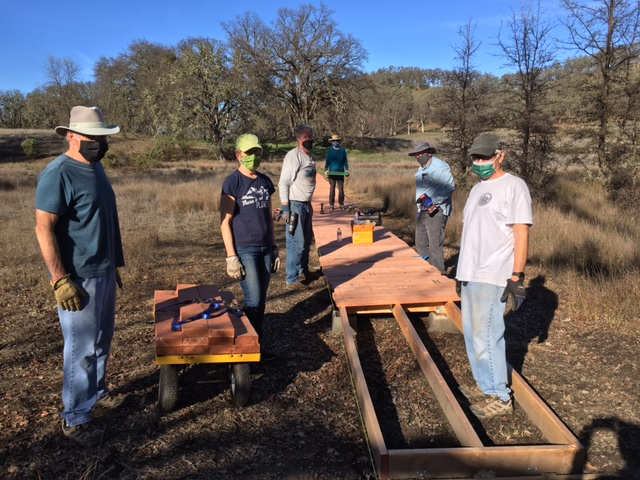
Lumber and materials were purchased locally, and social-distanced volunteers including Bill Lincoln, Bob Schoenherr, Roberta Lyons, Val Nixon and Erica Lundquist met four times to cut, carry, install and secure the footings, framing and walkway planks.
A crew of 10 AmeriCorps volunteers who were isolating as a team and working on projects at Anderson March and Clear Lake State Park also pitched in to help for a day, completing in a day what would have normally taken three.
“When this is all over, we’ll have to have a toast with our supporters on the new boardwalk. We’re really looking forward to its debut. It’s remarkable what can be accomplished with a few dedicated volunteers even during a pandemic,” said Land Trust President Val Nixon.
Despite COVID-19 restrictions, a limited staff is on hand to open the preserve for self-guided walks on Tuesdays between 10 a.m. and 2 p.m. Interested parties are encouraged to call ahead to 707-262-0707 to ensure the gate is unlocked.
The Lake County Land Trust was founded in 1994 with the goal to protect and preserve important natural habitats and wild land areas of Lake County.
The Rodman Preserve, located on Westlake Drive off of the Nice-Lucerne Cutoff, is the organization's flagship property and also features a small nature center. The preserve totals over 200 acres and is home to a variety of flora and fauna. The Land Trust owns four properties in fee title and holds three conservation easements. One of its main efforts is to protect and preserve the remaining natural habitat on the shores of Clear Lake.
For more information about the Land Trust go to www.lakecountylandtrust.org.