 How to resolve AdBlock issue?
News
- Details
- Written by: Elizabeth Leyva, Texas A&M-San Antonio; David J. Purpura, Purdue University, and Emily Solari, University of Virginia

Math and reading scores for 12th graders in the U.S. were at a historic low even before the COVID-19 pandemic forced a massive shift to remote learning, according to results of the 2019 National Assessment of Educational Progress released in late 2020. We asked three scholars to explain why so many high school seniors aren’t proficient in these critical subjects.
Elizabeth Leyva, director of entry-level mathematics, Texas A&M University-San Antonio
One might expect the jump from high school to college mathematics to be a natural progression, or a small step up in difficulty or expectations. But over time it has actually become a chasm, and that chasm continues to grow.
More students are taking advanced coursework – algebra II or higher – in high school. But studying the material doesn’t mean that a student has truly learned it. As a result, a student can pass a course which should be a college preparatory course, such as algebra II, yet fail a standardized placement exam, or not score high enough on SAT/ACT tests to be deemed “college ready.”
Most high school teachers hold their students to a different set of expectations than college faculty do. In many cases, the policies are set by the school district, so high school teachers are simply upholding rules that the community and parents have pushed for. This can include allowing students to submit late work, retest on assessments they performed poorly on and use a calculator for most assignments.
The rationale is well intentioned; high school students are young learners, and may need multiple opportunities to master a concept.
Multiple opportunities to pass means more students pass. But this generous assessment strategy has unintended consequences on student motivation and accountability. The effect is that students can earn a passing grade but not retain or master the material in a meaningful way. This is how a student can receive a B in algebra II, for example, but land in a developmental class when they enter college.
David Purpura, associate professor of human development and family studies, co-director of the Center for Early Learning, Purdue University
When looking at the striking data for 12th graders from the national report card, policymakers, researchers, parents and teachers often ask: What’s going on with high school math? Should we change math instruction at this age?
However, the performance trends at middle and elementary schools are similar.
Math is often taught with few explicit connections across individual classes. Sometimes these classes follow a certain order: for example, algebra I and algebra II. But the content in and across the classes isn’t being thoroughly connected. For example, in the early elementary years, we talk about addition and subtraction, then multiplication and division. We move on to fractions, and then algebra. Yet this still treats these concepts as separable rather than integrated.
But math is an interrelated web of knowledge with new information building on previously learned information. And, this acquisition of knowledge begins early. There are significant individual differences in children’s math performance even prior to kindergarten.
I believe children aren’t receiving a strong enough foundation for basic math skills in the earliest years. Preschool teachers spend less than five minutes per day on numbers. Nearly a third of classrooms provide no number instruction at all.
In kindergarten, the level of math instruction is typically well below what children already know and can do. The misalignment could be attributable to the low expectations set forth in the Common Core Standards – the academic standards shared across the majority of states. Over 85% of children are able to meet certain end-of-kindergarten expectations before they even enter kindergarten. These disparities continue through elementary school.
So, the question in my mind isn’t: Why are so many high school seniors not proficient in math? The question is: How can teachers better link math concepts across all grade levels and improve learning?
To start, I believe schools and communities need to make math a bigger priority in the earlier years – even before kindergarten. Research shows that testing students regularly and tailoring lessons to meet their individual needs can build their math skills appropriately.
Emily Solari, professor of reading education, University of Virginia
How kids learn to read is a well-researched aspect of human learning. Scientists have identified what happens in the brain when children learn to read and why some children have difficulty mastering this skill. Despite this wealth of evidence about how reading develops, only 37% of 12th gradersread at a proficient or advanced level, according to the national assessment.
While standardized tests are not the perfect measure of reading ability, they do provide a pulse of reading attainment across the country. Importantly, the scores show significant differences in reading performance between particular groups of students. Profound gaps exist between white and Black students and white and Hispanic students.
The education system is fraught with inequities that have a greater negative impact on historically marginalized students – particularly those who are Black, Hispanic, poorer or have a disability. Recent data suggests the COVID-19 pandemic has exacerbated these gaps. Improving the system, and how students are taught reading, is a matter of equity.
Why, if there is solid evidence on how children learn to read, has this not translated into classroom practice and better reading outcomes for students?
Studies show that children should be taught the alphabetic system – the relationship between the sounds of letters and their written form – in order to learn how to read words. The ability to read words combined with vocabulary and language development is essential to reading comprehension.
In addition to what is taught, how children are taught to read is also important. Reading instruction should have a clear scope and sequence, with skills building on each other over time.
However, a recent survey suggests that about 75% of teachers use curricula that teach early reading using a cueing approach. And, 65% of college professors teach this approach to new teachers. This method does not align with the scientific evidence of how children learn how to read.
Sometimes called “MSV” – shorthand for meaning, syntactical and visual – the cueing approach emphasizes reading whole words over learning the alphabetic code. This method of teaching reading can be especially problematic for children who are having difficulties learning how to read.
To improve students’ reading ability, I believe schools, districts and states must push multiple levers simultaneously. This includes making sure instruction, curriculum and testing all align with the science of reading, and that teachers and administrators are provided adequate professional development about reading instruction.
Further, teacher education programs must commit to preparing teachers who understand how reading develops in children’s brains and how to implement teaching practices that are based on current evidence.
Elizabeth Leyva, Director, Entry-Level Mathematics, Texas A&M-San Antonio; David J. Purpura, Associate Professor of Human Development and Family Studies, Purdue University, and Emily Solari, Professor, University of Virginia
This article is republished from The Conversation under a Creative Commons license. Read the original article.
- Details
- Written by: Lake County News reports

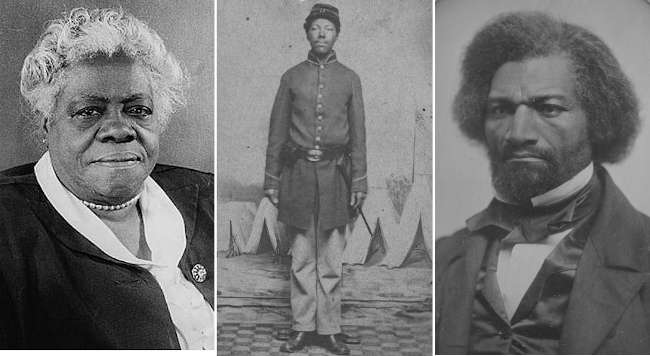
LAKE COUNTY, Calif. – February is Black History Month, a celebration acknowledging the achievements of Black Americans and how they have uniquely shaped the nation’s history.
Celebrating the contributions to our nation made by people of African descent goes back to 1915, half a century after the Thirteenth Amendment abolished slavery in the United States.
The effort began with the advocacy of Harvard-trained American historian Carter G. Woodson and the prominent minister Jesse E. Moorland., who sought to recognize the heritage and achievement of Black Americans.
The event was first celebrated during the second week of February 1926, selected because it coincides with the birthdays of both Abraham Lincoln (Feb. 12) and abolitionist/writer Frederick Douglass (Feb. 14). That 1926 event was sponsored by the Association for the Study of African American Life and History.
That first celebration inspired schools and communities nationwide to organize local celebrations, establish history clubs and host performances and lectures.
In 1975, President Gerald Ford issued a message on the observance of Black History Week urging all Americans to "recognize the important contribution made to our nation's life and culture by black citizens."
Since 1976, February has been officially designated as Black History Month.
That week would continue to be set aside for the event until 1976 when, as part of the nation’s bicentennial, it was expanded to a month. Since then, U.S. presidents have proclaimed February as National African American History Month.
Earlier this month, the Board of Supervisors and the Clearlake City Council presented proclamations in honor of Black History Month.
The city of Clearlake’s proclamation notes that, “while the history of Black Americans is also the story of countless nameless heroes brought to our shores who endured lives of bondage and oppression, the deprivation of their civil rights, and ravages of bigotry and racism, it is a history for which most of the chapters have yet to be written as Black Americans contribute to the American promise.”
The proclamation also notes that, “for generations, African Americans have strengthened our Nation by urging reforms, overcoming obstacles, and breaking down barriers,” and cites the contributions of individuals including Martin Luther King Jr., Elijah Cummings, Harriet Tubman, Sojourner Truth, Rosa Parks, Cicely Tyson, Hank Aaron, Kamala Harris and Rev. Rafael Warnock.
Mendocino College also is celebrating Black History Month.
“As we continue to face a global pandemic, allow the celebration of Black History Month to serve as a reminder of the multiple contributions made by Black Americans and other ethnic communities,” says Mendocino College President Tim Karas. “We commemorate Black History Month by continuing the essential work of self-reflection and strengthening our resolve to stay engaged in equity work in our district and to work harder against racism (overt and structural) and toward social justice.”
On Feb. 24, a webinar titled “You Don’t Know Who We Be: A Conversation about the Pre-enslavement & Pre-Colonial History of Africans in America” will be hosted by BCC Speaker Series with Dr. Edward Bush, President of Cosumnes River College. Register for this webinar here.
The Mendocino College librarians have also put together a LibGuide for Black History Month and the Black Lives Matter movement specifically. View the page here.
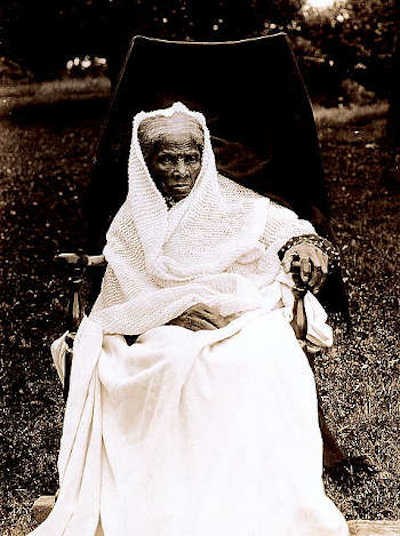
More information about the celebration of Black Americans can be found here: https://www.africanamericanhistorymonth.gov/?loclr=ealn.
The following facts come from the U.S. Census Bureau’s surveys.
Did you know?
48.2 million
The Black population, either alone or in combination with one or more races, in the United States in 2019.
1,916
Total population of Lake County residents identifying as Black.
87.9%
The percentage of African Americans age 25 and older with a high school diploma or higher in 2019.
30.7%
The percentage of the employed Black population age 16 and older working in management, business, science and arts occupations in 2019.
124,004
The number of Black-owned employer businesses in the United States in 2017.
2.1 million
The number of Black military veterans in the United States nationwide in 2019.
- Details
- Written by: Lake County News reports
Rep. Mike Thompson (CA-05) will hold a virtual press conference at noon Pacific Time on Tuesday, Feb. 16.
This event will be held over Zoom and interested participants must email Thompson’s office at
The event will also be streamed on Facebook Live via Thompson’s page.
During the event, Thompson will highlight the importance of the state and local funding that was included in the American Rescue Plan.
Thompson will be joined by leaders from across the Fifth Congressional District that support this legislation.
The Fifth Congressional District includes all or part of Contra Costa, Lake, Napa, Solano and Sonoma counties.
- Details
- Written by: Jennifer Wollock, Texas A&M University
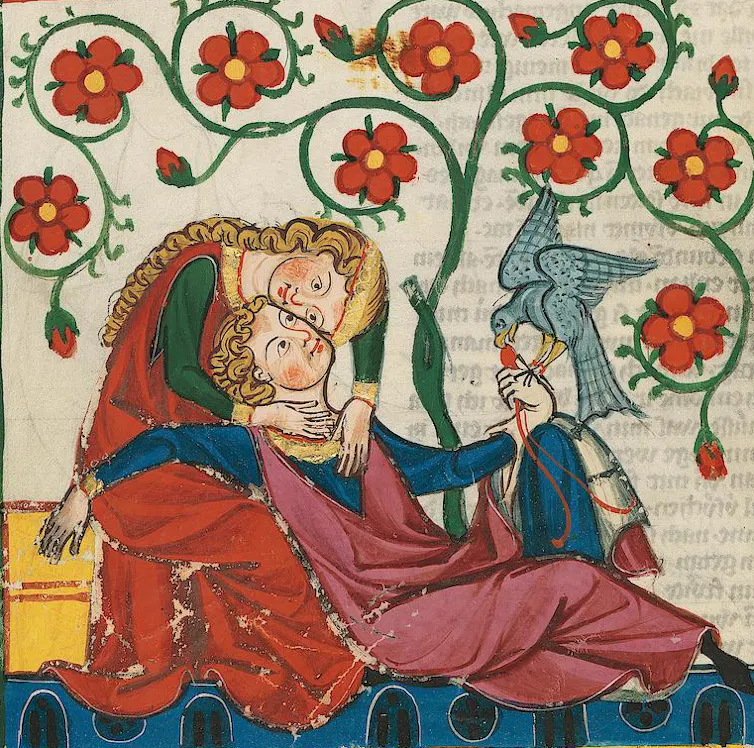
Valentine’s Day annoys many people.
For many in a relationship, the pressure to impress a partner can weigh heavily, and expensive gifts serve as a reminder of the relentless commercialization of the holiday. Meanwhile those still looking for love approach the day with trepidation – another reminder of their single status and the pressure to find a partner.
As a chivalric literary historian who has studied the origins of the holiday, I find this a shame. When the notion of Valentine’s Day as a day for romance emerged in the 1380s it was all about love as a natural life force – birds choosing their mates, the freedom to choose or refuse love and the arrival of springtime. But even then many people did not understand or value these things. In fact, that is why it was invented.
Odes to love
The first to write of Valentine’s Day – a feast day with ancient pagan roots – as a holiday celebrating love and lovers were the 14th-century English squire Geoffrey Chaucer and his friend, the internationally admired knight and poet Oton III de Granson, from Savoy in modern-day France. Both poets were recognized in their own time as chivalrous advocates for human rights. And in tandem, they seem to have concocted Valentine’s Day as a day for lovers.
Their work supported principles still important for us today, notably the right to free choice in love and the right to refuse romantic advances.
Chaucer and Granson encountered one another in the service of Richard II of England and admired one another’s poetry. Their poems about Valentine’s Day show them operating as an international chivalric team to address pressing issues in the theory and practice of love, then and now.
In the poem “The Parliament of Fowls,” Chaucer presents Valentine’s Day as a day when birds gather to choose their mates under the supervision of nature. In the poem, presented as a dream, three rival eagles each express a lifelong commitment to a single female. Birds of lower social status and different temperament, waiting in line, quarrel about how to resolve the impasse so they, too, can select their mates.
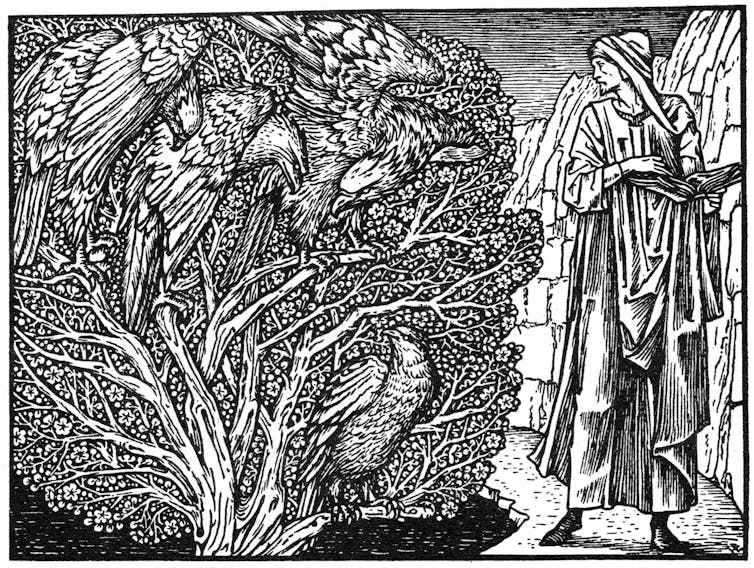
In the scenario, two of the eagles must be disappointed – Valentine’s Day is no guarantee that all will find love. But in the end the wise female eagle obtains from the figure of Nature the right to take her time in deciding her mate. She chooses not to choose. It is a story of waiting to recognize one’s true love, knowing your own heart and having the right to choose your partner yourself.
Chaucer’s tale relates to an actual courtship that included three suitors and ended in the wedding of two 15-year-olds: Richard II and the princess Anne of Bohemia, in 1382.
Meanwhile, Granson promoted Valentine’s Day in his French poems as a day for human lovers to choose one another and pledge their love, as do the birds. Granson pledges his own undying love to a mysterious lady in his “Complaint to Saint Valentine.” There was no merchandise involved and no gifts were expected.
Free love
Chaucer and Granson’s celebration of love as a relationship between partners, a union of souls grounded in respect and the freedom of choice, contrasts with many of the traditions of the age in which they lived.
Throughout the Middle Ages, most marriages were arranged and often forced, usually in childhood – as many still are today – with the full support of tradition and the law. Saints’ lives and legal documents describe parents coercing children to marry by brute force. Chaucer’s own father was kidnapped at age 12 by his aunt in an attempt to force him to marry her daughter in order to gain control over his inheritance.
In this context, Chaucer and Granson reimagined the already existing Valentine’s Day festival to celebrate the potential beauty of love itself. In a world where forced and child marriages are still all too common, it is important to reflect on Chaucer and Granson’s visions. Their reinvention of the day opened the eyes of poets, knights, ladies and just plain folk to the need for respect and self-respect in courtship – and the value of partnerships entered into for love, not just for lust, power or money.
Servants of love, these two knightly poets shaped Valentine’s Day as a gift for future generations. Their chivalrous enterprise deserves to be celebrated as we pursue our own happiness.
Jennifer Wollock, Professor of English, Texas A&M University
This article is republished from The Conversation under a Creative Commons license. Read the original article.