 How to resolve AdBlock issue?
News
- Details
- Written by: Lake County News reports
The decision requires companies providing wireline communications, including landline phone service and Internet service, to have 72 hours of backup power during power outages.
This new policy is meant to protect Californians in areas with high wildfire risk, including low-income people and the elderly, who are least likely to have cell phones during emergencies.
The Public Advocates Office, the independent consumer advocate at the California Public Utilities Commission, said it supports the CPUC’s decision on the policy.
However, the Public Advocates Office raised concerns that delayed timelines for implementing these requirements may impact some residential customers.
“These difficult times are making Californians more dependent than ever on our phones and the Internet for communications to telework, visit a doctor via telehealth, attend school via distance learning, and be in touch with loved ones,” said Elizabeth Echols, director of the Public Advocates Office.
“Everyone should be able to rely on their phones and Internet during power outages, regardless of where they live or what kind of phone technology they have,” Echols said. “That is why the Public Advocates Office will continue to advocate for holding telephone companies accountable so that everyone has access to essential communications services.”
The CPUC’s backup power requirement for wireline communications service providers must be met in eight months for three types of facilities in areas with high fire risk: 1) critical facilities such as hospitals and fire departments, 2) facilities providing service to wireless networks, and 3) facilities serving communities lacking sufficient wireless service coverage.
However, for all other facilities located in areas with high wildfire risk, the commission is delaying implementation of the backup power requirement for 18 months.
The Public Advocates Office urged the commission to require the 72-hour backup power requirements be in place by no later than October 2021 for all facilities in high fire threat areas to protect the public health and safety of Californians.
“We will continue to push for backup power so all communities can rely on their phone and Internet service, especially if they live in an area with high wildfire risk,” the Public Advocates Office said in a Thursday statement.
The Public Advocates Office recommendations can be found here.
- Details
- Written by: Lake County News reports
On Thursday, Chairman of the House Ways and Means Subcommittee on Select Revenue Measures Rep. Mike Thompson (CA-05) voted to advance certain measures of the American Rescue Plan through the Ways and Means Committee.
Provisions under the jurisdiction of the committee will help boost the health care response to the pandemic and support workers, families and businesses that have been hit hard financially.
“The coronavirus pandemic is unprecedented and continues to hurt working families and small businesses. We have to do everything we can to get people the help they need to stay afloat and save lives,” said Chairman Thompson. “That’s why I was proud to vote to advance key provisions that will support our district and communities across the nation.”
He continued, “This legislation will support families, so they are able to provide for their children and stay healthy, even if they’ve lost their job or their employer-sponsored health coverage. This also includes an additional $1,400 in Economic Impact Payments, to boost this round of relief to $2,000. It will also position our economy and our local businesses for a strong recovery. We have to act boldly now to help our families and businesses and I will do all I can to get this bill passed on the House floor in the coming weeks.”
The key measures that were considered in the markup in the Ways and Means Committee include:
– An additional Economic Impact Payment for working families;
– An extension of the enhanced Federal unemployment insurance benefits;
– Expanded tax credits that help working families, including the Earned Income Tax Credit, the Child Tax Credit and the Child and Dependent Tax Credit;
– A boost to health coverage affordability and accessibility;
– Important protections for older Americans in nursing homes;
– Aid for vulnerable children, workers and families that are struggling to make ends meet; and,
– A boost to retirement security.
You can click here to read more about the provisions advanced through the Ways and Means Committee today and you can click here to read more about the American Rescue Plan.
Thompson represents California’s Fifth Congressional District, which includes all or part of Contra Costa, Lake, Napa, Solano and Sonoma counties.
- Details
- Written by: Lake County News reports
McGuire, whose district includes Lake County, has held the post for the last two years.
“I am deeply honored to work with President Atkins and I’m grateful for the opportunity to help lead the Senate during what has been one of the most difficult times for our state and nation. Tackling this pandemic, expediting vaccine distribution and economic recovery will remain our top priorities here in 2021. And, we must be relentless in our continued pursuit to build more affordable housing, tackle our homelessness crisis and invest more in resources that will keep our communities safe from the growing threat of wildland fires,” Sen. McGuire said.
Sen. McGuire will continue to serve as chair of the Senate’s Governance and Finance Committee, which is responsible for hearing legislation related to tax and revenue, most housing and housing financing bills, all land use and development policy, proposed new local government laws and district revenue legislation.
He also will continue to serve as vice chair of the Democratic Caucus.
Additionally, Sen. McGuire sits on the following committees: Budget and Fiscal Review, Budget Subcommittee No. 2 on Resources, Environmental Protection and Energy, Special Committee on Pandemic Emergency Response, Joint Legislative Committee on Emergency Management, Energy, Utilities and Commerce, Transportation, Housing, Education, Joint Rules and he Chairs the Joint Committee on Fisheries and Aquaculture.
- Details
- Written by: Scott N. Schiffres, Binghamton University, State University of New York

On Feb. 10, the Centers for Disease Control and Prevention released new mask guidelines based on a study of how mask fit affects the wearer’s exposure to airborne particles. With more transmissible COVID-19 strains emerging around the world, it is important to properly use the right kinds of face masks.
Some practices – such as taking your mask off to speak or wearing your mask below your nose – are clearly problematic. Other mistakes may be less obvious. Everyone still needs to be wearing masks as much as possible – even if you’ve been vaccinated or have previously been infected with COVID–19. So how do you get the most out of a mask?
Mask materials
Your mask material is the most important consideration. Certain manufacturing techniques can make masks more efficient at filtering out the tiny droplets and aerosols that can carry the coronavirus.
During the past year, my graduate students and I at Binghamton University teamed up with scientists from the surgical robot company Intuitive Surgical and the Intuitive Foundation to test the effectiveness of different fabrics at filtering out airborne particles. Our work has been used by the CDC to inform mask guidelines.
Researchers believe that an infected person who talks expels droplets that can spread COVID-19 – especially in the 2- to 5-micron range, about 10 times smaller than the width of a typical human hair. One reason to wear masks is to catch these relatively big particles before they dry out and shrink into smaller particles, called aerosols, which linger in the air longer because of their diminished size.
For example, a 3-micron saliva droplet could shrink down to about 1 micron. Researchers think that droplets in the 2- to 5-micron range are most transmissive of COVID-19. This range is the sweet spot for droplets to linger in the air due to their small size, while still having a high probability of containing the virus.
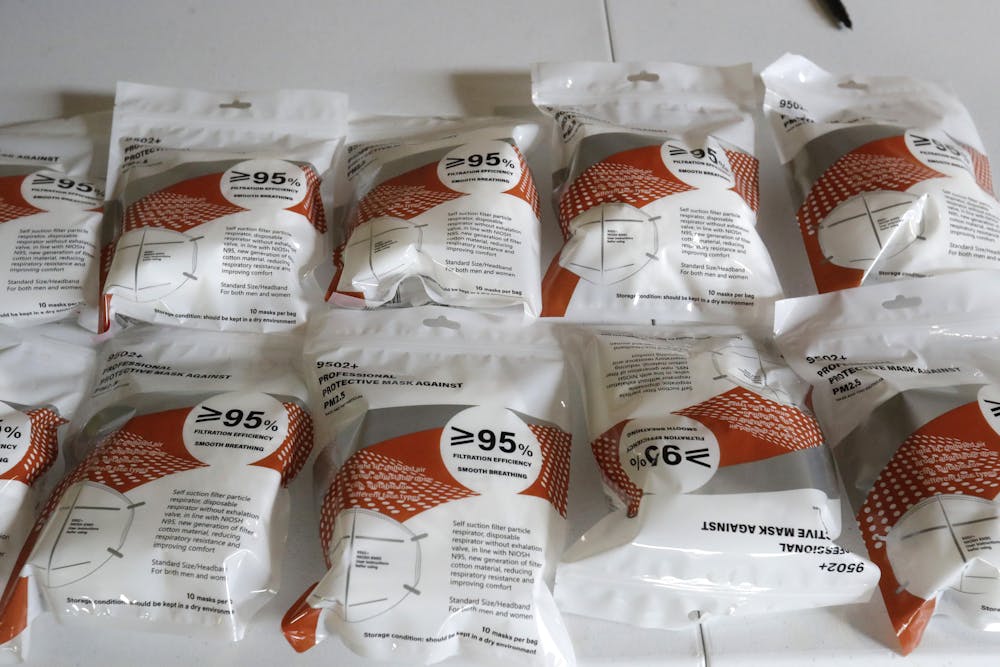
N95 masks are the gold standard among lightweight respirators and are at least 95% effective at filtering out particles at 0.3 microns, well below the average size thought to dominate COVID-19 transmission. They are typically greater than 99% effective for particles 2 to 5 microns across. When leakage around the mask seal is taken into account, the performance typically drops to 90% to 95%.

KN95 masks, which have become more prevalent in the U.S. over the past few months, are the Chinese equivalent of N95 masks and are often the next best mask option in terms of performance. While KN95 masks often meet the N95 specifications, some researchers found their performance to be inconsistent in a study that has not yet been peer reviewed. The CDC maintains a list of internationally produced masks and their filtration performance that you can use to confirm the performance of masks before purchase.
Medical-procedure masks – specifically ASTM F2100-19, Class 1 masks, the blue papery ones you see everywhere – are typically made of several layers of meltblown nonwoven fabrics. If one had a perfect seal to your face, the material could filter out 95% of particles as small as 0.1 microns across. But these masks don’t seal all that well, and when you take into account the air leakage, filtration in typical usage drops to about 80%.
Cotton masks are among the most commonly worn and can also provide decent filtration. The filtration varies according to the tightness of the weave, and one study found that two layers of various widely available cotton fabrics filtered out between 34% and 66% of particles in the 2- to 5-micron range. This is good for catching particles from a person talking, but it won’t block small aerosols in the environment.
In our research, we tested a wide range of fabrics to see which worked best. Some samples were washed as many as 10 times with a variety of detergents and then retested for effectiveness. In our study, which is currently under peer review, we found the best combination was soft flannel on the inside for comfort, thin-as-possible cotton on the outside and an efficient filter in the middle.
Two masks are good, but make sure they fit
No matter how good a mask’s material is, it won’t work well if it doesn’t fit well. A lot of filtration efficiency is lost from leakage around the face mask, such as around the bridge of the nose or at the gaps between any facial hair and the mask. A well-fitting mask is one that seals tightly onto your face, ensuring that almost all the air you breathe goes through the filtering material rather than through gaps in the sides.
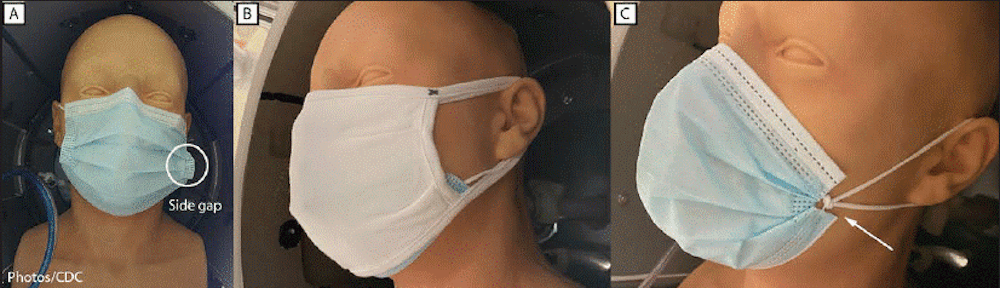
The CDC’s new guidelines are based on a study that tested ways to improve how masks fit – specifically double-masking and what they call “knotting and tucking.”
Double-masking is wearing a cotton mask over a medical-procedure mask. Knotting and tucking entails tying a knot in the elastic loops that go over your ears, close to where they attach to the mask. Then, you tuck the extra mask fabric into the gap that is often present where the ear loops attach to the mask, and flatten that part as much as possible. Both of these tricks to make a better fit decrease the mask-wearers’ exposure to potentially infectious aerosols by 95% as compared with wearing no mask at all. That’s a 15% improvement over the 80% efficiency found when using a single surgical mask.
DIY fit test
To get the best fit when using a mask, bend the metal nosepiece so that the mask tightly fits the curve of your nose. It is also important to make sure your mask fits beneath your chin and to remove any facial hair – air will take the path of least resistance through stubble rather than through the fine fibers of the mask.
Some places, such as hospitals and labs, do mask fit tests that are certified by the Occupational Safety and Health Administration. But these are impractical for home use. You can do your own qualitative fit test at home by lighting a citronella or other oil-scented candle and trying to smell it with and without a mask. The aerosols from a citronella candle are 0.01 to 0.02 microns across – much smaller than typical droplets from humans that would contain COVID-19. If you can’t smell the candle, or the smell is significantly reduced, you’re likely wearing your mask correctly.
Keep in mind, however, that this test is far from exact. For instance, cotton masks won’t filter out these tiny candle aerosols, but are still an important tool to block the majority of coronavirus droplets.
Making sure you are getting the most out of your masks is critical to slowing this pandemic. Double-masking or knotting and tucking, as well as using the right materials, can ensure that you and those around you are safer.
[Get our best science, health and technology stories. Sign up for The Conversation’s science newsletter.]
Scott N. Schiffres, Assistant Professor of Mechanical Engineering, Binghamton University, State University of New York
This article is republished from The Conversation under a Creative Commons license. Read the original article.