 How to resolve AdBlock issue?
News
- Details
- Written by: Lake County News reports
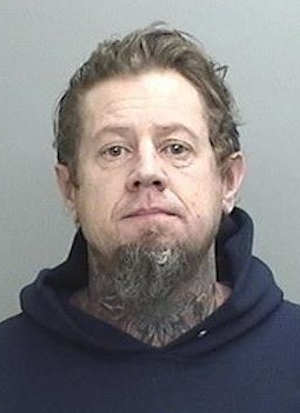
LAKE COUNTY, Calif. — The Lake County Sheriff’s Office said Wednesday that its detectives have arrested a Potter Valley man who they believe is responsible for the 2020 murder of a Lake County resident whose remains were found in the Mendocino National Forest.
Christopher Jon McDonald, 44, of Potter Valley has been arrested in connection to the killing of 48-year-old John Turner Dickerson, 48, of Nice, said Lt. Corey Paulich.
Paulich said Lake County Sheriff’s deputies were dispatched to an area in the Mendocino National Forest on Aug. 9 on a report of possible human remains being discovered.
Detectives from the Lake County Sheriff’s Major Crimes Unit also responded to the location and determined the remains were human, badly decomposed and were believed to have been in the forest for several weeks, Paulich said.
The remains were recovered and an autopsy was conducted later that week. Paulich said the autopsy revealed that the remains belonged to a male and the death was a homicide due to a gunshot wound.
Paulich said the detectives also were able to positively identify the victim as Dickerson, who reportedly came to Lake County from the East Coast.
On Aug. 19, 2020, detectives served a search warrant at a property in Potter Valley associated with McDonald, Paulich said.
Through the investigation, Paulich said detectives determined McDonald was one of the last people seen with Dickerson before his death.
During the search of McDonald’s property, evidence was located and later tested that linked McDonald to the murder of Dickerson, Paulich reported.
In the months since, detectives have continued investigating several leads related to Dickerson’s death, Paulich said.
Paulich said that work led on Tuesday to detectives obtaining an arrest warrant for McDonald.
He was arrested for a charge of murder and is currently being held in the Mendocino County Jail where he is in custody for unrelated charges. Paulich said McDonald is awaiting extradition to Lake County.
So far, authorities have not said what they believe McDonald’s motive was in the killing.
Paulich said the sheriff’s office is asking anyone who may have more information regarding this case to contact Detective Jeff Mora at 707-262-4224 or by email at
- Details
- Written by: Elizabeth Larson
The board voted unanimously to approve a resolution to establish position allocations for the planning budget unit, which once again will include the Community Development director classification.
County Administrative Officer Carol Huchingson said that in February 2020 the board combined the Community Development Department with the departments of Public Works and Water Resources.
The board in February of last year appointed Scott De Leon director of Community Development. At that point, Public Works and Water Resources already were under his direction; those two departments had been reconsolidated in August 2019.
As a result, in the next fiscal year budget cycle, the Community Development director budget classification was eliminated from the planning budget unit, Huchingson said.
Huchingson noted the proposed change would mean that the county would return to the longtime model of having a director focused 100-percent of the time on Community Development, which is vital to the economy and deals with a high volume of complex work.
“Community Development is very vital to our economic well-being,” said Board Chair Bruno Sabatier, adding it’s one of the most difficult departments to manage.
He said he believed that the action will help ensure that the department has the greatest level of support.
Sabatier said he appreciated the work that De Leon has done and that he hoped the board was correct that the change will create the better solution they’re looking for.
There were no comments by other board members during the discussion and only one member of the public, Bart Levenson of Kelseyville, spoke.
Levenson queried the board on how many planners the county needs to handle the planning department’s large workload.
Sabatier said it was a good question but there isn’t an easy answer to it.
Levenson followed up by asking if the county would consider pausing large development projects until a new director is in place and they can determine how many staff they need.
Sabatier replied that he wanted as seamless a transition as possible in order to have the least impact on applicants and that he didn’t support pausing projects.
Supervisor Moke Simon moved to approve the resolution, which passed with a board vote of 5-0.
This is the latest in changes to the department’s staffing.
Last month, in the run-up to the board’s action, it was reported that Toccarra Thomas, De Leon’s deputy Community Development director, had submitted her resignation letter, effective May 19. She joined the department in April 2020.
Also in April, the board held two closed session evaluations of De Leon in his role as director of Public Works, Water Resources and Community Development.
Sabatier told Lake County News earlier this week that the county intended to begin recruiting immediately for a new Community Development director.
The resolution to reallocate the Community Development director job as a separate position did not include a pay rate.
So far, the job has not been posted on the county’s Human Resources Department webpage, but a job description posted on the county website lists the annual pay range as $102,668.80 to $124,779.20.
When De Leon was Public Works director, he said his annual salary was $120,600. He received a 25-percent increase, bringing him to more than $150,000 annually when he was assigned Water Resources permanently in 2019.
When the board passed pay raises for county employees last year, the Public Works director job classification received a nearly 43-percent increase, the largest of any employee, due to the combined responsibility of De Leon leading three county departments.
At the time of the pay raises, the county would not give specifics about how much De Leon was being paid, but gave a pay range for the combined Water Resources, Public Works and Community Development director job as $127,449.60 annually for the first step to a fifth-step salary of $154,924.80.
Officials did not indicate on Tuesday if the board will have to take additional action to update its resolution from last fall establishing salaries and benefits for management employees in order to restructure De Leon’s position and pay once Community Development is handed off.
Email Elizabeth Larson at
- Details
- Written by: NATIONAL OCEANIC AND ATMOSPHERIC ADMINISTRATION
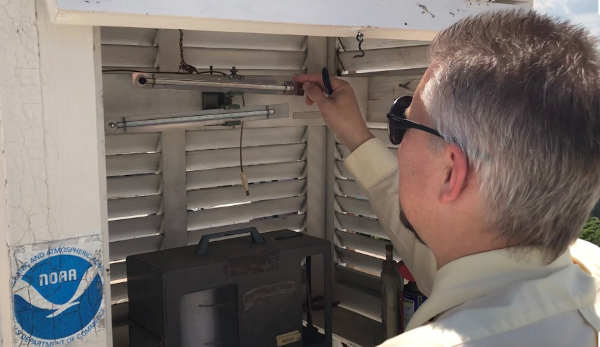
Every 10 years, NOAA releases an analysis of U.S. weather of the past three decades that calculates average values for temperature, rainfall and other conditions.
That time has come again.
Known as the U.S. Climate Normals, these 30-year averages — now spanning 1991-2020 — represent the new “normals” of our changing climate.
They are calculated using climate observations collected at local weather stations across the country and are corrected for bad or missing values and any changes to the weather station over time before becoming part of the climate record.
Simply stated: The Normals are the basis for judging how daily, monthly and annual climate conditions compare to what’s normal for a specific location in today’s climate.
For the past decade, the Normals have been based on weather observations from 1981 to 2010. In early May, climate experts at NOAA’s National Centers for Environmental Information, or NCEI, issued an updated collection based on the weather occurring from 1991 to 2020.
The data set reflects a “new normal” that takes the most recent 30 years of climate change-influenced weather and climate conditions into account.
A warmer normal
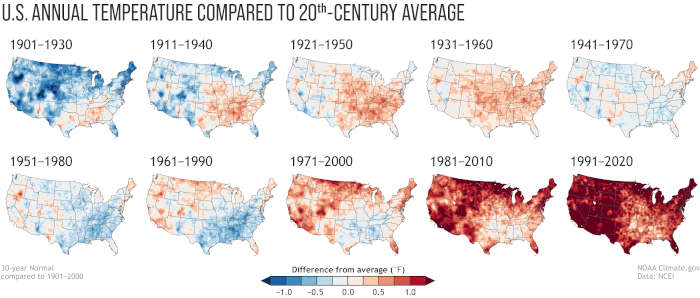
The U.S. Climate Normals collection has 10 versions: 1901-1930, 1911-1940 and so on through 1991-2020.
In the image below, we’ve compared the U.S. annual average temperature during each Normals period to the 20th-century average (1901-2000).
The influence of long-term global warming is obvious: The earliest map in the series has the most widespread and darkest blues, indicating colder temperatures, and the most recent map has the most widespread and darkest reds, denoting warmer temperatures.
A wetter normal?
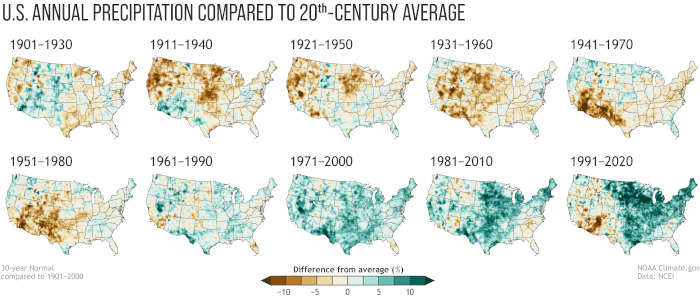
In the collection of precipitation maps, few places exhibit a precipitation trend that is either steadily wetter or steadily drier than the 20th-century average. Instead, drier areas and wetter areas shift back and forth without an obvious pattern.
And yet, it’s probably not a coincidence that the last four maps in the series — the 1961-1990, 1971-2000, 1981-2010 and 1991-2020 Normals — are nationally the four wettest-looking maps in the collection.
At least some of that wetness relative to the 20th-century average is linked to the overall climate warming and “wetting” of the atmosphere that’s occurred as rising temperatures cause more water to evaporate from the ocean and land surface.
What used to be normal
The 1991-2020 Normals tell us what is normal in today’s climate. NOAA scientists conduct other analyses that tell us about what used to be normal.
For example, In NOAA’s monthly and annual climate monitoring reports, temperature averages and precipitation totals are ranked in the climate record dating to 1895; U.S. and global climate conditions are compared to the 20th-century average.
Visualizing climate is easier now than ever
NCEI has a collection of maps showing both recent and long-term trends in temperature and precipitation. You can also create a custom graph showing monthly, seasonal or yearly climate conditions for any region, state and many cities that shows the long-term trend.
The Normals might be shifting, but NOAA scientists and forecasters aren’t losing track of climate change.
- Details
- Written by: Lake County News reports
On Tuesday, Gov. Gavin Newsom announced a series of initiatives building on the state’s work to vaccinate California’s hard-to-reach communities against COVID-19, address vaccine hesitancy and drive innovative efforts in the communities hardest hit by the pandemic.
New efforts focus on direct appointment assistance; community outreach including neighborhood canvassing, phone banking and text banking; at-home vaccinations and transportation services; and an additional $33 million in funding, bringing the total to $85.7 million, to support community-based organizations.
“We’re at a pivotal moment in our COVID-19 vaccine rollout – more than 30 million doses have been administered in California to date, and it’s going to take some new approaches to reach those who haven’t been vaccinated yet,” said Governor Newsom. “These enhanced initiatives build on the community-based approach the state has taken throughout this crisis, in order to ensure vaccines are easily within reach of more people.”
In addition, building on the bipartisan work done during the “Wear A Mask” campaign, California Governors Gavin Newsom, Jerry Brown, Arnold Schwarzenegger and Pete Wilson have come together to encourage all Californians to get vaccinated. The PSA was created and produced by ATTN and can be viewed above.
About 60 percent of eligible Californians have received at least one dose and as of April 15, anyone age 16 and up is eligible to receive the vaccine. As the number of unvaccinated Californians narrows, the state’s robust vaccine performance management system has helped determine where to focus efforts.
To bolster vaccine access in hard-to-reach communities, the state is moving away from mass vaccination sites and toward more targeted outreach with small clinics in communities with the highest disease burden. Officials said this move will make it easier for people to access vaccines.
Mobile sites will continue to operate in partnership with places of worship throughout the state, as well as in coordination with businesses, school districts and local health departments where vaccination efforts are already underway.
These new initiatives build on the state’s Vaccine Equity Metric, or VEM, that started in early March to send double the amount of doses to those communities facing the highest disease burden, defined as those ZIP codes in the lowest quartile in the Healthy Places Index, or HPI.
Since the VEM went into effect, California has dedicated 40 percent of the state’s supply of doses to the lowest HPI quartile to improve equity in vaccinations.
An estimated 53 percent of individuals in the lowest quartile still need COVID-19 vaccinations, while just 28 percent of individuals in the highest quartile remain unvaccinated. Since January, California has accelerated its pace of vaccination and now exceeds the national average.
"One of the most important responsibilities of government is to make sure that the most vulnerable receive equal protection, especially during a crisis,” said California Surgeon General Dr. Nadine Burke Harris. “These enhanced efforts aim to meet people where they are while building upon California’s ongoing commitments to ensure that equity is guiding our overall strategy."
The governor announced seven new and enhanced equity strategies in the state’s vaccine rollout, including the following.
More transparency on vaccination progress
The state’s www.covid19.ca.gov website now displays data on California’s progress in vaccinating groups and communities with the most urgent need.
Dashboards include statewide and county progress by the VEM, race and ethnicity or age.
A map displays ZIP-code-level data on vaccination progress within each VEM quartile. These dashboards will be updated weekly, on Wednesdays.
“Get Out the Vaccine” phone bank and door-knocking campaign
Modeled after successful ground-level campaigns, a new state “Get Out the Vaccine” effort coordinates with 70 community-based organizations to employ callers and door-knockers to help Californians make a plan to get vaccinated.
The program is in partnership with Healthy Future California and the UCLA Clinical and Translational Science Institute’s STOP COVID CA initiative.
About 2,000 individuals from targeted communities will be employed to make peer-to-peer appeals and provide support to help overcome barriers to vaccinations. The program, now underway, has already resulted in more than 4,900 appointments scheduled.
Partnering with philanthropic organizations to enhance support for community organizations
Trusted messengers play a vital role in supporting the state’s equitable administration of vaccines. California is expanding its public-private partnerships to support community-based organizations, or CBOs, bringing the total amount of funding to $85.7 million and aiding a total of 480 organizations to date.
The state is expanding its partnership with the Public Health Institute Together Toward Health initiative, created and funded through 18 major philanthropic organizations led by the California Endowment to stop the spread of COVID-19 and strengthen health and resilience in the state’s most impacted communities.
This fund now totals $33.4 million and supports more than 323 organizations. Additional CBOs will be awarded grants on a rolling basis in the months to come.
The state is also partnering with Sierra Health Foundation on a new $29 million “Vaccine Equity Campaign” fund that will invest in CBOs and faith-based organizations across the state.
This new funding builds on $23.3 million awarded by the California Department of Social Services and Labor & Workforce Development Agency to support 157 organizations on multilingual outreach and public health education in communities disproportionately impacted by the pandemic.
A subset of these organizations have helped facilitate approximately 111,000 vaccine appointments and 236,000 referrals to appointment platforms or providers. FAQs on the statewide network of community-based organizations can be found here.
Grants to support vaccination equity
Building off the previously announced awards for Los Angeles County and Bay Area counties, the state is now making available an additional $34.2 million in funding for underserved and high-risk communities throughout California’s other counties.
This funding will be directed by local health jurisdictions to support back-end operations and expand vaccine distribution to enhance targeted outreach in communities and ZIP codes most impacted by COVID-19.
Counties with a population over one million will receive $1.5 million for every one million people; those with populations between 500,000 and one million will be eligible for $650,000 in grant funding; and counties with populations under 500,000 will be eligible for $350,000 in funding to expand vaccination programs and achieve equity goals.
In total, $56.8 million is now being provided to, or at the direction of, local health jurisdictions throughout all of California to support the state’s equity goals.
Localized plans for promoting equity in vaccination
Along with statewide strategies, leaders of each of California’s 61 local health jurisdictions working in partnership with the state’s third-party administrator, Blue Shield of California, created and submitted plans to the state to promote vaccination equity in their communities.
This includes a wide range of approaches, from small mobile vaccine clinics located in remote areas; to engaging micro-influencers to impact specific groups or populations; to partnering with schools and faith-based partners for outreach, education and selection of trusted clinic sites.
At-home vaccination program
Homebound residents can currently contact their health care providers for in-home vaccinations.
These services are expanding statewide and individuals unable to leave their home to get vaccinated may also indicate as such via www.myturn.ca.gov or contact the state’s CA COVID-19 hotline at 833-422-4255 to be connected with their local health jurisdiction to arrange for in-home vaccination services.
Free transportation to vaccine appointments
Individuals who do not have a means of transportation can receive free transportation through www.myturn.ca.gov or by contacting the state’s COVID-19 hotline at 833-422-4255.
Transportation includes automobile transportation for ambulatory patients and non-emergency medical transportation for non-ambulatory patients including wheelchair vans, gurney transportation and other options.
Medi-Cal managed care and fee-for-service beneficiaries will be connected with their health plan or service provider to access this service as an existing health benefit.
Californians needing a vaccination can schedule an appointment at www.MyTurn.ca.gov or by calling the CA COVID-19 hotline at 833-422-4255, Monday through Friday, 8 a.m. to 8 p.m., and Saturday and Sunday, 8 a.m. to 5 p.m., for assistance.