 How to resolve AdBlock issue?
News
- Details
- Written by: Lake County News reports
The California Highway Patrol takes the opportunity each year to remind bicyclists and motorists to share the road and remember traffic safety saves lives.
“Thousands of Californians ride their bicycles every day for exercise, leisure, and commuting,” said CHP Commissioner Amanda Ray. “Keeping California’s roads safe is a priority and the shared responsibility of motorists and bicyclists.”
“More and more people are taking up bike riding, and it is important that drivers are aware of bicyclists and travel safely around them,” California Office of Traffic Safety Director Barbara Rooney said. “If you need to move past a bike, try to provide at least three feet of space whenever possible. Think of others on the road who are not driving as your closest friends or family.”
Motorists can help keep cyclists safe by sharing the road, looking twice for bicyclists before turning left or right onto a road, and always checking before opening a vehicle door when parked on a street to avoid opening it into a bicyclist’s path.
The law requires motorists to give at least three feet clearance when passing a bicycle or to slow to a reasonable and prudent speed and pass only when doing so would not endanger the safety of the bicyclist.
Keep in mind the vulnerability of bicyclists in the event of a crash, which could result in serious injury or even death.
Preliminary data from the CHP’s Statewide Integrated Traffic Records System indicate that during the past five years, nearly 800 bicyclists were killed and more than 51,000 were injured in crashes in California.
The data also show that bicyclists riding on the wrong side of the roadway and improper turning movement violations are the primary causes of fatal bicycle-involved crashes.
A bicyclist has the same rights and is required to follow the same rules of the road as motorists.
Bicyclists should eliminate distractions while riding, obey all traffic signs and signals, indicate when making a turn, pull off the roadway if five or more vehicles are lined up behind them, yield to pedestrians and never bicycle while under the influence of drugs or alcohol.
Bicyclists should remember to be aware of their surroundings and the ever-changing traffic conditions, wear appropriate reflective or bright-colored clothing, wear a helmet, and make certain their bicycle is in good condition and has the appropriate reflectors and lighting.
During the month of May, CHP officers throughout the state will be conducting bicycle safety rodeos and educational presentations to help promote safe behavior to protect both bicyclists and drivers.
- Details
- Written by: Elizabeth Larson
LAKE COUNTY, Calif. — A documentary that follows the effort of Lake County tribes to protect their sacred sites against archaeological crimes has been nominated for an Emmy Award.
“Saving the Sacred” has been nominated for an Emmy in the best documentary, historical/cultural category, said Dino Beltran, a tribal council member for the Koi Nation of Lower Lake, one of the film’s producers.
Beltran said he received news of the nomination on Thursday.
His co-producer is Sherry Treppa, tribal chair for the Habematolel Pomo of Upper Lake.
“As native people no longer in control of our aboriginal lands it’s in our DNA to protect our lands but if we can’t do that then we must protect the historical and cultural artifacts that are evidence of our existence,” said Treppa. “This film educates the public on the topic and demonstrates that a community that values this culture and works together to protect it can be successful.”
Treppa said the goal was to educate and really demonstrate the power of community and hopefully entertain. An award wasn’t her goal, she added, but she’s happy people liked it.
The film is competing against a documentary by Hawaiian Airlines called “Ka Huaka’i: The Journey to Merrie Monarch.”
This is the second Emmy Beltran has been nominated for in his effort to preserve and document the tribal history of Lake County.
In June 2017, he was among a group that won the Emmy in the “Historic/ Cultural-Program/ Special” category for “A Walk Through Time: The Story of Anderson Marsh.”
By the time he won the Emmy, Beltran already was in the process of doing the groundwork for “Saving the Sacred,” which was started in 2018 and completed in 2019.
The topic of this film, which debuted in the fall of 2019, is Ancestors 1, the agreement the Koi Nation, the Habematolel Pomo, Elem Indian Colony and Robinson Rancheria entered into with the county of Lake and which the Board of Supervisors approved in December 2015.
The goal of the agreement, the sixth of its type in California, is to protect sacred sites through the development process. It also established formal relationships with the sheriff and district attorney to prosecute archaeological crimes.
The 28-minute film follows the efforts of Beltran and Treppa as they put the agreement together with the county government and other tribes.
Featured in the film are former Gov. Jerry Brown; Christina Snider, Native American Heritage Commission executive secretary and governor’s tribal advisor, Office of the Governor, who is herself Pomo; Sheriff Brian Martin; and Supervisor EJ Crandell.
The film’s director is Dan Bruns of the California State University, Chico Advanced Lab for Visual Anthropology, who won the Emmy along with Beltran for “A Walk Through Time.”
Award-winning actor, director and documentary narrator Peter Coyote, who narrated “A Walk Through Time,” also narrated “Saving the Sacred.”
This year’s Emmy event will be a virtual ceremony on June 5.
Email Elizabeth Larson at
- Details
- Written by: Karen Sullivan, Kim Riley, and Terre Logsdon
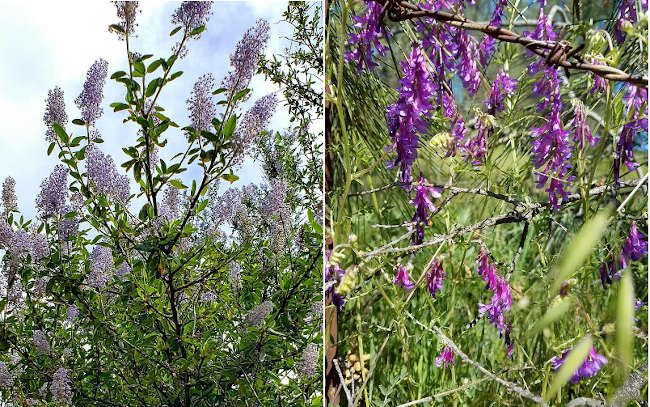
LAKE COUNTY, Calif. — There’s a purple haze on the hills and in the valleys; one is a native flowering shrub (usually on the hills), and one is anon-native invasive vine (usually in the valleys) and both are blooming right now giving a lilac tinge to spring.
Ceanothus is a California native with 26 different species in Lake County alone according to the California Native Plant Society, with 15 of those species with pale lilac to deep violet flowers; others are white, cream-colored, yellow or a mixture.
It is commonly called “wild lilac” that infuses the hillsides and chaparral areas with sweet aromas in the spring. So, if you want to attract the birds and the bees to your landscaping, any species of ceanothus are one of the most beautiful — and important — native plants to grow for them.
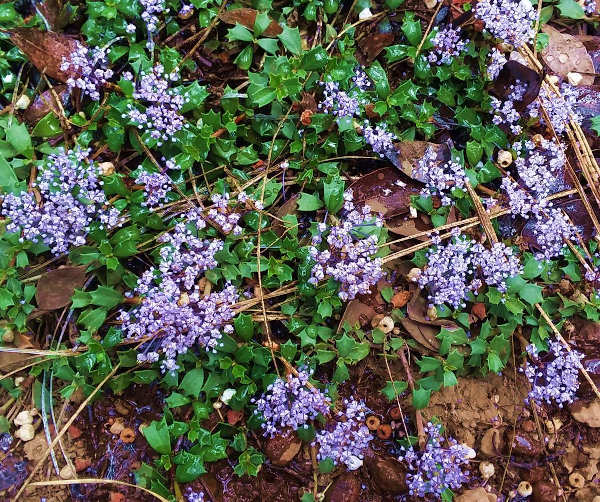
In addition to flowering shrubs that can reach heights over 10’ tall, there are also some that grow like prickly ground cover with holly-shaped evergreen leaves known as Mahala mats, which are well adapted to our clay-heavy soils.
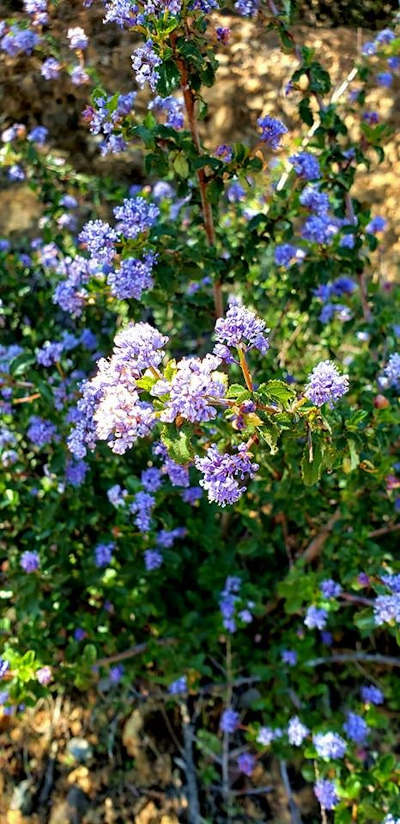
In addition to attracting birds and bees, ceanothus also thrives by neglecting it (no need to irrigate once established) is deer resistant (and the less nutrients and moisture in the soil, the more deer avoid it), and according to the UC Sonoma County Master Gardeners, has historic uses as a fresh or dried flowers, with some varieties used for lathering into soap, providing relief from poison oak, eczema, and rash. If you want to learn more about Ceanothus, we recommend reading Ceanothus by Davis Fross and Dieter Wilken (Timber Press, 2006).
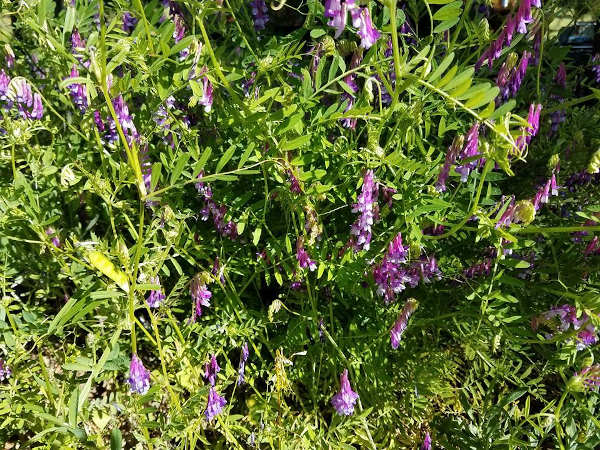
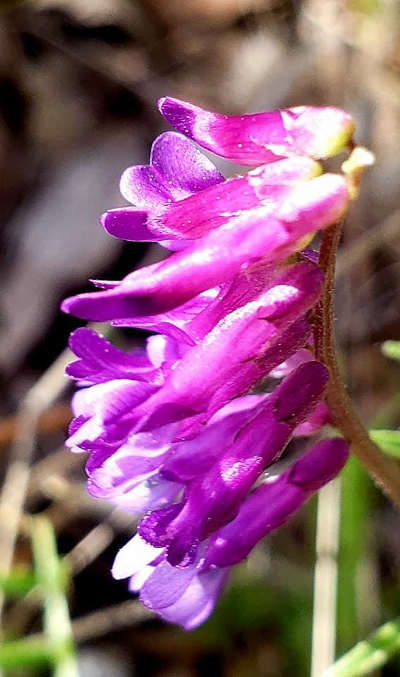
The other haze of purple (well, technically, “purple” isn’t a color because there is no beam of pure or wavelength that corresponds to purple. “Purple” is a name and color invented by the Binney & Smith Crayola Crayon Company to replace “violet” — which is an actual color), is hairy vetch.

Hairy vetch is a nitrogen fixer, which means they harbor a bacteria in their roots that convert nitrogen from the atmosphere into a form that plants can absorb and use, so farmers and gardeners have planted this nonnative vetch to use as a cover crop to increase the nitrogen in their soils for increased plant growth, so it has naturalized across Lake County and California. However, it has a downside for equestrians.
Historically used in roadside revegetation projects, hairy vetch has encroached on pasturelands and valleys throughout Lake County, which can be a problem for horses who graze on the plants and cause them to founder, so best to remove it and replant other native vegetation.
Enjoy the purple haze of hills and valleys — for spring is waning and the haze will soon disappear ...
Nurseries where you can purchase seeds/starts:
Ceanothus: See all of the species, then follow the link for nurseries https://calscape.org/loc-40.7449,-122.9759 (ceanothus)/?&poploc=1
Hairy Vetch: Invasive; remove it.
Terre Logsdon is an environmentalist, certified master composter, and advocate for agroecology solutions to farming. An avid fan and protector of California wildflowers, plants, natural resources, and the environment, she seeks collaborative solutions to mitigate the effects of climate change. Kim Riley is retired, an avid hiker at Highland Springs, and has lived in Lake County since 1985. After 15 years of trail recovery and maintenance on the Highland Springs trails, she is now focused on native plants, including a native plant and pollinator garden on her property as well as promoting and preserving the beauty of the Highland Springs Recreation Area. Karen Sullivan has operated two nurseries to propagate and cultivate native plants and wildflowers, has lived in Kelseyville for the past 30 years, rides horses far and wide to see as many flowers as possible, and offers native plants and wildflowers for sale to the public. You can check her nursery stock here. They are collaborating on a book, Highland Springs Recreation Area: A Field Guide, which will be published in the future. In the meanwhile, please visit https://www.facebook.com/HighlandSpringsNaturalists and https://www.facebook.com/HighlandSpringsRecreationArea.
- Details
- Written by: Melissa L. Caldwell, University of California, Santa Cruz
The COVID-19 pandemic has revealed uncomfortable and distressing truths about American society: namely, the struggle many Americans face just getting by.
Yet, while the pervasive food insecurity that has always existed in the U.S. became more visible, how the problem disproportionately affects people with disabilities has received less attention.
As an ethnographer of food, poverty and welfare, I study how people respond to economic scarcity through caregiving networks. Although caregiving networks like neighborhood mutual aid groups and pop-up food banks quickly emerged to support vulnerable groups during the pandemic, people with disabilities have continued to face additional challenges.
High risk of food insecurity
An estimated 25% of U.S. adults have some form of physical or intellectual disability. Functional disabilities – such as the inability to walk more than a quarter of a mile, climb stairs or lift objects weighing over 10 pounds – are among the most common.
People with disabilities are more likely to experience other chronic health conditions such as anxiety and depression, arthritis and cardiovascular problems. They also have higher rates of unemployment and economic instability. In 2019, the poverty rate for Americans with disabilities was almost 27% – more than double the rate of those without disabilities.
Collectively, these factors put them at greater risk for food insecurity, which the USDA defines as limited or uncertain access to adequate food.
Yet people with disabilities are underrepresented in accounts of pandemic-related poverty and food insecurity. Given their reduced access to food shopping, they are less likely to be included in research on disruptions to the food system. This is prompting demands from health researchers and disability activists for greater attention and solutions.
Shopping with a disability
Even before the pandemic, limited physical access to food shopping and preparation for persons with disabilities led to greater reliance on precooked and heavily processed foods.
In the early stages of the pandemic, many Americans endured long lines and stocked up on groceries to avoid repeat trips to the stores. But these inconveniences – as well as going from store to store in search of scarce goods – can be physically and emotionally grueling for people with limited mobility or stability, or who are easily exhausted. And although many supermarkets created special shopping hours for elderly and disabled customers, getting there at specific times required people to either be able to drive or navigate the scheduling uncertainties of public transportation.
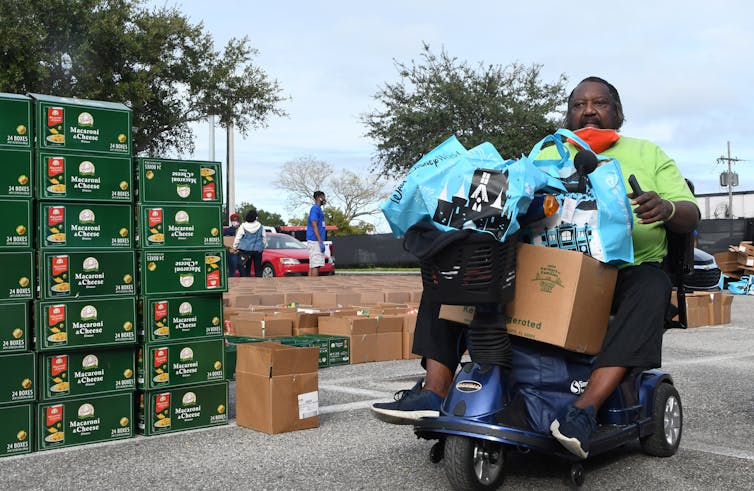
Once inside stores, disabled persons are further disenfranchised by the physical limitations of shopping. Shopping for one to two weeks – as public health officials had recommended – is especially difficult while using a wheelchair or motorized scooter that holds only a small basket of goods. The same is true for pushing a cart or carrying a basket while using a walker or cane.
Customers who are able to drive themselves to shop may also find themselves unable to get their items from the store into their vehicles. Stores that once offered assistance stopped these services in order to protect their employees.
Food donation and delivery programs attempted to meet some of these needs by providing meals and groceries for several days or even weeks at time. Despite these efforts, demand outstripped the availability of both food supplies and volunteers.
For some individuals with disabilities, going to a food bank or community service center was also an important social encounter – an opportunity to visit friends, access news and interact with social workers. Once those programs were shuttered or made contactless, many people were further isolated in their homes. Studies have shown that social isolation among people with disabilities reduces not only access to food but also the motivation to prepare and eat food.
While new digital technologies have allowed customers to outsource their food shopping to gig workers, they require basic infrastructure, equipment and knowledge that may be unaffordable to low-income people with disabilities. Moreover, reliance on others to choose one’s food can cause people to feel a loss of control and autonomy over their food choices.
In many ways, the stories that have been most visible around food insecurity have been those of the people who were in fact able to stand in lines, stock up on groceries and even barter with neighbors for supplies. During a pandemic that has made life much more difficult for billions of people around the world, I believe the experiences of disabled persons have become further marginalized and less visible.
[Insight, in your inbox each day. You can get it with The Conversation’s email newsletter.]
Melissa L. Caldwell, Professor of Anthropology, University of California, Santa Cruz
This article is republished from The Conversation under a Creative Commons license. Read the original article.