 How to resolve AdBlock issue?
News
- Details
- Written by: NATIONAL OCEANIC AND ATMOSPHERIC ADMINISTRATION

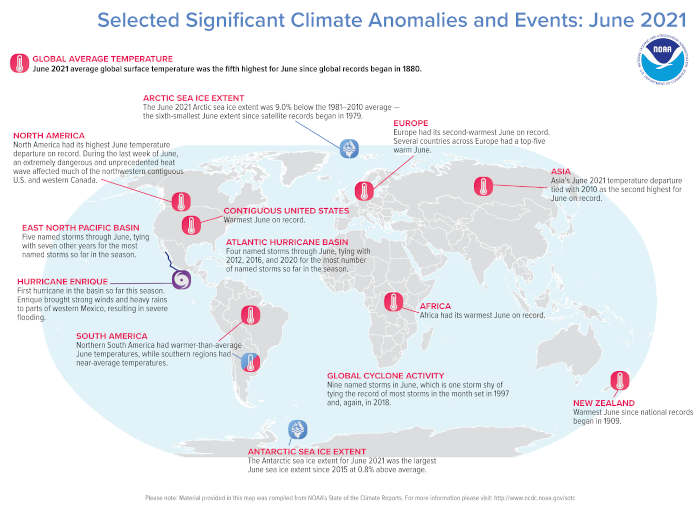
Exceptional heat waves from coast to coast helped push June 2021 to the No. 1 spot on the list of hottest Junes on record for the U.S.
The first six months of 2021 also brought eight billion-dollar weather disasters, ranging from destructive severe weather to a historic deep freeze, according to experts from NOAA’s National Centers for Environmental Information.
Below are more highlights from NOAA's U.S. monthly climate report for June:
Climate by the numbers
June 2021
The average June temperature across the contiguous U.S. was 72.6 degrees F (4.2 degrees above average), making it the hottest June in 127 years of record keeping and surpassing the record set in June 2016 by 0.9 of a degree.
Eight states — Arizona, California, Idaho, Massachusetts, Nevada, New Hampshire, Rhode Island and Utah — also saw their hottest June on record. Six other states — Connecticut, Maine, Montana, Oregon, Washington and Wyoming — marked their 2nd hottest June.
The average June precipitation across the U.S. was 2.93 inches, matching exactly the historical average for the month, though some states had extremes in rainfall — either too much or too little. For example, South Dakota saw its driest June on record while Mississippi had its second wettest.
Year to date, January through June 2021
The year-to-date, or YTD, average temperature for the contiguous U.S. was 49.3 degrees F, (1.7 degrees above the 20th-century average) and placed in the warmest third of the record. Maine saw its third-warmest YTD, and both California and New Hampshire had their fifth warmest.
The precipitation total was 14.64 inches, 0.67 of an inch below average, which ranked in the driest-third YTD on record. Nine states across the interior West, northern Plains and New England logged a top-10 driest YTD on record.
A U.S. map plotted with 8 billion-dollar weather and climate disasters that occurred in the first six months of 2021.
Billion-dollar disasters to date
The U.S. experienced eight weather and climate disasters in the first six months of 2021, each with losses exceeding $1 billion. They were:
— 4 severe storms including tornadoes, hail and high wind damage;
— 2 flooding events;
— 1 winter storm with a deep freeze; and
— 1 heat wave-influenced drought.
The costliest event so far was the February 10-19 winter storm and cold wave that incurred direct losses of approximately $20 billion. The next costliest was the severe weather outbreak of April 27-28 in Texas and Oklahoma that caused $2.4 billion in damages.
The 2021 YTD inflation-adjusted losses from all eight disasters were also at a near-record high for the first six months and came in at nearly $30 billion – only behind 2011.
The U.S. has experienced 298 weather and climate disasters since 1980 where overall damages/costs reached or exceeded $1 billion (including CPI adjustment to 2021). The total cost of these 298 events exceeds $1.975 trillion.
Other notable climate events
— Claudette battered the South: Tropical Storm Claudette formed on June 19 and brought heavy rainfall and flash flooding to the South, causing at least 13 deaths. Tornadoes spawned by Claudette also brought significant damage to parts of the region.
— The nation’s drought intensified: According to the June 29 U.S. Drought Monitor report, a little more than 47% of the contiguous U.S. was in drought, up from nearly 44% at the beginning of June. Drought intensified or expanded across portions of the West, northern and central Plains, Midwest, New England and Hawaii. Drought improved across the Carolinas, Virginia and Puerto Rico.
- Details
- Written by: Elizabeth Larson
The newest dog is at the top.

‘Tinsel’
“Tinsel” is a female American pit bull terrier mix with a short brindle and brown coat.
She is dog No. 4433.

‘Bear’
“Bear” is a male American Staffordshire terrier mix with a short brown coat.
He has been neutered.
He is dog No. 3476.

‘Cleo’
“Cleo” is a female Doberman pinscher mix with a short gray coat who is new to the shelter.
She has been spayed.
She is dog No. 4865.

‘Dusty’
“Dusty” is a male American Pit Bull Terrier with a tan and white coat.
He is dog No. 4750.

‘Girly’
“Girly” is a senior female Chihuahua mix.
She has a short tan coat.
Girly is house-trained.
She is dog No. 4940.

‘Gizmo’
“Gizmo” is a senior male Chihuahua mix with a short tan and white coat.
He is dog No. 4902.

‘Ike’
“Ike” is a senior male Chihuahua.
He has a short tan coat.
He is dog No. 4942.

‘Jake’
“Jake” is a senior male Chihuahua mix.
He has a short tan and white coat.
He is dog No. 4941.

‘Lucky’
“Lucky” is a male Labrador retriever mix with a short yellow coat.
He is dog No. 4908.

‘Mara’
“Mara” is a female Rottweiler mix.
She has a short black and tan coat.
He is house-trained.
She is dog No. 4628.

‘Mary J’
“Mary J” is a female pit bull terrier mix.
She has a white and tan coat.
She is house-trained.
She is dog No. 4927.

‘Mitzy’
“Mitzy” is a female shepherd mix with a medium-length black and white coat.
She is dog No. 4648.

‘Mojo’
“Mojo” is a male Chihuahua mix with a short black and tan coat.
He has been neutered.
He is dog No. 4881.

‘Oakley’
“Oakley” is a male pit bull terrier mix.
He has a short red and white coat.
He is dog No. 4934.

‘Patches’
“Patches” is a male Chihuahua mix with a short tricolor coat.
He is dog No. 4903.

‘Sassy’
“Sassy” is a female American bully mix with a short black coat.
She has been spayed.
She is dog No. 4602.

‘Tanisha’
“Tanisha” is a female shepherd mix with a short orange and white coat.
She is dog No. 4647.

‘Terry’
“Terry” is a male Dutch shepherd mix with a smooth brindle coat.
He is dog No. 4880.
Call the Clearlake Animal Control shelter at 707-273-9440, or email
Visit Clearlake Animal Control on Facebook or on the city’s website.
Email Elizabeth Larson at
- Details
- Written by: Lake County News reports
The bill later passed the State Senate by 39-0 margin.
Aguiar-Curry was a member of the Assembly negotiating team that reached the deal with Gov. Gavin Newsom and the Senate on the package.
AB 156 revolutionizes the state’s broadband deployment program under the California Advanced Services Fund Program, and provides new and increased funding to bring California into the technological 21st century.
The ongoing COVID-19 pandemic has laid bare the massive gaps in internet connectivity at sufficient speeds for too many Californians.
As more Californians have struggled to conduct distance learning, virtual work, access telehealth services, and safeguard small business participation in the virtual marketplace, the need to connect the state at sufficient speeds with adaptable technology has reached crisis proportion.
"Even before the pandemic, which shone a glaring light on Californians’ lack of reliable, affordable internet services, we knew access to the internet is essential for participating in the promise of today’s online world," said Aguiar-Curry (D-Winters).
She said that with the passage of SB 156, “California has committed to a generational investment in providing for all Californians the access they need to internet-based services like education and job training, telehealth, and the digital economy.”
She added, “The California of today cannot lead our people into the future with the technology of the past. We must now pass the policy companions in AB 14 and SB 4 to complete the roadmap to Internet For All in our State."
“Today’s unanimous vote in favor of SB 156 is a huge milestone in our efforts to close the digital divide in California,” said Sen. Lena A. Gonzalez (D-Long Beach), one of Aguiar-Curry’s partners in negotiating the legislation. “This investment to modernize our broadband infrastructure is sorely needed and was long overdue. Expanding access to affordable, high-speed internet will empower future generations, provide them better opportunities and greater upward mobility. We cannot leave any child, senior, individual or family behind.”
Gonzalez said the bill will also spur a competitive environment amongst local internet service providers and California small businesses of all sizes to drive technical innovation and increase broadband affordability.
She said it’s now important to pass SB 4 and AB 14 as well in order to secure continuous funding and strengthen policy to advance Digital Equity through Broadband for All.
The Broadband Budget Bill prioritizes the deployment of broadband infrastructure in California’s most vulnerable and unserved rural and urban communities by extending the ongoing collection of funds deposited into the California Advanced Services Fund to provide communities with grants necessary to bridge the digital divide.
AB 14 offers a vital pathway to connect California’s workforce to gainful employment, harness the life-saving technology of telemedicine, democratize distance learning, enable precision agriculture, and sustain economic transactions in the 21st Century E-Marketplace.
The Act extends eligibility for grants administered by the California Public Utilities Commission to local and tribal governments, who are willing and able to quickly and efficiently connect households, community anchor institutions (including educational institutions, fairgrounds for emergency response, and healthcare facilities), small businesses, and employers.
AB 156 is a measured and meaningful approach to building a statewide fiber middle-mile “backbone” network, and last-mile connections to homes and businesses, that will provide higher speeds and access to connectivity to all those who are unserved along the path of deployment.
Assemblymember Aguiar-Curry represents the Fourth Assembly District, which includes all of Lake and Napa Counties, parts of Colusa, Solano and Sonoma counties, and all of Yolo County except West Sacramento.
- Details
- Written by: Lake County News reports
This action follows the deployment of California firefighting support sent to Oregon last week through the Emergency Management Assistance Compact.
Climate change impacts are contributing to wildfires that are increasingly dangerous and destructive across the Western U.S. California’s latest mutual aid deployment to Oregon comes just a day after the National Multi-Agency Coordinating Group elevated the National Preparedness Level to Level 5 — its highest level — due to high fire activity across the country and resources committed to large fires.
Responding to a request from Oregon Gov. Kate Brown, Gov. Newsom has directed the California Governor’s Office of Emergency Services to send the additional resources, which entail one Type 6 (wildland fire fast attack) strike team, and one task force, consisting of three Type 3 fire (wildland fire) engines and two Type 6 fire engines to the Bootleg fire in Klamath County, Oregon.
California is also sending two Type 1 (structure protection) strike teams to preposition in Southern Oregon in advance of new fires.
In total, California has sent eight strike teams/task forces, or 40 fire engines with firefighting crews, to Oregon.
Type 3 and Type 6 engines are the most used engines for wildland urban interface fires and are known for their off-road capabilities.
The Bootleg fire has burned more than 227,000 acres and impacted transmission lines used to import electricity to California. Local government firefighting personnel deployed on Cal OES engines to Oregon include staff from the following agencies: Cosumnes, Sacramento Metro, Lake Shastina, Placer Hills, Mosquito, San Francisco, Napa, Ben Lomond, Mountain View, Alameda County, Monrovia, Arcadia, Monterey Park, Santa Fe, Huntington Beach, Loma Linda, Big Bear, Idlewyld, Corona and Riverside.
California has regularly offered support to assist in response and recovery for disasters throughout the United States and internationally through Emergency Management Assistance Compact, or EMAC, requests.
EMAC, which includes the participation of all 50 states, the District of Columbia, Puerto Rico, Guam and the U.S. Virgin Islands, is a nationally recognized mutual-aid system that provides the foundation for states to request and send resources across their borders when impacted by a disaster.
For more information on the Emergency Management Assistance Compact, follow this link.